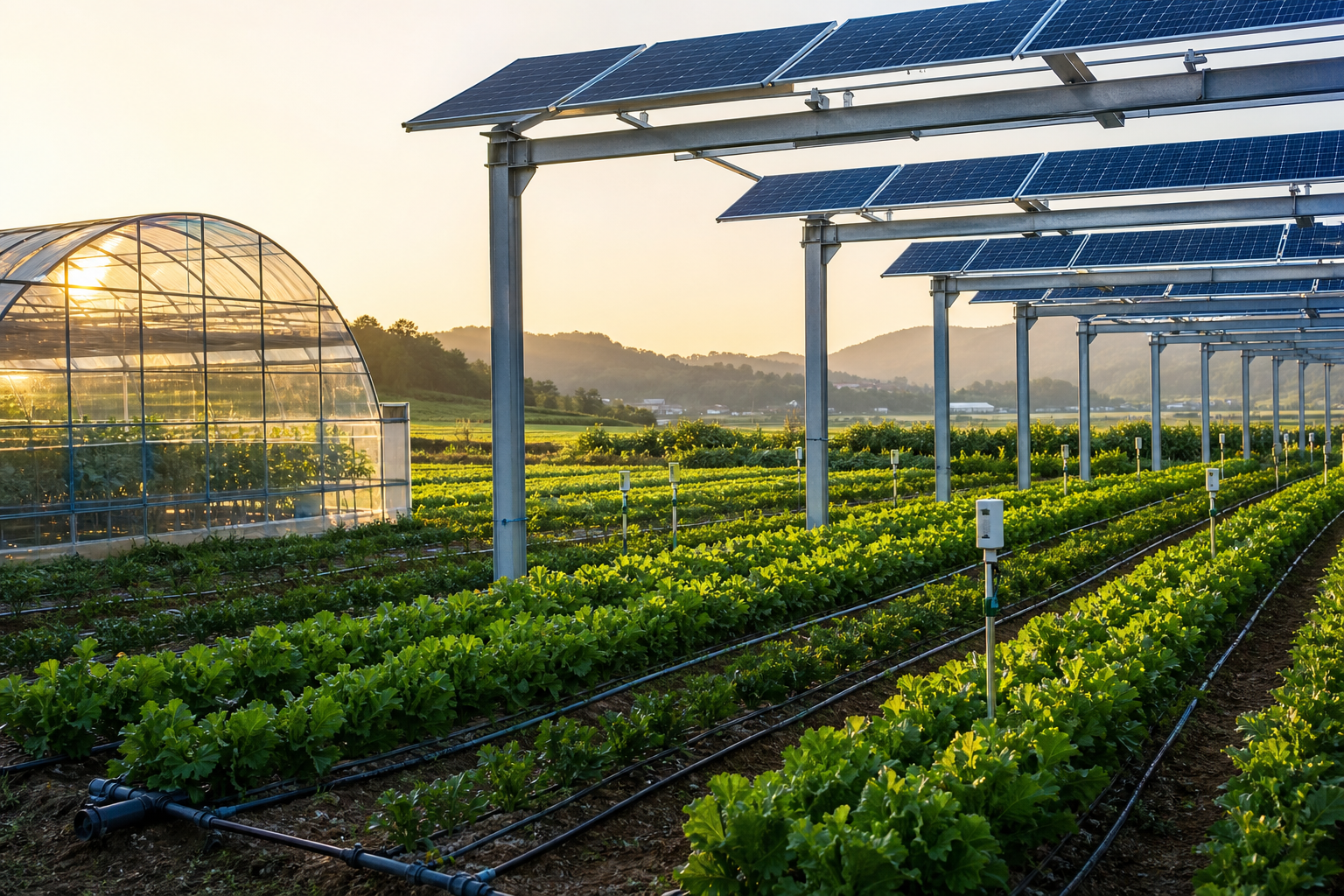
A practical profitability guide for combining smart farms with solar power, including 100kW revenue scenarios, self-consumption, agrivoltaic crop loss, and permitting risks.
Smart Farm + Solar Farming: Where Profit Really Comes From
A smart farm uses electricity. More than people expect. Nutrient pumps, circulation pumps, ventilation fans, thermal curtains, cooling and heating units, sensors, and network equipment breathe all day in small electrical pulses. When the utility bill arrives, that breathing suddenly sounds loud.
That is why solar power looks tempting. Make electricity during the day, use it in the greenhouse, sell what remains, and keep farming under or around the panels. On paper, it feels like placing one more wallet on top of the field.
The numbers are less polite. Combining a smart farm with solar power does not automatically make money. Profitability changes depending on whether the system is self-consumption, grid-sale, agrivoltaic, greenhouse-adjacent, or roof-mounted, and whether the farm actually uses electricity when the sun is producing it.
1. Start by separating the business models
People say “smart farm plus solar” as if it were one business. It is not. There are three main models.
The first is self-consumption. The solar system supplies part of the electricity used by the smart farm. The main value is lower utility bills, not power sales. This works best when the greenhouse uses a lot of electricity during the day.
The second is grid-sale solar. The solar plant is treated as a separate revenue asset. The farmer earns from SMP and REC revenue, while the smart farm runs beside it. Generation, SMP, REC price, grid connection cost, and financing dominate the calculation.
The third is agrivoltaics. Solar panels are raised above farmland, and crops continue growing underneath. This model tries to combine crop income with power income. It also brings crop yield loss, higher structures, machinery movement, drainage, and temporary farmland-use permission into the calculation.
These models look similar, but they are not the same business. Mixing them together makes the math cloudy.
2. The 100kW solar baseline comes first
The most common starting point is 100kW. It is large enough to matter and small enough for a farm-level project.
Use a conservative annual generation assumption of 1,300kWh per kW. A 100kW system then produces about 130,000kWh per year. Actual numbers vary by region, angle, shading, maintenance, and module quality, but this is a useful starting point.
For a simple grid-sale case, the calculation looks like this.
- Capacity: 100kW.
- Annual generation: 130,000kWh.
- SMP assumption: 90 KRW/kWh.
- REC assumption: 70,000 KRW/MWh.
- REC weight assumption: 1.0.
- Annual revenue: about 20.8 million KRW.
- O&M assumption: 3 million KRW per year.
- Annual net income: about 17.8 million KRW.
If the installation cost is 150 million KRW, the simple payback period is about 8.4 years. If the cost is 180 million KRW, payback is about 10.1 years. If the cost is 220 million KRW, payback stretches to about 12.4 years.
The message is blunt. For solar, the first construction cost often matters more than a small difference in generation. A 30 million KRW difference at the start can move the payback period by one or two years.
3. For smart farms, saving electricity can be sweeter than selling it
A smart farm consumes electricity. That makes self-consumption attractive in some cases. Avoiding a 150 KRW/kWh electricity bill can be better than selling electricity at 90 KRW/kWh.
Assume the same 100kW system produces 130,000kWh per year, and the smart farm directly uses 80 percent of it. If avoided electricity cost is valued at 150 KRW/kWh, the math looks like this.
- Self-used electricity: 104,000kWh.
- Electricity bill savings: about 15.6 million KRW.
- Surplus 20 percent sold at 90 KRW/kWh: about 2.34 million KRW.
- Total savings and sales effect: about 17.94 million KRW.
- Net effect after 3 million KRW O&M: about 14.94 million KRW.
At a 150 million KRW installation cost, simple payback is about 10.0 years. At 180 million KRW, it is about 12.0 years. At 220 million KRW, it becomes about 14.7 years.
This may look weaker than grid-sale solar. The field can be different. If the farm’s electricity tariff is high, daytime load is large, and batteries or demand management are added carefully, the self-consumption value can rise. If the farm mostly uses power at night for winter heating, solar alone feels thin. The sun clocks out at night.
4. Agrivoltaics can lose profit through the structure
Agrivoltaic systems cost more than ordinary ground-mounted solar. The panels cannot sit low. Machines need to pass. Crops need air, light, and room. If workers must duck under every beam, it becomes an obstacle course, not farming.
Existing cost references and field estimates often put 100kW agrivoltaic systems at about 1.3 to 1.5 times the cost of ordinary ground-mounted solar. The extra cost comes from structures over 3 meters high, foundations, wind load design, machinery paths, and drainage planning. That is why a 100kW project can move from 150 million KRW to well over 200 million KRW.
This means the structure is the heart of profitability. Module prices may fall, but steel, foundations, and construction work do not fall as easily. The metal bones above the field eat money.
The pattern is simple.
- A low-cost grid-sale solar project can pay back faster.
- Agrivoltaics usually has a longer payback because the structure is expensive.
- A smart-farm-integrated model must count electricity bill savings as well as power sales.
- Grants or low-interest financing can change the result sharply.
Profit often gets decided under the panel, not on top of it.
5. Crop yield loss must be subtracted
Agrivoltaics keeps farming under the panels. That means power revenue is only half the story. Crop output and crop quality have to stay in the calculation.
Domestic demonstrations and research often discuss yield reduction of roughly 10 to 20 percent for crops such as rice, potatoes, and soybeans under properly designed agrivoltaic systems. The actual number depends on crop type, shading rate, panel height, spacing, variety, soil, and drainage. Some crops, such as tea in certain cases, may benefit from partial shading. Poor design can create much larger losses.
Use rice as a quick example. If a 10a paddy produces 700kg and rice is valued at 2,500 KRW per kg, the revenue is 1.75 million KRW. A 15 percent yield loss reduces revenue by about 262,500 KRW.
If a 100kW solar system creates 15 to 18 million KRW in annual net income, the power income can look much larger than the rice revenue loss. That example works because rice is a relatively low-revenue crop. High-value greenhouse crops, fruit, and specialty crops are different. A 10 percent change in marketable quality can change the whole business.
So the better question is not only how much electricity the system makes. It is what the shade does to the crop. Sunlight may look free, but shade arrives with a price tag.
6. Some smart farms match solar better than others
Not every smart farm is a good solar partner. The farm’s electricity timetable matters.
The best fit is a farm that uses a lot of electricity during the day. Ventilation fans, pumps, nutrient dosing, circulation, curtain systems, and cooling loads can directly consume solar electricity. In that case, using the power on-site may beat selling it.
A weaker fit is a greenhouse with heavy winter nighttime heating demand. Solar produces during the day, while heating cost rises at night. Bridging that gap may require batteries, thermal storage, heat pumps, or a tariff strategy. Panels alone do not make the spreadsheet pretty.
A practical good-fit profile looks like this.
- A hydroponic greenhouse with high daytime pump, fan, or cooling load.
- A farm with hourly or at least monthly electricity data.
- A farm that can consume 70 percent or more of solar output on-site.
- A design where machinery paths and solar columns can be planned together.
- A crop where electricity savings exceed the economic damage from shading.
If the farm does not know its electricity use, it is too early for a solar quote. Twelve months of utility bills come first. Then the solar estimate.
7. Permitting risk belongs inside the return calculation
The spreadsheet can make the business look easy. Farmland brings paperwork. When Agricultural Promotion Zones, farmland conversion, temporary alternative-use permission, development permits, and grid connection all meet, time becomes money.
Article 36 of Korea’s Farmland Act covers temporary alternative use of farmland. The basic structure is permission to use farmland for a set period on the condition that it is restored afterward. The article also includes solar energy facilities and ICT-linked crop cultivation facilities under specific conditions. Actual availability depends on location, facility form, building-permit status, enforcement decree requirements, and local interpretation.
For agrivoltaics, the key question is whether farming continues in substance. If the documents say agrivoltaics but real cultivation is weak, the business logic becomes fragile. The same applies to smart farms. A facility named smart farm may face a different review if the real use is storage, events, or café traffic.
Most return models do not include permitting delay. In reality, six months of delay, grid connection waiting, civil complaints, or redesign costs turn into financing cost and lost time. That mud sits outside the Excel sheet.
8. A safer 100kW profitability frame
A 100kW smart-farm-plus-solar project can be grouped into three cases.
The optimistic case has installation cost around 150 million KRW, high self-consumption, low grid connection cost, low crop yield loss, and access to grants or low-interest loans. Payback can fall into the 7 to 9 year range.
The base case has installation cost around 180 million KRW and annual net benefit around 15 to 18 million KRW. Payback is usually around 10 to 12 years. That is not short, but it can still be worth reviewing if the system operates for more than 20 years.
The risky case has installation cost above 220 million KRW, expensive grid connection, low self-consumption, high crop yield loss, and high financing cost. Payback can move beyond 13 to 15 years. At that point, the word “green” cannot cover weak economics.
A 100kW project can make money when the pieces fit. Place it on the wrong farm, and the return scatters like sand.
9. Checklist before starting
Do not begin with instinct. Instinct helps in farming, but it can poison investment decisions.
Check these first.
- Review the last 12 months of electricity bills.
- Separate monthly use and daytime/nighttime use patterns.
- Check available area and shading for a 100kW system.
- Confirm grid connection availability and expected cost.
- Check farmland conversion, temporary use, and development permit requirements.
- Estimate crop-specific shading sensitivity and yield loss.
- Design panel height, machinery paths, and drainage before quoting.
- Use conservative SMP, REC, and electricity tariff assumptions.
- Check grants, policy loans, and low-interest financing.
- Include inverter replacement, dismantling, and restoration costs.
After this checklist, the business becomes much clearer. The most important documents are the electricity bill and the crop sales record. Those two papers show the farm’s real face.
10. The real business is farm optimization, not just power sales
Smart farm plus solar is not only a power business. The real value is reducing farm electricity cost, maintaining crop output, and monetizing surplus energy.
The smart farm creates data. Solar creates electricity. When the two are connected well, the farm changes from a place that only consumes energy into a place that manages energy. That shift is where profitability begins.
Push too hard, and the model starts to creak. Install panels too densely, and the crop suffers. Build the structure too cheaply, and maintenance suffers. Assume power prices too optimistically, and the spreadsheet smiles before the bank account does.
In one line, smart farm plus solar farming can work. The more accurate sentence is this: it works when electricity use patterns, crop response, structure cost, financing, and permits fit together.
References
- Korean Law Information Center, Farmland Act, Article 36, Temporary Alternative Use Permission for Farmland, effective August 28, 2026.
- Korean Law Information Center, Enforcement Decree of the Farmland Act, Article 29, Acts Allowed in Agricultural Promotion Zones, effective March 24, 2026.
- imun.farm, “How Much Crop Yield Loss Actually Happens Under Agrivoltaics,” February 20, 2026.
- imun.farm, “Real 100kW Agrivoltaic Installation Cost Estimate,” February 19, 2026.
- imun.farm, “Annual Solar Power Revenue Analysis by Capacity in Gumi, 2026,” January 29, 2026.
- Korea Power Exchange power statistics and SMP publications, used as reference for solar revenue assumptions.
- Korea Energy Agency New and Renewable Energy Center and RPS/REC guidance materials, used as reference for REC revenue structure.