After the Agrivoltaics Act: How Will Farm Income Models Change?
After the Agrivoltaics Act: How Will Farm Income Models Change?
3-Line Summary The Agrivoltaics Act passed on May 7, 2026, extending the maximum farmland use period from 8 years to 23 years. Farm income structures shift from single-source crop revenue to a dual model of agriculture + energy generation, with income potentially rising up to 4.1x under favorable conditions. However, key figures remain delegated to enforcement ordinances — the actual shape of income models depends on what those sub-regulations decide.
The Wall That Just Came Down
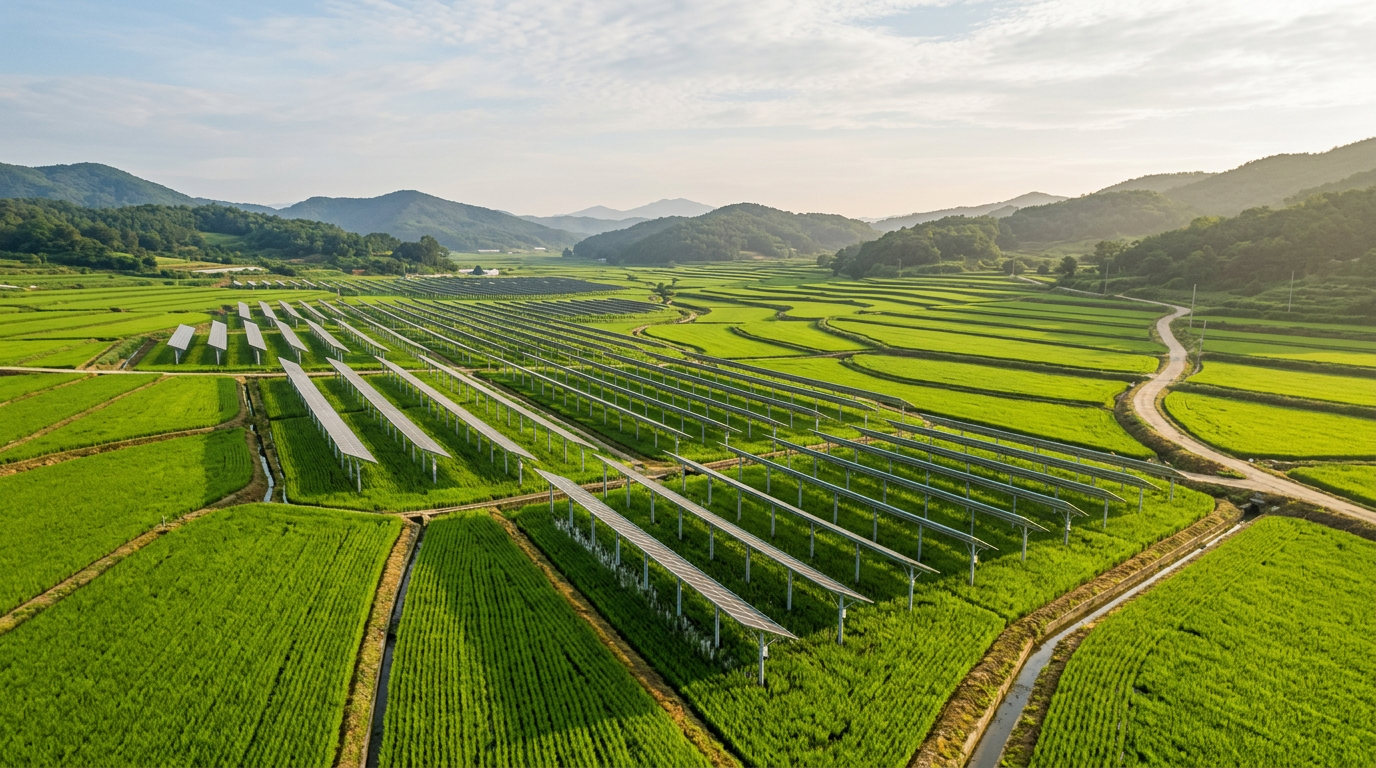
Before this law passed, agrivoltaic systems on farmland were restricted to an 8-year temporary-use permit. Solar panel lifespans run 25–30 years. Investment recovery typically takes 12–14 years. An 8-year ceiling meant the math never worked. Banks were reluctant to finance it. Most farmers couldn’t even try.
On May 7, 2026, the “Act on the Promotion and Support of Agrivoltaic Power Generation Businesses” and the revised Farmland Act passed the National Assembly simultaneously. Fourteen years of policy debate broke through in one session. The operational period expanded to a maximum of 23 years (initial 5 years + 18-year extensions). For the first time, the business period aligns with the investment recovery horizon.
That single change rewires the entire farm income model.
The Structure of Income Changes
The old farm income structure was simple: plant, grow, sell. Everything depended on crop prices and yields. A bad harvest or a price drop, and that was it. No hedge, no fallback.
With agrivoltaics, the structure looks like this:
Before: Agricultural income (single source)
└─ Crop sales
After: Agricultural income + Power generation income (dual source)
├─ Crop sales (maintained or slightly reduced)
└─ SMP (electricity market price) + REC (Renewable Energy Certificate) revenue
Generation revenue comes through two channels. SMP is the wholesale price for electricity sold to the grid. REC is an additional revenue stream from selling renewable energy certificates, with weighted multipliers applied by installation type and scale.
For a 100kW installation, estimated annual generation revenue reaches approximately 30 million KRW. In Yeongam County, South Jeolla Province, a real agrivoltaic demonstration project reported that even though rice yield dropped 21%, the estimated annual generation revenue (approximately 8.97 million KRW at 185 KRW/kWh) more than offset the loss — adding a net 8.72 million KRW annually.
How Much More Income? Three Scenarios
The Korea Rural Economic Institute (KREI) analysis using a 20-year-plus operational baseline projects farm income increases of 2.63 to 2.8 times current rice farming income. RE:FACT, a renewable energy fact-checking platform, released a comprehensive analysis in May 2026 showing that with reduced financing costs and lower installation expenses, income could reach up to 4.1 times baseline.
| Scenario | Conditions | Income Multiplier (vs. rice farming) |
|---|---|---|
| Baseline | 20+ year operation, current SMP/REC rates | 2.63–2.8x |
| Policy Finance | Low-interest policy loans + reduced installation cost | Up to 4.1x |
| Crop Optimization | Shade-tolerant crops (green tea, figs, grapes) | Both farming + generation income increase |
| Rice Continuity | Crops with <20% yield reduction | No significant impact on profitability |
A 100kW agrivoltaic installation requires approximately 700 pyeong (~2,314 m²) of land — accessible for small and medium-scale farms.
Three Income Models Emerging
Within the legal framework, farmers can choose from three distinct income paths.
Model 1 — Individual Farmer Direct Operation
A farming household installs agrivoltaic panels on their own or leased farmland and captures 100% of generation revenue directly. Initial capital outlay is significant, but the government has expanded policy financing — up to 85% of installation costs can be financed through long-term low-interest loans. Approximately 450 billion KRW in renewable energy financial support is budgeted for 2026.
Model 2 — Community Cooperative (Sunshine Income Village)
Villagers form a cooperative to build and operate a solar generation project collectively, with revenue distributed back into community welfare programs and individual income. The government targets over 700 “Sunshine Income Villages” nationwide in 2026, with 500 new villages per year from 2025 onward. Risk is distributed across the community, lowering individual barriers to entry. Each Sunshine Income Village is designed around a 1MW-or-less capacity model with project costs around 1.6 billion KRW.
Model 3 — Agricultural Corporation Participation (Renewable Energy Zones Only)
In areas designated as Renewable Energy Zones under the Rural Space Reorganization Act, agricultural corporations can participate as project operators. This allows capitalized entities — agricultural cooperatives or farming companies — to pursue larger-scale projects. Individual farmers can participate indirectly through equity stakes or lease arrangements. The concern is potential abuse by non-agricultural capital using nominal farmer participation to circumvent intent, making the enforcement ordinance’s equity requirement definition critical.
Crop Choice Becomes a Revenue Strategy
One more variable matters enormously: what you grow.
Rice needs a lot of sun. Panels blocking light reduce yields. The Yeongam demonstration project confirmed this with a 21% yield reduction. But green tea behaves differently. Research by the South Jeolla Province Agricultural Research and Extension Services (2019–2021) found that first-harvest green tea yield under agrivoltaic systems was 622 kg per 10 ares, compared to 514 kg in open fields — significantly higher because shade benefits the tea plant’s growth. Figs and grapes show similar advantages.
Professor Chung Jae-hak of Yeungnam University analyzed over 80 demonstration sites and concluded that crops with yield reduction rates below 20% show no significant impact on profitability from agrivoltaic installation. In other words: change the crop, and generation income stacks on top of farming income without meaningful trade-off. For farmers, crop selection is now a revenue model optimization decision.
What the Law Left Unanswered
Honestly, this law set the framework but delegated the numbers. Farming maintenance ratios, area and generation capacity caps, panel height standards, Renewable Energy Zone designation criteria — none of these appear as specific figures in the law itself.
The government is considering limiting module coverage to under 30% of total area. But that same 30% threshold is devastating for rice and irrelevant for green tea. A blanket rule applied without crop-specific differentiation creates extreme winners and losers.
Also, the 23-year period is not a blanket guarantee. The government is examining a structure requiring permit renewal every 3 years, contingent on verified farming compliance. “Maximum 23 years” and “guaranteed 23 years” are not the same. Building a business plan directly on the legal maximum without accounting for triennial review is a significant risk.
Six months from promulgation until enforcement. The moment the ordinances land, the actual income model contours become visible.
Risks Worth Naming
- SMP/REC price volatility: As renewable energy supply expands, REC prices will compress. In 2023, rising SMP/REC prices brought fraudulent agrivoltaic operators into the market — and falling prices reversed their economics.
- High upfront investment: Agrivoltaic installation costs run approximately 1.5x higher than standard solar installations. Payback periods remain 12+ years minimum.
- Tenancy disputes: On leased farmland, the 5% cap on rent increases could perversely incentivize landowners to terminate leases rather than accept restrictions.
- Farming compliance verification: Operating generation equipment without active farming triggers a four-step penalty chain: corrective order → fine → suspension → license revocation. Symbolic farming won’t pass.
The Core of What Changed
Fourteen years of policy circling finally moved. The Agrivoltaics Act is not just energy policy. It is a structural redesign of farm income architecture.
A stable generation revenue stream layered onto volatile crop income changes the fundamental financial profile of a farming household — something like adding fixed rental income alongside business earnings. The downside risk floor rises. The ceiling for total income rises further.
The government is pushing to establish 700+ Sunshine Income Villages nationwide in 2026. Field demonstration projects are posting numbers like “8x revenue compared to rice-only farming.” Not every farm will see those results. Location, crop type, financing structure, and cooperative formation capacity all determine individual outcomes.
What farmers need right now is not “should I do this?” It is: Is my land’s primary crop shade-tolerant? What are my lease conditions? Can my village form a cooperative? The law passed. The ordinances are coming in six months. Farmers who prepare before the sub-regulations are finalized will have a head start.
References
| # | Source | Published |
|---|---|---|
| 1 | Ministry of Agriculture, Food and Rural Affairs (MAFRA) Press Release: “Agrivoltaics Act passes National Assembly plenary” | 2026.05.07 |
| 2 | Korea Institute of Food and Climate (KIFC): “What the Agrivoltaics Act Contains and What Remains” | 2026.05.08 |
| 3 | Kyunghyang Shinmun: “Agrivoltaics uneconomical? Largely false — farm income can rise up to 4x” | 2026.05.14 |
| 4 | Korea Rural Economic Institute (KREI): “Economic Feasibility Analysis of Agrivoltaics and Policy Implications” (P293) | 2023 |
| 5 | Namu Wiki: “Agrivoltaics (영농형 태양광)“ | 2025.10 |
| 6 | MBC Mokpo News: “Agrivoltaics 8x revenue — Yeongam County demonstration results” | 2025.11.11 |
| 7 | Gekko System: “Agrivoltaics Outlook for 2026” | 2025.11.16 |
| 8 | Yonhap News: “500 Sunshine Income Villages to be established nationwide per year” | 2025.12.16 |
| 9 | Eco Focus: “Residents generate electricity and share profits — 700 Sunshine Income Villages expansion” | 2026.05.07 |
| 10 | Electric Newspaper (Jeon-gi Sinmun): “Agrivoltaics and Sunshine Income Village government guidelines” | 2026.02.26 |
| 11 | Journal of Korean Society for New and Renewable Energy: “Policy Directions to Enhance Economic Feasibility of Agrivoltaics in Korea” | 2024 |
| 12 | MBC News: “Why has agrivoltaics deployment stalled?“ | 2024.11.13 |