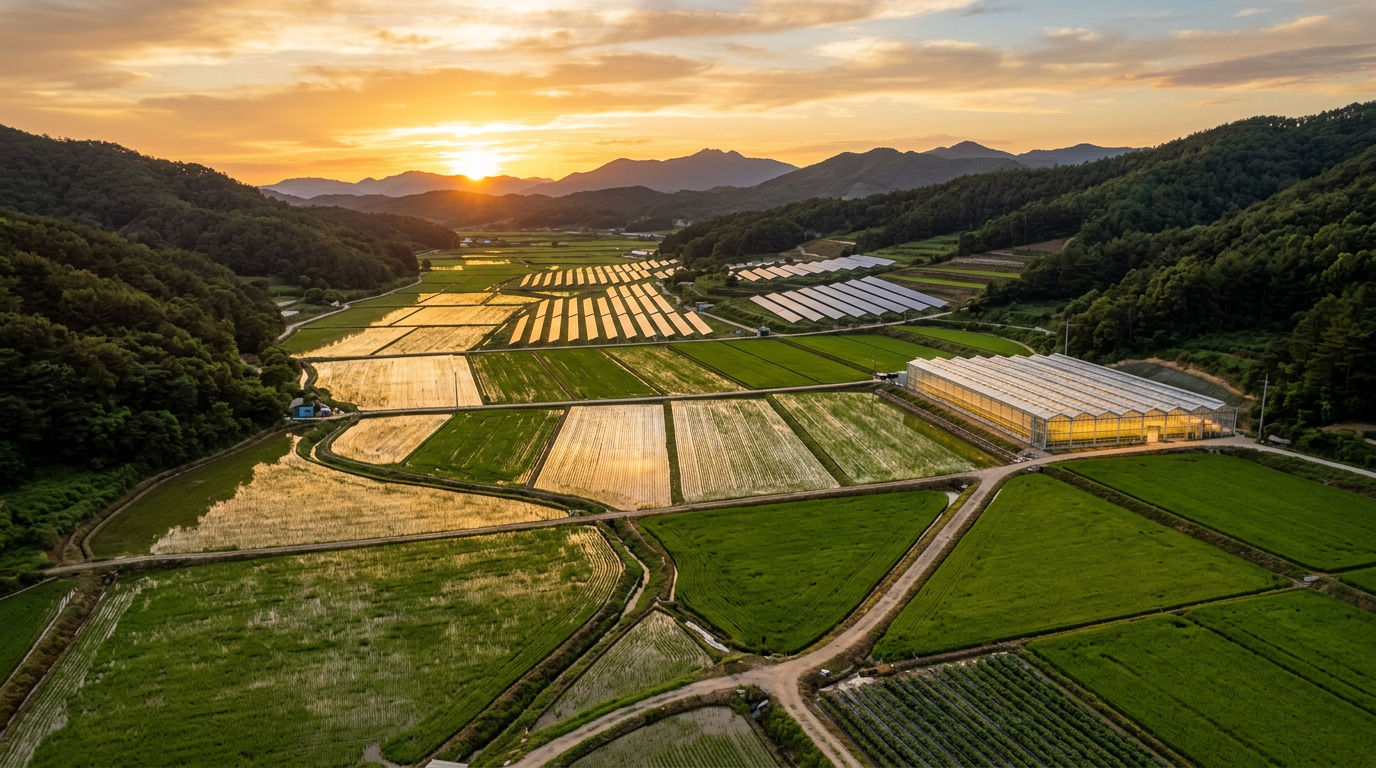
Low-Labor Income Strategies and Future Directions for Absolute Farmland Owners in Korea
Low-Labor Income Strategies and Future Directions for Absolute Farmland Owners in Korea
3-Line Summary Absolute farmland (농업진흥지역, Agricultural Promotion Zone) carries strict regulations, but the 2025–2026 Farmland Act amendments have significantly expanded its usability. Low-labor income models such as farmland pension, trust-based leasing, agrivoltaics, and smart farm subleasing are already operational. Policy is shifting from “production-centric” to “utilization-centric” — now is the right time to build a strategy.
1. Absolute Farmland: Regulatory Burden or Hidden Opportunity?
The term “absolute farmland” carries weight. It sounds like land where nothing can be done. Historically, that was mostly true. Since the designation system was introduced in 1972, land classified as Agricultural Promotion Zones has been almost entirely restricted to cultivation.
Then came January 2025 — the most sweeping revision to South Korea’s Farmland Act in 30 years. Experience farming on absolute farmland was newly permitted, and smart farm installation periods were extended to a maximum of 16 years. On January 29, 2026, the National Assembly passed another amendment introducing rural stay-type shelter programs and broader land utilization rights.
In short, this is a turning point. Leaving farmland idle means throwing away opportunity costs.
2. Three Most Practical Low-Labor Income Models
2-1. Farmland Pension — Monthly Cash from Your Land as Collateral
The most reliable no-labor income model is the farmland pension (농지연금). Available to farmers aged 65 and above with at least 5 years of farming experience, it operates as a reverse mortgage — the land serves as collateral in exchange for monthly living support.
Actual payment examples:
- Land value KRW 100M, age 70, lifetime plan → approx. KRW 470,000/month
- Land value KRW 200M, age 70, lifetime plan → approx. KRW 940,000/month
- Land value KRW 300M, age 70, lifetime plan → up to KRW 1,410,000/month (cap: KRW 3,000,000)
According to a KBS report from March 2026, the average expected monthly pension for actual enrollees is approximately KRW 970,000. A key strength: pension recipients can simultaneously lease the enrolled farmland, creating a dual-income structure of pension + rental income.
Absolute farmland is considered stable collateral by the Korea Rural Community Corporation (한국농어촌공사), often making it a preferred asset type for pension enrollment.
2-2. Farmland Leasing — Rental Income Without Lifting a Finger
Direct farming is not required. Through the Farmland Bank Trust Program operated by the Korea Rural Community Corporation, landowners can have their land managed, leased to a tenant farmer, and receive rental income passively.
A significant policy change has taken effect: from January 2026, lease trust fees for agricultural landowners are completely waived (reduced from 5% to 2.5% in January 2025, then fully eliminated from January 2026). The last fee burden has been removed.
Rental rates vary by region, soil quality, and location, but the national average for paddy fields is approximately KRW 150,000–250,000 per 10a (approximately 300 pyeong) per year. While the figures seem modest, they require zero labor input. For a 10,000㎡ (approximately 3,000 pyeong) plot, annual passive rental income of KRW 1.5M–2.5M is entirely realistic.
2-3. Agrivoltaics (Agri-Solar) — Grow Crops, Sell Electricity
The combination of absolute farmland and solar power is still not fully open. To be direct: as of the government’s official statement in April 2026, agrivoltaics within Agricultural Promotion Zones is not universally permitted. It is only allowed in areas that meet the Renewable Energy District designation requirements under the Rural Space Restructuring Act.
That said, the direction is clearly opening. The recent farmland bill includes provisions allowing agrivoltaics in depopulation zones even within absolute farmland, and the temporary use permit period is being extended from 8 years to over 20 years.
The economics:
- Installation cost: KRW 150M–200M (reduced with government subsidies and loans)
- 20-year operation basis: cost-benefit ratio of 1.24 (Korea Rural Economic Institute analysis)
- IRR for paddy and salt farm configurations: ~9.4% (vs. 6.5% for conventional rooftop agrivoltaics)
- Public direct payment subsidies may be applicable on agrivoltaic-permitted farmland
The regulatory framework has not fully settled, but for landowners in areas designated as Renewable Energy Districts, this warrants serious evaluation.
3. Three Strategic Future Directions
3-1. Smart Farm Sublease — Provide the Land, Skip the Work
Following the July 2024 Farmland Act Enforcement Decree revision, the temporary use period for smart farms (greenhouse-type vertical crop production facilities) was extended to a maximum of 16 years. Installing glass greenhouse or vinyl tunnel-type smart farms on absolute farmland is already permitted without a conversion procedure.
For landowners, the most practical path is long-term sublease to smart farm operators. The operator invests in infrastructure; the landowner provides the land and collects rent. Per the Ministry of Agriculture, Food and Rural Affairs’ 2026 Smart Agriculture Promotion Plan, the government is actively developing Korean-style smart farm standard models, which will increase demand for suitable land.
3-2. Rural Stay-Type Shelter — New Rental Income From 2026
The 2026 Farmland Act amendment includes the formalization of rural stay-type shelters (농촌 체류형 쉼터), allowing urban residents to stay in rural areas on weekends and holidays. This is a core policy in the shift from production-centric to utilization-centric land use.
For absolute farmland owners, the implication is clear: without operating accommodations directly, landowners can lease sites to shelter program operators and generate additional income. Rural tourism demand is genuinely growing. Healing agriculture and rural wellness space have emerged as key keywords in 2026 agricultural policy.
3-3. Carbon Credit Integration — Currently Forest-Focused, Expanding to Farmland
Currently, carbon credit systems primarily center on forest carbon offset projects. A forest manager maintaining 20 hectares can earn approximately 300 carbon credit units annually (1 unit = 1 ton CO₂e) and sell them on the market.
Direct farmland linkage remains limited. However, the Ministry of Agriculture has acknowledged agrivoltaics’ potential contribution to Korea’s NDC (Nationally Determined Contribution), and long-term policy direction points toward expanding carbon-linked incentives into agricultural land. Landowners should begin monitoring their region’s Renewable Energy District designation status and carbon credit integration potential now.
4. What You Can Do Right Now
You don’t need to master every regulatory nuance. Here is a clear action-ready summary:
| Income Method | Requirements | Labor Level | Estimated Annual Income |
|---|---|---|---|
| Farmland Pension | Age 65+, 5+ years farming | None | Proportional to land value, tens of thousands to hundreds of thousands KRW/month |
| Farmland Bank Trust Lease | Owned farmland, farming background | Very Low | KRW 150K–250K per 10a |
| Smart Farm Long-Term Sublease | Greenhouse-permitted site | Low | Contract-dependent |
| Agrivoltaics | Renewable Energy District or depopulation zone | Low | ~9.4% IRR over 20 years |
| Rural Stay-Type Shelter Sublease | 2026 formalization in progress | Low | Early-stage market |
5. What Is Changing Behind the Scenes
The fundamental nature of farmland policy is transforming. Across multiple 2026 analyses from the Korea Rural Economic Institute and NH Agricultural Research Institute, “utilization-centric transition” appears consistently. The focus is shifting from rice production subsidies to value creation through the 6th industry model, carbon reduction, and experiential tourism.
Owning absolute farmland is, in fact, owning a scarce asset. Agricultural Promotion Zones represent the protected core of Korea’s 1.9 million hectares of farmland. Strong regulations mean low development pressure — and low development pressure means stable long-term value.
This is not speculation. It is strategy. The realistic approach: use the pension for immediate cash flow, use leasing to cover holding costs, then transition to agrivoltaics or smart farm subleasing as policy windows open. A phased, deliberate approach.
No need to rush. But ignorance is too expensive to afford.
References
-
Ministry of Agriculture, Food and Rural Affairs, “Agrivoltaics Introduction Strategy” (April 23, 2024) https://www.mafra.go.kr
-
Korea Policy Briefing, “Agrivoltaics in Agricultural Promotion Zones Not Fully Open” (April 13, 2026) https://www.korea.kr/news/policyNewsView.do?newsId=148962688
-
Ministry of Agriculture, “2026 Smart Agriculture Promotion Implementation Plan” https://www.mafra.go.kr/bbs/home/791/594105/download.do
-
NewDaily, “Experience Farming Allowed on Absolute Farmland, Land Acquisition Eased” (January 13, 2025) https://biz.newdaily.co.kr/site/data/html/2025/01/13/2025011300228.html
-
Asia Economy, “‘Absolute Farmland’ Regulations Relaxed Further” (January 13, 2025) https://view.asiae.co.kr/article/2025011315143930965
-
Korea Policy Briefing, “54 Agricultural Regulations Improved” (November 12, 2025) https://www.korea.kr/news/policyNewsView.do?newsId=148954693
-
Korea Rural Economic Institute (KREI), “Economic Analysis of Agrivoltaics Introduction” https://repository.krei.re.kr/bitstream/2018.oak/30971/1/P293.pdf
-
Korea Science, “Profitability Analysis of Rural Fence-Type Solar Projects” (2025) https://koreascience.kr/article/JAKO202521154004758.pdf
-
KDI Economic Education & Information Center, “Farmland Pension Guide” https://eiec.kdi.re.kr/policy/customView.do
-
Daum News, “Farmland Trust Lease Fee Fully Abolished for Farmers from 2026” (December 28, 2025) https://v.daum.net/v/20251229140125666
-
Metro Seoul, “Worker Housing Allowed on Absolute Farmland; Smart Farms Up to 16 Years” (July 2, 2024) https://www.metroseoul.co.kr/article/20240702500481
-
Loople Blog, “2026 Agricultural Policy Issues: From Farmland Act Reform to 6th Industry Opportunities” (January 7, 2026) https://loople.tistory.com/11
-
Korean Young Farmers Newspaper, “Is the Principle of Cultivation by Owners Disappearing or Being Revised?” (February 2, 2026) http://pdf.youngnong.co.kr/2026/02/02/20260202-01.pdf
-
KBS News, “Rural Aging Accelerates, Farmland Pension Enrollment Surges” (March 7, 2026) https://www.youtube.com/watch?v=ykvhikImqXo
-
Greenium, “Agrivoltaics Promotion to 2025: Legal Framework Being Established” (August 6, 2024) https://greenium.kr/news/32705/