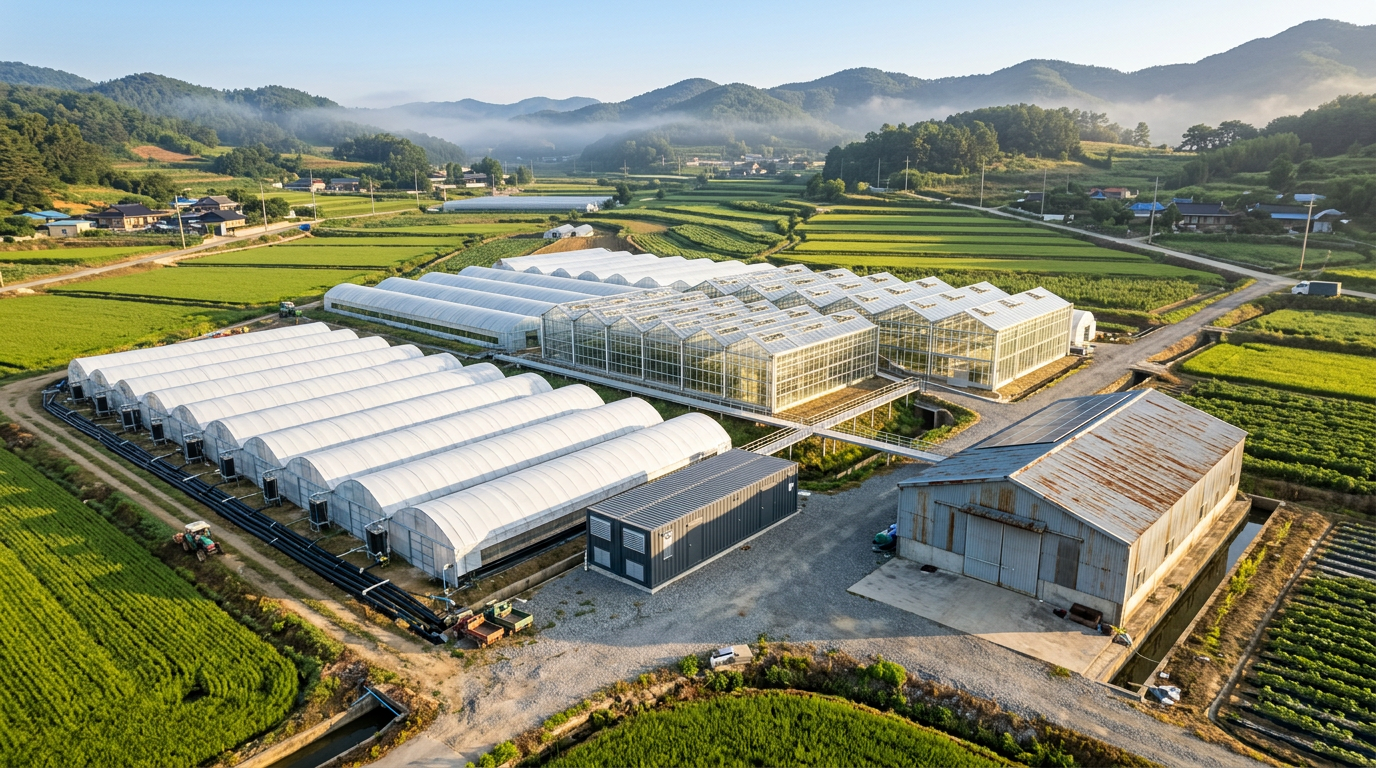
Legal Agricultural Smart Farms & Storage: Types and Cost Estimates
Legal Agricultural Smart Farms & Storage: Types and Cost Estimates
Based on 2026 Korean regulations and real installation cost data
Overview
The era of farming by “gut feeling” is over. Data controls greenhouse temperatures; apps handle irrigation. But before starting, one wall stands in the way: no single resource clearly explains what’s legal and what it costs.
This guide covers legally installable agricultural smart farm and storage types in Korea, their characteristics, legal frameworks, and realistic cost estimates.
1. What is a Smart Farm?
A smart farm applies ICT (Information and Communication Technology) to vinyl greenhouses, glass greenhouses, livestock facilities, and open fields — enabling remote and automated management of crop growing environments (temperature, humidity, CO₂, soil moisture). The official definition from the Ministry of Agriculture, Food and Rural Affairs (MAFRA) encompasses open fields, greenhouses, vertical farms (plant factories), and livestock facilities.
Korean Smart Farm Generations:
- 1st Gen: Remote control via smartphone/PC (temperature, humidity, auto-ventilation)
- 2nd Gen: IoT + Big Data-based precision crop management
- 3rd Gen: AI + robotics-based fully autonomous operation (in development)
2. Legally Installable Smart Farm Types
2-1. Single-Span Vinyl Greenhouse Smart Farm
The most common type. A polyethylene (PE) film-covered arch structure with ICT systems integrated. Over 6.5 million units are installed across Korea.
- Legal Status: Agricultural facility; subject to farmland conversion notification
- Legal Basis: Farmland Act Article 32(1), Enforcement Decree Article 29
- Installation Requirements: Farmer or agricultural corporation on their own managed farmland
- Area Limit: Up to 1,500㎡ per household → notification only (no permit needed)
| Item | Detail |
|---|---|
| Structure | Single/multi-span arch, PE film |
| Automation | Temperature, humidity, irrigation auto-control |
| Target Crops | Tomatoes, strawberries, paprika, lettuce |
| Lifespan | 10–15 years |
Basic Estimate (per 330㎡ / ~100 pyeong)
| Item | Cost (KRW) |
|---|---|
| Greenhouse structure | 20M–30M |
| ICT integrated control system | 10M–15M |
| Nutrient solution & irrigation | 7M–10M |
| Video monitoring | 2M–5M |
| Subtotal | ~40M–60M |
- Per pyeong unit cost: 350,000–1,000,000 KRW
- 200 pyeong (660㎡) total: ~70M–120M KRW
2-2. Steel-Frame Multi-Span Vinyl Greenhouse
Larger and structurally stronger than single-span. Multiple connected bays enable economies of scale. Suitable for 1,000+ pyeong (3,300㎡) commercial operations.
- Legal Status: Same as single-span (farmland conversion notification)
- Installation Requirements: Farmer or agricultural corporation
| Size | Cost per Pyeong | Total (1,000 pyeong) |
|---|---|---|
| Basic single-span | 300,000–500,000 | 300M–500M KRW |
| Steel-frame multi-span | 500,000–800,000 | 500M–800M KRW |
2-3. Glass Greenhouse Smart Farm (Advanced Greenhouse)
The Dutch-style Venlo glass greenhouse is the standard. Highest initial cost, but best durability (30+ years) and productivity. Side wall height exceeds 6m for maximum cultivation efficiency.
- Legal Status: Farmland conversion permit or notification required
- Note: Over 1,500㎡ requires farmland conversion permit (for general farmers)
- Tax Benefits: Acquisition tax reduction; 100% waiver of farmland preservation charge
| Grade | Cost per Pyeong | Total (1,000 pyeong) |
|---|---|---|
| Standard | 900,000–1,200,000 | 900M–1.2B KRW |
| Advanced | 1,500,000–2,000,000 | 1.5B–2B KRW |
2-4. Vertical Farm / Plant Factory
Completely enclosed indoor cultivation using artificial LED lighting in multi-layer racks. Production is unaffected by weather or seasons year-round.
Post-July 2024 Legal Changes (Farmland Act Enforcement Decree Amendment):
- Temporary structure-type vertical farms can now be installed with farmland temporary use permit (no farmland conversion required)
- Maximum retention period extended from 8 years to 16 years
- Since November 2024: vertical farms may enter all 1,315 national industrial complexes (Smart Agriculture Act basis)
- Building-type vertical farms in designated Smart Agriculture Promotion Zones will be permitted without conversion
| Type | Estimated Cost |
|---|---|
| 20ft container smart farm | 35M–45M KRW (incl. used container) |
| 9-pyeong panel prefab building | 60M–70M KRW |
| Building-type (per pyeong) | 2.5M–3.5M KRW/pyeong |
Note: vertical farms have high upfront costs per area but yield approximately 40x the productivity of open-field farming per unit area.
2-5. Smart Livestock Farm (Smart Barn)
IoT sensors and automation applied to cattle, dairy, swine, and poultry facilities. Core functions include health monitoring, automated feeding/watering, and integrated CCTV management.
- Legal Status: Agricultural livestock building; farmland conversion notification or permit (scale-dependent)
- Building Coverage Ratio: Up to 60% allowed for agricultural buildings (vs. 20% general farmland limit)
| Scale | Cost |
|---|---|
| Basic ICT barn (small) | 20M–40M KRW |
| Mid-scale smart barn | 100M–300M KRW |
| Large integrated smart barn | 500M+ KRW |
2-6. Open-Field Smart Farm
IoT sensors, drones, and automated irrigation applied to paddy fields, dry fields, and orchards. Lowest capital investment; easiest entry point.
- Legal Status: Field cultivation operations — no building permit required for sensor/drone installation
- Note: New irrigation structures or storage buildings still require separate procedures
| Item | Cost |
|---|---|
| Soil sensors + weather station | 5M–15M KRW |
| Automated irrigation system | 10M–30M KRW |
| Drone spraying equipment | 15M–30M KRW |
| Total | 30M–75M KRW |
3. Agricultural Storage Facilities (Legal Conditions)
Agricultural storage built alongside smart farms. Legally distinct from “farm huts” (농막). Clear legal basis with significant tax benefits.
Legal Definition
Farmland Act Enforcement Decree Article 29(5)(1): “Facilities installed by a farmer or agricultural corporation to dry and store their own agricultural products.” Also includes storage for fertilizers, seeds, pesticides, and farm equipment.
Key Legal Requirements
- Who can build: Farmers or agricultural corporations only. Non-farmers cannot.
- Area limit: Up to 1,500㎡ per household → notification only
- Agricultural corporations: Up to 7,000㎡ (3,300㎡ inside farmland promotion zones)
- Location: Must be in or adjacent to the city/district/township of the applicant’s farming base
- Use restriction: Cannot store other people’s agricultural products — own production only
Tax Benefits
- 100% waiver of farmland preservation charge
- Acquisition tax reduction (must prove agricultural use after completion)
- Building coverage ratio up to 50–60% (vs. 20% in general farmland areas)
Cost Estimates by Storage Type
| Storage Type | Cost | Notes |
|---|---|---|
| General agricultural storage (sandwich panel) | 600,000–1,000,000 KRW/pyeong | Basic storage function |
| Cold storage room (1–3 pyeong) | 4.5M–6.3M KRW/unit | Includes refrigerator unit + panels |
| Cold storage room (10+ pyeong) | Custom quote | Smart temperature monitoring capable |
| Smart humidity-controlled storage | 1M–1.5M KRW/pyeong | IoT-integrated environmental monitoring |
Cold storage uses approximately 45,000–48,000 KRW per m² for interior lining material (separate from equipment cost).
4. Legal Procedure Checklist
□ Confirm farmer status (Agricultural Business Entity registration required)
□ Confirm farmland classification → farmland promotion zone vs. protection zone
□ Decide: temporary structure vs. permanent building
□ File farmland conversion notification or permit (local mayor/governor)
□ File building notification or permit (under 200㎡, under 3 floors in rural areas = notification)
□ Confirm 3-phase power / water supply / access road availability
□ Apply for acquisition tax reduction after completion (proof of agricultural use required)
Penalties: Farmland converted without notification → up to 3 years imprisonment or 30M KRW fine (Farmland Act Article 60(2))
5. Government Subsidy Programs
| Program | Support | Target |
|---|---|---|
| Smart Farm Fund (Youth) | Fixed 1.0% rate, up to 3B KRW | Farmers under 40 |
| Smart Farm Fund (General) | Fixed 1.0%, up to 5B KRW | Farmers, agricultural corporations |
| Smart Farm Expansion Subsidy | 50–70% of equipment costs | Existing farms, cooperatives |
| Nonghyup Basic Smart Farm | ~70% installation subsidy (~12M KRW/farm) | Horticulture & open-field farms |
| Young Farmer Settlement Fund | 90–110M KRW/month up to 3 years + startup fund up to 500M (1.5% rate) | Ages 18–39 |
The 2026 target for Nonghyup basic smart farm installations is 2,000 sites nationwide. Government subsidies can cut actual investment below 50% of total cost.
6. Facility Comparison Table
| Type | Initial Cost | Per-Pyeong Cost | Legal Process | Key Crops | Lifespan |
|---|---|---|---|---|---|
| Single-span vinyl greenhouse | 40M–120M KRW | 350K–1M | Farmland conversion notification | Strawberry, lettuce, tomato | 10–15 yrs |
| Steel-frame multi-span | 300M–800M (1,000 pyeong) | 500K–800K | Notification | Paprika, cucumber | 15–20 yrs |
| Glass greenhouse | 900M–2B (1,000 pyeong) | 900K–2M | Permit/notification | Tomato, paprika | 30+ yrs |
| Vertical farm (container) | 35M–45M | 2.5M–3.5M | Farmland temporary use permit | Leafy greens, herbs | 15 yrs |
| Vertical farm (building) | Hundreds of millions + | 2.5M–5M+ | Industrial complex entry | Lettuce, strawberry | 30 yrs |
| Smart livestock barn | 20M–500M+ | Varies | Conversion notification/permit | Cattle, swine, poultry | 20–30 yrs |
| Open-field smart farm | 30M–75M | Sensor-focused | No building permit | Rice, beans, fruit trees | Device lifespan |
| Agricultural storage (general) | Varies by size | 600K–1M | Farmland conversion notification | Dry goods, equipment | 20–30 yrs |
| Cold storage room | 4.5M–6.3M/unit | — | Farmland conversion notification | Fruit, vegetable refrigeration | 15–20 yrs |
References
- Ministry of Agriculture, Food and Rural Affairs (MAFRA), 2026 Smart Agriculture Promotion Implementation Plan, Jan 2026
- MAFRA Press Release, “Smart Farm Installation Period on Farmland Extended to Maximum 16 Years,” Newsis, July 1, 2024
- Korea Agricultural Corporation Federation (KAFCC), “Installation of Agricultural Storage Facilities,” kafcc.or.kr, Sep 2020
- Korea Legal Information Center, “Farmland Conversion Notification Procedures,” easylaw.go.kr
- Korea Rural Economic Institute (KREI), Operational Status and Policy Tasks for Vertical Farms, 2022
- Smart Farm Korea, “Concept and Functions of Smart Agriculture,” smartfarmkorea.net
- Smart Farm Korea, “Smart Farm Integrated Fund,” smartfarmkorea.net, Oct 2024
- Seeders, “Generational Characteristics of Korean Smart Farms,” seeders.tistory.com, Aug 2024
- IOCrops Blog, “FAQ for Aspiring Facility Horticulture Smart Farmers,” blog.iocrops.com, Mar 2026
- Real Smart Farm Construction Cost Cases, midogin111.tistory.com, Oct 2025
- Farmland Act Articles 32, 35, 60 / Enforcement Decree Articles 29, 36, Appendix 1
- Smart Agriculture Promotion and Support Act Enforcement Decree, enacted July 2024
- Korea Industrial Complex Corporation, Vertical Farm Industrial Complex Entry Guidelines, Nov 2024
- Chungcheongnam-do, “2026 Young Farmer Settlement Support Program,” chungnam.go.kr, Nov 2025
- Practical cold storage construction cost cases, blog.naver.com/krsc0412, Mar 2025