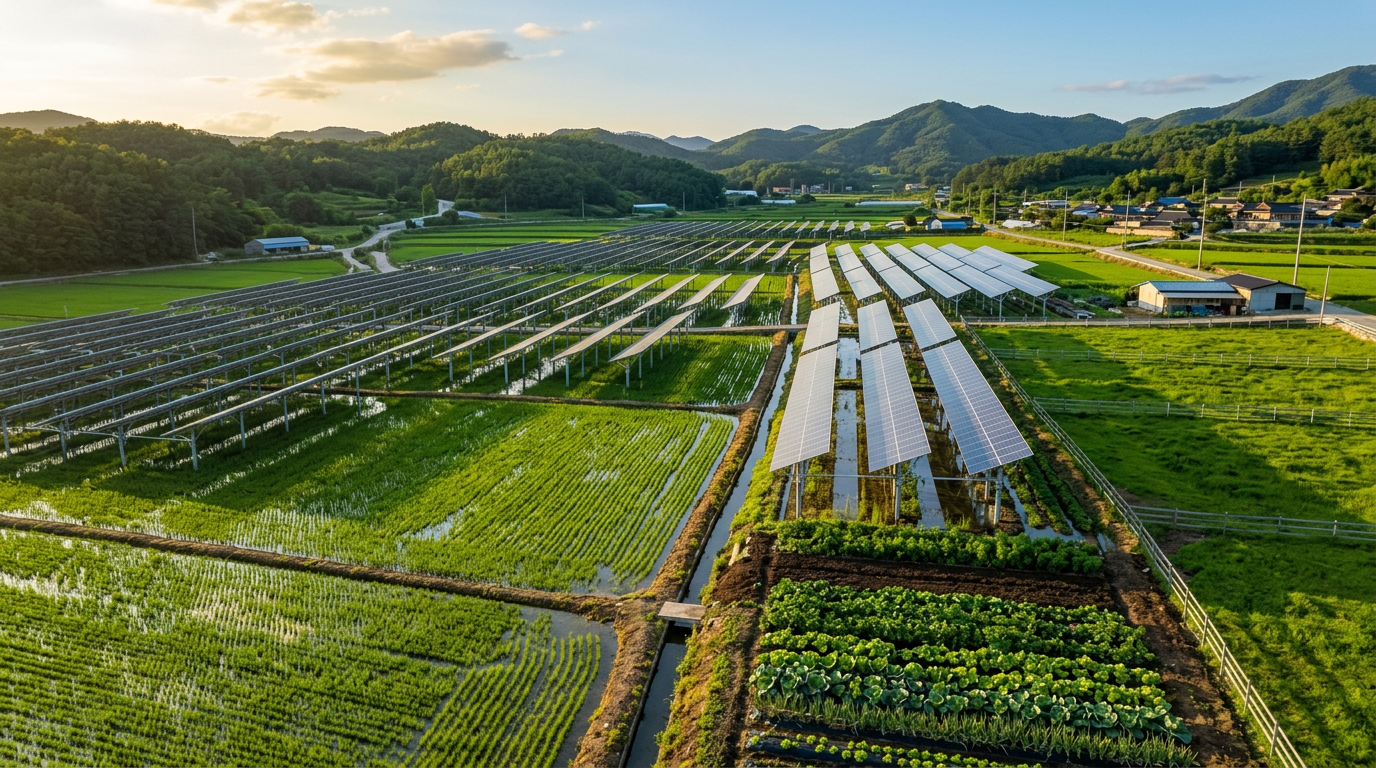
Agrivoltaic Systems — Crop-Yield and Power Generation Balance Design Based on Real Data
Agrivoltaic Systems — Crop-Yield and Power Generation Balance Design Based on Real Data
Evidence-Based Design Guide | Paddy (畓) · Upland Field (田) · Pasture (牧) — Optimal kW per Acreage
Why Design Matters
Installing solar panels above farmland is straightforward. Finding the balance where crop yields are maintained and power revenue is maximized is an entirely different challenge. Over-sizing capacity raises the shading ratio, cuts crop yields, and ultimately compromises both agricultural and generation income.
The core principle confirmed in real-world data is this: only the surplus solar irradiance exceeding a crop’s light-saturation point should be converted to electricity. Shade beyond that point damages photosynthesis. Analysis of 62 domestic agrivoltaic demonstration sites (2022) by the Korea Rural Economic Institute confirmed that when the shading ratio exceeds 30%, yield loss in most crops crosses the critical threshold.
Universal Design Standards (Applicable to All Land Types)
Before site-specific design, the following legal and structural requirements must be met for any agricultural land type.
| Item | Standard |
|---|---|
| Structure Height | ≥ 3 m (agricultural machinery clearance) |
| Column Spacing | ≥ 4 m (tractor, combine harvester access) |
| Max. Shading Ratio | ≤ 30% (photosynthesis maintenance) |
| Eligible Land | Outside Agricultural Promotion Zones / Agricultural Protection Zones (temporary use permit) |
| Permit Duration | Max. 8 yrs + 3 yr extensions (up to 30 yrs under 2026 new legislation) |
| Capacity Cap | < 500 kW (KNREC loan eligibility) |
| Yield-Loss Limit | ≤ 20% recommended (National Assembly Research Service) |
A structure height of 3.5–4 m is the practical recommendation. The 3 m figure is the legal minimum; spray equipment typically requires 4 m of clearance.
Area-to-Capacity Conversion Reference
| Land Area | Approx. (㎡) | Recommended Capacity | Notes |
|---|---|---|---|
| 300 pyeong (~990 ㎡) | ~990 ㎡ | 30–50 kW | Entry-level small farm |
| 500 pyeong (~1,650 ㎡) | ~1,650 ㎡ | 50–80 kW | Optimal KNREC loan bracket |
| 1,000 pyeong (~3,300 ㎡) | ~3,300 ㎡ | 100–150 kW | Standard commercial unit |
| 2,000 pyeong (~6,600 ㎡) | ~6,600 ㎡ | 200–300 kW | Cooperative/corporate scale |
| ≥ 3,000 pyeong (~9,900 ㎡) | ~9,900 ㎡ | 300–500 kW | Must stay below 500 kW cap |
KNREC demonstration benchmark: 99 kW on 2,000 ㎡ (~605 pyeong) generates approximately 114,000–120,000 kWh/year. Agrivoltaic installation requires approximately 6–7 pyeong per kW (versus 2–3 pyeong for standard ground-mount).
Paddy Fields (畓) — Rice-Centered Design
Crop Characteristics and Shade Tolerance
Rice has a light-saturation point of approximately 50,000–70,000 lux. Since Korean summer irradiance routinely exceeds 80,000–100,000 lux, a shading ratio of 20–25% does not materially impair photosynthesis. Domestic demonstration results:
- Tracking (adjustable) systems: average yield 81% of baseline (19% reduction)
- Fixed systems: average yield 82% of baseline (18% reduction)
- Tracking: every 10% increase in shading → ~31 kg/unit yield decrease
Planting density adjustments can partially offset yield losses.
Paddy — Area-Based Design Table
| Paddy Area | Recommended Capacity | System Type | Est. Annual Generation | Est. Annual Revenue (×185 KRW/kWh) |
|---|---|---|---|---|
| 300 pyeong | 30 kW | Fixed | ~36,000 kWh | ~6.66M KRW |
| 500 pyeong | 50 kW | Fixed | ~60,000 kWh | ~11.1M KRW |
| 700 pyeong | 100 kW | Fixed/Tracking | ~120,000 kWh | ~22.2M KRW |
| 1,000 pyeong | 100–150 kW | Tracking preferred | ~132,000–156,000 kWh | ~24.4–28.9M KRW |
| ≥ 2,000 pyeong | 200–300 kW | Tracking | ~240,000–324,000 kWh | ~44.4–59.9M KRW |
Revenue rate: SMP + REC combined ~185 KRW/kWh (Yeongam 2025 demonstration rate)
Real Case: Yeongam, Jeollanam-do (2025)
In the 2025 Yeongam demonstration project combining rice cultivation and solar generation, total annual revenue was estimated at ~9.89 million KRW. Rice yield fell by ~21%, but solar revenue (~8.97M KRW) more than offset the loss, yielding 8.4× the revenue of rice farming alone.
In Boseong, Jeollanam-do (Korea’s first farmer-led agrivoltaic project, 2020), annual net income reached approximately 14.4 million KRW (13.0M from power + 1.4M from rice).
Key Design Considerations for Paddies
Column foundations must not disrupt irrigation flow. Concrete footings should be placed on field boundaries or separate base platforms. Concentrated runoff (rainfall channeling from panel edges) is a documented cause of localized crop damage — drainage design must accompany structural design.
Upland Fields (田) — Horticulture and Specialty Crops
Crop Shade Tolerance Classification
Crop selection determines design more than any other variable.
Suitable crops (yield loss ≤ 20%)
| Crop | Yield Change | Notes |
|---|---|---|
| Potato | ~10% decrease | Heat stress reduction effect |
| Cabbage | Potential increase | Significant summer shading benefit |
| Green onion (jjokpa) | Minimal impact | Semi-shade preference |
| Perilla | Minimal impact | High shade tolerance |
| Sweet potato | Maintained | Long growing season, adaptive |
| Sesame | No impact | Confirmed in Goesan demonstration |
| Ginseng | Favorable | Traditionally shade-cultivated |
| Green tea | +29.8% yield increase | Relieves summer photoinhibition |
Higher-risk crops (yield loss > 20%)
| Crop | Yield Change | Note |
|---|---|---|
| Garlic | ~21.5% decrease | Underground crop, light-sensitive |
| Onion | ~16.0% decrease | Near tolerance limit |
| Cabbage (napa) | ~15.1% decrease | High seasonal variability |
The Jeju Western Agricultural Technology Center demonstration (40 kW, 750 ㎡, 26.8% shading) confirmed garlic and onion yield declines but cabbage yield increase. Crop selection precedes capacity design.
Upland Field Design Tables
Shade-tolerant / semi-shade crops (shading ratio 25–30% allowed)
| Field Area | Recommended Capacity | Est. Annual Generation | Est. Revenue |
|---|---|---|---|
| 300 pyeong | 40–50 kW | ~48,000–60,000 kWh | ~8.9–11.1M KRW |
| 500 pyeong | 70–100 kW | ~84,000–120,000 kWh | ~15.5–22.2M KRW |
| 1,000 pyeong | 150–200 kW | ~180,000–240,000 kWh | ~33.3–44.4M KRW |
| ≥ 2,000 pyeong | 300–400 kW | ~324,000–432,000 kWh | ~59.9–79.9M KRW |
Sun-demanding crops (shading ratio must be held to 15–20%)
| Field Area | Recommended Capacity | Rationale |
|---|---|---|
| 300 pyeong | 20–30 kW | Fewer panels to limit shading |
| 500 pyeong | 40–50 kW | Wider spacing + tracking required |
| 1,000 pyeong | 80–100 kW | Crop protection over generation |
For garlic or onion farmers interested in agrivoltaics, crop transition to shade-tolerant species is the most practical path before committing to system design.
Field-Specific Design Notes
Upland machinery (bed formers, cultivators, plastic mulchers) is often narrower than paddy equipment, but column spacing should still be ≥ 5 m for operational comfort. Wider spacing reduces installable kW per area — account for this in capacity estimates.
Pasture / Grassland (牧) — Forage Crop and Livestock Design
Why Pasture Suits Agrivoltaics
Pastureland offers the most forgiving shade tolerance among the three land types. European agrivoltaic research consistently shows that panels over pasture reduce summer evapotranspiration and relieve heat and drought stress on grass, sometimes increasing biomass. The key: panel height must accommodate crop canopy.
Pasture crop shade tolerance
| Forage Crop | Allowable Shading Ratio | Notes |
|---|---|---|
| Italian ryegrass | Up to 30–35% | High tolerance |
| Forage maize / sorghum | ≤ 20% | Tall crops need ≥ 4 m structure height |
| Kentucky bluegrass, orchardgrass | Up to 25–30% | Standard pasture mix |
Pasture — Area-Based Design Table
| Pasture Area | Recommended Capacity | Structural Notes | Est. Annual Generation | Est. Revenue |
|---|---|---|---|---|
| 500 pyeong | 50–70 kW | Column spacing ≥ 5 m | ~60,000–84,000 kWh | ~11.1–15.5M KRW |
| 1,000 pyeong | 100–150 kW | Height ≥ 4 m mandatory | ~120,000–180,000 kWh | ~22.2–33.3M KRW |
| 2,000 pyeong | 200–250 kW | Tracking system recommended | ~240,000–300,000 kWh | ~44.4–55.5M KRW |
| ≥ 3,000 pyeong | 350–500 kW | Clustered layout preferred | ~420,000–540,000 kWh | ~77.7–99.9M KRW |
Livestock Co-benefits
Livestock naturally seek shade under panels in summer, providing an animal welfare benefit. However, cattle rubbing or pushing against columns is a real operational concern. Lower-column protective guards are mandatory.
Profitability Comparison — 1,000 Pyeong Benchmark
| Land Type | Crop | Capacity | Est. Agri Income | Est. Solar Revenue | Total | vs. Farming Alone |
|---|---|---|---|---|---|---|
| Paddy (畓) | Rice | 100 kW | ~2M KRW | ~22.2M KRW | ~24.2M KRW | ~10× |
| Field (田) | Perilla / green onion | 150 kW | ~5M KRW | ~33.3M KRW | ~38.3M KRW | ~5–6× |
| Field (田) | Ginseng | 80 kW | ~20M KRW | ~17.8M KRW | ~37.8M KRW | ~1.5× |
| Pasture (牧) | Italian ryegrass | 150 kW | ~3M KRW | ~33.3M KRW | ~36.3M KRW | ~8× |
Pre-loan-repayment revenue figures. 100 kW installation cost ~150–200M KRW; 70–90% financing available through KNREC. 20-year operation B/C ratio = 1.24; income 2.63–2.8× rice farming alone (KREI analysis).
Design Decision Flow
1. Confirm land cadastral type → Paddy / Upland Field / Pasture
2. Identify current crop's light-saturation point
3. Assess whether yield loss will stay ≤ 20%
└ If > 20% risk → switch crops or constrain shading to ≤ 15%
4. Measure exact area → estimate capacity at 6–7 pyeong/kW
5. Set structure height and column spacing (min. 3 m / 4 m; recommended 4 m / 5 m)
6. Confirm shading ratio ≤ 30%
7. Finalize capacity within < 500 kW limit
8. Apply for temporary agricultural land use permit + power business license
References
- Korea Rural Economic Institute (KREI). (2023). Economic Analysis of Agrivoltaic Adoption and Policy Implications. Report P293.
- Rural Development Administration / Nongsaro. (2023). Agrivoltaic Under-Panel Environment and Rice Yield Changes.
- Green Energy Research Institute. (2023). Agrivoltaic Demonstration Site Survey: 62 Sites.
- Yeongam County, Jeollanam-do. (2025). Agrivoltaic Rice-Power Co-production Demonstration Results.
- Boseong, Jeollanam-do. (2020). Korea’s First Farmer-Led Agrivoltaic Project Operations.
- Jeju Western Agricultural Technology Center. (2023). Agrivoltaic Suitability for Brassica Crops.
- Korea New and Renewable Energy Center (KNREC). (2024). Rural Solar Support Program Standards. (knrec.or.kr)
- National Assembly Research Service. (2024). Agrivoltaic Yield-Loss ≤ 20% Recommendation Basis.
- RE:FACT. (May 2026). Agrivoltaic Economic Viability Fact-Check Report.
- Journal of the Korean Solar Energy Society. (2021). Design Considerations for Agrivoltaic Systems Considering Upper and Lower Irradiance.
- Act on Promotion and Support of Agrivoltaic Power Generation Business (passed National Assembly May 7, 2026).
- Goetzberger, A. & Zastrow, A. (1981). On the coexistence of solar-energy conversion and plant cultivation. International Journal of Solar Energy, 1(1), 55–69.