Why Opposition to Agrivoltaic Solar Energy Exists
Why Opposition to Agrivoltaic Solar Energy Exists
The pro-agrivoltaic argument is simple: farm and sell electricity at the same time. Two birds, one stone. So why has the Korea Full-Time Farmers Association issued formal statements opposing it, why has the Korea Agricultural Management Association raised concerns, and why does resistance continue to emerge from farming communities across the country?
Call it agrivoltaic all you want — what’s actually happening is steel structures being driven into farmland. The interests entangled in that soil are far more complicated than the promotional materials suggest.
1. Tenant Farmers Getting Pushed Out: The Most Explosive Objection
More than half of Korean farm households are tenant farmers. As of 2015 Statistics Korea data, 59.6% of farm households rent their land from others. This group is the first to target the “rent increase” problem.
The logic runs like this: once agrivoltaic projects become permitted, solar developers offer landowners far more than any tenant farmer could pay for the same land. A landowner can suddenly earn multiples more by leasing to an energy developer than by renting to a farmer growing cabbage. The tenant farmer gets displaced.
There is already a precedent. When the Farmland Act was revised in 2019 to allow solar development on salt-damaged tidal land, ambiguous eligibility criteria led to a wave of tenant farmers being pushed off their land as solar contracts surged. The Korea Full-Time Farmers Association used exactly this case to argue: “Since approximately 75% of Korea’s farmland is owned by absentee landlords, passage of this legislation will inevitably force tenant farmers out.” Even those who aren’t evicted, they argued, will face skyrocketing rents and the additional burden of purchasing new machinery compatible with the panel structures above them. The government acknowledged the problem. The Ministry of Agriculture, Food and Rural Affairs stated in October 2025 that it would work to “minimize tenant farmer burden,” but concrete solutions remain unclear.
2. Farmland Degradation: Once the Steel Foundations Go In
Agrivoltaic is still agrivoltaic — but steel footings still get driven into the earth.
Under the National Land Planning and Utilization Act, installing solar power facilities normally requires a formal change in land classification. Conventional rural solar projects go through farmland conversion permits to accomplish this. Agrivoltaic systems, operating under a temporary alternative use permit rather than a formal conversion, arguably creates a regulatory blind spot: standards for determining what constitutes “degradation” versus “normal use” are not clearly defined.
In practice, concerns include the land area occupied by structural foundations, changes to drainage patterns, soil compaction, and effects on soil biodiversity. The Korea Agricultural Management Association stated that “the likelihood of farmland degradation increases” under agrivoltaic development. A review of the decade-long pilot program found that some demonstration sites were left as scrap metal after the programs ended, with unclear accounting for project funds.
3. Crop Yield Reduction and Food Security: Do Crops Grow Well Under Panels?
Installing agrivoltaic systems reduces the amount of sunlight reaching crops. This is established fact. Multiple pilot studies consistently show yield reduction rates of around 20%.
Proponents counter that solar revenue more than offsets this loss. A fact-check conducted by Slownews in April 2026 estimated that a 0.5-hectare rice farm household installing agrivoltaic panels could earn 2.63 times the income over 20 years compared to farming alone. However, the opposition’s core concern is not a farm-level income calculation — it’s a structural question about what happens to Korea’s food self-sufficiency rate if this scales across the country. Only certain crops are well-suited to agrivoltaic conditions. If farmers shift toward those specific crops, essential food crops that Korea must produce domestically may be gradually abandoned.
4. Landscape Damage and Uncontrolled Development
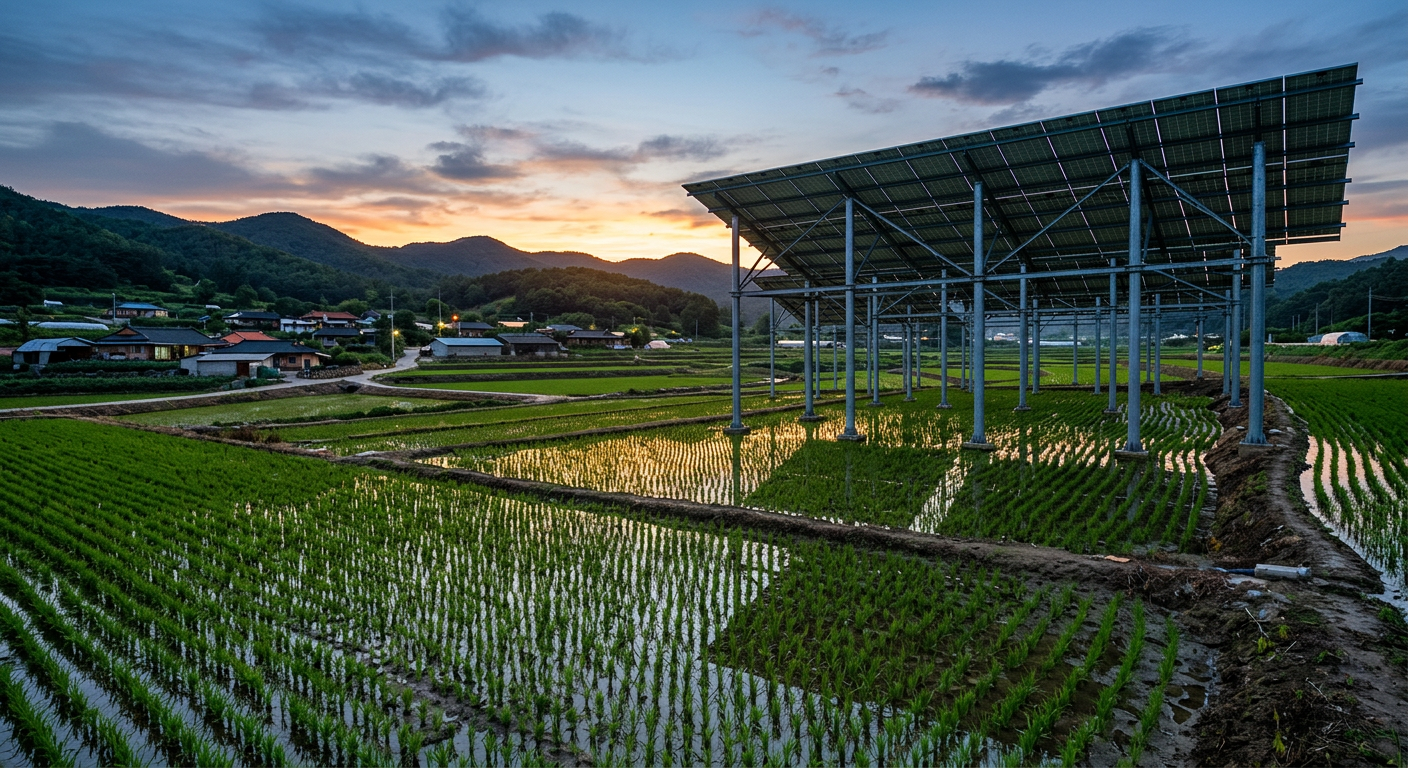
Agrivoltaic opposition meetings reliably feature photographs: hillsides blanketed in panels, rice paddies obscured under black structures. That visual shock transfers directly into distrust of agrivoltaic projects.
A research team led by Professor Yang Seung-ryong at Korea University published findings estimating that if agrivoltaic systems spread across the country’s farmland, the resulting loss of rural landscape value would total approximately 1.9 trillion Korean won. The Slownews fact-check challenged this, arguing the landscape impact of agrivoltaic installations is fundamentally different from — and less severe than — conventional hillside solar farms. Even so, it concedes that some change is unavoidable.
Behind the landscape argument lies a deeper concern about actual farmland conversion disguised as agrivoltaic development. If a few token crops are planted beneath panels while the site effectively operates as a solar farm, high-quality farmland becomes absorbed into power generation infrastructure — and it becomes very hard to reverse.
5. High Upfront Costs and Uncertain Economics: Can Small Farmers Manage This?
In a Korea Energy Economics Institute survey of 500 farm households, the most common reason for not wanting to adopt agrivoltaic was “burden of initial investment costs” — cited by 248 respondents. “Concern about crop damage” came second at 225, and “lack of economic viability” third at 147.
A 100kW installation costs approximately 150 to 200 million KRW. That’s up to three times more expensive than rooftop solar, because deeper steel foundations are required to handle weather loads. According to the Korea Rural Economic Institute, agrivoltaic installations require more than 20 years of operation to become profitable. Under the previous farmland law, the maximum temporary use period was 8 years — an obvious conflict. The new special law allows up to 30-year operations, which addresses the policy gap, but small farmers still face exposure to interest rate fluctuations and electricity price risk over that span.
6. Japan’s Cautionary Example: When Management Standards Are Loose, Agriculture Loses
Agrivoltaic proponents frequently cite Japan and European examples. But the Japanese experience contains an uncomfortable detail.
Analysis of Japan’s agrivoltaic trajectory shows that after initial policy adoption, the program shifted in a direction that effectively did not require meaningful agricultural activity — accelerating agricultural decline rather than supporting it. Loose enforcement allowed “solar without farming” to become the practical reality. The same trajectory is what Korean opponents fear domestically. Korea’s new law includes permit revocation provisions if crop yield standards go unmet for three consecutive years, but whether that enforcement mechanism will actually be applied remains to be seen.
7. External Capital Inflows and Revenue Leakage: Who Actually Keeps the Money?
The ideal picture behind agrivoltaic policy is that farmers themselves operate the projects and retain the income. The new law formally restricts eligible operators to farmers, resident participation cooperatives, and agricultural corporations.
In practice, however, there are concerns that large energy companies or outside investors will effectively control the projects by offering farmers a guaranteed cut while the real decision-making and profit extraction remain outside the community. This exact pattern played out in earlier rural solar programs, where external capital entered farming villages and revenue flowed out of the region. If it repeats under agrivoltaic branding, the intent behind the law’s operator restrictions — protecting genuine farmers — becomes symbolic at best.
3-Line Summary
- The tenant farmer problem is the sharpest edge of the opposition — when development income rises, landowners raise rents or terminate leases, and the most vulnerable farmers bear the cost.
- Landscape damage, food security, and yield reduction are partially countered by evidence, but the structural implications of nationwide rollout remain genuinely unresolved.
- High installation costs and Japan’s cautionary precedent leave small-scale farmers with real and justified skepticism — good policy design means nothing without enforcement that matches it.
References
- Enlighten, “All Issues Surrounding Agrivoltaic Solar: Tenant Farmer Damage vs. Power Revenue” (enlighten.kr)
- Korea Full-Time Farmers Association, Jeju Chapter, Formal Opposition Statement, republished by Headline Jeju (headlinejeju.co.kr)
- Agricultural and Rural Research Institute, “Does Agrivoltaic Solar Really Catch Two Birds with One Stone?”, December 2025 (nongyeon.org)
- Slownews, “Fact-Check: Four Concerns About Agrivoltaic Solar,” April 29, 2026 (slownews.kr)
- Kyunghyang Shinmun, “Agrivoltaic Solar Uneconomical? Largely False,” May 13, 2026 (khan.co.kr)
- Betanews, “Farming and Selling Electricity: Is Agrivoltaic Solar Actually Profitable?”, May 26, 2026 (betanews.net)
- Ministry of Agriculture, Food and Rural Affairs, Official Press Release, “Resolving Rural Solar Issues Through Orderly Agrivoltaic Introduction,” October 16, 2025 (mafra.go.kr)
- Daily Hankook (via Daum), “Solar Above Rice Paddies Gets Approved, But Standards to Prevent Farming-Free Power Generation Are the Real Question” (v.daum.net)
- Korea Energy Economics Institute, Nationwide Survey of 500 Farm Households on Agrivoltaic Adoption Intent (cited via Kyunghyang Shinmun)
- Academic Journal: Environmental Policy, Vol. 33, No. 2, June 2025 — farmer perception survey results (jepa.or.kr)