Key Conditions Local Governments Check When Approving Agrivoltaic (Farming + Solar) Projects
Key Conditions Local Governments Check When Approving Agrivoltaic (Farming + Solar) Projects
Installing solar panels above farmland sounds straightforward. In practice, it’s one of the most bureaucratically layered processes in Korean renewable energy development. Not knowing what local government officials look for first can cost months of progress.
On May 7, 2026, the Act on the Promotion and Support of Agrivoltaic Power Generation Business passed the National Assembly. Previously, agrivoltaic projects had to squeeze through the narrow window of temporary farmland use permits under the Farmland Act, with a maximum project duration of just 8 years. The new framework allows up to 30-year operations under an independent special act.
But the approval hurdles haven’t disappeared.
1. Applicant Eligibility: The First Gate
The first question at any permit desk is: “Are you actually a farmer?”
Article 5 of the Agrivoltaic Act explicitly limits eligible project operators to three categories:
- Farmers residing at the project site location who have operated agricultural businesses for 3+ years
- Resident participation cooperatives established by 10 or more residents living at the project site
- Agricultural corporations — only in areas designated as Renewable Energy Zones
Without at least 3 years of verified farming activity, an individual cannot apply as a farmer. Whether that farming was owner-operated or tenant-based doesn’t matter — proof of actual cultivation is what counts.
Outside investors and general developers cannot directly own an agrivoltaic project. Someone buying farmland purely to install solar without genuine agricultural activity is effectively blocked under this law.
2. Site Conditions: Location Is Everything
A single zoning classification can determine whether a project is feasible at all.
Under Article 6 of the Agrivoltaic Act, eligible project sites are limited to:
- Farmland outside agricultural promotion zones (non-priority farmland)
- Farmland within designated Renewable Energy Zones (can include agricultural promotion zones)
Agricultural promotion zones (the Korean equivalent of protected arable land) are off-limits by default. The exception is when a local government formally designates a zone under the Agricultural and Rural Space Restructuring Act. As of the first half of 2026, such zone designations remain limited nationwide.
Even outside agricultural promotion zones, the average slope of the land must be below 15 degrees — a condition that survives in development permit reviews.
3. Development Permit Review: Where the Real Assessment Happens
The development permit (issued by the local government) and the power generation business permit (issued by the Ministry of Trade, Industry and Energy) are two completely separate processes. Confusing the two is how project timelines get derailed.
Under the new law, mayors, county chiefs, and district heads serve as the permit authority. Documents reviewed during the local permit assessment include:
Required Documents
- Development permit application
- Land ownership documents (or land use consent letter if not the owner)
- Construction plan and site layout drawings
- Engineering specifications (including panel height and structural diagrams)
- Environmental protection and hazard prevention design documents with budget breakdowns
- Farmland temporary use permit (processed as a concurrent approval under the new law)
- Agricultural Production Plan — what crops, what acreage, projected yields, and machinery access routes
The agricultural production plan is where many applications stumble. Submitting a generic or vague plan leads to rejection. Officials want specifics: crop types, cultivation area, annual yield projections, and proof that agricultural machinery can access the land under the panel structure.
4. Physical Installation Standards: Height and Setback Distances
Local officials physically check the design drawings for these specifications.
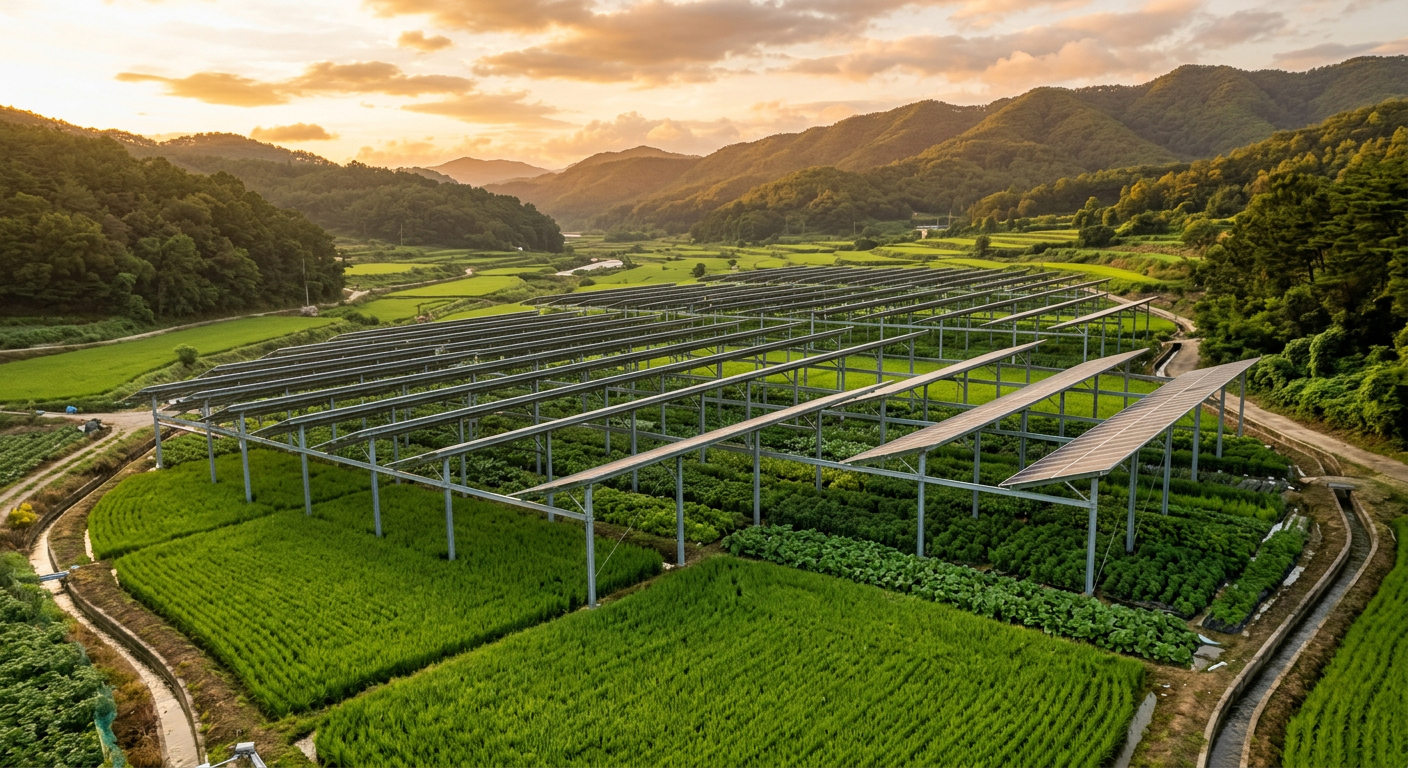
Panel (Structure) Height Standard practice requires a minimum clearance of 3 meters from ground level to allow agricultural machinery to operate freely. The functional access of tractors, combines, and other large equipment is evaluated in practice.
Setback Distances As of 2026, an amendment to the Renewable Energy Act is targeting nationwide standardization. Current targets are 200 meters from residential areas and 100 meters from roads, effective September 2026. Previously, individual local governments had imposed restrictions of 500 to 1,000 meters — those extremes are being eliminated.
Resident participation, rooftop-mounted, and self-consumption solar systems are explicitly exempt from setback requirements.
Light Transmittance (Shading Rate) Because agrivoltaic systems must not excessively block sunlight from reaching crops, shading rate limits — generally 30% or below — are increasingly being added as permit conditions.
5. Generation Capacity: 100kW–200kW Is the Practical Range
The law does not directly specify a capacity ceiling; that will be set by Presidential Decree. The range seen most frequently in practice is 100kW to 200kW. At 100kW scale, installation costs run approximately KRW 150–200 million, with estimated annual revenues of around KRW 26–27 million based on combined SMP and REC income.
Using August 2025 figures as reference: annual generation of approximately 120,000 kWh, SMP at 112.94 KRW/kWh and REC at 71.85 KRW/kWh yields annual revenue of approximately KRW 26.61 million. Local authorities review the ratio of project footprint to generation capacity as part of the approval process.
6. Post-Permit Obligations: The Approval Is Not the End
This is where many operators get caught off guard.
Article 13 of the Agrivoltaic Act requires project operators to continue agricultural production activities each year in accordance with the submitted farming plan. The government conducts periodic checks on compliance with this obligation. Permit revocation, fines, and penalties apply to operators who obtained permits through misrepresentation or who subsequently fail to maintain genuine farming activity.
For resident cooperatives and agricultural corporations, a portion of project revenues must be returned to local residents. Revenue sharing is effectively becoming a built-in permit condition.
7. Local Government Variations: Check Before You File
As of November 2024, only 129 out of 228 basic local governments (56.6%) had established development permit standards for agrivoltaic projects. The rest either had no standards or incomplete frameworks.
Even among localities with standards, conditions vary widely. Yeongdong County in North Chungcheong Province allows up to 50% setback reduction for applicants with 5+ years of residency and 3+ years of land ownership. Jecheon City waives setback requirements entirely for rooftop installations.
The most reliable way to check local conditions is directly through the Self-Governing Legal Information System (elis.go.kr), or by consulting the local development permit office in person. Don’t arrive empty-handed — bring the land lot number, acreage, and estimated generation capacity as a minimum.
3-Line Summary
- Eligibility comes first — must reside at the project site and have 3+ years of farming history; no application is possible without this.
- Location determines feasibility — only non-priority farmland or Renewable Energy Zone-designated land qualifies; zoning status is checked before anything else.
- Farming plan quality and post-approval compliance are ongoing requirements — installing panels and not farming will lead to permit revocation.
References
- Shin & Kim Law Firm, “Enactment of the Act on the Promotion and Support of Agrivoltaic Power Generation Business,” May 17, 2026 (shinkim.com)
- 2050 Carbon Neutrality and Green Growth Commission, “Agrivoltaic Introduction Strategy,” August 6, 2024 (greenium.kr)
- Ministry of Agriculture, Food and Rural Affairs, “Agrivoltaic Introduction Strategy Briefing,” April 22, 2024 (mafra.go.kr)
- Nongsaro, “Agrivoltaic Legislation Advances,” April 14, 2026 (nongsaro.go.kr)
- Haezoom Blog, “Solar Setback Regulation Reform Summary,” March 9, 2026 (blog.haezoom.com)
- Academic Journal: Environmental Policy, Vol. 33, No. 2, June 2025 — statistics on local government agrivoltaic permit status (jepa.or.kr)
- National Assembly Bill Information, Agrivoltaic Special Act Proposal (opinion.lawmaking.go.kr)
- Namwon City Solar Panel Ordinance Revision Details (blog.naver.com/kgen1014)
- North Chungcheong Province Renewable Energy Ordinance Summary (blog.haezoom.com)