Agrivoltaic Solar Power in Korea — Pilot & Demonstration Project Status
Agrivoltaic Solar Power in Korea — Pilot & Demonstration Project Status
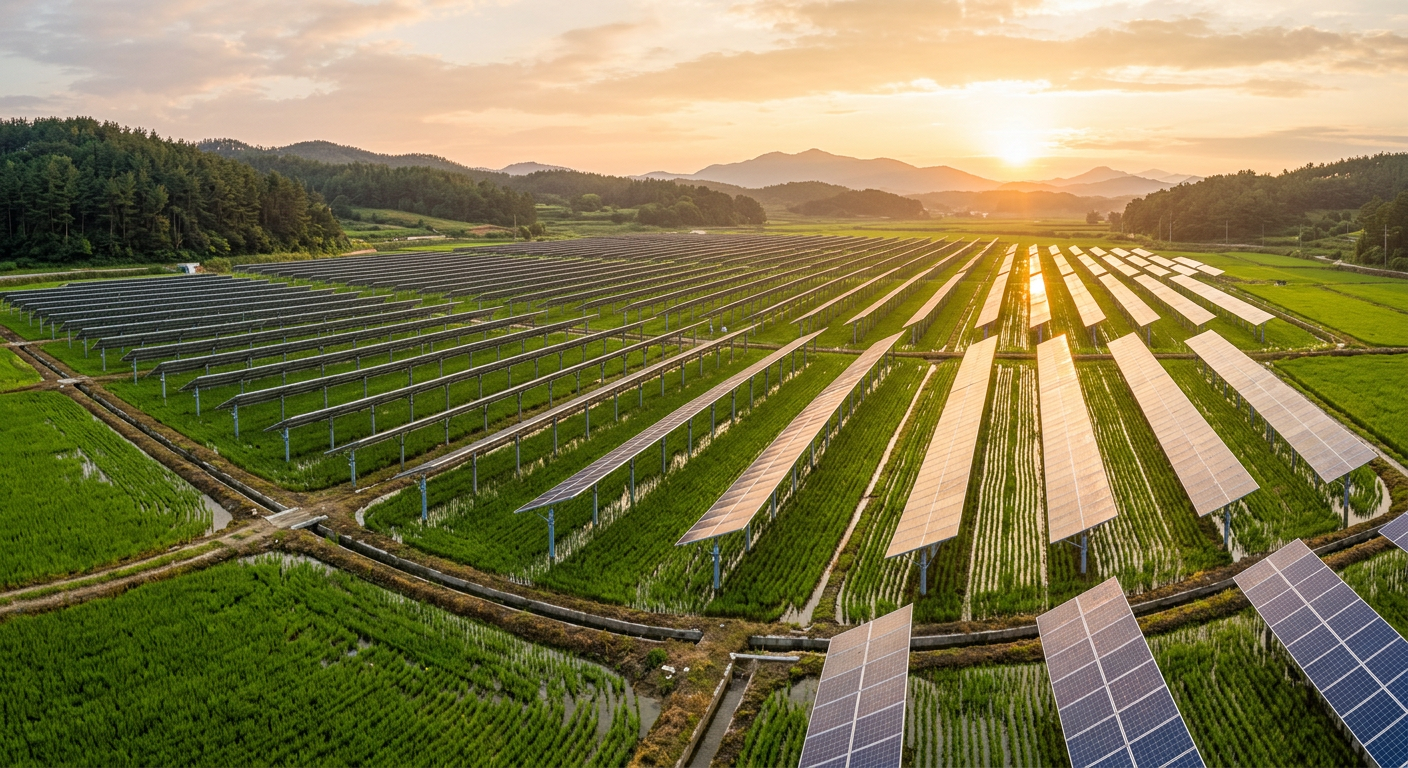
Solar panels above a rice paddy. Electricity from the sky, rice from the soil. This isn’t just a clever concept — it’s already running on over 60 farms across South Korea.
The Science: Intercepting the Light Saturation Point
Plants stop increasing photosynthesis once light exceeds a certain threshold — the light saturation point. Agrivoltaic systems tap into this surplus sunlight before it ever reaches the crop. The panels take what the plant doesn’t need; the plant takes what it does. They split the sunlight.
German physicists A. Goetzberger and A. Zastrow first proposed the concept in 1981. Japan’s Nagashima Akira built the first practical prototype in 2004. South Korea’s first installation came in 2016, when agricultural corporation SolarFarm set up 15kW each on paddy and field plots in Ochang, North Chungcheong, growing rice and cabbage.
Structurally, panels must be mounted at least 3 meters high with 4-meter column spacing. Shading rate is held to around 30% — enough room for tractors, enough light for crops. That elevated, open structure costs 20–30 million KRW more than conventional rural solar installations.
Pilot Status: 62 Sites, Mostly Still Experiments
As of 2022, South Korea has 62 operating agrivoltaic installations nationwide. By institution: Korea Green Energy Institute 9, Korea South-East Power (KOEN) 8, Korea Hydro & Nuclear Power (KHNP) 6, Wonkwang Electric 8, Korea East-West Power 5, SolarFarm 5, GS Construction 4, and 10 at local government research centers.
Regionally, South Jeolla leads with 18 sites, followed by North Chungcheong (12), Gyeonggi (10), and South Gyeongsang (9). Almost all are small-scale: 36 sites under 50kW, 23 between 50–100kW, and only 3 above 100kW. One critical number stands out: only 2 sites — in Boseong (South Jeolla) and Goesan (North Chungcheong) — are commercially operated by individual farmers on their own investment. The other 60 are run by corporations and research institutions for R&D purposes.
In October 2025, the Ministry of Agriculture, Food and Rural Affairs (MAFRA) announced a new pilot targeting the Seoul metropolitan area — 2 sites of at least 1MW scale each, in regions with high industrial power demand and stable grid conditions. It’s the first real attempt to move beyond small-scale research toward a commercial-scale model.
Key Institution Results
Korea South-East Power (KOEN)
KOEN started in 2017 on a 6,611㎡ plot in Goseong, South Gyeongsang. Through university and SME collaborations, it expanded to install 100kW-class solar systems free of charge across 6 South Gyeongsang counties — Geochang, Haman, Hamyang, Hadong, Namhae, and Goseong — with community cooperatives established in each village. Crop harvest rates below the panels held above 80% while generation utilization rates exceeded standard solar benchmarks.
But the controversy is real. Data submitted to the National Assembly showed that in Geochang County, harvest rates under KOEN’s panels dropped by up to 71%. Hamyang showed 51% loss; Haman, 40%. The gap between the official average of 15.7% and the worst-case field results is hard to ignore.
Korea Hydro & Nuclear Power (KHNP)
KHNP operates a “community-participation solar farm” on farmland near the Cheongpyeong Hydropower Plant in Gapyeong, Gyeonggi. At 73.125kW capacity on 1,988㎡, initial harvest verification recorded 86% of normal yield compared to adjacent non-solar plots — sufficient to demonstrate viable dual-use farming.
South Jeolla Yeongam County Pilot (2025)
The most talked-about result of 2025. After one year of operation, Yeongam County announced that total revenue from combined rice farming and solar generation was 8.4 times higher than conventional rice farming alone. Rice yields fell by 21% due to reduced sunlight, but estimated solar generation revenue of approximately 8.97 million KRW more than offset the loss — adding a net 8.72 million KRW over what rice alone would have earned. Total annual revenue came to an estimated 9.89 million KRW, versus 1.18 million KRW for rice-only farming.
South Jeolla’s Largest Site Commissioned (May 2025)
The largest agrivoltaic installation in South Korea went online in South Jeolla Province. Phase 1 of a 3MW total project has been completed. Residents formed their own cooperative to develop it — meaning the revenue stays local, not captured by outside capital.
Crop Yield Reduction by Species
Based on 2022 data from the Korea Green Energy Institute:
| Crop | Farms Tested | Avg. Yield Change |
|---|---|---|
| Rice | 20 | −12.6% |
| Onion | 12 | −16.0% |
| Garlic | 9 | −21.5% |
| Potato | 10 | −10.0% |
| Cabbage | 6 | −15.1% |
| Pear | 3 | −22.0% |
| Grape | 4 | −2.0% |
| Green tea | 2 | +29.8% |
Green tea is the standout. Green tea thrives on diffused light rather than direct sun — the partial shade from panels actually improves growing conditions. Grapes barely dropped. Rice averaged 12.6%, but under the worst real-world conditions, can fall to 71%. Crop selection is arguably the single most important variable for project economics.
Economics: Eight Years Is Too Short
Korea Rural Economic Institute (KREI)‘s 2023 report tackled this head-on. Under current agricultural land law, the maximum permitted temporary use period for agrivoltaic installations is 8 years. At 8 years, the cost-benefit ratio (B/C) drops to 0.74 — economically nonviable.
Extend the permit to 20+ years, and B/C rises to 1.24 — roughly 2.8x more profitable than rice farming alone. KREI concluded that a minimum operating period of 20 years is necessary for financial viability. Real-world data from a Goesan, North Chungcheong farmer confirms it: average monthly solar revenue of 2.2 million KRW, or over 20 million KRW per year in additional income.
Legal Status: Still Outside the System
All existing pilot projects operate under a legal workaround. There is no law that explicitly defines or permits agrivoltaic systems. They rely on Article 36(2) of the Agricultural Land Act — a general provision for temporary alternative use — with the 8-year ceiling that makes the economics unworkable.
In April 2024, the Presidential Commission on Carbon Neutrality and Green Growth approved a national Agrivoltaic Introduction Strategy: ①farmers as primary operators, ②cluster development on non-prime farmland, ③strict post-installation compliance. The temporary use permit would be extended from 8 to 23 years for farmland outside agricultural promotion zones.
In August 2025, Rep. Seo Wang-jin and 13 co-sponsors introduced the Agrivoltaic Solar Development Promotion Act (Special Bill). Key provisions: project approval periods of up to 30 years, designation of agrivoltaic development zones, policy financing support, and a national Agrivoltaic Support Center. By January 2026, parliament was debating a requirement that only those with 3+ years of actual farming experience — whether tenant or owner-farmer — may participate in projects.
Potential: 60GW From 6.2% of Farmland
The scale potential is significant. Installing agrivoltaic systems on just 6.2% of South Korea’s approximately 1.9 million hectares of agricultural land could yield approximately 60GW of solar capacity by 2050, according to analysis by KREI and Agora Energiewende’s K-Map 2.0 scenario. This makes agrivoltaics a central variable in Korea’s 2050 carbon neutrality equation.
Land-use efficiency is the key argument: when crops and solar share the same land, each operates at around 80% of standalone efficiency — but combined, total land productivity reaches 160%. One plot of land, doing two jobs at once.
Challenges Ahead
-
Legislative vacuum. The special bill has not yet passed. Every project remains in a temporary, legally ambiguous framework. Without clear law, neither private capital nor farmers will commit at scale.
-
Yield reduction variance. The national average is 15.7%, but the worst documented case is 71%. Results vary dramatically by panel design, regional sunlight, and crop type. Standardized design guidelines and crop-specific optimization datasets remain insufficient.
-
Tenant farmer exclusion. A significant portion of Korea’s farmland is farmed by tenants, not landowners. If agrivoltaic development inflates land rental rates, the farmers who actually work the land may be priced out or excluded. The government has pledged to develop protections, but the mechanics remain unresolved.
Looking Ahead
Agrivoltaics doesn’t need a complicated pitch. Farm and generate power at the same time. The Yeongam County result — 8.4x revenue — cuts through all the policy noise. But law and permit structure determine whether that math ever reaches real farmers. The passage or failure of the Special Bill in 2026 is the single biggest hinge point for this sector’s future in South Korea.
References
- Korea Rural Economic Institute (KREI), Economic Analysis of Agrivoltaic Introduction and Policy Implications, Policy Report P293, Nov. 2023 — https://repository.krei.re.kr/bitstream/2018.oak/30971/1/P293.pdf
- Ministry of Agriculture, Food and Rural Affairs (MAFRA), Agrivoltaic Introduction Strategy Announcement, April 22, 2024 — https://www.mafra.go.kr/home/5109/subview.do?enc=Zm5jdDF8QEB8…
- MAFRA, Metropolitan Area Agrivoltaic Pilot Project, October 13, 2025 — https://www.mafra.go.kr/home/5109/subview.do?enc=…
- eToday, Agrivoltaic Institutionalization Accelerates, November 18, 2025 — https://www.etoday.co.kr/news/view/2527335
- National Assembly Legislative Portal, Special Act on Agrivoltaic Development Promotion, Rep. Seo Wang-jin et al., August 27, 2025 — https://opinion.lawmaking.go.kr/gcom/nsmLmSts/out/2212438/detailRP
- Greenium, Agrivoltaics: Capturing Both Renewable Energy and Food Security, October 9, 2024 — https://greenium.kr/news/57684/
- Daum News, Opposition: Agrivoltaic Rice Yields Drop Up to 71%, October 13, 2025 — https://v.daum.net/v/20251013173938478
- YouTube (AI뉴스), Yeongam County Agrivoltaic 8x Revenue Results, November 11, 2025 — https://www.youtube.com/watch?v=VMkM-IBaPbA
- Agora Energiewende, 2050 Climate Neutrality Roadmap for Korea K-Map Scenario 2.0 — https://www.agora-energiewende.org/fileadmin/Projekte/2021/202104INTKoreaMap/K-Map2.0_EN-final.pdf
- Gekko System, Agrivoltaics: 2026 Outlook, November 16, 2025 — https://gekkosystem.com/영농형-태양광-2026년의-조망/
- Electronic Times, KOEN Agrivoltaic Farming Business Model, November 17, 2020 — https://www.etnews.com/20201117000067
- Kyunghyang Shinmun, Rice Below, Electricity Above: Agrivoltaics, November 22, 2022 — https://www.khan.co.kr/article/202211221357001