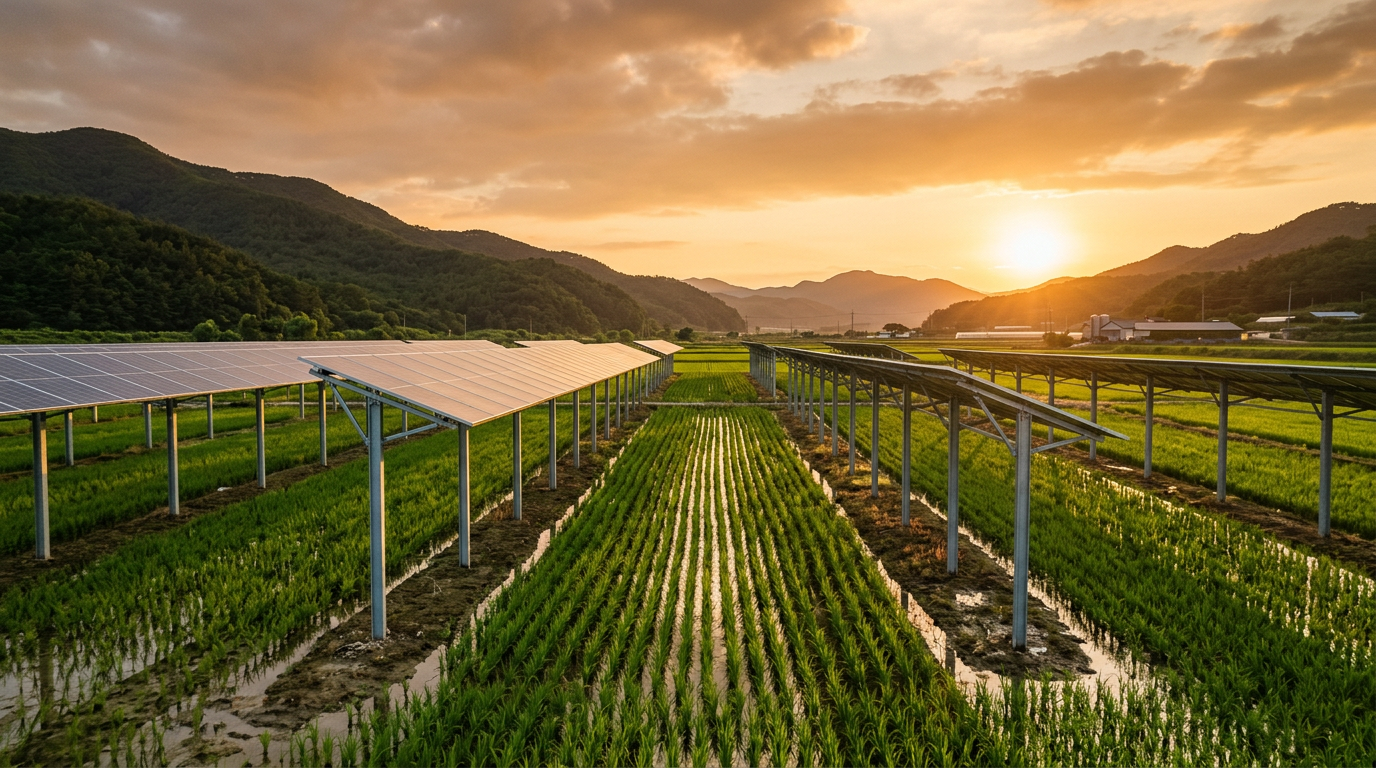
Sub-regulatory Issues After the Korean Agrivoltaic Law Passed
Sub-regulatory Issues After the Korean Agrivoltaic Law Passed
On May 7, 2026, 14 years of institutional debate culminated in legislation. But the real battle starts now.
What the Law’s Passage Actually Means
On May 7, 2026, the Act on the Promotion and Support of Agrivoltaic Power Generation Projects passed the National Assembly plenary session. The Farmland Act amendment passed on the same day. Korean agrivoltaic development has finally moved out of the “temporary alternative-use permit” framework under the existing Farmland Act and into its own independent regulatory domain.
Korea’s theoretical agrivoltaic potential is 682 GW — 4.7 times the country’s total installed generation capacity of approximately 145 GW. Yet this potential repeatedly ran into a wall: the 8-year permit limit. With panel lifespans of 25–30 years and a minimum 12-year payback period, project financing was structurally impossible under the old framework. The law’s passage is not merely a legislative event — it resolves that structural contradiction.
The law establishes the framework. The problem is that the numbers actually shaping how projects will look — farming maintenance ratios, area caps, panel heights, renewable energy zone designation criteria — appear nowhere in the statutory text. Everything was delegated to presidential decrees. Within 6 months of promulgation, those numbers must be filled in.
What the Law Decided
Eligible project operators are limited to three types:
- Farmers (including tenant farmers) residing in or adjacent to the project area with at least 3 years of farming management history
- Community participation cooperatives established by 10 or more rural residents
- Agricultural corporations — permitted only in renewable energy zones designated under the Rural Space Restructuring Act
Eligible land is, in principle, farmland outside agricultural promotion zones. Farmland inside agricultural promotion zones is permitted only when designated as a renewable energy zone.
Project duration is set at a maximum of 30 years (to be specified by the permitting authority under presidential decree). This effectively extends the prior 8-year cap to 23 years — though the Ministry of Agriculture is reviewing a 3-year renewal structure, meaning “23 years” is a ceiling, not a guarantee.
Tenant farmer protection is codified for the first time: rent increases are capped at 5% of the agreed amount, and lease auto-renewal is mandatory throughout the project period.
Farming obligation is explicitly stated. Operating a solar facility without actual farming triggers a four-stage sanction: corrective order → penalty surcharge → business suspension → license revocation. Operating without a permit or obtaining one fraudulently carries up to 5 years imprisonment or a ₩50 million fine.
Six Detonators Left in the Presidential Decree
① Farming Maintenance Rate — One Number Changes Everything
What does “maintaining farming” actually mean in quantitative terms? The Ministry of Agriculture is reviewing a proposal to cap solar module area at under 30% of total farmland area. But this 30% figure means entirely different things depending on the crop.
According to 2025 National Assembly Agriculture Committee data, rice yields at a KOSEP (Korea South-East Power) demonstration site in Geochang fell by up to 71%. The multi-site average reduction rate for rice is 15.7%, but regional variance is extreme. Meanwhile, shade-tolerant crops like green tea, figs, and grapes actually show productivity gains under panels. A uniform area ratio standard creates winners and losers entirely based on crop type.
Regional data from Jeonnam Green Energy Research Institute shows rice yield reductions of 12.1–20.3%, potatoes 8.9–16.5%, and cabbage 7.3–22.9%. Whether the decree applies crop-differentiated standards or a blanket area ratio will determine which farmers benefit and which are excluded.
② Project Duration Renewal Structure — 23 Years Is Not Guaranteed
If the 3-year renewal structure is adopted, project finance (PF) becomes complicated. A 23-year full-term guarantee and a structure requiring farming compliance verification every 3 years carry very different collateral values from a lender’s perspective.
The Korea Rural Economic Institute analyzed that at least 20 years of project duration is necessary for economic viability (2023). Duration has increased, but effective financial security depends on the renewal structure. Strict 3-year renewal requirements could substantially limit access to financing.
③ Renewable Energy Zone Designation Criteria — Who Holds the Key
Whether farmers in agricultural promotion zones can participate depends entirely on renewable energy zone designation. The designation authority lies with metropolitan and provincial governors, linked to the Rural Space Restructuring Act. What farmland can actually be designated remains unclear until separate Ministry of Agriculture guidelines emerge.
Agricultural promotion zones are the core of Korea’s farmland. Without access to them, the eligible area for agrivoltaic projects shrinks dramatically. Without timely zone designations, the law may pass but actual projects may concentrate only in a narrow band of non-promotion-zone farmland.
④ The Dual Nature of Agricultural Corporation Participation
Allowing agricultural corporations into the project mix in renewable energy zones broadens the capital base beyond what village cooperatives alone can mobilize. This is a meaningful expansion.
However, under the current Act on the Fostering and Support of Agricultural and Fisheries Business Entities, agricultural corporations (agricultural companies) can accept investment from non-farmers up to 90%. This creates a structural opening: a developer or financial investor positions a farmer as a nominal shareholder and effectively controls the project. The law’s stated principle of “farmer-led” operation could become nominal.
The decree needs to determine: (1) the minimum share of active farmers in the corporate structure; (2) how the non-farmer investment cap interacts with project operator requirements; and (3) how the “residing in or adjacent to project area” standard applies to corporate entities versus individuals.
⑤ Tenant Farmer Protection — The Standard Contract Is the Real Safeguard
The 5% rent cap and auto-renewal obligation are in the law. Their effectiveness depends on how specifically the Ministry of Agriculture designs its standard lease contract template. If dispute resolution procedures, refusal-to-renew scenarios, and pathways for tenant farmers to join cooperatives are not explicitly included, the protections exist only on paper.
Previous rural solar energy projects repeatedly saw landowners terminate tenant farmer leases or dramatically raise rents to capture solar revenue. Closing the gap between “tenant farmers can participate as project operators” and actual tenant farmer participation is the standard contract’s central challenge.
⑥ Grid Interconnection — The Grid Comes Before the Law
This sits outside the decree framework but may be the most immediate practical barrier. Many rural substations in Korea are already at capacity. Even with the law in place, a project cannot start if there is no available grid capacity. The theoretical 682 GW potential exists only as a number without grid infrastructure. The law includes grid support provisions, but actual distribution network investment timelines require separate planning.
Revenue Structure Reality
The Korea Environment Institute estimates annual farm household income gains of ₩4–9 million from agrivoltaic installation. A Jeonnam demonstration project estimated that a 0.5 ha rice farm with agrivoltaic installation could generate 2.63 times the revenue over 20 years compared to rice farming alone.
These projections assume current REC (Renewable Energy Certificate) weighting levels. Agrivoltaic systems currently receive the same REC weight of 0.7 as conventional solar. Experts have consistently argued that the structural cost premium of agrivoltaic systems — elevated mounting structures, agricultural machinery access lanes, additional management — justifies a differentiated REC weighting. The law obligates the government to establish an “electricity priority purchase and REC weighting preferential support policy” but leaves the specific number for post-decree determination.
Six Months Remaining
The law takes effect 6 months after promulgation. The presidential decree must be completed within that window.
The disputes will not be simple. Crop-differentiated yield maintenance standards will see differing positions between the Rural Development Administration and farming groups. Renewable energy zone designation criteria represent a value choice between food security and energy transition. Agricultural corporation investment requirements balance capital access against rural asset preservation.
Whether the name “agrivoltaic” genuinely secures actual farming, or becomes a wrapper placed over solar power projects — that outcome is determined in this 6-month window.
References
| Source | Content |
|---|---|
| Ministry of Agriculture, Food and Rural Affairs press release (2026.5.7) | Agrivoltaic Law National Assembly passage |
| Act on the Promotion and Support of Agrivoltaic Power Generation Projects (passed 2026.5.7) | Full text |
| Farmland Act Amendment (passed 2026.5.7) | Codification of temporary alternative-use permits |
| KIFC, “What the Agrivoltaic Law Contains and What Remains” (2026.5.8) | Core provisions and decree-level issue analysis |
| KIFC, “Agrivoltaic Grid Bottleneck” (2026.5.8) | Grid interconnection constraints |
| Korea Rural Economic Institute, Agrivoltaic Economic Analysis (2023) | 20+ year project duration requirement |
| MAFRA explanatory document (2025.10.16) | Three principles: anti-haphazard development, food security, revenue internalization |
| National Assembly Agriculture Committee, Rep. Cho Seung-hwan data (2025.10.13) | Up to 71% rice yield reduction in Geochang demonstration |
| Jeonnam Green Energy Research Institute | Crop yield reduction by species |
| Korea Environment Institute | Annual farm income gain of ₩4–9 million |
| Law firm Shin & Kim newsletter (2026.5.17) | Legal interpretation of special law nature and operator eligibility |