The Brain Above the Soil — How Agriculture and AI Agents Are Converging
The Brain Above the Soil — How Agriculture and AI Agents Are Converging
Farming was always the domain of instinct and experience. A veteran farmer’s intuition — built over decades of working the land — was more accurate than any manual. Smell the rain, know tomorrow’s weather. But a completely different kind of intelligence is now entering that sensory world.
AI agents (Agentic AI) are not simple chatbots or automation scripts. They perceive their environment autonomously, set goals, and execute actions. Rather than completing a task once and stopping, they revise their judgments as conditions change. In an environment as variable as agriculture, that characteristic moves from “useful” to “essential.”
Why Now
The reality facing Korean agriculture is stark. The farming population is shrinking rapidly due to aging, cropping patterns are disrupted by climate abnormalities, and labor grows scarcer every year. According to Ministry of Agriculture data, smart farm adoption stands at only 15% of facility horticulture and 6% of livestock farms. The government aims to convert 30% of agricultural production to smart farming by 2027 — but the current state falls far short.
The technology is already ready. The question is how to connect it. AI agents can be that connector: not examining drone imagery, soil sensors, weather data, and market prices as separate streams, but synthesizing all of it in real time and converting insights into action. That is the core of agent-based precision agriculture.
Structure: Multiple Brains Over the Field
Agricultural AI agent systems typically operate in a multi-layered architecture — field agents, an orchestrator agent, and an execution layer, all meshing organically.
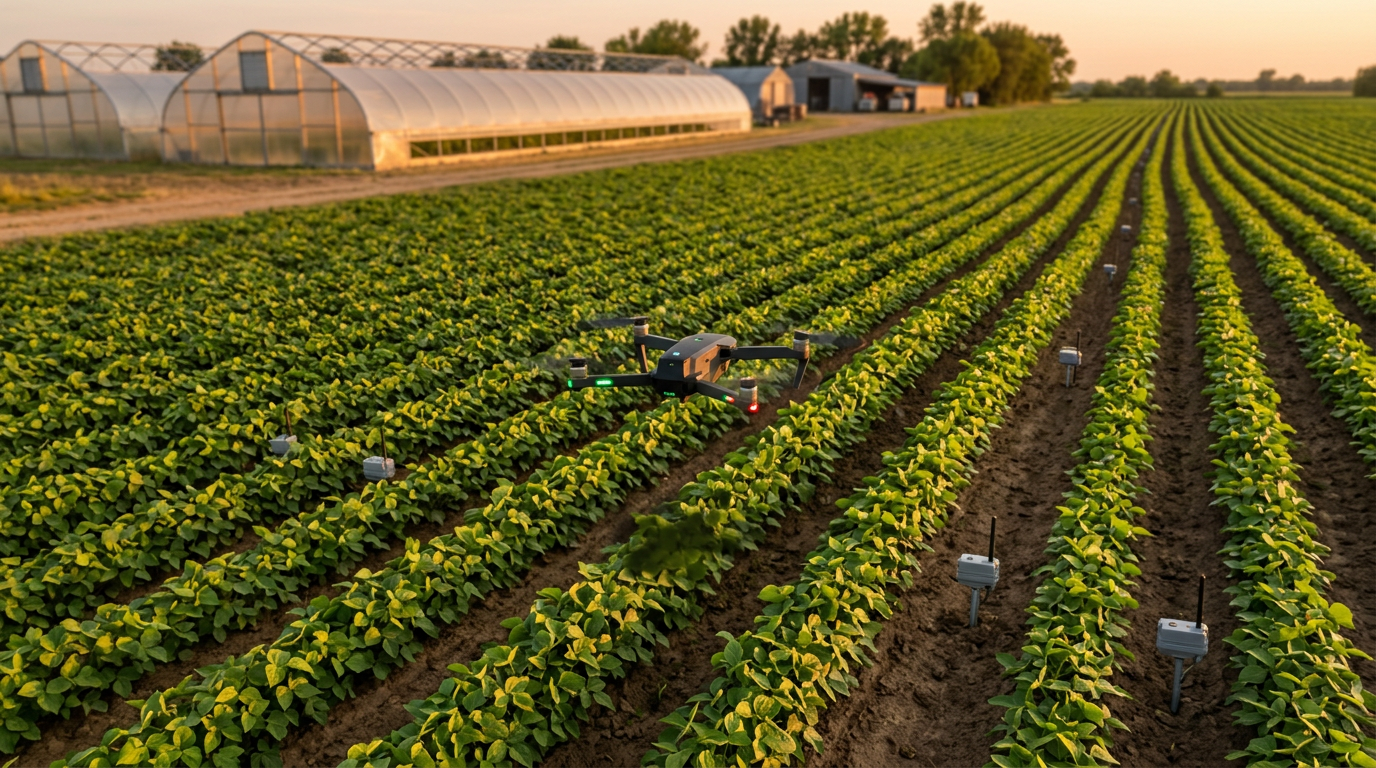
Field Agents (Sensing Layer) each have a specialized role. The soil agent monitors nitrogen, phosphorus, and potassium (NPK), moisture, and pH in real time. The weather agent tracks temperature and humidity and forecasts short-horizon conditions. The crop health agent uses drone cameras and computer vision to detect disease and pests. Each agent focuses on its own domain, but information flows upward.
The Orchestrator Agent (Decision Layer) is the true brain. When signals from field agents conflict — for instance, the soil agent reports “moisture deficit” while the weather agent forecasts “heavy rain within 6 hours” — the orchestrator synthesizes both signals and decides to hold irrigation. This is how LLM-based reasoning enters agriculture.
What AI Agents Actually Do
Early Disease and Pest Detection
CNN-based models achieve accuracy rates above 98.77% in crop image analysis. More than 54,000 images spanning 14 crop species and 26 diseases were used for training. AI detects early symptoms invisible to the human eye. A single drone sweeps hundreds of hectares and immediately marks the coordinates of anomalies.
Precision Irrigation and Water Savings
Farms using AI agent-based irrigation systems report up to 40–50% reductions in water usage. Smart irrigation synthesizes soil moisture, weather forecasts, and crop water demand to adjust schedules in real time. The judgment of “should I water the field now” shifts from human to agent.
Yield Prediction and Farm Decision-Making
LSTM-based yield prediction models recorded an R² of 0.93 for winter wheat, and neural network prediction accuracy averaged 96.06% across six crops. The implication is straightforward: farmers can know how much will come in before the harvest. Inventory management, distribution planning, and sales strategy all change accordingly.
Autonomous Farm Machinery
The vision-sensor-based autonomous tractor unveiled by Daedong at CES 2025 operates with a driving error under 7 cm. Straight-row seeding and pesticide spraying are possible without a driver. Daedong targets 36,500 farms and a 1 trillion KRW economic impact by 2029. Korea’s first AI-based autonomous transport robot launched in Q1 2025.
Korea’s National Strategy
The Rural Development Administration (RDA) announced its “Agricultural Science and Technology AI Convergence Strategy” in November 2025. Three targets: increase farm income by 20%, reduce agricultural accident risk by 20%, and cut technology development and dissemination time by 30%. The generative AI assistant “AI Isak-i” analyzes per-farm management data, identifies vulnerabilities, and proposes responses. The plan calls for expansion to 1,000 farms in 2026 and nationwide rollout thereafter.
Disease diagnosis scope expands to 82 crops and 744 species. “AraOnshil,” which automatically adjusts greenhouse environments based on temperature, humidity, and growth data, is slated for commercialization in 2026. A satellite-based cultivated area and production model extending across major crops will sharpen supply and demand forecasting.
Under a Ministry of Science and ICT support project, Korea’s first agricultural AI agent was unveiled in 2024, built in collaboration with Naver Cloud. The agent covers three functions: an agricultural information chatbot, personalized education recommendations, and a step-by-step farm establishment planning service for new entrants.
Global Deployments
Farmer.Chat, an AI chatbot serving smallholder farmers across Africa and South Asia, combines RAG (Retrieval-Augmented Generation) with LLMs to deliver agricultural advice in local languages. Kenya’s Tulime Tuvune sends pest warnings and weather information to farmers through WhatsApp. India’s Saagu Baagu project in Telangana used AI chatbots to assist smallholders with soil testing and irrigation optimization.
In Europe, the AgRibot project has deployed AI-powered weeding robots and precision spot-spraying systems in actual fields. The primary goal is reducing pesticide use while minimizing workers’ exposure to chemical substances — a signal that AI in agriculture is being designed to protect human health and the environment alongside yield improvement.
Multi-Agent Systems: The Power of Collaboration
Single agents have limits. That is why multi-agent systems (MAS) emerged. Irrigation agents, pest-detection agents, weather agents, and harvest-scheduling agents exchange information and collaborate. The Agentic AI market is projected to grow from USD 7.06 billion in 2025 to USD 93.20 billion by 2032, a CAGR of 44.6%. Agriculture is a significant driver of that growth.
With inter-agent communication standards such as MCP (Model Context Protocol) and A2A (Agent to Agent) established from 2025, data exchange between heterogeneous systems has become far smoother. The AI in a tractor and the AI in a drone now speak the same language.
Extending Into the Supply Chain
It does not stop at the field. AI agents extend into post-harvest logistics and supply chain management. Yield forecast data flows to a logistics agent, which adjusts transport schedules and storage capacity in advance. A demand forecasting agent analyzes market price fluctuations and consumption patterns and recommends optimal shipping timing. AI reads the market information that individual farmers cannot easily access.
The Barriers That Remain
Much of what is technically possible is not yet deployed at scale. The reasons are concrete: inadequate rural telecommunications infrastructure, data quality issues, and difficulty integrating with existing farm machinery. For older farmers, AI interfaces remain unfamiliar, and upfront adoption costs are non-trivial.
That said, pessimism is unwarranted. Edge computing and low-power IoT sensor prices continue to fall, smartphone-based interfaces are becoming simpler, and government subsidy programs and technical training are expanding. The seeds have been planted — germination is a matter of time.
What AI Agents Change About the Nature of Farming
AI agents ultimately close the gap between experience and data. The instinct of a farmer with fifty years in the field remains invaluable. But when that instinct is combined with satellite data, soil sensors, and weather prediction models, farming moves to an entirely different plane.
Farming is, at its core, “the art of waiting.” Plant the seed, wait for growth, harvest at the right moment. AI agents do not eliminate that waiting. They simply never sleep during the wait — they watch the field around the clock and alert farmers before problems emerge. A tireless assistant standing beside the farmer. That is what AI agents do in agriculture.
References
- Rural Development Administration (RDA), “Agricultural Science and Technology AI Convergence Strategy” (Nov 2025) — https://www.rda.go.kr
- Electronic Times, “Farm Income to Rise 20% with ‘AI Isak-i’” (Nov 2025) — https://www.etnews.com
- Digiqt Blog, “AI Agents in Smart Farming: Proven Wins, Fewer Losses” (2025) — https://digiqt.com
- Codewave, “AI Agents in Agriculture: Precision Farming at Scale” (May 2026) — https://www.codewave.com
- Nature Scientific Reports, “Agentic AI-driven autonomous decision support system for smart agriculture” (Feb 2026) — https://www.nature.com
- Frontiers in Plant Science, “Agentic AI for smart and sustainable precision agriculture” (Jan 2026) — https://www.frontiersin.org
- ZTABS, “AI Agents for Agriculture & AgTech: Complete Guide 2026” — https://ztabs.co
- SmythOS, “How Multi-Agent Systems Are Transforming Agriculture” (2024) — https://smythos.com
- MarketsandMarkets, “Agentic AI Market Report 2025–2032” — https://www.marketsandmarkets.com
- Codewave, “AI in Precision Agriculture: Smarter Farming Decisions” (May 2026) — https://codewave.com
- Xenonstack, “Early Crop Disease Detection with AI” (2024) — https://www.xenonstack.com
- FCDO / GRTD, “The use of artificial intelligence in food and agriculture systems” (Nov 2025) — https://www.grtd.fcdo.gov.uk
- KREI, “Policy Enhancement Using AI in Forestry and Agriculture” (2024) — https://repository.krei.re.kr
- NIA (National Information Society Agency), “Era of AI Agents” — https://www.nia.or.kr
- Davinci Blog, “Agricultural AI: From Pesticide Spraying to Harvest Automation” (Apr 2025) — https://www.dvn.ci