Rental Warehouse on Absolute Farmland: How Much Can You Really Earn?
Rental Warehouse on Absolute Farmland: How Much Can You Really Earn?
If you own farmland, the thought has probably crossed your mind. “Can’t I just build a warehouse and collect monthly rent?” A perfectly reasonable idea — until the land turns out to be absolute farmland (Agricultural Promotion Zone).
What Exactly Is Absolute Farmland?
The old distinction between “absolute farmland” and “relative farmland” has been replaced by the Agricultural Promotion Zone system under Korea’s Farmland Act. The Agricultural Promotion Zone corresponds to the old absolute farmland. Article 32 of the Farmland Act strictly controls land use within this zone — in principle, anything unrelated to agricultural production is prohibited.
If the land category is “paddy field” or “dry field” and the land-use planning certificate shows Agricultural Promotion Zone, that’s absolute farmland. Even if the parcel falls under planned management zone, if it’s been designated as an Agricultural Promotion Zone, the Farmland Act takes precedence. The stricter rule wins.
Can a Warehouse Even Be Built There?
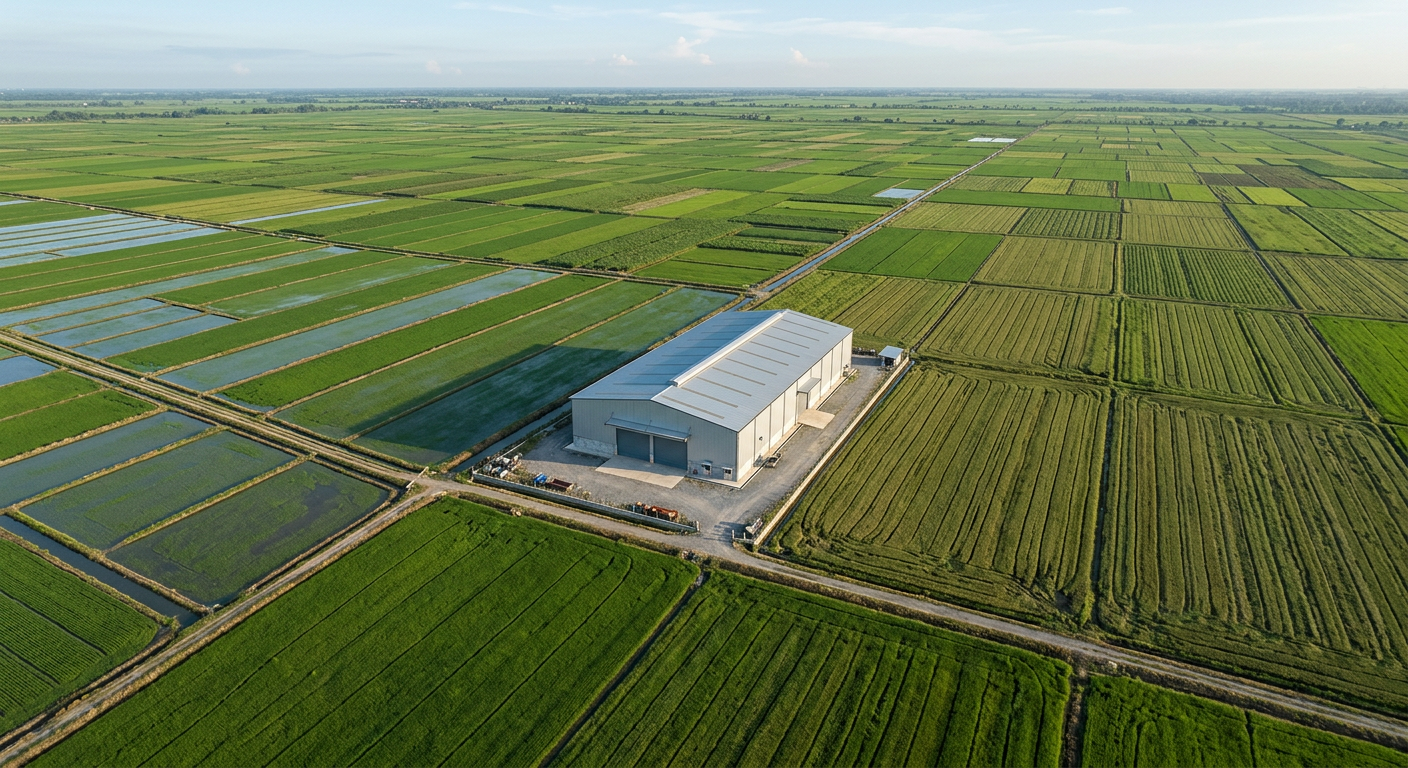
Bluntly: building a general rental warehouse is legally impossible. The only warehouses permitted in an Agricultural Promotion Zone are agricultural storage facilities built by farmers — warehouses intended for storing farm equipment or harvest. Nothing else.
Individual farmers may build up to 1,500㎡, while agricultural corporations can go up to 7,000㎡, but within the Agricultural Promotion Zone, corporations are capped at 3,300㎡. Restrictions pile on top of restrictions.
The core issue is purpose restriction. Getting a permit for an agricultural warehouse and then renting it to non-farmers — for logistics, e-commerce storage, or any non-agricultural use — is a Farmland Act violation. Criminal penalties apply: up to five years imprisonment or a fine of up to 50 million KRW. Hundreds of illegal conversion cases have been caught, as documented in Gimpo City inspections.
Land outside the Agricultural Promotion Zone (including Agricultural Protection Zones) tells a different story. Farmland conversion permits open the door to general warehouse construction and rental. But absolute farmland conversion itself is principally prohibited.
Legal Paths to Generate Income
Options are limited — but not zero.
1. Rent an Agricultural Warehouse to a Qualified Farmer
Renting to a farmer who will actually use the space for agriculture is permitted. The restriction is real: the tenant must genuinely use it for agricultural purposes. Realistically, a 50-pyeong (165㎡) warehouse in a rural area brings in roughly 500,000–1,000,000 KRW per month.
2. Direct Farmland Lease
Leasing bare land for agricultural management purposes is another option. A 2025 revision to the Farmland Act enforcement decree lowered the minimum participant count for Farmland Use Promotion Projects from 10 to 5 farmers, and agricultural corporations can now operate independently. However, rental income remains low — approximately 10,000 KRW per 3.3㎡ annually. On 300 pyeong (990㎡), that’s roughly 3,000,000 KRW per year.
3. Solar Power Facility Lease
One of the few income-generating uses actually permitted in Agricultural Promotion Zones. Solar energy facilities under 10,000㎡ are allowed. A real example from Iksan, North Jeolla Province: a landowner leased 3,000 pyeong to a solar developer for 25 years, receiving a fixed 4.5% annual return with no setup or maintenance costs.
4. Agricultural Processing Facilities
A 2025 enforcement decree revision expanded the permitted area for agricultural processing facilities from 1.5 hectares to 3.0 hectares — double the previous limit. Running or leasing to agri-processing businesses is now more feasible. But non-agricultural use of these facilities still constitutes a violation.
Revenue Numbers: What Do They Actually Look Like?
| Investment Type | Upfront Cost (300-pyeong basis) | Monthly Income | Annual Return |
|---|---|---|---|
| Agricultural warehouse in Promotion Zone (farmer tenant) | Construction 45–75M KRW | 500K–1M KRW | ~2–3% |
| Solar facility land lease | None (developer pays) | Fixed 4.5% yield | 4.5% (25-year fixed) |
| Direct farmland lease | None | ~250K KRW | Under 1% |
| General logistics warehouse (converted land outside zone) | Construction + conversion fees | 2M–5.6M KRW | 8–12% |
The comparison is stark. General logistics warehouse yields 8–12% annually — but only on land that has undergone proper conversion, outside the Agricultural Promotion Zone.
Warehouse construction costs vary widely. Simple panel construction runs 1.0–1.5M KRW per pyeong, while steel-frame with insulation reaches 2.3–3.0M KRW per pyeong. A 300-pyeong warehouse can easily surpass 300 million KRW in construction cost. Against a 2–3% annual return on that investment, the math barely beats a bank deposit — and carries far more operational risk.
The Legal Trap Nobody Talks About Enough
This is where things get dangerous.
Agricultural warehouse permits come with a significant perk: 100% exemption from the Farmland Conservation Charge — equivalent to 30% of the official land value. Obtaining this exemption and then converting the facility to commercial use or renting to non-agricultural tenants is treated as fraudulent misuse. Penalties include repayment of the exempted charge plus criminal prosecution.
Case law is clear. The Supreme Court ruled in 2017 (Case No. 2013da79887) that Article 23 of the Farmland Act is a mandatory provision — lease agreements without valid exceptions are automatically void. In a separate precedent, a property owner who leased a permitted agricultural processing facility for use as a logistics warehouse was charged and convicted under the Farmland Act.
The Bottom Line
Absolute farmland simply cannot be legally monetized as a general rental warehouse. The permitted alternatives — solar leasing or direct farmland rental — produce modest returns of 1–4.5% annually. That’s barely better than a fixed-term bank deposit.
Three realistic directions exist for owners of absolute farmland:
- Long-term strategy: Pursue Agricultural Promotion Zone de-designation to unlock general warehouse development potential.
- Mid-term strategy: Accept solar facility leasing at a stable but low yield.
- Operational strategy: Invest in agricultural processing facilities that create value from agricultural production directly.
The idea of getting an agricultural warehouse permit, renting it to a logistics company, and making serious money has been circulating for years. It’s illegal. And enforcement has been active for longer than most people realize.
📌 Summary
- Only agricultural-use warehouses are permitted in Agricultural Promotion Zones; renting to non-farmers violates the Farmland Act (up to 5 years imprisonment).
- Legal income options — solar leasing (~4.5%) or bare land leasing (under 1%) — deliver modest returns.
- The 8–12% yields seen in general logistics warehouse investment only apply to land that has undergone proper farmland conversion outside the Agricultural Promotion Zone.
References
- Ministry of Agriculture, Food and Rural Affairs (MAFRA), Farmland Civil Complaint Case Collection, official publication
- MAFRA Press Release, Amendment to Farmland Act Enforcement Decree: Expanded Permitted Facilities in Agricultural Promotion Zones, April 6, 2025
- Supreme Court of Korea, Decision 2013da79887, March 15, 2017 (Farmland Act Article 23 as mandatory provision)
- Korea Rural Economic Institute, Study on the Causes and Effects of Farmland Conversion
- Gyeonggi Newspaper, “Some Agricultural Warehouses in Gimpo Disguised as Business Sites,” December 21, 2024
- KBS News, “Agricultural Warehouse Illegal Leasing Rampant,” January 27, 2009
- Asia Economy, “More Flexibility for Absolute Farmland… Weekend Farm Use to Be Permitted in Agricultural Promotion Zones,” January 13, 2025
- Chosun Biz, “Leasing Land for Warehouse Sites and Parking Lots — ‘Building-Free Monthly Income’ as a Second Pension,” November 12, 2025
- Maeil Business Newspaper, “Recession-Proof Warehouse Rentals…10% Annual Return Amid Logistics Market Boom,” January 19, 2016
- Ministry of Government Legislation, Legal Interpretation on Warehouse Construction in Agricultural Promotion Zones, 2019
- Korea Law Information Center, Farmland Act Enforcement Decree Article 29 (Agricultural Facility Standards)
- Korea Rural Community Corporation, Farmland Use Promotion Project Operational Guidelines