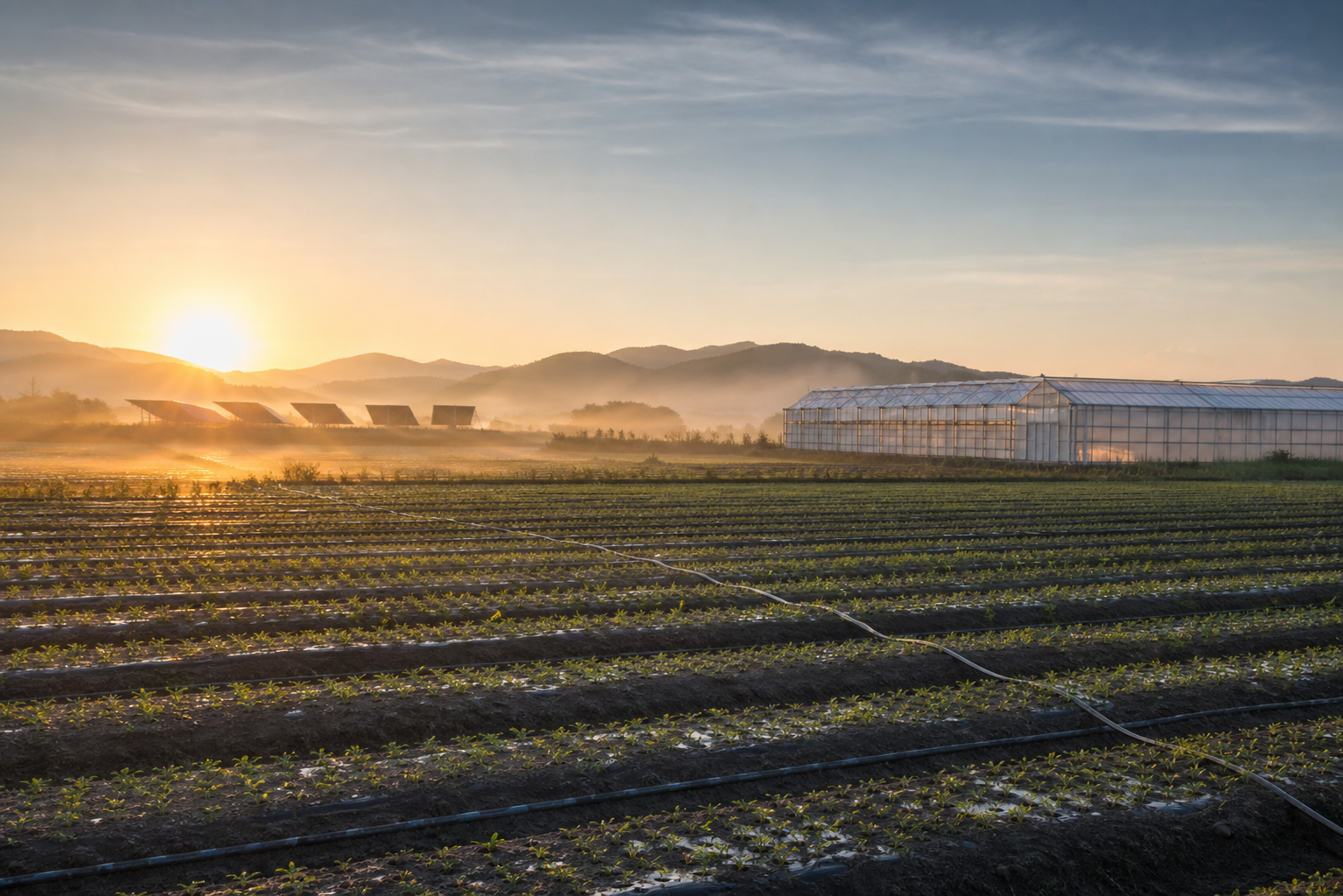
A practical guide to using Farmland Bank leases in Korea as a low-capital starting point for smart farming and future agrivoltaic business planning.
Starting a Farm Business with Farmland Bank Leases
Many new farm operators assume that the first step is buying land. That sounds clean on paper. In real life, land can become the heaviest part of the business before the first crop even grows.
Good farmland is expensive. Cheap farmland often comes with distance, access, soil, water, or zoning problems. That is why leasing land through Korea’s Farmland Bank can be a more practical first move for some farm businesses.
The idea is simple. Do not lock too much capital into land on day one. Use leased farmland to test crops, build operating records, understand electricity and water conditions, and decide whether smart farm facilities or agrivoltaic systems make sense later.
This is not a shortcut around regulation. A leased farm is still farmland. The lease is primarily for agricultural use, and any fixed structure, greenhouse, power facility, or agrivoltaic project needs separate review under the lease terms and local rules.
1. A Farmland Bank lease is a way to buy time, not just access land
The Farmland Bank is a public farmland support system operated by the Korea Rural Community Corporation. It connects farmland owners, farmers, and policy programs through services such as public reserve farmland leases, lease support, and entrusted farmland leasing.
For a new farming business, the benefit is capital flexibility. Buying farmland requires land cost, acquisition tax, surveying, access improvement, drainage, and often extra preparation work. Leasing reduces the upfront burden and leaves more money for greenhouse equipment, irrigation, sensors, seedlings, packaging, and working capital.
The Ministry of Agriculture, Food and Rural Affairs announced a plan to expand public reserve farmland leases for young farmers and other users from 2,500 ha to 4,200 ha in 2026. The same announcement described lease fees at about 80 percent lower than typical private lease levels, with an average of about KRW 560,000 per hectare. That number will not fit every region or parcel, but the policy direction is clear. Korea is trying to make farmland access easier for new and growing farmers.
For a business operator, this matters. In a market where land prices can rise faster than farm income, testing the business through a lease can be faster than waiting until enough capital is available to buy land.
2. Smart farming can be a realistic first use of leased farmland
A smart farm does not always mean a huge glass greenhouse. A small plastic greenhouse with automated irrigation, temperature and humidity sensors, ventilation control, cameras, and remote alerts can also be a smart farm. For leased farmland, that smaller and recoverable setup is often more realistic.
Putting a large permanent facility on leased farmland from the first year is risky. The lease period, renewal terms, restoration obligations, ownership of installed facilities, landlord consent, and farmland use restrictions all matter. A safer design starts with equipment that can be moved, removed, or reused.
A practical path may look like this.
- In year one, confirm soil, water, access road, drainage, and electricity conditions.
- In year two, add automated irrigation and basic environmental sensors.
- In year three, review crop profitability and decide whether greenhouse expansion or cold storage makes sense.
- After that, consider heavier fixed investments only if lease renewal, purchase options, and business cash flow are clear.
This approach is not flashy. That is the point. A farm business that fails softly has a better chance of learning and continuing.
3. Agrivoltaics on leased farmland needs more caution, not less
Many people ask whether agrivoltaics can be installed on Farmland Bank leased land. The honest answer is that it depends on the lease terms, the farmland program, local interpretation, grid connection, and project structure. The fact that a farmer leases the land does not automatically create the right to install a power generation facility.
Korea’s Farmland Act Article 23 limits farmland leasing or free-use arrangements to certain cases. Article 24 states that farmland lease and free-use contracts should generally be made in writing, and that a lease can gain effect against third parties when it is confirmed by the relevant local office and the farmland is delivered to the lessee.
Those provisions help stabilize the farmer’s agricultural use of the land. They do not remove the need to separately review power-generation structures. For agrivoltaics, the operator must check the Farmland Bank or landowner’s consent, the lease purpose, local farmland rules, solar power business licensing, development-related rules, and grid connection conditions.
A 2024 Korea Rural Community Corporation release said that the time limit for requesting approval to install agricultural vinyl greenhouses on public leased farmland had been removed. That is useful for farm facility planning. It should not be read as a blanket permission for solar power structures. A greenhouse and a generation facility are not the same administrative object.
For that reason, agrivoltaics should usually be treated as a second-stage option. First, prove that farming works on the parcel. Then review whether a structure can be added while farming continues. If the order is reversed, the project may stall before it becomes a farm.
4. In a farmland lease, restoration clauses matter more than the equipment brochure
The most expensive word in a leased farmland project can be restoration. A greenhouse, irrigation pipes, electrical service, farm storage, cold storage, or solar structure all leave traces on land. If the contract does not define who removes them and who pays, the final bill can be ugly.
Before investing, the lease should be checked for these points.
- Whether the lease purpose clearly covers agricultural operation.
- Whether greenhouses, irrigation, and electrical equipment are allowed.
- Whether written consent is required before facility installation.
- What must be removed when the lease ends.
- Who pays restoration costs.
- Whether lease renewal is possible and under what conditions.
- Whether subleasing, assignment, or joint operation is restricted.
- Whether a separate clause is needed before reviewing agrivoltaic or power-generation facilities.
These clauses are not exciting. They protect the business. Farming may begin with ambition, but contracts do not run on ambition.
5. A land-light farm business should draw cash flow before drawing a site plan
Leasing reduces the cost of land acquisition. It does not make the business free. Lease fees, facility cost, seeds, labor, electricity, heating, cooling, packaging, transport, and platform commissions still exist.
A 1 ha lease does not automatically create smart farm revenue. A greenhouse strawberry operation and an open-field soybean operation have completely different cash flow. The crop, facility level, logistics distance, labor plan, and sales channel decide the result.
The first planning document should be a cash flow sheet, not a beautiful rendering. A farm works every day, but money may arrive only after harvest, settlement, or shipment. The operator must survive that gap.
At minimum, the plan should estimate these items.
- Annual lease fee.
- Initial facility cost.
- Monthly electricity cost and peak load.
- Irrigation, heating, and cooling cost.
- Expected yield and selling price by crop.
- Sorting loss and discard rate.
- Packaging, delivery, and sales commission.
- Working capital for at least six difficult months.
This is also where agrivoltaics should be judged. Is the solar income covering a weak farm, or is it adding resilience to an already viable farm operation. The first model is fragile. The second is a business.
6. Farmland Bank leasing can be a useful testbed for young farmers and return-to-farm operators
The 2026 policy announcement includes expanded lease-before-purchase programs and pilot projects for young farmer startup zones. It describes a model where young farmers can lease farmland for 10 to 30 years and later purchase it, with expanded supply. It also mentions a pilot in Miryang, linked to demand from graduates of the Gyeongnam Smart Farm Innovation Valley, where quality farmland would be acquired and leased to young farmers as a clustered startup base.
That point is important. Smart farming is stronger in a cluster than on an isolated parcel. Shared sorting, logistics, training, technical support, and infrastructure can reduce mistakes. A farmer fighting alone with electricity, access, and logistics is at a disadvantage.
Return-to-farm operators can also benefit from leasing first. Buying land too early is hard to reverse. Two or three years on leased farmland can reveal the right crop, region, work rhythm, and personal limit. Agriculture is not only a spreadsheet business. It is also a body business.
7. A safe sequence is more valuable than a bold promise
A leased farmland strategy should stay simple. Putting smart farm facilities, agrivoltaics, subsidies, incorporation, and land purchase into one plan too early makes the plan cloudy.
First, search for available farmland through the Farmland Bank portal and the regional Korea Rural Community Corporation office. Check map location, parcel size, access, water, electricity, soil, and nearby residents. The 2026 policy announcement also says that the Farmland Bank portal will be improved with GIS-based information, including lease listings, map location, crop history, and transaction-related information.
Second, prepare the farming plan and farm business registration path. The lease exists for agricultural operation. If the crop plan is vague, the facility plan will also be vague.
Third, review the lease agreement before installing facilities. Movable irrigation equipment and fixed structures carry different levels of risk.
Fourth, use the first growing season to collect data. Track yield, marketable rate, electricity bills, labor hours, and sales price by channel. The real smart farm device is not the sensor itself. It is the habit of recording.
Fifth, after one or two seasons, review fixed facility expansion and agrivoltaic feasibility. At that stage, check the local farmland office, power business licensing, KEPCO grid connection, landowner consent, and Farmland Bank approval together.
This may feel slow. In agriculture, the slow route is often the fastest route that survives.
8. The core asset is optionality, not ownership
A Farmland Bank lease can open a door for people who do not own farmland. That door should not be mistaken for guaranteed profit. It is a way to test farming, facilities, electricity, labor, sales channels, and local rules with lower capital risk.
Smart farming can expand that option. Agrivoltaics may become a later option. The lease is the platform for testing both, not a free pass for every structure.
The first question is not how much money the land can make. The first question is what can be legally and economically tested on that parcel, for how many years, at what cost. If that answer is clear, leased farmland can become a real starting point for a farm business.
References
- Korea Law Information Center, Farmland Act Article 23, Lease or free-use of farmland, effective August 28, 2026.
- Korea Law Information Center, Farmland Act Article 24, Farmland lease and free-use contract method and confirmation, effective August 28, 2026.
- Korea Rural Community Corporation, Farmland Bank Division, “Use the improved customized farmland support program,” June 17, 2024.
- Ministry of Agriculture, Food and Rural Affairs, “Public reserve leased farmland supply will be greatly expanded,” press release, December 14, 2025.
- Farmland Bank portal, farmland lease, sale, and entrusted lease service information.