Institutionalizing Agrivoltaics in Korea: Balancing Farmland Preservation, Social Acceptance, and Profitability
Institutionalizing Agrivoltaics in Korea: Balancing Farmland Preservation, Social Acceptance, and Profitability
In Korean farming communities, the fear has long been expressed as “the land will be eaten alive.” When solar comes in, agriculture dies — that’s the anxiety. It’s partly right, partly wrong. The question of where to draw the line is the true essence of institutionalizing agrivoltaics.
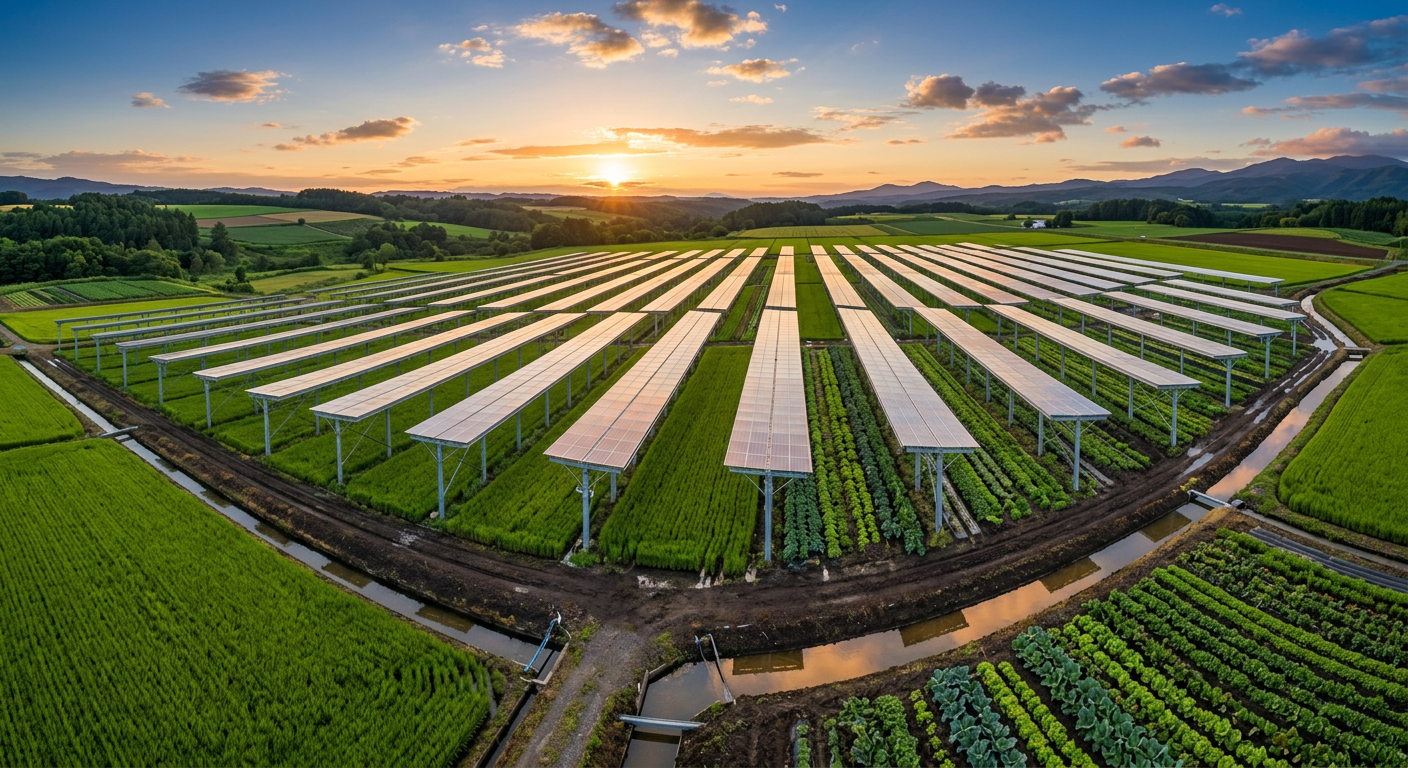
Agrivoltaics refers to the simultaneous use of agricultural land for both crop cultivation and solar power generation, with panels elevated above growing crops. The concept was first proposed in 1981 by German physicist Adolf Goetzberger. Germany, France, and Japan began demonstration projects in the early 2000s. In Korea, pilot projects launched around 2019 — but the legal framework remains incomplete.
1. Why This Moment Is Decisive
Under the national goal of carbon neutrality by 2050, scaling up renewable energy is non-negotiable. Yet South Korea’s geography leaves almost no flat land available for solar deployment without either clearing mountains or converting farmland. Agrivoltaics is virtually the only card that avoids that dilemma.
The Ministry of Agriculture, Food and Rural Affairs (MAFRA) officially codified three principles when it released the “Agrivoltaics Introduction Strategy” in April 2024: (1) farmland preservation, (2) continuous farming, (3) farmer-centered benefit distribution. It also began pursuing an extension of the temporary land use permit from 8 years to 23 years. The Korea Rural Economic Institute (2023) concluded that a minimum 20-year project duration was necessary to achieve investment recovery.
The issue was elevated to a presidential agenda item. In October 2025, under President Lee Jae-myung’s administration, the government announced regulatory reforms at the “Second Core Regulation Rationalization Strategy Meeting.” A three-phase legislative roadmap was announced: enactment of a special act, revision of the Renewable Energy Act, and revision of the Farmland Act — with the Farmland Act revision targeted for completion in the first half of 2026.
2. Farmland Preservation: The Heaviest Weight on the Scale
Farmland is the physical foundation of food security. Once converted, it is nearly impossible to reclaim. In the face of that reality, even proponents of agrivoltaics struggle to raise their voices too loudly.
The central question is whether farming is actually happening. Under current Korean farmland law, installing panels is classified as “temporary use for other purposes” — not recognized as an agricultural activity. This creates a structural incentive for “ghost farming”: panels go up, but actual cultivation is abandoned. As recently as April 2026, cases were reported of agrivoltaic installations with zero power revenue and unfulfilled farming obligations one year after commissioning.
France addressed this through its ministerial decree (Décret n° 2024-318) of April 2024. To qualify as agrivoltaic, the area rendered non-farmable must not exceed 10% of the installation site; soil must remain restorable; and farming must constitute the “primary activity.” Specificity in numbers creates specificity in enforcement.
Korea’s proposed special act (introduced by Rep. Seo Wang-jin and 13 co-authors in August 2025) takes a similar approach — setting a maximum approval period of 30 years while prohibiting the use of farmland-damaging materials, banning cultivation of non-designated crops, and mandating post-installation performance reporting. Farmland preservation is framed as a prerequisite for institutionalization, not merely a regulatory constraint.
3. Social Acceptance: When the Landowner and the Farmer Are Different People
Korea’s most uncomfortable agricultural reality is that landowners and those who actually till the soil are, in many cases, different people. By the 2020s, the national average tenancy rate for rice paddies had exceeded 50% by a wide margin. Restricting agrivoltaic project eligibility to “farming landowners” structurally concentrates benefits with landlords.
The most tangible fear among tenant farmers is rental inflation. When the expected power revenue makes agricultural land more valuable, rents rise — and the people actually farming the land get pushed out. This is not theoretical. It played out in some areas during the expansion of salt-flats solar in 2019.
The government pledged in October 2025 to produce a resolution plan “within the year.” Proposed solutions include allowing tenant farmers to participate as cooperative members in the development project, and routing power revenues into a village community fund. The cooperative model in Yeonggwang, South Jeolla Province, is the flagship example — residents formed a cooperative, combined rice farming with power generation, and distribute revenues as what they call a “sunshine pension.”
Social acceptance does not come without community-level benefit sharing. Expansion without acceptance is just another form of reckless development. As seen in the Gyeonggi Province pilot, the government plans to establish 1 MW-scale community-led agrivoltaic complexes in the metropolitan area to validate the participatory model.
4. Profitability: Numbers That Don’t Lie
For a 100 kW installation, costs run approximately KRW 150–200 million. That is about 1.5 times the cost of rooftop solar, due to the structural requirements: panel height of 3 meters or more, agricultural machinery access lanes, and carefully designed module spacing.
As of August 2025, estimated annual revenue for a 100 kW system: annual generation of approximately 120,000 kWh, at SMP 112.94 KRW and REC 71.85 KRW, yielding annual revenue of approximately KRW 26.61 million. The Korea Environment Institute estimates annual farm household revenue from agrivoltaics at KRW 4–9 million depending on financing conditions and power price support — a wide range that makes conditions decisive.
On crop productivity: data from Jeollanam-do Agricultural Research and Extension Services (2020) shows harvest levels can be maintained above 80% after agrivoltaic installation. With shading rates below 30%, leafy vegetables such as cabbage actually show yield increases. Root vegetables — garlic, onion — are disadvantaged. Crop selection is half the profitability equation.
The biggest variable in profitability is the Renewable Energy Certificate (REC) weighting. Agrivoltaics currently receives REC weightings of 1.5–2.0 in some cases, but the criteria remain opaque. Article 17 of the proposed special act explicitly calls for preferential or newly designated REC weightings. Whether this is realized will determine whether the business case holds.
5. Designing the Framework: Three-Way Balance in Practice
Simultaneously achieving three values inevitably produces regulatory complexity. But the structural logic is simple.
On farmland preservation: legally cap non-farmable area loss at 10%, mandate post-project soil restoration through performance bond mechanisms, and codify clear permit revocation and penalties for ghost farming.
On social acceptance: embed tenant farmer participation pathways (cooperative membership eligibility, revenue-sharing ratios) directly in statutory language. Include provisions preventing landlords from unilaterally terminating lease contracts. Opening a legal pathway for villages to serve as project entities creates durable acceptance.
On profitability: guarantee project terms of 23–30 years, explicitly codify REC weightings, and unify setback distance standards nationwide. And critically — grid connection bottlenecks must be resolved. The Distributed Energy Activation Special Act (effective June 2024) designated distributed energy special zones; applying this priority status to agrivoltaic concentration zones is an administrative linkage that cannot be skipped.
6. Learning from Abroad, Building Something Korean
Japan institutionalized agrivoltaics in 2012 and by 2022 had documented cultivation records for more than 120 crop types. Germany holds the world’s most comprehensive demonstration dataset; field reports document power revenues several times larger than farm income. France elevated agrivoltaics to a national strategy in pursuit of its 40% renewable energy target by 2030, and has built the world’s most precise framework of legal recognition criteria and post-installation management.
The lesson is simple: regulatory specificity. “It must be agrivoltaic” is a declaration. “Non-farmable area must not exceed 10%” is a rule that actually works. The more discretion left to field judgment, the more the institution bends.
Korea’s unique challenge is structural: a high proportion of small-scale and tenant farmers. The agrivoltaic success stories in France and Germany are premised on large-scale owner-operated farms. Transplanting those models directly into Korea produces tenant farmer displacement as a predictable side effect. Designing cooperative-based community participation as the fundamental unit of the institution — not an optional add-on — is the direction a Korean model of agrivoltaics must take.
References
- Ministry of Agriculture, Food and Rural Affairs (MAFRA), “Agrivoltaics Introduction Strategy” Press Release, April 23, 2024
- MAFRA, “Toward Orderly Agrivoltaics Introduction” Press Release, October 16, 2025
- Rep. Seo Wang-jin et al. (14 sponsors), “Special Act on Promotion of Agrivoltaic Power Generation Business” (Bill No. 2212438), August 27, 2025
- National Strategy Portal of Korea, “France’s Agrivoltaics Regulatory Framework,” August 2024
- Kim & Chang Law Office, “France’s Agrivoltaics Regulatory Framework” Newsletter, 2024
- Korea Environment Institute, Economic Analysis of Agrivoltaics
- Korea Rural Economic Institute, Economic Analysis of Agrivoltaics, 2023
- Jeollanam-do Agricultural Research and Extension Services, Agrivoltaic Crop Demonstration Data, 2020
- Environmental Policy (환경정책) Vol. 33 No. 2, Agrivoltaics Acceptance Study, June 2025
- Energy and Space Research Institute, “Various Agrivoltaic Business Models for Rural Energy Transition,” 2025
- KIFC (Korea Institute of Food and Climate), “Agrivoltaics Grid Bottleneck,” May 8, 2026
- KTV National Broadcasting, “Agrivoltaics Regulatory Reform for Farm Income and Renewable Energy,” October 26, 2025
- Décret n° 2024-318 du 8 avril 2024 relatif au développement de l’agrivoltaïsme (France)
- LOI n° 2023-175 du 10 mars 2023 relative à l’accélération de la production d’énergies renouvelables (France)