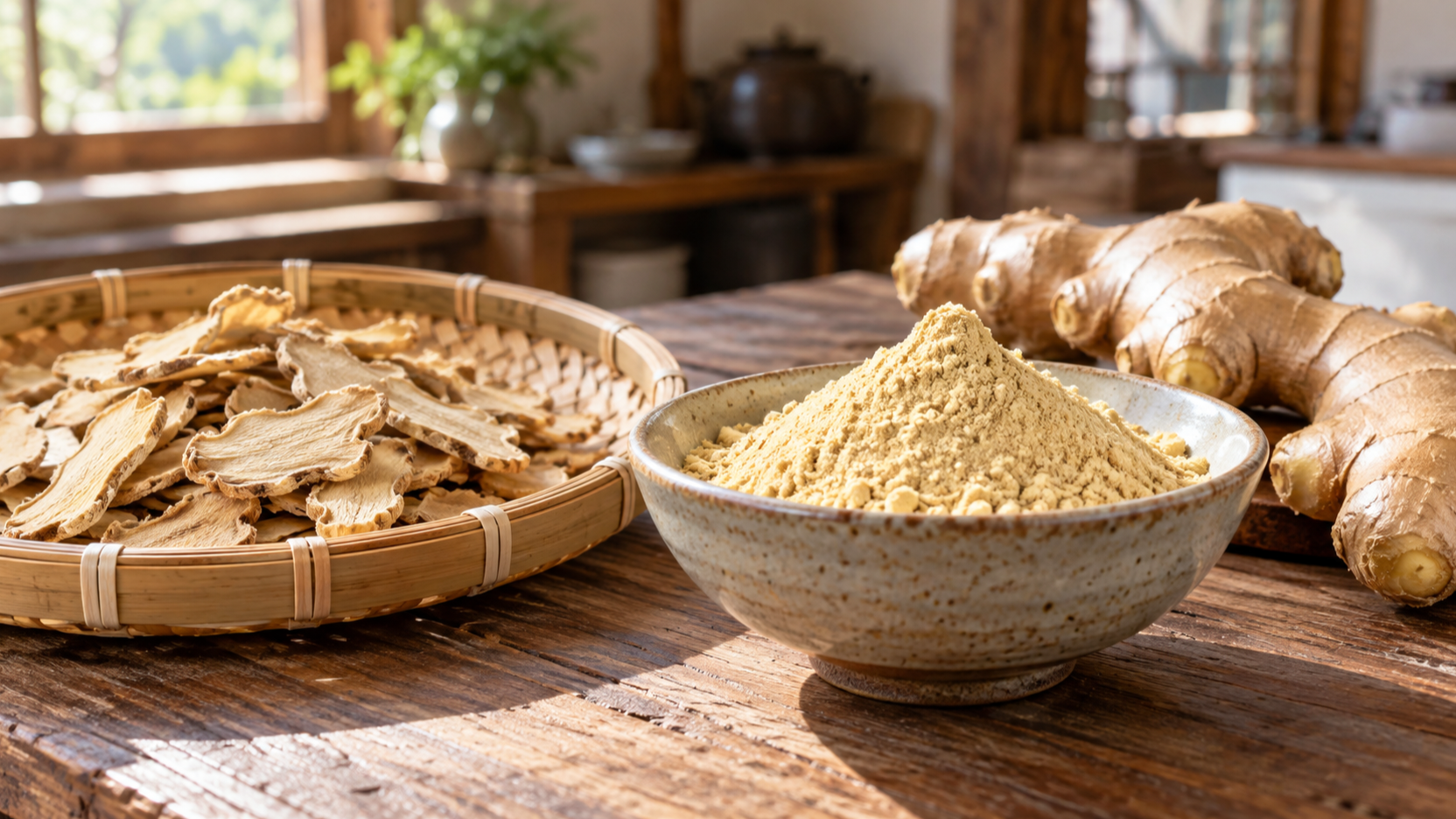
Using KAMIS domestic ginger wholesale prices for October 16, 2026, this post estimates the raw-material cost of 1 kg of homemade ginger powder, compares retail Korean ginger powder, calculates powder yield from official moisture data, and covers drying, steamed ginger powder, storage, and the permit and labelling rules for farmers.
A 10 kg box of new-crop Korean ginger has dropped to around KRW 60,000. After making ginger syrup, many households still have small, knobby ginger left over, and the thought follows: dry it, grind it and have a year’s worth of powder. But domestic ginger powder sells for a few thousand won per 100 g. Is homemade actually cheaper, and how much powder does 10 kg make?
Bottom line: Drying and grinding 10 kg of fresh ginger yields at most about 1.3 kg of powder. That follows from the national food composition table: fresh ginger is 88.2% water and ginger powder is 6.8%. At the KAMIS five-city average wholesale price of KRW 55,640 for 10 kg of top-grade domestic ginger on October 16, 2026, the raw material for 1 kg of powder costs about KRW 44,000. Domestic ginger powder on Coupang starts at roughly KRW 30,000–40,000 per kg. On cost alone it is a draw, or buying wins. Making it yourself pays off when you use leftover or lower-grade ginger that would otherwise go to waste.
Earlier notes: see new-crop ginger price and harvest time 2026, homemade ginger syrup cost, and ginger price and storage strategy. Drying equipment is covered in how to choose a food dehydrator.
1. What does 10 kg of ginger cost today?
KAMIS wholesale prices (intermediary wholesalers) for domestic ginger, 10 kg, in KRW:
| City | Top grade (Oct 16) | Top grade (Sep 16) | Top grade (Oct 16, 2025) | Mid grade (Oct 16) |
|---|---|---|---|---|
| Seoul | 61,600 | 61,600 | 71,300 | 49,300 |
| Daegu | 58,300 | 68,300 | 75,000 | 50,000 |
| Gwangju | 57,300 | 63,600 | 80,600 | 48,600 |
| Busan | 52,000 | 67,000 | 71,000 | 42,000 |
| Daejeon | 49,000 | 75,400 | 74,000 | – |
| Five-city average | 55,640 | 67,180 | 74,380 | – |
The top-grade average fell 17.2% in a month and is 25.2% below a year earlier, as new-crop ginger arrived. Mid grade averaged KRW 47,475 across four cities. Shape and size do not matter for powder, so mid grade is fine. Imported ginger (mid grade) was KRW 80,600 in Seoul, higher than domestic. Daily prices are on /en/prices/ginger/.
2. How much powder does 10 kg of ginger make?
I found no official yield figure for ginger powder, but the national food composition table gives the moisture content:
| Item | Water per 100 g | Source |
|---|---|---|
| Ginger, domestic, raw | 88.2 g | National food composition table (2015) |
| Ginger, imported, raw | 89.0 g | National food composition table |
| Ginger powder | 6.8 g | National food composition table (2019) |
At 88.2% water, 10 kg of ginger holds 1.18 kg of solids. Dried to powder-level moisture (6.8%), that is about 1.27 kg. Using the roughly 83% water figure from a National Institute of Agricultural Sciences leaflet, it is about 1.8 kg. Peeling, trimming and losses while grinding and sieving come off that. A realistic home figure is a little over 1 kg per 10 kg, or 100–130 g per kilogram of fresh ginger. This is a calculation, not a measured yield.
Raw-material cost of 1 kg of powder
| Ginger (KAMIS, Oct 16) | 10 kg price | Per kg of powder (1.27 kg yield) | Per kg (1.8 kg yield) |
|---|---|---|---|
| Domestic top grade, five cities | 55,640 | about 43,800 | about 30,900 |
| Domestic mid grade, four cities | 47,475 | about 37,400 | about 26,400 |
Wholesale prices are what intermediaries charge retailers, so a household buying direct or online will usually pay the same or more, plus electricity and time.
3. What does retail domestic ginger powder cost?
From a Coupang Partners product search on October 18, for powders labelled domestic, converted to 1 kg:
| Product (pack size) | Price | Per kg |
|---|---|---|
| Domestic A-grade powder, 500 g (Bongdong) | 18,280 | about 36,600 |
| Domestic ginger powder, 300 g | 12,060 | about 40,200 |
| Domestic ginger powder, 200 g | 22,400 | 112,000 |
Even among domestic products, the per-kg price varies threefold. Small packs, steamed powder and organic labels cost more. A plain “ginger powder” listing with no origin may be imported, so check the origin field first.
Import rules have changed. According to Nongmin Shinmun (December 2023), the general tariff on ginger is 377.3%, but from January 2024 the Korea–Vietnam FTA removed tariffs on Vietnamese dried ginger, whole and ground. Korea imported 1,340 tonnes of dried ginger in 2022, 89% from Peru, and the same article put dried ginger at about KRW 30,000 per kg for domestic versus about KRW 10,000 for Peruvian. Very cheap powder is worth checking for imported raw material.
4. How to dry and grind ginger at home.
I found no official Rural Development Administration method specifying slice thickness, temperature and time, so here the research findings and the general steps are kept separate.
- Wash off the soil and cut away damaged or mouldy parts. Scrape off the skin with a spoon, or leave it on; skin-on powder is darker.
- Slice thinly, about 2–3 mm. Thick slices dry slowly in the middle and mould easily.
- Spread the slices in one layer on dehydrator trays and swap trays halfway.
- Dry until a slice snaps cleanly. If it bends, it is not dry. Underdried ginger clumps in the grinder and moulds in storage.
- Cool completely, grind, and sieve. Regrind what stays in the sieve.
On temperature, a 2019 study by researchers at Hankyong National University and Ewha Womans University (Korean Journal of Food Science and Technology) dried 5 mm ginger pieces in hot air at 60°C and 80°C for 1–4 hours. Gingerol and shogaol contents peaked at 60°C for 2 hours and fell with longer drying. That was a compositional experiment, not drying to powder dryness. A 2023 study found little difference in basic composition between hot-air, freeze and microwave-vacuum dried ginger powders, with hot-air powder the darkest. For home use, a fair summary is to dry at around 60°C until crisp, without long periods at high heat.
What is steamed ginger powder?
It is ginger that is steamed, then dried and ground. The Gyeongbuk Agricultural Research and Extension Services reported in a 2021 patent filing that steaming and drying ginger seven times raised gingerol from 332.7 mg/L to 479.1 mg/L. Chungnam’s extension service reported in 2020 that pressure-heating ginger syrup above 110°C for 1–2 hours gave about five times the shogaol. I found no RDA research backing sellers’ claims that steamed powder has “several times more shogaol”. Look for a test certificate in the product details before trusting such numbers.
Storing ginger powder
I found no Korean official guidance on storing ginger powder. Texas A&M AgriLife Extension advises keeping ground spices, ginger included, in tightly closed containers away from light, heat and moisture, where they keep best quality for 2–4 years. Avoid the spot next to the stove. Powder that was not fully dry will not last that long.
Fresh ginger is different. A National Institute of Agricultural Sciences leaflet says ginger suffers chilling injury below 10°C and sprouts above 18°C, and storage at 13°C and 95% humidity cut red mould by an average of 58% compared with 5°C and 70%. A home fridge is too cold, so ginger you cannot use within a few weeks is better dried into powder quickly.
5. For growers: can you sell lower-grade ginger as powder?
During the October–November harvest, prices drop and small or damaged ginger is hard to sell at a fair price, so some growers consider powder. Check the permit question first.
- Article 25 of the Enforcement Decree of the Food Sanitation Act exempts produce that is only cut, peeled, dried, salted, aged or heated, without additives or other ingredients, from business registration. Grinding is not on that list.
- The Korean Food Code lists ginger as a spice plant and classifies spice plants processed into powder as “natural spice”, a separate processed food type.
- So dried ginger slices may fall within the exemption, but ginger powder is likely to require registration as a food manufacturing business or an on-site manufacturing-and-sales business. A Chuncheon public health official has said that drying and grinding red pepper counts as manufacturing. I found no Ministry of Food and Drug Safety ruling on ginger powder itself, so check with the city or county food hygiene office before starting.
- For origin labelling, if one ingredient is 98% or more of the product, only that ingredient’s origin is required, for example “ginger (Korea)” on a 100% ginger powder.
| Option | Fits when | Check |
|---|---|---|
| Sell fresh right after harvest | High share of top grade, a buyer lined up | Oct 16 top grade 10 kg average KRW 55,640 |
| Store, then sell | Curing and cool storage (12–14°C, 90%+ humidity) available | Storage cost, losses, December price pattern |
| Sell dried slices | Many small or blemished roots, a dryer on hand | Whether it stays within simple drying; weight falls to about 1/8 |
| Sell powder | You have or can get a processing registration | Registration, origin label, competing at KRW 30,000–40,000 per kg |
Powder competes with domestic products at KRW 30,000–40,000 per kg. If 10 kg of top-grade ginger (KRW 55,640) gives 1.27 kg of powder, raw material alone exceeds KRW 40,000 per kg. Turning top-grade ginger into powder does not pay. It only makes sense for ginger that would not sell well fresh.
6. Checklist.
- Domestic top-grade ginger, 10 kg: five-city average KRW 55,640 on October 16, 25% below a year earlier.
- 10 kg of fresh ginger makes at most about 1.3 kg of powder (88.2% to 6.8% water).
- Raw material per kg of powder: about KRW 44,000 with top grade, about KRW 37,000 with mid grade.
- Retail domestic ginger powder starts at about KRW 30,000–40,000 per kg. Check the origin field first.
- Slice 2–3 mm, dry until slices snap, cool, then grind.
- Store powder airtight, away from light, heat and moisture.
- Growers should confirm with the local office whether powder needs a business registration.
7. Conclusion.
Ginger powder keeps only about one-eighth of the fresh weight. Buying top-grade ginger to make powder costs as much as or more than buying domestic powder. The point of making it at home is to turn leftover and lower-grade ginger into a year’s supply instead of throwing it away. When buying, compare origin and the per-kg price together. Growers should check the permit rules first.
References
- Korea Agro-Fisheries & Food Trade Corporation (aT) KAMIS, domestic and imported ginger 10 kg wholesale prices (October 16, 2025; September 16 and October 16, 2026).
- Rural Development Administration, National Institute of Agricultural Sciences, Korean Food Composition Table (ginger, raw, domestic and imported; ginger powder).
- RDA Nongsaro and National Institute of Agricultural Sciences, ginger storage leaflet (posted September 19, 2022).
- Ko et al. (Hankyong National University, Ewha Womans University), gingerol and shogaol content by hot-air drying temperature and time, Korean Journal of Food Science and Technology 51(5), 2019.
- Study comparing hot-air, freeze and microwave-vacuum dried ginger powder, Journal of the Korean Society of Food Science and Nutrition 52(9), 2023.
- Kyongbuk Maeil, Gyeongbuk extension service steamed ginger patent filing, April 11, 2021. NewsTnT, Chungnam extension service ginger syrup pressure-heating research, December 17, 2020.
- Enforcement Decree of the Food Sanitation Act, Article 25; Ministry of Food and Drug Safety, Korean Food Code (spice products); Enforcement Decree of the Act on Origin Labelling of Agricultural and Fishery Products, Article 3.
- MS TODAY, Chuncheon public health center on red pepper powder registration, November 15, 2023.
- Nongmin Shinmun, Korea–Vietnam FTA dried ginger tariff removal, December 12, 2023.
- Texas A&M AgriLife Extension, “Storing Dried Herbs and Spices”, 2025.
- Coupang Partners product search prices, October 18, 2026. Discounts and coupons change daily.