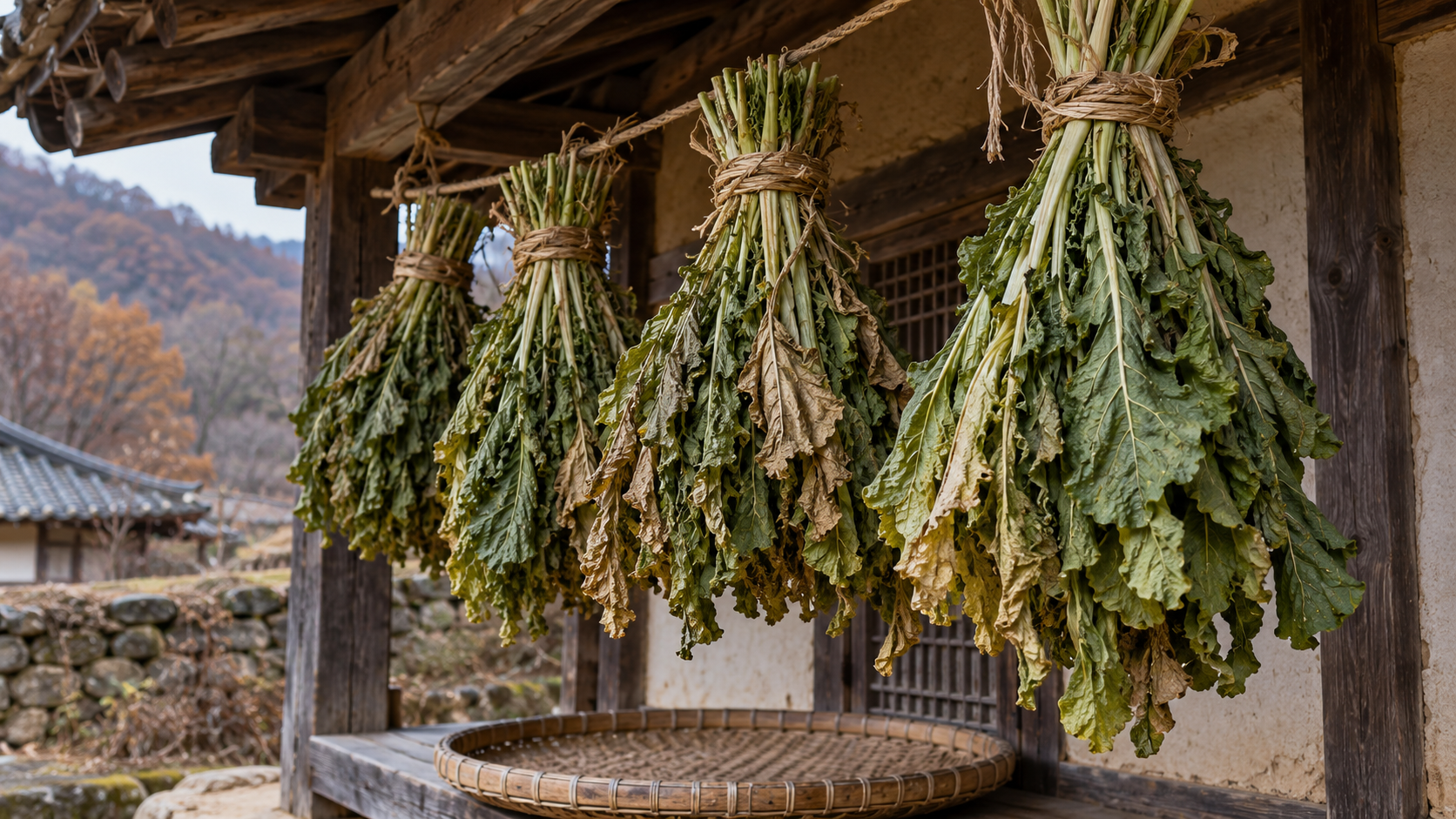
How to turn kimchi-radish tops into siraegi (dried radish greens) using Korea's Rural Development Administration guidance: when to cut, how to hang and dry in shade, avoiding mold, boiling for 25–30 minutes, storing dried and boiled siraegi, how it differs from dried radish strips, and KAMIS 20 kg radish prices on October 22, 2026.
Pull the kimchi radishes in November and you are left with an armful of green tops. Thrown away, they are waste; hung up, they become soup greens all winter. On Naver, “siraegi” is searched 11,470 times a month, up from 9,810 earlier this month as kimchi season approaches. Radishes also cost more than last year. This note follows Korea’s Rural Development Administration (RDA) guidance to turn radish tops into siraegi.
Bottom line: Radish tops cut in October–December, ideally after frost, are best; hang them in shade with good airflow, out of direct sun. Humidity brings mold. Soak dried siraegi, then boil it for 25–30 minutes (RDA). Freeze boiled siraegi with a little water left in it. On October 22, 2026, KAMIS radish (highland, top grade, 20 kg) averaged KRW 17,940 across five cities, 32.9% above the same day last year (KRW 13,500).
Earlier notes: Salted cabbage 20 kg price 2026 and kimchi cost 2026. Daily radish prices are on the radish price page.
1. When to cut the greens
The RDA webzine says to collect radish tops between October and December, and that tops that have been through frost are better. That matches kimchi-radish harvest. In KAMIS data, the 2025 autumn-radish survey started on November 10–12 depending on the city; radishes on the market in late October are highland radishes. Cut the tops just above the root, and remove yellowed or insect-damaged leaves first.
2. How to dry them
The RDA recommends a place “with good ventilation where sunlight does not shine directly”, such as a plastic greenhouse or an apartment balcony.
- Tie small bundles at the stems and hang them upside down from a line or under the eaves.
- Keep bundles small; large bundles stay wet in the middle and rot.
- Keep them out of the rain.
- Leave space between bundles.
Hung in moving air, they freeze and thaw through winter and dry naturally (RDA webzine). Drying time depends heavily on weather and humidity, and we found no official number of days. They are done when leaves crumble and stems snap without moisture.
3. Siraegi vs dried radish strips
Siraegi is the dried leaves and stems; mumallaengi is the root cut into strips and dried. Strips dry best spread in a single layer on a rack or hanging mesh dryer rather than hung in bundles.
4. Boiling
Soak dried siraegi well first. There is no official soaking time; a Segye Ilbo recipe (October 14, 2026) suggests at least 6 hours in cold water. The RDA webzine says:
| Item | RDA webzine |
|---|---|
| Boiling time | 25–30 minutes |
| Salt | A little keeps the color |
| Pressure cooker | Fine to use; weigh the greens down so they do not float |
Cool, rinse, peel tough stem skins, squeeze out water and cut.
5. Storage
| State | Storage |
|---|---|
| Dried siraegi | In a box in the shade; for longer storage, sealed in plastic in the fridge |
| Boiled siraegi | Sealed and frozen, with a little water left in so it does not turn tough |
High humidity can make even dried siraegi mold or rot.
6. Radish prices this year
KAMIS radish (highland, top grade, 20 kg), intermediate wholesaler prices:
| City | Oct 22, 2026 | Oct 22, 2025 | Change |
|---|---|---|---|
| Seoul | KRW 23,000 | KRW 14,600 | +57.5% |
| Busan | KRW 17,000 | KRW 12,500 | +36.0% |
| Daegu | KRW 17,300 | KRW 13,600 | +27.2% |
| Gwangju | KRW 16,700 | KRW 15,200 | +9.9% |
| Daejeon | KRW 15,700 | KRW 11,600 | +35.3% |
| 5-city average | KRW 17,940 | KRW 13,500 | +32.9% |
The Seoul monthly average for October 2026 (through the 22nd) was KRW 22,950, 50.2% above October 2025 (KRW 15,278), though the five-city average is down 13.8% from KRW 20,800 on October 1. On October 23, a 1 kg box of dried siraegi from the Yanggu-gun co-op listed at KRW 22,900 on Coupang. Radish tops come free with the radishes.
7. Growers selling siraegi
Start the day you pull the radishes: cut the tops and hang them in shade, since piled tops spoil from the inside. Keep bundle sizes even and dry them under cover. Drying cuts the weight sharply, but we found no official fresh-to-dried ratio; weigh one bundle before and after to set your own ratio before pricing 1 kg boxes.
8. FAQ
How many days does siraegi take to dry? It depends on weather; there is no official figure. It is done when leaves crumble and stems snap dry.
How long should I boil it? Soak well, then boil 25–30 minutes (RDA).
How do I freeze boiled siraegi? Seal it with a little water left in; squeezing it bone-dry makes it tough.
References
- RDA webzine, February 2022, “Siraegi, a winter vitamin store” (harvest timing, drying location, boiling time, storage): rda.go.kr
- Segye Ilbo, October 14, 2026, siraegi soybean-paste soup recipe (soaking time): segye.com
- aT KAMIS period wholesale (intermediate wholesaler) prices via data.go.kr: radish (highland) top grade 20 kg, five cities, October 22, 2025, and October 1 and 22, 2026; 2025 start dates of the autumn-radish survey.
- aT KAMIS monthly wholesale prices via data.go.kr: radish (highland) top grade 20 kg, Seoul, October 2025 and October 2026.
- Naver Search Ad keyword tool monthly searches (checked October 23, 2026).
- Coupang listing, “Yanggu Punchbowl dried siraegi 1 kg” (October 23, 2026; prices change often).