A practical 2026 ginger market and storage guide for deciding whether to sell now, hold in cold storage, or split the crop by quality grade.
After harvest, ginger growers face a hard question. Should the crop be sold now, or should it be stored and sold later?
The answer is not simple. Ginger can be stored, but storage is not free. Weight loss, decay, grading loss, electricity, labor, and cold-room cost can erase the benefit of a higher future price.
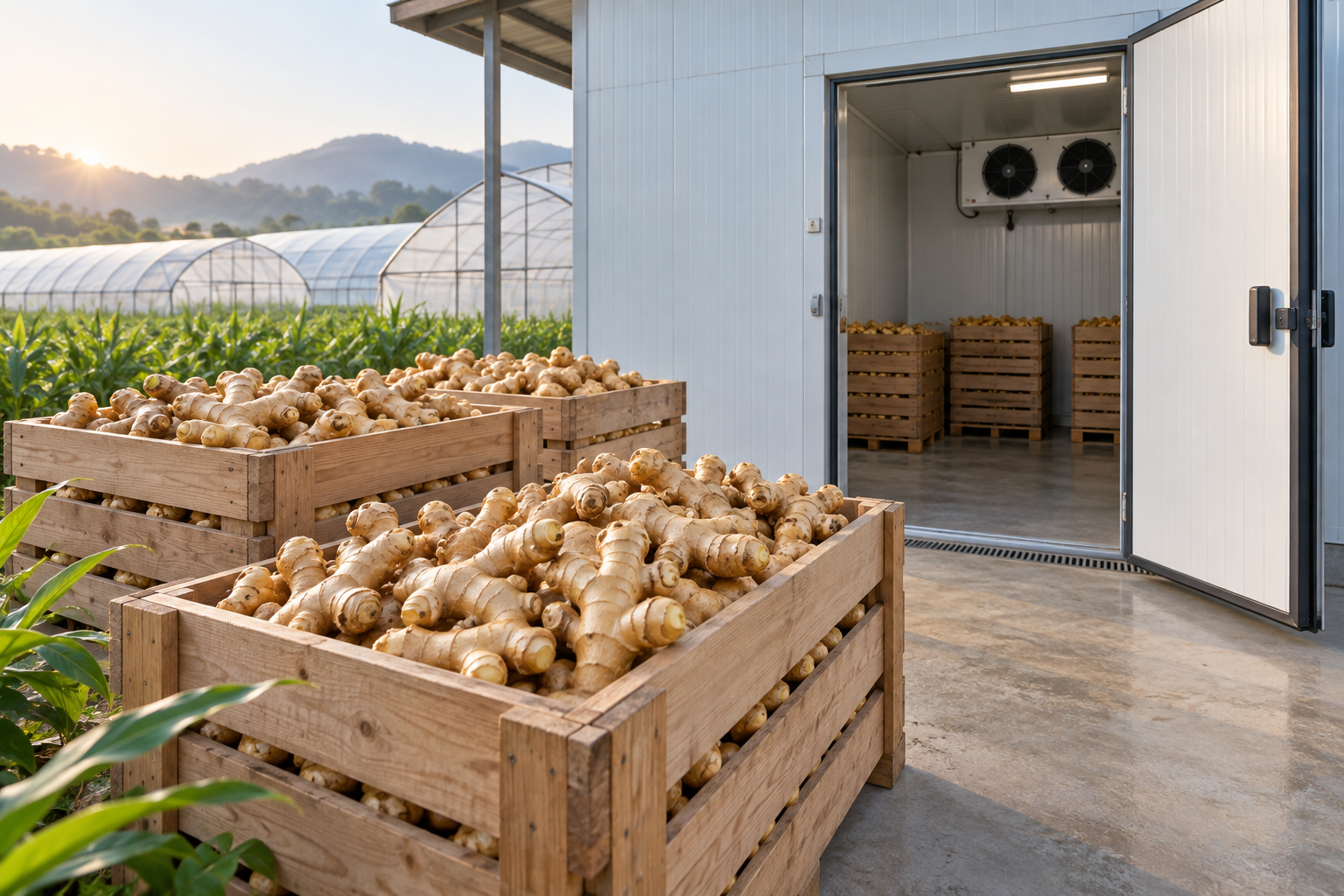
How to read the current ginger price
Based on the IMUN.FARM price table, the Seoul Garak market reference price for ginger on September 21, 2026 is shown below. The table uses KAMIS-style item and unit references as a planning benchmark, so actual farm-gate settlement prices can differ.
| Item | Unit | Sep. 21 price | 30-day average | 30-day range | 30-day trend |
|---|---|---|---|---|---|
| Korean ginger, A grade | 10kg | 70,200 KRW | 71,140 KRW | 68,700 to 73,500 KRW | -1.8% |
| Imported ginger, B grade | 10kg | 90,500 KRW | 91,990 KRW | 88,700 to 96,000 KRW | -4.3% |
The table suggests a slightly weak short-term market. Korean A-grade ginger is a little below its 30-day average, and imported B-grade ginger also shows a weaker 30-day trend.
Ginger prices still depend heavily on quality, washing condition, storage condition, local supply, and seasonal demand. A single price is not enough. Three questions matter more.
- Can your ginger still sell as A-grade quality?
- Can the crop survive storage loss and decay?
- How much must the price rise to cover storage cost?
Some ginger should be sold quickly
Storage only works for good-quality ginger. If rhizomes are damaged, wet, soft, or uneven, time may not help. Waiting for a higher price can reduce the marketable grade first.
Fast sale should be considered for these lots.
- Ginger with many harvest wounds.
- Ginger with excess surface moisture or mud.
- Ginger showing soft or decayed spots.
- Lots with a high share of uneven or lower-grade pieces.
- Lots that must be stacked too tightly in the storage room.
- Contracted volume with an acceptable confirmed price.
For these lots, reducing loss may be more important than waiting for a price rebound. Produce storage is not only a price game. It is a quality-preservation game.
When storage can make sense
Storage becomes more reasonable when the ginger is firm, well-cured, clean enough, and likely to remain in a high grade after storage.
| Factor | Favorable storage condition |
|---|---|
| Quality | Firm ginger with few wounds and little softness |
| Grading | A-grade and lower-grade lots can be separated |
| Volume | Boxes can be stored with airflow space |
| Sales channel | A future buyer or channel is somewhat clear |
| Cash flow | The farm does not need immediate cash for all volume |
| Price upside | Expected price gain can exceed storage loss and cost |
The most important point is the sales channel. Putting ginger into cold storage does not automatically create a buyer. If the price improves but no sales route is ready, the farm may still miss the opportunity.
How much must the price rise?
A simple example helps. Suppose the current Korean A-grade ginger price is 70,200 KRW per 10kg box. A farm stores 100 boxes, or 1,000kg.
Current sales value is:
70,200 KRW × 100 boxes = 7,020,000 KRW
Storage analysis must include more than the future price. Weight loss, decay, grading loss, electricity, room cost, and extra labor must be deducted.
Assume that one month of storage reduces the marketable A-grade volume by 5%, and storage-related cost is 200,000 KRW.
| Future price | Marketable boxes | Sales value | Gain before storage cost | After 200,000 KRW cost |
|---|---|---|---|---|
| 72,000 KRW | 95 boxes | 6,840,000 KRW | -180,000 KRW | -380,000 KRW |
| 75,000 KRW | 95 boxes | 7,125,000 KRW | 105,000 KRW | -95,000 KRW |
| 78,000 KRW | 95 boxes | 7,410,000 KRW | 390,000 KRW | 190,000 KRW |
| 80,000 KRW | 95 boxes | 7,600,000 KRW | 580,000 KRW | 380,000 KRW |
In this example, the price must rise to around 78,000 KRW per 10kg box before storage starts to pay. That is roughly an 11% increase from 70,200 KRW. If storage loss rises to 8%, or if storage cost is higher, the break-even price rises again.
Before storing, do not ask only whether the price may rise. Ask what price is needed to win.
Cold storage is not a magic box
A cold room does not make all produce safe. Ginger needs careful handling of moisture, airflow, and temperature. Crop storage conditions differ by item, and Korean rural extension materials also separate produce by temperature and humidity needs.
Ginger storage needs caution in these areas.
- Wet ginger stored too tightly can decay.
- Wounded ginger can spread problems to nearby boxes.
- Boxes stacked without airflow can trap heat and humidity.
- Temperature alone is not enough; condensation and humidity matter.
- Mixing with high-ethylene crops such as apples or melons is usually not ideal.
A farm cold room is not just a cold box. It is a small climate. Door opening, box spacing, airflow, floor moisture, and grading quality all affect the final selling price.
A five-step decision process
1. Confirm the actual price you can receive
Market tables are benchmarks. Your actual price depends on grade, volume, buyer, transport, and settlement method.
2. Separate A-grade, B-grade, and damaged lots
Do not store everything as one pile. A-grade lots may be storage candidates. Lower-grade lots may need faster turnover.
3. Use conservative storage-loss assumptions
A zero-loss storage plan looks nice on paper. Real farming does not work that way. For a first storage decision, model 5% and 10% loss cases.
4. Set a break-even target price
Use current price, expected marketable volume, and storage cost to set the target. If the target is too high, storage becomes speculation.
5. Consider storing only part of the crop
The choice is not only all sell or all store. Storing only the best lots and selling lower-grade lots early is often the more practical farm decision.
Split the crop into strategy groups
| Lot type | Suggested strategy | Reason |
|---|---|---|
| Firm A-grade ginger | Consider partial storage | It can benefit from a later price increase |
| B-grade ginger | Sell faster or use a separate channel | Storage rarely upgrades quality |
| Damaged or soft ginger | Process, direct-sell, or move quickly | Storage loss can grow quickly |
| Contracted volume | Honor the agreed price | Trust can matter more than timing |
| Cash-flow volume | Sell part immediately | Reduces operating pressure |
Produce prices are difficult to predict. Splitting the crop is risk management.
IMUN.FARM’s current reading
On September 21, 2026, IMUN.FARM’s reference for Korean A-grade ginger is 70,200 KRW per 10kg box, while the 30-day average is 71,140 KRW. The current price is slightly below the recent average. Imported B-grade ginger also shows a weaker 30-day trend.
Based on those numbers, full storage is not the safest default. Grading and split strategy look more practical.
- Store only the strongest A-grade lots if storage conditions are good.
- Move B-grade and damaged lots faster.
- Set a target price near the break-even point before storing.
- Do not keep storing if the market fails to reach that target.
- Recalculate storage loss and cost every week.
Good storage is not blind waiting. It is waiting with a written break-even price, separated grades, and a ready sales channel.
References
- aT KAMIS agricultural market information and wholesale price reference structure.
- IMUN.FARM
/prices/produce price table data. - Rural Development Administration materials on fruit and vegetable storage temperature and humidity.
- Han전ON agricultural electricity tariff information and agricultural cold-storage electricity-use categories.
- IMUN.FARM,
Agricultural cold-storage electricity cost calculation for 3, 5, and 10 pyeong units. - The calculation in this article uses the IMUN.FARM September 21, 2026 reference price and a 100-box storage example. Actual prices, storage loss, electricity cost, room cost, and settlement terms can vary by region, quality, buyer, and contract.