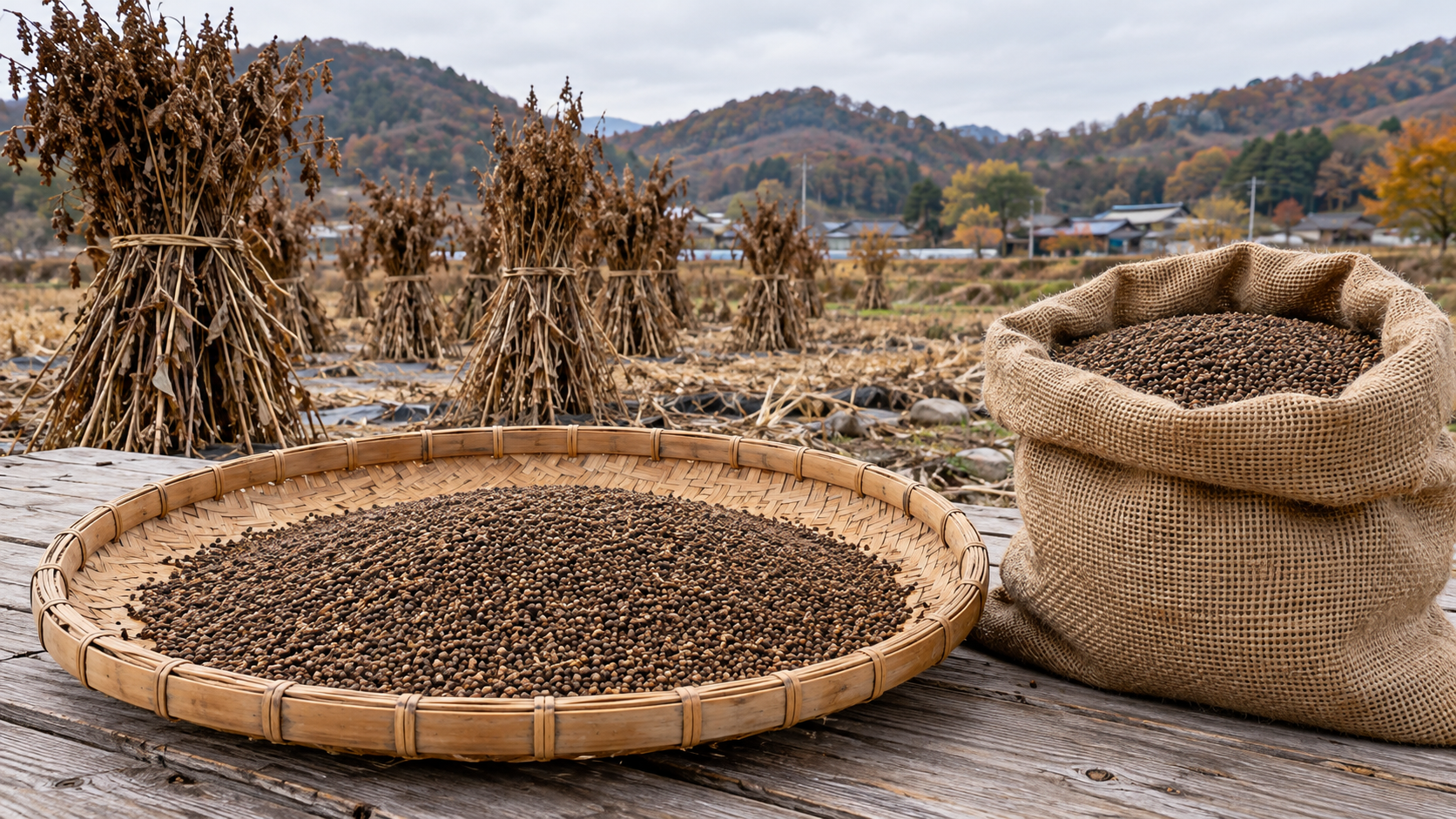
KAMIS data as of October 23, 2026: domestic and imported perilla seed wholesale prices per kilogram and per "mal" (5–6 kg), the trend since late September, and how October prices moved into November over 11 years.
By the last week of October, Korean perilla threshing is nearly done. Sacks line up outside oil mills, and direct-sale listings fill with one question: what does a “mal” of this year’s perilla cost? Buyers want to know whether they paid too much. Growers want to know whether they should have waited. Both answers start from the same two numbers: this week’s wholesale price, and how prices moved from October into November in past years.
Bottom line: In the KAMIS survey on October 23, 2026, domestic perilla seed (top grade, 23 kg) averaged KRW 380,800 at wholesale across five cities, about KRW 16,560 per kilogram. Only Gwangju moved in the past ten days, slightly down. Prices are 9.8% higher than a year earlier. Over the past 11 years, Seoul prices rose an average of only 0.9% from October to November. There is little evidence that waiting a month changes much.
Earlier records: late September and mid-October (new crop).
1. Wholesale price this week
| City | 23 kg, KRW (Oct 23) | Per kg | A year earlier | Change |
|---|---|---|---|---|
| Daegu | 397,000 | 17,261 | 355,000 | +11.8% |
| Busan | 380,000 | 16,522 | 337,000 | +12.8% |
| Gwangju | 377,000 | 16,391 | 343,000 | +9.9% |
| Daejeon | 376,000 | 16,348 | 359,000 | +4.7% |
| Seoul | 374,000 | 16,261 | 340,000 | +10.0% |
The five-city average is KRW 380,800, against KRW 346,800 on October 23, 2025. Gwangju was the only city to change this week: it rose to 382,000 on October 6, then eased to 381,000 on the 21st and 377,000 on the 23rd. Seoul has stayed at 374,000 since June. Perilla wholesale prices move in steps and can hold for weeks or months. Daily prices are on the perilla seed price page.
2. Trend since late September
| Survey date | Domestic 23 kg avg | Per kg | Imported 45 kg avg | Per kg |
|---|---|---|---|---|
| Sep 29 | 376,600 | about 16,370 | 295,800 | about 6,570 |
| Oct 16 | 381,800 | about 16,600 | 293,000 | about 6,510 |
| Oct 23 | 380,800 | about 16,560 | 290,200 | about 6,450 |
Domestic perilla is 1.1% above late September and 0.3% below mid-October. The new crop neither pushed prices down nor lifted them. Imported perilla (mid grade, 45 kg) eased as Busan, Daejeon and Gwangju cut prices in mid-October, but it is still 13.6% above a year earlier. Imported perilla costs about 39% of domestic per kilogram.
3. What a “mal” costs
Direct sellers still quote by the “mal,” a traditional volume unit. Some sell it as 5 kg, others as 6 kg. At KRW 16,560 per kilogram, a 5 kg mal is about KRW 83,000 at wholesale and a 6 kg mal about KRW 99,000. A higher direct-sale price usually includes cleaning, packing and shipping. A much lower one deserves a second look at crop year, cleaning and origin.
4. Buyers: is November any cheaper?
Seoul monthly averages from 2015 to 2025 show that the gap between October and November was mostly within about 6%. What matters more is the crop year (much “domestic perilla” on sale is still from 2025), how clean the seed is, and storage. Perilla is rich in oil and goes rancid in warm rooms, so keep what you will not press soon in an airtight container somewhere cool.
5. Growers: does holding into November pay?
| Crop year | October avg | November avg | Change |
|---|---|---|---|
| 2015 | 196,429 | 190,000 | −3.3% |
| 2016 | 180,000 | 180,000 | 0.0% |
| 2017 | 158,000 | 153,091 | −3.1% |
| 2018 | 205,000 | 228,977 | +11.7% |
| 2019 | 247,429 | 236,619 | −4.4% |
| 2020 | 292,500 | 302,500 | +3.4% |
| 2021 | 320,895 | 336,818 | +5.0% |
| 2022 | 311,000 | 292,000 | −6.1% |
| 2023 | 255,000 | 256,909 | +0.7% |
| 2024 | 271,900 | 273,143 | +0.5% |
| 2025 | 340,000 | 358,000 | +5.3% |
November was higher in six years, lower in four and flat in one, with an average change of +0.9%. Only 2018 rose more than 10%. This year starts high: Seoul’s October price of KRW 374,000 is already above last November’s average. Holding also has costs. Seed that is not dried to about 10% moisture heats and molds in the sack. A practical approach is to finish drying first, sell through regular buyers into early November, and, if you have cool, dry storage, keep part of the crop to decide on in December.
City gaps matter more than timing: the same 23 kg sells for KRW 397,000 in Daegu and 374,000 in Seoul. Compare markets with transport costs in the market sales calculator.
6. Conclusion
Late-October perilla prices barely moved after the new crop arrived. They remain about 10% higher than a year ago, while imported perilla eased slightly. Buyers gain little by waiting for November; growers gain little by holding a month. Drying, cleaning and the right buyer matter more than the calendar.
References
- Korea Agro-Fisheries & Food Trade Corporation (aT) KAMIS, daily wholesale (intermediate wholesaler) prices via data.go.kr: domestic perilla seed top grade 23 kg, imported mid grade 45 kg, five cities, October 23, 2025; September 29, October 16 and October 23, 2026.
- aT KAMIS monthly average prices via data.go.kr: Seoul domestic perilla seed, October 2015 to October 2026.
- Jeonbuk Agricultural Research and Extension Services guidance on drying perilla to about 10% moisture for storage.
- Per-kilogram figures divide KAMIS wholesale prices by unit weight and are not farm-gate or retail prices. The October 2026 monthly figure covers data through October 23.