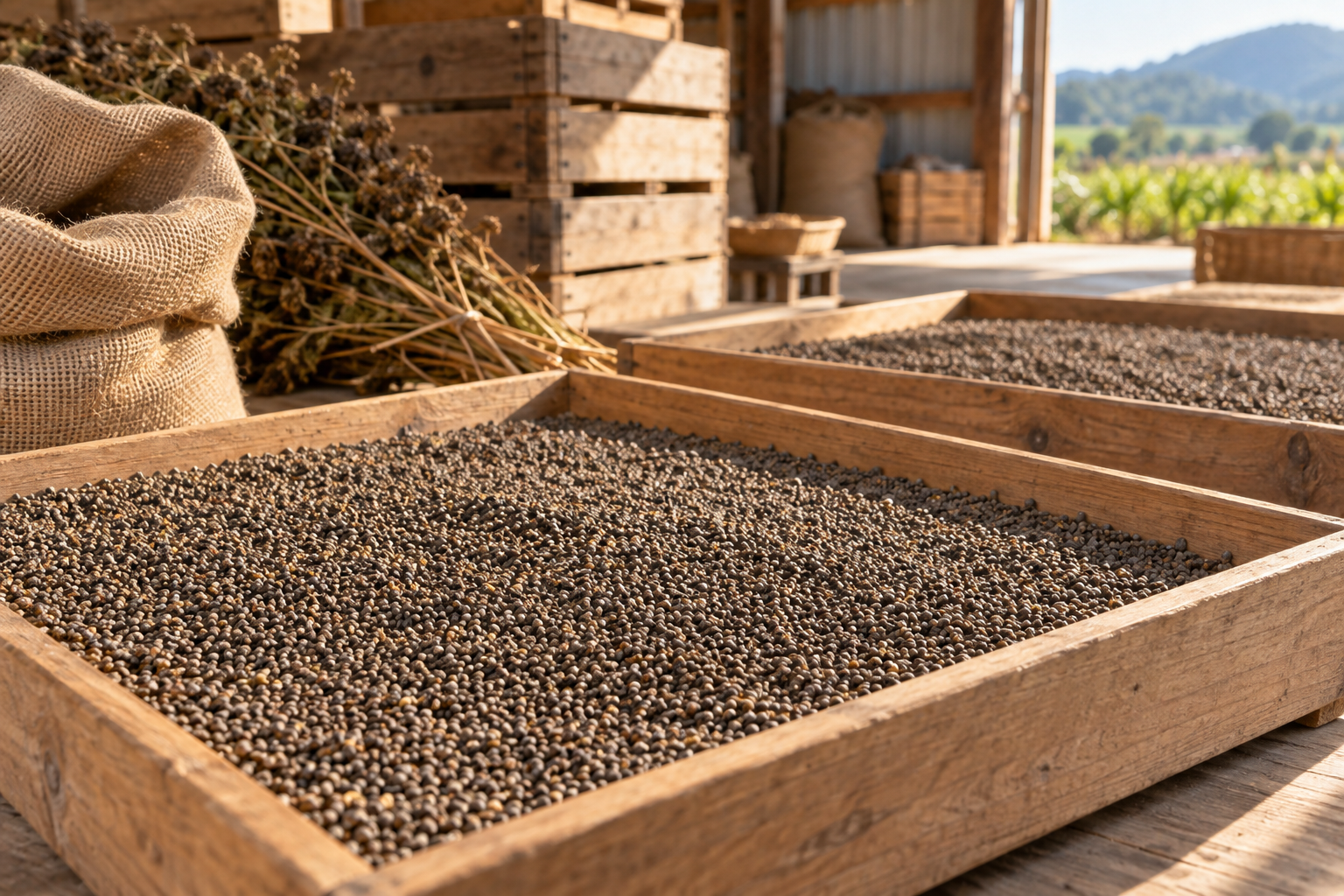
A practical guide to Korean perilla seed prices, mal-unit confusion, domestic vs imported prices, and sell-or-store decisions.
After harvest, perilla seed farmers usually ask one question first: how much is one mal worth this year. The problem is that the market does not always speak in mal. Official wholesale tables often use 22.5 kg for domestic perilla seed and 45 kg for imported perilla seed. Local buyers may talk in mal, sacks, or bulk lots.
Bottom line: do not judge perilla seed only by a one-mal quote. Convert the price by weight, separate domestic and imported lots, and decide based on drying quality, storage risk, and actual buyers.
1. Why the one-mal price is tricky.
A mal is useful in local conversation, but it is not enough for a clean selling decision. Moisture, cleaning quality, foreign matter, and local trade habits can change the real value of the same-looking lot.
For practical price reading, track four numbers.
| Number to check | Why it matters | Farm use |
|---|---|---|
| Domestic 22.5 kg price | Main official unit | Market baseline |
| Imported 45 kg price | Substitute pressure | Upper-price risk |
| Price per kg | Removes unit confusion | Fair comparison |
| Local mal quote | Field negotiation number | Final check |
2. Domestic premium matters in 2026.
Domestic perilla seed can earn a premium because of aroma, oil quality, and buyer trust. Imported perilla seed still matters because it sets the reference price for restaurants, processors, and oil mills.
IMUN.FARM keeps separate price pages for domestic perilla seed and imported perilla seed: /prices/perilla-seed/ and /prices/perilla-seed-imported/. Use them as navigation and comparison pages, then confirm actual transactions through KAMIS or your local wholesale market before making a final sale.
The KAMIS wholesale API structure also separates domestic 22.5 kg and imported 45 kg units. That means a direct headline comparison can be misleading unless you convert both sides to a per-kg basis.
3. Sell now or wait.
Waiting feels tempting when neighbors say prices may rise. Perilla seed does not reward waiting if quality is weak.
Selling now makes sense when:
- drying is uneven;
- storage is humid;
- cleaning is not complete;
- cash flow is tight;
- a local oil mill offers a firm price.
In this case, sell the better lots first. A small price gain can disappear quickly if aroma or moisture quality declines.
Partial selling makes sense when:
- drying is even;
- the lot is well cleaned;
- you have reliable local buyers;
- storage humidity is controlled;
- imported prices are not falling sharply.
A split strategy is often better than trying to catch the top. Sell part now and review the rest every two to four weeks.
Waiting is risky when:
- imported perilla seed gets cheaper;
- mid-grade domestic lots are slow to move;
- oil-mill buying weakens;
- wet weather raises storage risk;
- many nearby farms are holding inventory.
The real question is not what price people mention. It is who will actually buy at that price today.
4. Common mistakes.
First, farmers mix cleaned and uncleaned lots. Those are different products. Second, they compare premium domestic seed with mid-grade seed. Third, they hear a mal price without asking the weight basis.
Before accepting a quote, ask: how many kilograms is this price based on, and is it cleaned seed.
5. Farm checklist.
- Convert every offer to a per-kg price.
- Track domestic 22.5 kg and imported 45 kg prices separately.
- Do not mix cleaned and uncleaned lots in the same quote.
- Separate oil-use, roasting-use, and seed-use lots if possible.
- Do not wait if the lot smells damp.
- Include packaging, freight, and return risk in direct-sale pricing.
References
- aT KAMIS agricultural price OpenAPI, wholesale daily price query structure.
- IMUN.FARM
/prices/perilla-seed/and/prices/perilla-seed-imported/price pages. - Actual transaction prices can vary by market, grade, moisture, cleaning quality, and buyer.