3 Real Changes Coming to Agricultural Promotion Zones After the Agrivoltaics Law Passes
3 Real Changes Coming to Agricultural Promotion Zones After the Agrivoltaics Law Passes
On May 7, 2026, it passed the National Assembly plenary session. The name is a mouthful: the “Act on Activation and Support of Agrivoltaic Power Generation Businesses.” But for farmers on the ground, this law boils down to one question.
”Can I finally put solar panels on my protected farmland?”
The answer is a conditional yes. And within those conditions, Agricultural Promotion Zones are set to change in fairly concrete ways.
1. Absolute Farmland Opens Up — If Designated as a Renewable Energy Zone
Agricultural Promotion Zones were off limits before. Under food security rationale, non-agricultural use was heavily restricted, and agrivoltaics were no exception.
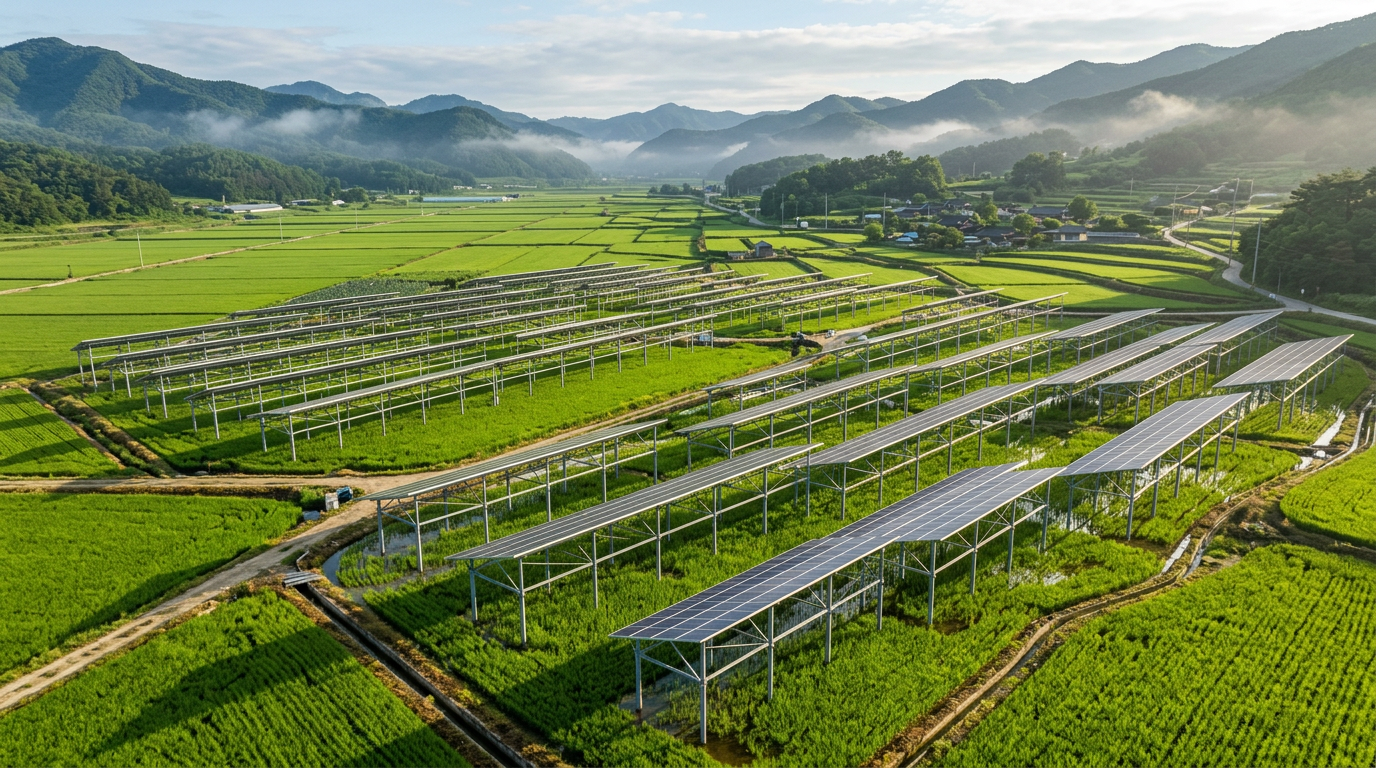
This law cracked open that wall. If an Agricultural Promotion Zone is designated as a Renewable Energy Zone under the Rural Spatial Restructuring Act, agrivoltaic power generation is now permitted. This is not a blanket opening. It requires clearing the hurdle of zone designation — local governments must designate the area as a Renewable Energy Zone under rural spatial planning, and only land within that zone qualifies.
The significance is bigger than it looks. Until now, the equation “Agricultural Promotion Zone = no solar” was treated as common sense among farmers. That equation has been broken. Individual farmers still cannot install panels on a whim, but village-level cooperative projects now have a viable path forward.
2. Project Terms Extended to Within 30 Years
In solar projects, the key variable determining profitability is operating period. Industry consensus is that you need at least 15 years to recover initial installation costs and start generating profit.
Under the old Agricultural Land Act framework, the maximum permitted period for temporary agrivoltaic use was 8 years — a timeline that made the economics structurally unworkable. Many farming households hesitated to participate for this reason.
The new law sets the project period at within 30 years, as determined by Presidential Decree. During government discussions, a 23-year extension was the leading proposal, and that is expected to apply to Agricultural Promotion Zones within Renewable Energy Zones. The 30-year figure closely matches the practical lifespan of solar panels — meaning revenue can continue from installation through end-of-life.
3. Tenant Farmers Can Participate, and Profits Stay in the Village
Under the previous system, only landowners could be project operators for agrivoltaic ventures. If you did not own the land, you were completely excluded. Tenant farmers who had worked the same fields for decades had no access to solar income.
This law corrects that. Tenant farmers can now participate in power generation projects, provided they actually engage in agricultural activity and reside in the area. Furthermore, by allowing resident participation cooperatives as project operators, the law creates a structure where power revenues circulate within the village rather than flowing to outside investors. The government’s goal of establishing 500 “Sunshine Income Villages” by 2030 is built on exactly this structure.
The law also mandates automatic renewal of lease contracts for the duration of the project and caps rent increases at no more than 5% of the previously agreed rent or deposit — preventing landowners from suddenly raising rates or terminating contracts midway through a project.
Note: Farming Obligations Get Stricter
Not everything changing is an opportunity. If a project operator fails to actually farm the land, penalties escalate from corrective orders to surcharges, project suspension, and ultimately license revocation. The intent is to close the loophole of installing solar panels and then abandoning agricultural activity.
The law takes effect 6 months after National Assembly resolution. Now is the time to get paperwork in order.
References
| # | Source | Content |
|---|---|---|
| 1 | MAFRA Press Release (May 7, 2026) | Official announcement of Agrivoltaics Act passing National Assembly |
| 2 | Newsis (May 7, 2026) | Tenant farmer eligibility, Agricultural Promotion Zone exceptions, Renewable Energy Zone framework |
| 3 | Jeonbuk Today (May 2026) | Structure for allowing agrivoltaics in Agricultural Promotion Zones via zone designation |
| 4 | Hankyoreh (Oct 15, 2025) | Government policy on 8-to-23 year extension and zone designation |
| 5 | MAFRA Explanation Document (Oct 16, 2025) | Three core principles and tenant farmer protections |
| 6 | Gwangju Climate Energy Agency (May 2026) | 30-year project period limit set by Presidential Decree |
| 7 | Korea.kr Policy Briefing (Aug 24, 2025) | Target of 500 Sunshine Income Villages by 2030 |
| 8 | imun.farm Law Digest (Jan 28, 2026) | Summary of project period extension and Renewable Energy Zone requirements |
| 9 | Gekko System Insight (Nov 16, 2025) | Background on 23-year extension proposal and village cooperative authorization |