South Korea's Agrivoltaics Progress: May 2026 Update
South Korea’s Agrivoltaics Progress: May 2026 Update
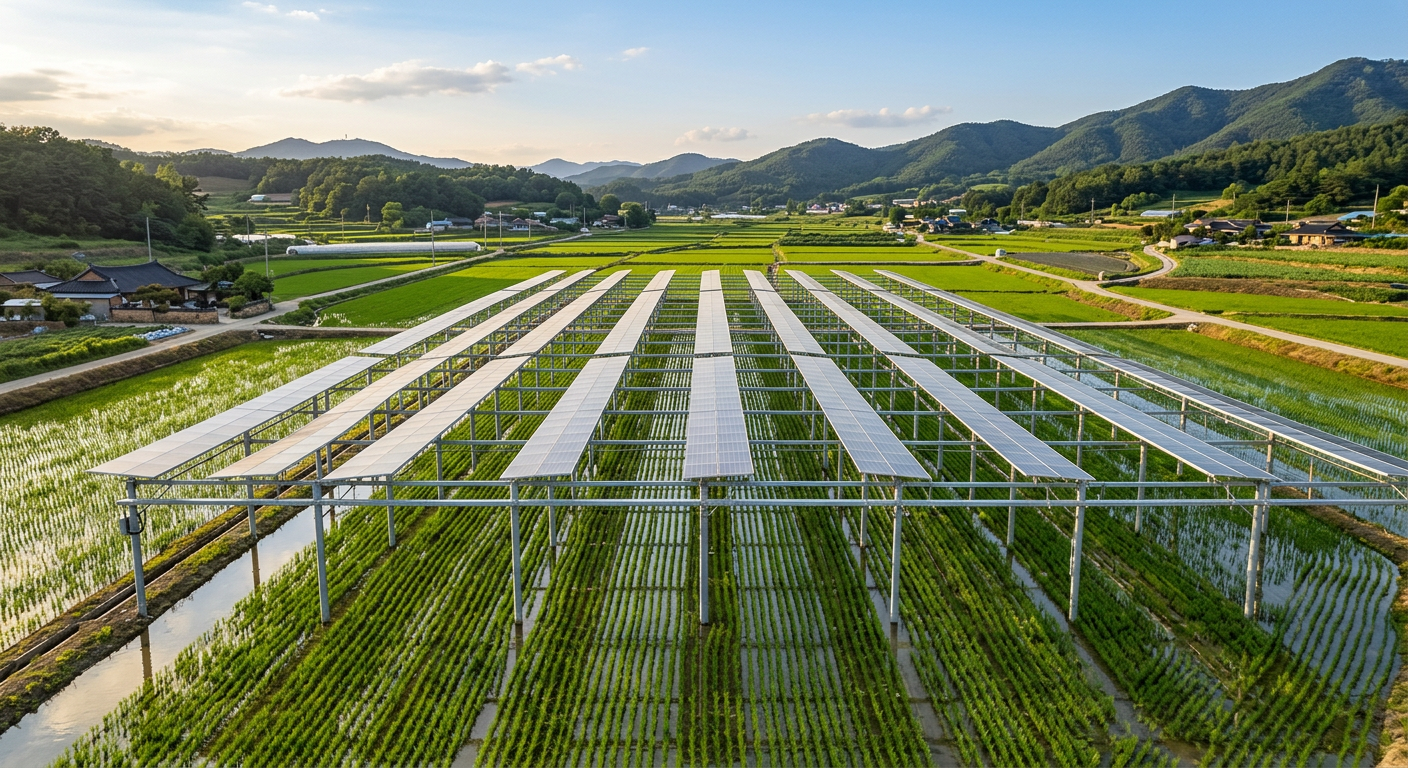
Solar panels above. Rice growing below. Electricity flowing out. This straightforward concept took longer than expected to take shape in South Korea — but as of May 2026, the pieces are finally moving.
The Carbon Neutrality and Green Growth Commission unveiled the country’s agrivoltaic adoption strategy back in 2024. Two years on, a landmark special law cleared the National Assembly’s subcommittee in April 2026, though the full plenary vote remains pending. On the ground, farmers and cooperatives are waiting — and growing impatient.
Legislative Progress: From Bills to Subcommittee Vote
Discussions around agrivoltaics in Korea date back to 2021, when the first farmland act amendments and standalone special bills began appearing. Dozens of bills were filed. None made it through.
Then, on April 14, 2026, the Agriculture, Food, Rural Affairs, Oceans, and Fisheries Committee’s Legislative Review Subcommittee passed the Act on Activation and Support for Agrivoltaic Power Generation. Key provisions:
- Eligible operators: Farmers residing in or near the project site, resident participation cooperatives
- Project duration: Up to 30 years (final term set by presidential decree)
- Siting rules: Installations limited to land outside agricultural promotion zones by default; exceptions allowed in designated renewable energy districts
As of late April 2026, this bill has not yet passed the full plenary session of the National Assembly. A cooperative operator running a demonstration site in Boseong, South Jeolla Province, put it bluntly: “Without the law, there’s no legal way to generate income from this.”
Deregulation: From 8 Years to 23–30 Years
The single biggest structural barrier has been the 8-year temporary farmland use limit under the current Agricultural Land Act. Solar module lifespans run 20–25 years. Nobody invests in an 8-year project.
In October 2025, the government’s 2nd Core Regulatory Reform Strategy Meeting addressed this directly. The plan: extend the temporary use permit to 23 years, and allow installations in agricultural promotion zones where renewable energy districts have been designated. Full amendment of the Agricultural Land Act was set to follow in the first half of 2026.
Kim So-hyeong, director of the Ministry of Agriculture’s Rural Energy Policy Division, confirmed the target: “We aim to finalize both the Agrivoltaic Special Act and amendments to the Agricultural Land Act by the first half of this year, then specify operational standards through sub-regulations.”
Sunlight Income Village Program: Running in Parallel
Separate from the special law debate, a faster-moving policy track is already in motion: the Sunlight Income Village (햇빛소득마을) program.
Led by the Ministry of the Interior and Safety, the program selects rural villages to install cooperative solar plants on idle local land and distribute revenues among residents. Targets:
- 2026: 500+ villages selected; installations of 300 kW–1 MW per village
- 2030: 2,500+ villages nationwide
- Financing: Long-term low-interest loans covering up to 85% of installation costs, from approximately KRW 450 billion in 2026 renewable energy financial support
The timeline: village selection in July, groundbreaking in August, grid connection and power generation by December 2026.
The Numbers: 8.4x Revenue in Practice
The most persuasive argument isn’t policy language — it’s actual data.
In 2023, South Jeolla Province’s Yeongam County launched an agrivoltaic demonstration on 1,000 m² (approximately 300 pyeong) of rice paddies, installing a 45 kW system with support from the Ministry of Agriculture. First-year results, released in late 2025:
| Metric | Rice-only | Agrivoltaic |
|---|---|---|
| Rice harvest | 668 kg | 525 kg (–21%) |
| Rice revenue | KRW 1.17M | KRW 0.92M |
| Power generation revenue | — | KRW 8.97M (est.) |
| Total revenue | KRW 1.17M | KRW 9.89M (8.4×) |
| Revenue per pyeong | KRW 3,900 | KRW 32,967 |
A critical note: installation costs were excluded from this calculation. Yeongam County officials estimated that factoring in capital costs, meaningful positive returns would begin appearing approximately 7 years after installation.
Crop yield reductions from panel shading, based on South Jeolla Province Green Energy Research Institute data, range from 12.1–20.3% for rice, 8.9–16.5% for potatoes, and 7.3–22.9% for cabbage.
Current Obstacles
The numbers look promising. The policy direction is set. But three structural obstacles remain.
-
Legislative gap. Despite the April subcommittee vote, the plenary session has not acted. Bills have been filed since 2021 — not one has become law. Farmers in active demonstration sites are operating in a legal gray zone.
-
Grid connection bottleneck. Insufficient transmission and distribution capacity in rural areas is the program’s “largest identified obstacle,” according to official government materials. Amendments to the Electric Utility Act and the Distributed Energy Special Act are in progress to grant Sunlight Income Village projects priority grid access.
-
Speculative capital concerns. There is significant pressure to ensure agrivoltaic income returns to actual farmers, not external investors. The special bill addresses this with a minimum 3-year continuous farming requirement and cooperative-centered ownership structures.
Global Context
The global agrivoltaics market is valued at approximately USD 5.75 billion in 2026, projected to reach USD 8.65 billion by 2030 at a 10.8% CAGR. Japan, Germany, and France are already in scaling phases with mature regulatory frameworks.
South Korea is at the inflection point between demonstration and institutionalization. Estimates suggest that installing agrivoltaic systems on just 6.2% of South Korea’s 1.9 million hectares of farmland could yield approximately 60 GW of solar capacity by 2050 — a significant share of the country’s long-term renewable targets.
Status Summary, May 2026
| Category | Status |
|---|---|
| Special Law | Passed Agriculture Committee subcommittee (Apr 14, 2026); full plenary vote pending |
| Permit Duration | Current: 8 years → Proposed: 23–30 years |
| Deployment Stage | Demonstration phase; commercial scale-up not yet initiated |
| Sunlight Income Villages | 500 villages targeted in 2026; 2,500 by 2030 |
| Demonstrated Revenue | Up to 8.4× vs. rice-only (Yeongam County, 2024 baseline) |
| Crop Yield Reduction | 7–23% depending on crop type |
References
- SlowNews (Apr 29, 2026) — Fact-check: Four Concerns About Agrivoltaics
- FoodToday (Feb 24, 2026) — National Agricultural Cooperative Federation Future Farming Forum 2026
- imun.farm (Jan 28, 2026) — 2026 Agrivoltaics Legal Framework Summary
- PV Magazine Australia (Oct 27, 2025) — South Korean government developing agrivoltaic legislation
- PV Magazine (Mar 25, 2026) — South Korea targets 2500 community solar cooperatives by 2030
- Money Today (Apr 29, 2026) — Institutionalization of Agrivoltaics Essential for Sunlight Pension
- Newstree (Nov 11, 2025) — Rice + Solar Farming Yields 8x More Revenue
- Greenium (Aug 6, 2024) — Government Plans Agrivoltaics by 2025; Carbon Neutrality Commission Announcement
- Daum/Rural News (Apr 28, 2026) — Agrivoltaic Special Act Urgently Needed for Rural Future
- YouTube/Korean Agricultural Broadcast (Jan 29, 2026) — Agrivoltaic Special Act: First Half 2026 Enactment Possible?
- Ministry of Interior and Safety (Mar 30, 2026) — 2026 Sunlight Income Village Selection Announcement
- Research and Markets (2026) — Agrivoltaics Market Report 2026