Agrivoltaics vs. Community Solar: Comparing Public Acceptance and Revenue-Sharing Structures
Agrivoltaics vs. Community Solar: Comparing Public Acceptance and Revenue-Sharing Structures
Setting the Scene
Solar power in South Korea wears two very different faces. One installs panels above rice paddies while crops continue to grow beneath — called agrivoltaics (영농형 태양광). The other has villagers form cooperatives, build power plants on idle land, and share the proceeds — known as community solar or the “Sunlight Income Village” (햇빛소득마을) model. Both aim at the same energy transition goal, but who gets the money, and whether residents actually welcome the project, diverge sharply between the two.
Agrivoltaics: Income for Individual Farmers
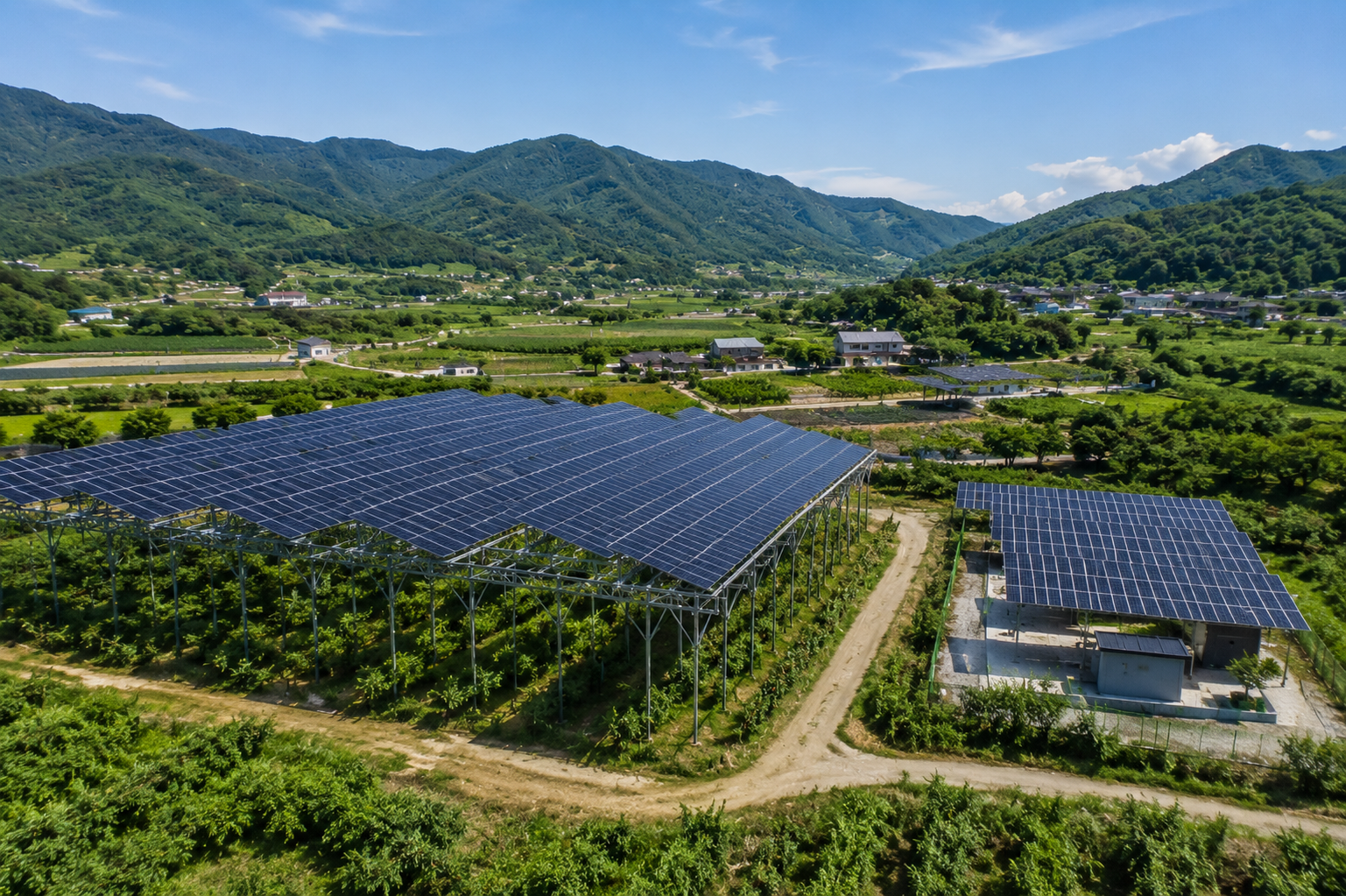
Agrivoltaic systems mount solar panels on structures at least 3 meters high over farmland, allowing continued cultivation underneath. The central premise is that agriculture never stops. South Korea’s Ministry of Agriculture, Food and Rural Affairs formalized this principle in its 2024 “Agrivoltaics Introduction Strategy,” restricting project operators to farmers only — either landowners or tenant farmers who actively cultivate the land.
The revenue structure is straightforward: farming income and electricity sales income run in parallel. Based on 2025 data, a 100 kW system generates approximately 120,000 kWh annually, yielding around KRW 26.6 million per year in combined SMP (System Marginal Price) and REC (Renewable Energy Certificate) revenues. A 20-year fixed-price REC contract provides long-term income stability.
Permitting conditions are strict. Panel structures may cover at most 30% of total farmland area. The permitted land-use period was previously capped at 8 years under the Agricultural Land Act — far shorter than equipment lifespans of 25+ years. Special legislation proposed in 2025 seeks to extend this to 23 years.
Key Revenue Structure: Agrivoltaics
| Item | Detail |
|---|---|
| Project operator | Individual farmer (owner or active tenant) |
| Capacity | Typically 100–200 kW |
| Annual generation | ~120,000 kWh (100 kW system) |
| Annual electricity revenue | ~KRW 26.6 million (SMP+REC, 2025) |
| Revenue recipient | Installing farmer: 100% |
| Agricultural income | Maintained alongside power generation |
| Permit duration | Current 8 years → 23 years proposed under new law |
| REC fixed contract | Up to 20-year fixed price available |
Community Solar: Village-Scale Cooperative Revenue
Community solar projects have village residents form cooperatives or local corporations, then install 300 kW to 1 MW of solar capacity on idle village land, reservoirs, or public sites. Revenues are distributed to members as dividends or channeled into a shared community welfare fund.
In December 2025, the Ministry of the Interior and Safety announced a national expansion plan targeting 2,500 Sunlight Income Villages by 2030. For 2026 alone, KRW 550 billion in national funds is earmarked to establish approximately 500 villages. Financing covers up to 85% of installation costs via long-term, low-interest policy loans, with local extinction response funds available to offset residents’ equity contributions in depopulation-risk areas.
The Guyangri Haetbit Dure Power Cooperative in Yeoju completed a 1 MW installation in November 2024 and now generates net monthly revenues of approximately KRW 10 million. These proceeds flow into the village welfare bus, free meal programs at the village hall, and direct resident dividends. In Buan, North Jeolla Province, a village distributes KRW 18 million annually from a 100 kW system among approximately 50 residents on an equal-share basis.
Shinan County’s “Haetbit Pension” (햇빛연금) remains the benchmark. Since the county ordinance took effect in 2018 and disbursements began in April 2021, the program’s cumulative revenues surpassed KRW 30 billion as of October 2025. As of 2025, 49% of the county’s population — 18,997 residents — receive benefits. Children up to age 18 receive a separate “Sunlight Child Allowance” of KRW 1.2 million annually (KRW 100,000/month). The structural key: developers must allow residents and the county to take a combined 30% equity stake as a condition of project approval.
Key Revenue Structure: Community Solar
| Item | Detail |
|---|---|
| Project operator | Village cooperative or local corporation |
| Capacity | 300 kW–1 MW |
| Annual revenue (100 kW basis) | ~KRW 18.2 million (at KRW 140/kWh) |
| Net revenue (after operating costs) | ~KRW 15 million |
| Distribution method | Resident dividends + community welfare fund |
| Member contribution | KRW 300,000–1,000,000 per person (self-determined) |
| Government financing | Up to 85% of project cost via policy loans |
| Key examples | Shinan Haetbit Pension, Yeoju Guyangri, Buan |
Public Acceptance: Why the Two Models Differ
Revenue-sharing figures matter less than the question of who decides and who benefits at the outset.
Agrivoltaics faces a structural acceptance dilemma. Landowners receive electricity revenues, but tenant farmers — who actually work the land — may lose cultivable area and livelihoods without any compensating benefit. This tension materialized during the 2024 “Haetbit Farm” pilot project in Yangpyeong, Gyeonggi Province. Residents filed lawsuits alleging insufficient participation in the decision-making process and lack of procedural transparency. The conflict deepened when the solar installer covered litigation costs for pro-project residents. Gyeonggi Province ultimately rejected the project application. At its most heated, opponents described the situation as rural communities being “colonized to produce energy for cities.”
Community solar structurally advantages acceptance. When residents are cooperative members — co-owning the power plant itself — opposition transforms into investment. A Korea Development Institute (KDI) study on acceptance determinants for renewable energy facilities identifies “procedural legitimacy” and “benefit sharing” as the two dominant factors. Seoul National University research confirms that solar facilities owned by local residents generate a stronger positive social diffusion effect (peer effect) than externally owned facilities.
Shinan County’s 80–90% resident participation rate did not happen by accident. The county ordinance effectively mandated developer equity-sharing with residents, and cooperatives were organized island by island across the entire administrative area. Compared to Gunsan City (a similarly sized installation portfolio with 4 participating power plants), Shinan achieved participation from 83 separate power plants.
Side-by-Side Comparison
| Dimension | Agrivoltaics | Community Solar (Sunlight Income Village) |
|---|---|---|
| Revenue recipient | Individual farmer | Village cooperative → resident dividends |
| Public acceptance | Tenant-farmer conflict risk | High: ownership-based participation |
| Project operator | Individual farmer (or legal entity) | Village-scale cooperative |
| Typical capacity | 100–200 kW | 300 kW–1 MW |
| Revenue transparency | Individual management | Cooperative charter + public general meeting |
| Land type | Active farmland (agriculture maintained) | Idle land, reservoirs, public sites |
| Conflict flashpoints | Landowner vs. tenant farmer | Internal cooperative governance disputes |
| Government support | Agricultural Land Act revision pending | 85% policy loan; depopulation fund available |
| Reference cases | Agrivoltaic pilot projects | Shinan Pension, Yeoju Guyangri, Buan |
| Long-term revenue | 20-year fixed REC contract | FIT / SMP+REC mixed |
Structural Weaknesses: Neither Model Is Without Risk
Agrivoltaics cannot avoid the question of who owns the land. In a farming landscape where much of the cultivated area is rented, a revenue structure that flows entirely to landowners generates internal community friction. Government policy has included restrictions — 30% panel coverage limit, height standards — partly to prevent “paper farming” schemes where solar installation displaces genuine agriculture. Still, the risk of abuse remains a documented concern within policy circles.
Community solar carries cooperative governance risk. Once revenues start flowing, disputes over distribution ratios emerge. In a 2024 case involving a Saemangeum-area solar project, the cooperative’s resident representative was arrested for diverting dividend funds. Transparent governance is not optional — it is foundational. The UK’s Westmill Solar Cooperative, often cited as a model, treats annual general meetings and open accounting as the basis of long-term community trust.
The Core Distinction
In a single sentence:
Agrivoltaics is income innovation for individual farmers; community solar is revenue innovation for entire villages.
For delivering a direct, stable second income stream to individual farming households, agrivoltaics provides a more targeted path. For ensuring an entire community becomes a stakeholder in the energy transition — with benefits flowing into welfare, dividends, and shared capital — community solar scales that impact across the village. Acceptance and durability both ultimately depend on where the money flows. When residents become owners, resistance becomes invitation.
References
- Ministry of Agriculture, Food and Rural Affairs (MAFRA), “Agrivoltaics Introduction Strategy,” 2024.
- Ministry of the Interior and Safety, MAFRA, Ministry of Climate, Energy and Environment, “National Expansion Plan for Sunlight Income Villages,” December 2025.
- Korea Rural Economic Institute (KREI), “Domestic and International Cases of Sunlight Income and Implications,” 2025.
- suncoop.tistory.com, “Case Analysis: Shinan Resident Participatory Benefit-Sharing Solar Power Project,” January 2025.
- suncoop.tistory.com, “2026 Sunlight Income Village Program Implementation Plan,” April 2026.
- Kyunghyang Shinmun, “Shinan County Haetbit Pension Cumulative Revenue Exceeds KRW 30 Billion,” October 26, 2025.
- Yonhap News Agency, “Shinan County Haetbit Pension Surpasses KRW 30 Billion Cumulative Revenue,” October 23, 2025.
- pv-magazine.com, “South Korea targets 2500 community solar cooperatives by 2030,” March 25, 2026.
- Korea Development Institute (KDI), “Study on Determinants of Local Acceptance for Renewable Energy Facilities,” December 2020.
- Seoul National University, “Analysis of Local Acceptance and Peer Effects in Domestic Commercial Solar Power,” February 2021.
- Energy and Climate Policy Institute, “Grounds for Opposition to Solar Power Plant Installation in Rural Communities,” March 2018.
- OhmyNews, “Agrivoltaics Is the Future of Korean Agriculture,” March 22, 2026.
- BizHankook, “Agrivoltaics: What Korean Farmers Are Actually Worried About,” October 22, 2025.
- ”Special Act on Support and Promotion of Agrivoltaic Power Generation Business,” proposed March 2025.
- Daum News, “‘Sejong Sunlight Income’ Model under Discussion: Solar Revenue Dividends for Residents,” January 6, 2026.