Agrivoltaic Solar — Complete Guide to Panel Installation Structures, Methods & Types
Agrivoltaic Solar — Complete Guide to Panel Installation Structures, Methods & Types
”What if one plot of land could grow rice and sell electricity?” — That is exactly why agrivoltaic solar exists.
1. What Is Agrivoltaic Solar — Getting the Concept Right
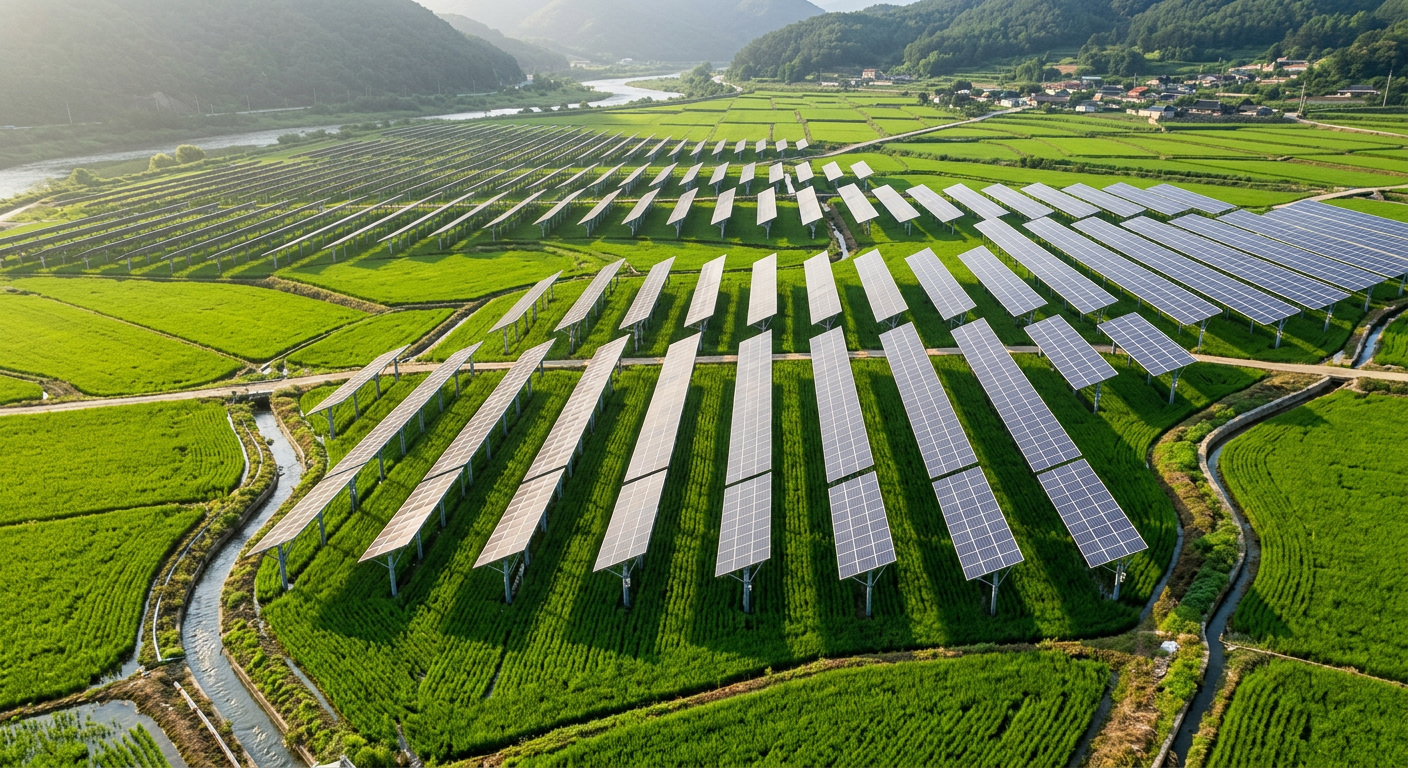
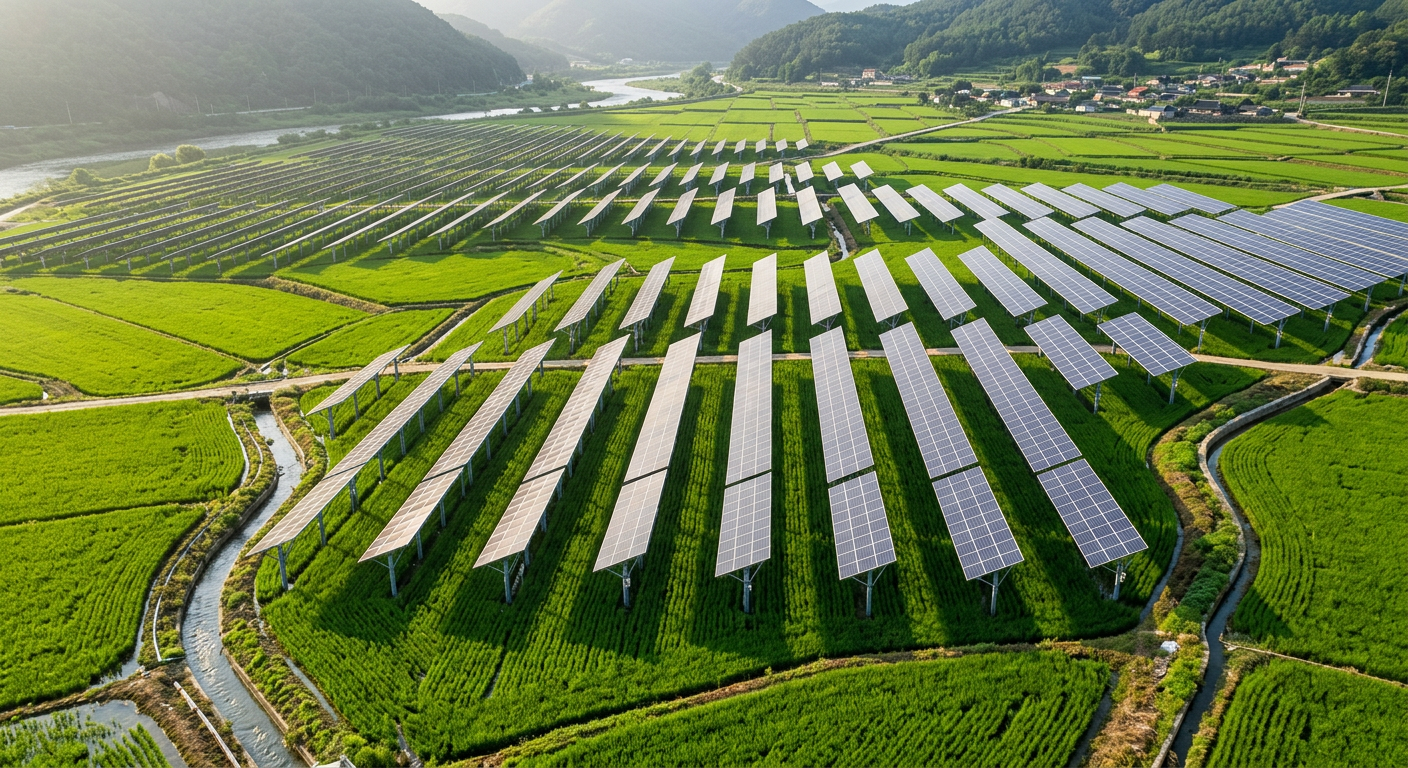
Poles are driven into the ground, panels are mounted at 3 m or higher, and crops grow in the space below — just like before. Simple enough on the surface, yet the engineering demands are considerable.
Solar panels block sunlight. Crops need sunlight. Making both work simultaneously requires hitting a precise equilibrium: shading ratio ≤ 30% of total farmland area, yield reduction ≤ 20% compared to a panel-free field. These two numbers are the starting point for every agrivoltaic design.
South Korea’s government currently specifies pole height 2.5–3 m, structural spacing ~4 m, and a 30% panel coverage cap as its core physical standards. The country’s first agrivoltaic installation appeared in 2016.
2. Installation Method — Two Primary Branches
The first design decision is simple: does the panel move or not?
2-1. Fixed Elevated Agrivoltaics
The panel orientation is set during installation and never changes. The most widely deployed type in Korea.
- South-facing fixed tilt: The Korean standard. Panels fixed at 25–30° facing south. Simple structure, minimal maintenance.
- East/West (E/W) vertical fixed: Panels stand nearly vertical and face east and west simultaneously. Morning and evening generation is more balanced, and sunlight distribution onto crops below is more spatially uniform. Research from the University of Turku (Finland) found that E/W vertical bifacial arrays with at least 8 m row spacing outperform south-facing tilted arrays in crop light uniformity.
Fixed systems have one unavoidable weakness: generation peaks around solar noon and drops off sharply at sunrise and sunset.
2-2. Tracking Agrivoltaics
The panel automatically rotates to follow the sun. The output numbers tell the story.
- Single-Axis Tracker (SAT): Rotates east-west only. Delivers approximately 12–31% higher generation efficiency than fixed systems.
- Dual-Axis Tracker (DAT): Tracks both azimuth and elevation — full sun-following from sunrise to sunset. According to Paru Solar Lab’s 2026 field data, dual-axis trackers achieved up to 25–31% higher efficiency than fixed arrays. In a 1 MW, 20-year cumulative revenue simulation, fixed systems projected ~KRW 3.19 B vs. dual-axis ~KRW 4.21 B — a gap of roughly KRW 1.02 B.
Trackers cost more upfront and have moving parts that can fail. On the agricultural side, the moving shadow they cast is distributed more evenly across crops, reducing localized shading stress.
3. Panel Type — How Each Handles Light
Three panel types are used in agrivoltaic systems, distinguished by how they handle light transmission.
3-1. Standard Monofacial
The conventional single-crystal silicon panel — light is collected from the front face only. Efficiency range 17–23%. A peer-reviewed study cited in DBpia recorded a shading ratio of approximately 31.5% with standard monofacial panels in a Korean agrivoltaic installation.
Shading on crops is uneven: high directly under a panel, none in the gap. Still the most popular choice because of low cost and reliable supply chains.
3-2. Bifacial
Solar cells on both front and back surfaces. The rear collects diffuse and ground-reflected light. Under comparable conditions, bifacial panels produce 10–30% more electricity than monofacial equivalents. The open underside and exposed ground typical of agrivoltaic structures are ideal for bifacial rear-side gain.
Glass/glass construction improves durability and longevity. The trade-off is a higher shading ratio: the DBpia study recorded 43.2% for bifacial installations, requiring more careful crop selection.
3-3. Semi-transparent (Translucent / BIPV-derived)
Panels engineered so that some sunlight passes through — either via thin-film technology or by widening the gaps between cells. Lowest generation efficiency of the three types. The advantage is more uniform light distribution below the array, making it viable for sun-demanding crops. For fields growing peppers or other high-light crops, semi-transparent modules are worth the trade-off in output.
4. Supporting Structure — The Skeleton Determines Everything
The mounting structure is a larger cost driver than most people expect. In a real 100 kW agrivoltaic quote from February 2026 (total ~KRW 165 M), structural components alone accounted for 31% of total installation cost.
Key Structural Parameters
| Parameter | Specification |
|---|---|
| Pole height | 2.5–3 m (min. 3 m for machinery clearance) |
| Column spacing | 4–6 m |
| Panel coverage ratio | ≤ 30% of farmland area |
| Tilt angle (south-fixed) | 25–30° |
| Permitted capacity | 300 kW – 1 MW |
Hot-dip galvanized steel is the dominant pole material. Aluminum-coated steel and FRP (fiber-reinforced polymer) are used where superior corrosion resistance is required.
Foundation
Concrete footings are standard. Under South Korean regulations, eco-friendly construction that minimizes soil contamination is mandatory. Soft ground requires additional pile foundations, adding KRW 5 M or more to site costs.
5. Panel Tilt Configurations — Three Approaches
Three fundamental tilt strategies are applied to agrivoltaic panel installation:
- North–South inclined (fixed tilt): The Korean norm. Panels face south at a fixed angle optimized for annual yield.
- East–West vertical: Panels stand near-vertical, facing east and west. Morning and evening generation is equalized; crop irradiance is spatially uniform throughout the day.
- Variable angle (tracking): Angle adjusts automatically with season and time of day.
E/W vertical configurations show superior spatial light uniformity — particularly beneficial for monoculture fields. However, in Korean latitudes, total annual generation is lower than south-facing equivalents, creating an energy vs. crop-uniformity trade-off.
6. Crop-Driven Panel Design
Crop choice drives structural decisions, not the other way around.
- Shade-tolerant crops (spinach, lettuce, perilla, soybean): Standard or bifacial panels can be used without major yield impact below the arrays.
- High-light crops (peppers, rice): Structures must be taller, wider-spaced, or fitted with semi-transparent modules. A Japanese field trial in Chiba Prefecture showed rice yield retention of 96.7% under an agrivoltaic installation.
Because panel coverage is capped at 30% of farmland area, agrivoltaic systems generate significantly less electricity than conventional ground-mounted solar on the same plot (approximately 2.5× less power). The agricultural income compensates for the difference.
7. Cost Reality
As of February 2026, total installed cost for a 100 kW agrivoltaic system runs approximately KRW 150–200 M (KRW 1.5–2 M per kW). Conventional ground-mounted solar costs around KRW 1.1 M/kW — agrivoltaic is roughly 50% more expensive, driven almost entirely by the elevated structural system.
References
- Paru Solar Lab, Agrivoltaic Tracking vs. Fixed System Comparative Field Study (April 2026)
- DBpia, “Agrivoltaic Agricultural Verification and Economic Analysis” (2025)
- Nongmin Ilbo (mdilbo.com), “Growing Electricity in the Sky, Farming on the Ground” (Feb 2023)
- imun.farm, “Real Agrivoltaic Installation Cost Breakdown — 100 kW Case Study” (Feb 2026)
- Namu Wiki, Agrivoltaic Solar Entry (last revised Oct 2025)
- Paru Co., Dual-Axis Tracker Product Specifications
- EnergyPlan Blog, “Agrivoltaic Solar on Farmland — Easy Guide” (Jun 2025)
- Agri-Solar Clearinghouse, “Agrivoltaic Farm Design: Vertical Bifacial vs. Tilted Monofacial PV Panels” (Feb 2025)
- University of Turku / PV Magazine, “Vertical Bifacial Agrivoltaics Feasible at High Latitudes with 8-meter Row Spacing” (Nov 2025)
- PatSnap Eureka, “Agrivoltaic System Design 2026” (Apr 2026)
- SolarTech, “Complete Guide to Bifacial Solar Panel Installation” (Feb 2026)