Preparing for the Agrivoltaic Act: What the 23-Year Land Use Structure Really Means
Preparing for the Agrivoltaic Act: What the 23-Year Land Use Structure Really Means

Eight years. That was the limit.
Solar panels last 25 to 30 years. Recovering the initial investment takes at least 12 to 15 years. Yet under South Korean law, the maximum permitted period for using farmland for agrivoltaic solar installations was capped at just 8 years. No bank would readily extend loans against that timeline. No farmer could comfortably commit. The regulation itself was blocking the business.
On May 7, 2026, that structure changed.
One Number, Fourteen Years in the Making
The Act on the Promotion and Support of Agrivoltaic Power Generation Projects (hereinafter, the Agrivoltaic Act) passed the National Assembly plenary. The revised Farmland Act passed on the same day. For the first time, agrivoltaic solar installations were explicitly included in the farmland law as a recognized category for temporary non-agricultural use permits.
Korea’s agrivoltaic discussions trace back to the early 2010s. Japan and Europe ran pilots first; domestic research programs launched in earnest from 2017. But without clear legal footing, projects relied on legal carve-outs in the Farmland Act. By end-2023, installed capacity stood at only about 62 sites and roughly 3 MW — a fraction of what Japan had achieved in the same period. The 8-year cap was the central reason.
What 23 Years Actually Changes: Economics Rewritten by a Single Number
In April 2024, the Presidential Commission on Carbon Neutrality and Green Growth approved the government’s Agrivoltaic Introduction Strategy, formally targeting a 23-year extension. The Ministry of Agriculture, Food and Rural Affairs (MAFRA) framed the policy around three core pillars: ① make farmers the primary operators, ② concentrate installations on lower-grade farmland, ③ build a tight monitoring system to prevent fake-farming.
Research from the Korea Rural Economic Institute (KREI, 2023) shows that agrivoltaic farm income becomes economically viable — at 2.63 to 2.8 times rice-farming income — only when operation periods exceed 20 years. With favorable financing, that ratio reaches up to 4.1 times. Under an 8-year cap, that economic threshold was simply unreachable. The 23-year figure does not just extend a timeline; it opens the door to project financing and makes long-term income modeling possible for the first time.
That said, 23 years is not a blanket guarantee.
Why It Became 8 + 5 + 5 + 5: The Logic Behind the Structure
Early debates centered on whether to grant the full 23 years in one permit. The government explored a phased structure: an initial 8-year permit followed by three 5-year extensions (8+5×3=23). The final legislation settled on a maximum of 23 years (initial 5 years + up to 18 years of renewal), with MAFRA reviewing a 3-year renewal cycle for implementation through subordinate regulations.
The reason for segmenting the period is straightforward. Granting 23 years in a single permit would create a risk of “phantom farming” — collecting solar revenue while neglecting actual agricultural production. The phased structure forces periodic verification of farming activity. Under the enforcement design, the Korea Rural Development Administration and Korea Rural Community Corporation will conduct on-site checks; mobile apps and on-farm cameras add further verification layers. Violations trigger a four-stage response: corrective order → fine → business suspension → permit revocation.
Agricultural Promotion Zones: The Remaining Challenge
The law’s default is clear: agrivoltaic projects are limited to farmland outside designated Agricultural Promotion Zones, protecting the country’s most productive agricultural land from conversion pressure.
However, an exception was built in. Farmland designated as a Renewable Energy Zone under the Rural Spatial Restructuring Act can host agrivoltaic projects even within Agricultural Promotion Zones, and agricultural corporations may participate as project operators in such zones.
The critical problem: all the specifics — which farmland qualifies for Renewable Energy Zone designation, what the allowable outsider investment ratio for agricultural corporations is — were delegated entirely to subordinate regulations (enforcement decrees). Until those numbers are published, the scope of projects in Agricultural Promotion Zones remains genuinely uncertain.
Operator Eligibility: The 3-Year Farming Requirement
The Agrivoltaic Act sets relatively strict entry conditions. Eligible operators must be farmers who have resided in the project area and managed agricultural operations for at least 3 years. Tenant farmers are included. Resident cooperatives with at least 10 members (the “Sunshine Income Village” model) also qualify. Agricultural corporations enter only in designated Renewable Energy Zones.
The “residency + 3-year farming” requirement serves as the first barrier against external capital taking direct control. Concerns persist that outside developers or financial investors could use nominal farmer-operators as fronts. Legal analysis from Shin & Kim notes that in practice, participants may structure projects through agricultural company corporations or indirect equity investment — a gray zone that subordinate regulations must address.
Installation Standards: Machinery Must Pass Through
The government’s draft physical standards are:
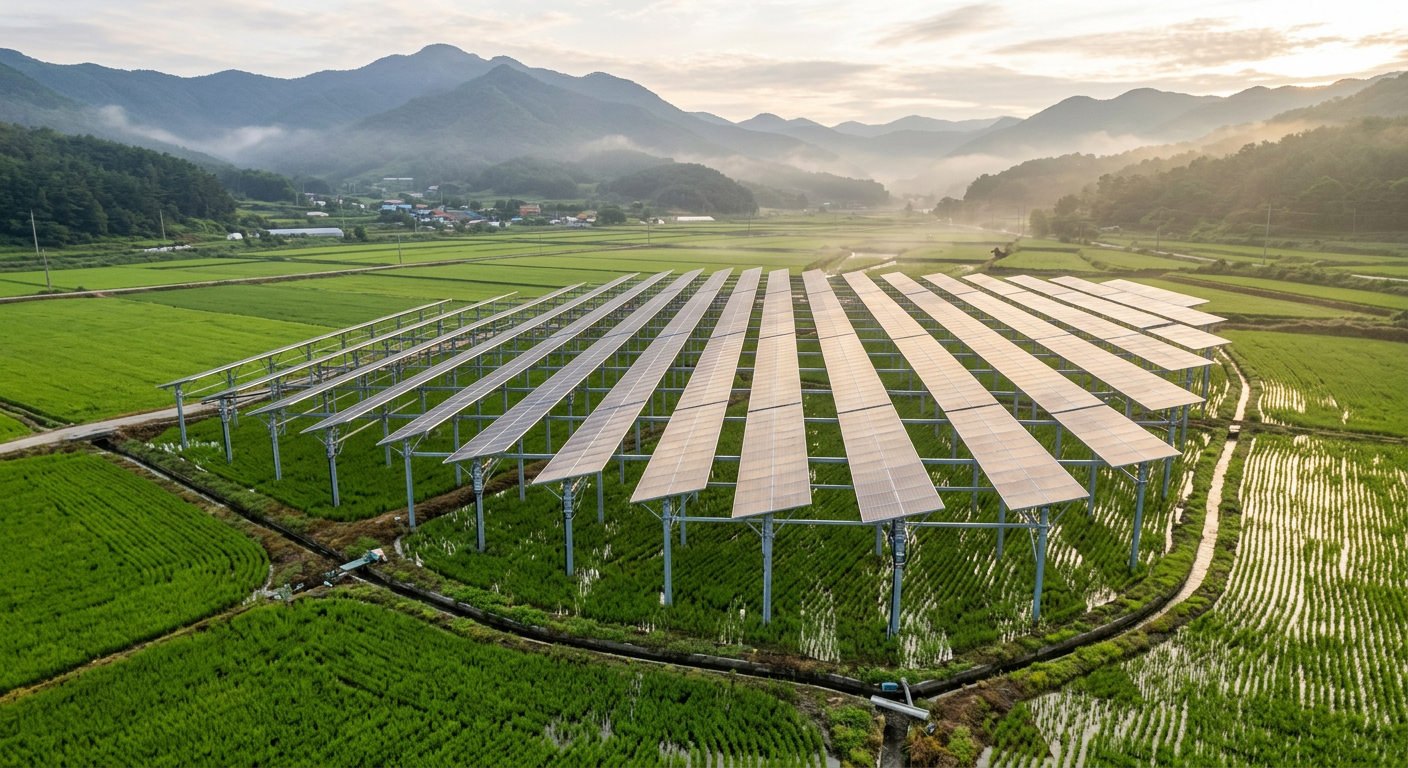
- Module coverage limit: 30% of total farmland area — restricts how much of the field can be shaded
- Support height: 2.5–3 meters — ensures tractors and combines can operate beneath the panels
- Column spacing: approximately 4 meters — maintains equipment maneuverability
The core principle is simple: this is farmland with solar panels placed above it, not a solar installation that happens to sit on farmland. The physical standards enforce that principle.
A blind spot remains, though. A flat 30% shading ratio affects crops very differently. Empirical data shows that rice experienced yield losses as high as 71% under heavy shading, while green tea, figs, and grapes actually saw productivity increase. A uniform standard effectively decides project feasibility by crop type. Whether the enforcement decree introduces crop-specific differentiation will determine whether the regulation works as intended.
Tenant Farmer Protections: A First
Among the law’s provisions, one deserves attention beyond its modest presentation: tenant farmer protections.
Landlords are now required to automatically renew tenancy contracts for the duration of a project. Rent increases are capped at 5% of the agreed lease payment or security deposit. MAFRA gains the authority to develop and distribute standard contract templates.
This matters because a significant share of Korean farmland is operated by tenant farmers rather than owners. When solar revenue enters the equation, landlords have new incentives to raise rents or terminate contracts. Protecting tenants in statute — for the first time — is a meaningful structural step toward ensuring that agrivoltaic income reaches the people actually doing the farming.
Where Implementation Stands: Six Months from Enforcement
The Agrivoltaic Act takes effect six months after official promulgation following Cabinet approval. With passage on May 7, 2026, enforcement is expected around November–December 2026.
MAFRA must use those six months to draft subordinate regulations covering: farming maintenance ratios, area and capacity caps per operator, Renewable Energy Zone designation criteria, physical installation standards, agricultural corporation ownership requirements, and standard tenancy contract templates. All of these currently sit behind the phrase “as prescribed by Presidential Decree” — not a single number is in the law itself.
The law established the framework. The enforcement decree sets the actual dimensions of the policy. Those six months are when the real design work happens.
What This Law Actually Says
The 23-year land use structure is not simply a longer permit period. It is, in effect, a policy declaration that agrivoltaic solar can be a farmer-led business. Under an 8-year cap, farmer-led business was structurally impossible — the investment timeline made external capital domination inevitable, or made the project non-viable entirely.
23 years inverts that structure. The framework is now set: the person farming the land earns the solar income; the land stays farmland; the tenant farmer is not displaced. That principle, written into law for the first time, is the real substance of the Agrivoltaic Act.
The subordinate regulations arrive within six months. Those numbers complete the policy.
References
| Category | Source | Notes |
|---|---|---|
| Legislation | Act on the Promotion and Support of Agrivoltaic Power Generation Projects (passed National Assembly, May 7, 2026) | Full text |
| Legislation | Partial Amendment to the Farmland Act (passed National Assembly, May 7, 2026) | Explicit inclusion of agrivoltaic in temporary non-agricultural use permits |
| Government | MAFRA Press Release (May 7, 2026) | Agrivoltaic Act passage announcement |
| Government | MAFRA, “Agrivoltaic Introduction Strategy: Raising Farm Income and Protecting Food Security” (April 23, 2024) | Three-pillar strategy; 23-year extension announcement |
| Government | Presidential Commission on Carbon Neutrality and Green Growth, Resolution on Agrivoltaic Introduction Strategy (April 23, 2024) | Official target formalization |
| Research | Korea Rural Economic Institute (KREI), “Economic Analysis and Policy Implications of Agrivoltaic Adoption” (2023) | Income comparison data |
| Media | Kyunghyang Shinmun, “No Economic Viability for Agrivoltaics? Mostly False” (May 14, 2026) | 2.63–4.1x income analysis |
| Media | MTN, “[Exclusive] Agrivoltaic Permit: 8+5×3=23 Years Under Review” (January 11, 2026) | Permit structure detail |
| Media | Farm Insight, “Agrivoltaic Land Use Extended to 23 Years” (November 16, 2025) | Regulatory reform overview |
| Analysis | Shin & Kim Newsletter, “Enactment of the Agrivoltaic Power Generation Act” (May 17, 2026) | Legal analysis; operator eligibility |
| Analysis | KIFC, “What the Agrivoltaic Act Contains — and What It Left Out” (May 8, 2026) | Enforcement decree issues |
| Analysis | Herald Economy / ENERGIUM, “Building a Model Agrivoltaic Showcase” (April 28, 2024) | Cost-benefit and technical analysis |