What Is the "Sunlight Pension" (Haetbit Yeongeum)? A Deep Dive
What Is the “Sunlight Pension” (Haetbit Yeongeum)? A Deep Dive
Sunlight turns into cash. Sounds like a gimmick, but it is real. Elderly residents on the islands of Shinan County, South Jeolla Province, open quarterly envelopes filled not with bank statements but with local gift certificates funded by the sun.
The One-Line Definition
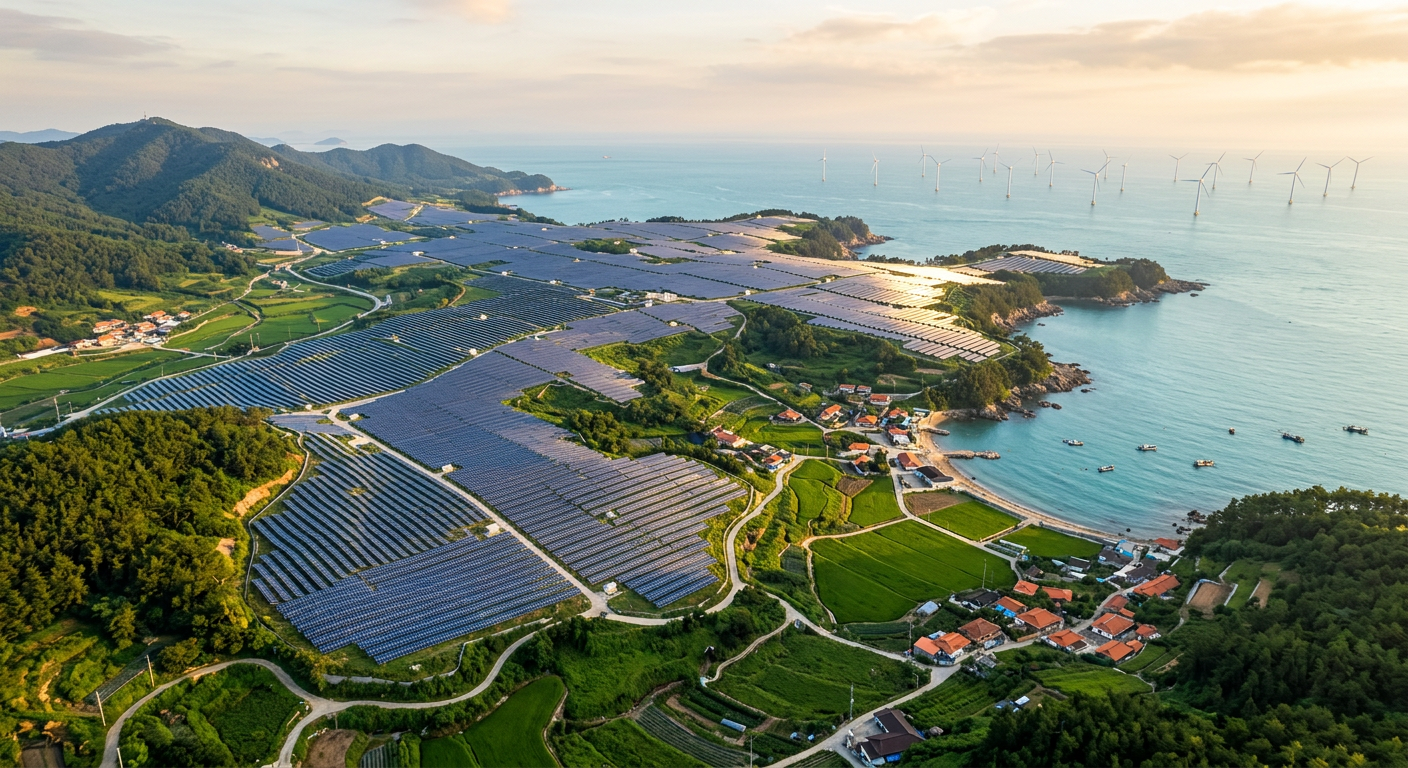
The “Sunlight Pension” is a profit-sharing system that redistributes solar-power revenue to local residents. Its official name is the “Renewable Energy Development Profit Community-Sharing System,” launched by Shinan County when its ordinance took effect in October 2018. Instead of letting developers keep all the earnings, residents who host the panels become shareholders of sorts and collect dividends.
How the Machine Works
A resident joins a “Renewable Energy Residents’ Cooperative” by paying a nominal 10,000-won membership fee. The cooperative holds equity, bonds, or fund positions in the local solar power corporation. When electricity is sold to the grid, a slice of the profit lands in the member’s pocket every quarter, paid out as Shinan local-currency gift certificates rather than cash. The reason for the voucher format is simple. Keep the money inside the island, spent at village diners, tackle shops, and pharmacies.
The county ordinance requires at least 4% of project costs, or 30% on an equity basis, to be held by residents. This cuts complaints and speeds up permits at the same time.
How Much Lands in the Envelope
The numbers are not small. Distance from the plant drives the amount.
- 400,000 to 2.72 million won per person annually
- Quarterly payouts range from 100,000 to 680,000 won, occasionally topping 600,000 won
- Jonpo Village in Anjwa-myeon distributes 150,000 won per person each quarter to 78 people across 43 households
- One eight-member family in Sinmyeong Village, Imja-myeon, once collected a record 2.25 million won in a single quarter, totaling 9 million won a year
- The annual cap per cooperative member is set at 6 million won
Locals joke that “solar panels have become better filial sons than our own children.”
The Scoreboard
Ordinance passed 2018. First resident dividends paid April 2021, a national first. As of October 2025, cumulative payouts crossed the 30-billion-won mark. At the end of 2024 the figure stood at 22 billion won, so nearly 8 billion won piled up in less than a year.
This year, 18,997 residents, roughly 49% of the county population, qualify for either the Sunlight or Wind Pension. Once the 390-megawatt Shinan Ui Offshore Wind project comes online in 2028, every single resident is expected to receive a check.
On top of that, children under 18 get a separate “Sunlight Child Allowance”: 400,000 won in 2023, 800,000 won in 2024, and 1.2 million won in 2025.
Wind Earns Too
November 2025 marked the debut of the “Wind Pension” for residents of Jaeun-myeon, paying 100,000 to 300,000 won per person. Once offshore turbines spin at full capacity, Shinan plans to pay every resident 500,000 won a month, 6 million won a year, starting in 2032.
Not Just Shinan
Guyang-ri in Sejongdaewang-myeon, Yeoju, Gyeonggi Province, runs its own version. All 67 households in the village joined the “Guyang-ri Sunlight Duree Cooperative” and operate a 992-kilowatt bundled solar project. Wolpyeong Village in Dangjin, South Chungcheong, built an agrivoltaic system where residents hold a 56% stake, and 28 households collect 118,000 won per month.
Nationwide, 183 sunlight-pension projects exist, with 83 of them concentrated in Shinan. The distribution is heavily lopsided.
The Shadow Side
No free lunch. Trace the money upstream and you find the “Climate Environment Charge” bundled into every electricity bill. Renewable Energy Certificate (REC) prices also filter back to consumers. Land acquisition, transmission bottlenecks, and economic viability remain open problems. Some villages thrive; others see payouts crawl near zero. The spread is wide.
Still, President Lee Jae-myung in December 2025 ordered a nationwide rollout, saying, “Bring the Shinan officials over here if you have to.” The National Planning Committee is reportedly designing a “Sunlight Dividend” fund model open to participants nationwide.
Three-Line Summary
- The Sunlight Pension shares solar revenue with residents; Shinan County launched it in 2018, began payments in 2021, and has now disbursed over 30 billion won
- Individuals receive 400,000 to 2.72 million won annually in local gift certificates, while minors get a separate 1.2-million-won Sunlight Child Allowance
- Celebrated as a success, the program still carries hidden costs in electricity bills and uneven results across villages
References
- Kyunghyang Shinmun, “Shinan County ‘Sunlight Pension’ Cumulative Revenue Surpasses 30 Billion Won,” Oct 26, 2025
- Dong-A Ilbo, “Shinan ‘Sunlight Pension’ Four Years In… Cumulative Dividends Exceed 22 Billion Won,” Feb 10, 2025
- Hankyoreh, “Can a 2.4-Million-Won Sunlight Pension Save Renewable Energy?” May 27, 2025
- JoongAng Ilbo, “Shinan’s Sunlight and Wind Pension Draws Global Attention,” May 25, 2025
- Maeil Business Newspaper, “Renewable Energy Pension: A Tale of Extremes,” Dec 10, 2025
- Kyungbuk Maeil, “Sunlight Pension,” Jul 30, 2025
- Naver Pay Money Story, “Sunlight Pays a Pension? Nothing Is Free,” Jun 30, 2025
- Yonhap News TV, “President Spotlights Shinan’s Sunlight Pension,” Dec 18, 2025
- Korea Energy Agency Issue Brief, “Sunlight and Wind Pension System Goes Full Scale”