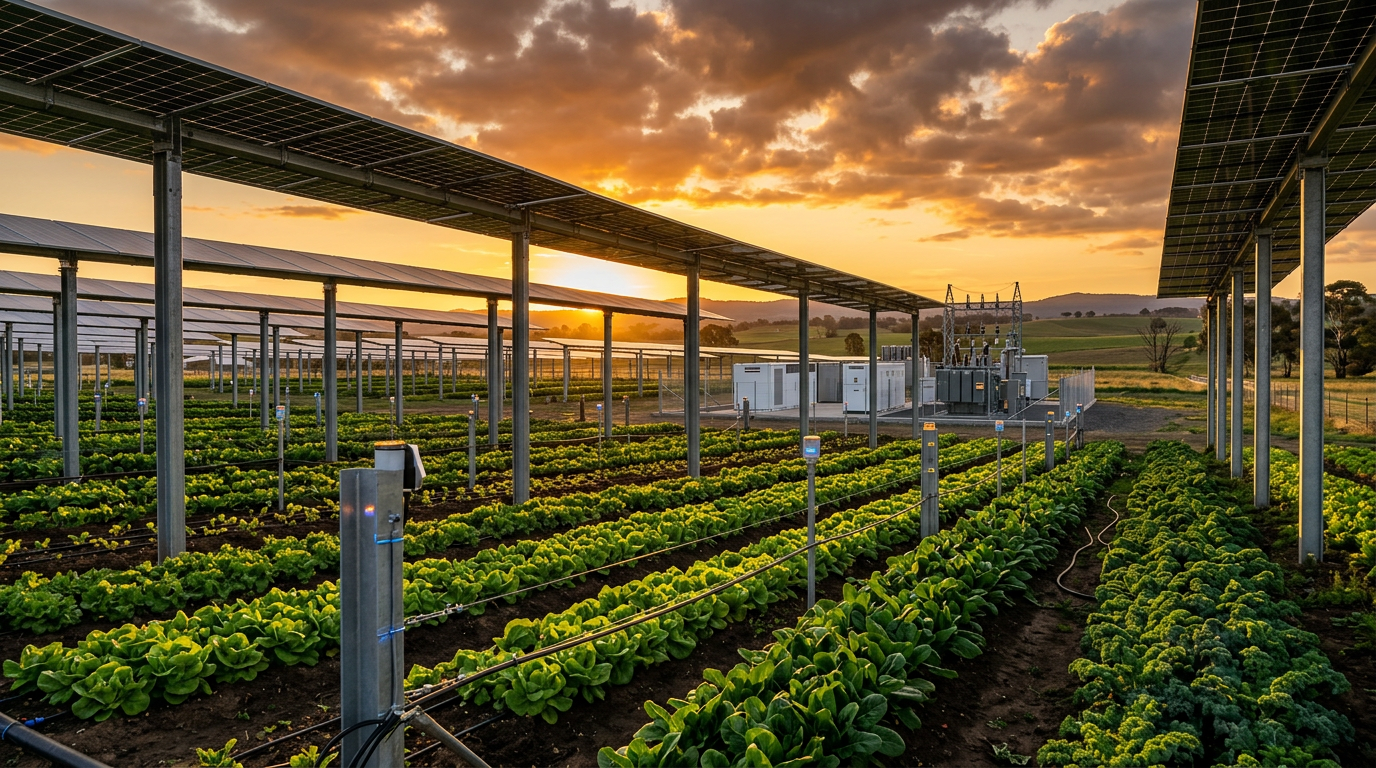
In 2026, AI Agents Take a Seat Between the Field and the Grid
In 2026, AI Agents Take a Seat Between the Field and the Grid
Agriculture and energy infrastructure have long operated in separate worlds — one defined by soil and seeds, the other by wires and generators. Yet in 2026, that boundary is dissolving fast. AI agents now sit squarely between the two, reading soil moisture while simultaneously forecasting power demand.
What Is Agentic AI?
Traditional AI answered questions. Agentic AI decides, plans, and acts. Give it a goal, and it finds a path. As of 2026, approximately 78% of Fortune 500 companies have announced plans to deploy agentic AI in core operations — up from under 20% in early 2025. A vertical climb.
In agriculture and energy, these agents are not mere assistants. They function as conductors orchestrating entire farm systems — processing weather data, soil conditions, crop growth metrics, and electricity market price signals in real time.
Case 1 — Agrivoltaics: Food and Electricity from the Same Plot of Land
Agrivoltaics co-locates crops and solar panels on the same land. The concept is not new. But add an AI agent, and the dynamic shifts entirely.
In India, farmers growing onions and leafy vegetables deployed AI models to dynamically adjust the tilt angles of solar panels installed above their crops. The outcome: a 15% increase in crop yield compared to open-field cultivation, a 30% reduction in water consumption, and enough electricity generated to run local irrigation pumps. Food and energy — produced simultaneously.
According to the National Solar Energy Federation of India (NSEFI), more than 22 agrivoltaic projects are currently operational across the country, with many connected to local grids supplying surplus power. The scale is growing globally. Central European countries could deploy up to 180 GW of agrivoltaic capacity — roughly triple current renewable generation — with an annual potential of 191 TWh. AI makes this possible. The minute-by-minute optimization of panel angle across crop growth stages and seasonal light conditions is beyond human manual control. The agent absorbs that complexity.
Case 2 — John Deere’s Operations Center: Data Harvest Is as Important as Grain Harvest
At CES 2026, John Deere arrived with a pointed slogan: “We harvest as much data as we do grain.” That is not marketing language.
The company’s Operations Center aggregates real-time data from hundreds of autonomous tractors — speed, fuel remaining, engine utilization — and feeds it into a single AI platform alongside soil moisture, nutrient status, and crop growth readings from hundreds of sensors. The AI recommends optimal farming actions and uses its “EjectShot” technology to automatically adjust pesticide and water volumes based on real-time crop condition readings.
In 2026, this electrification technology is expanding beyond tractors to combines and sprayers. Renewable-energy-based charging solutions — running farm machinery on solar and wind — are under active development. The physical integration of agricultural machinery with energy infrastructure is no longer a concept. It is rolling off the assembly line.
Case 3 — BluWave-ai: A Farm Energy Agent That Learns Every 5 Minutes
Canadian AI company BluWave-ai won the 2025 Grid Management Storage Award from Energy Storage Canada (ESC) in October 2025. Its AI optimizer, deployed at Sunbank Farm, performs “fast-loop learning” — refreshing operational schedules every five minutes.
In balancing areas where variable renewable resources exceed 35% of total generation, conventional statistical models cannot keep up with the irregularity. BluWave-ai’s AI agents forecast weather shifts and electricity price spikes simultaneously, optimizing battery energy storage systems (BESS) in real time. The farm stops being merely a food production site. It becomes an economic unit that actively trades energy.
Case 4 — Virtual Power Plants: The Farm Becomes a Generator
One of the fastest-spreading business models of 2026 is the Virtual Power Plant (VPP). AI agents aggregate thousands of small distributed resources — farm battery storage, smart irrigation systems, rooftop solar — into a single “virtual” plant that bids autonomously into energy markets.
According to Wood Mackenzie, North American VPP capacity grew 13.7% year-over-year to reach 37.5 GW. For peak demand reductions of up to 20%, VPPs are now a proven and cost-effective instrument. Agriculture adds a compelling layer. High-power farm equipment — irrigation pumps, cold storage, grain dryers — can be programmed to run when power prices are low and pause when prices spike, cutting energy costs while simultaneously stabilizing the grid.
Case 5 — AI Digital Twins and Smart Grids: Mapping a Path to Carbon Neutrality
Published in Scientific Reports in February 2026, a study validated an AI-based digital twin framework capable of cutting carbon emissions from smart grids by approximately 30% compared to conventional approaches. Specifically, Model Predictive Control (MPC) reduced the carbon footprint from 2,485.2 kgCO₂ to 1,741.1 kgCO₂ — a 29.9% reduction — with a corresponding 30% cut in operational costs.
Physical infrastructure is becoming increasingly autonomous. In 2026’s self-healing grid scenarios, when a storm severs a transmission line, an AI agent autonomously reroutes power, isolates the fault, and dispatches a repair drone to the exact GPS coordinates — all without human intervention. Outage duration is estimated to fall by up to 80%.
Case 6 — Big Tech’s Energy Internalization: AI Flips the Infrastructure Equation
Here is an unexpected angle. The AI data center boom is now pulling on agricultural and energy infrastructure from the other direction.
Data center electricity consumption is projected to exceed 1,000 terawatt-hours (TWh) in 2026 — more than double the 2022 figure. Microsoft signed a 20-year, $16 billion power purchase agreement to restart the Three Mile Island Unit 1 reactor in Pennsylvania, claiming essentially 100% of its ~837 MW output. Meta is securing up to 6.6 GW of nuclear capacity through deals with Vistra, Oklo, and Constellation. Google struck the first major U.S. corporate deal for a fleet of Small Modular Reactors (SMRs) with Kairos Power — up to 500 MW across roughly six or seven units.
Where this intersects with agriculture: data centers built in rural regions are beginning to form shared energy ecosystems with local farms — rural power generation, agricultural water management, and data processing converging into a single regional economy.
Key Figures at a Glance
| Metric | Value | Source |
|---|---|---|
| Agentic AI in Energy & Utilities Market (2026) | $870M | Mordor Intelligence |
| Market CAGR through 2031 | 36.35% | Mordor Intelligence |
| Target market size (2030) | $4.11B | Mordor Intelligence |
| Water savings via agrivoltaic AI | 20–40% | Multiple studies |
| Crop yield increase via smart farm AI | 15–30% | IBM, Reuters research |
| Global Smart Grid market (2026) | $120B | MEXC Intelligence |
| North American VPP capacity (2025) | 37.5 GW | Wood Mackenzie |
| AI grid carbon reduction | ~30% | Scientific Reports (2026) |
| Fortune 500 firms planning agentic AI adoption | 78% | Industry survey |
Where This Is Heading
All of these cases point to the same destination: farms, power plants, and data centers merging into a single AI-mediated “energy-food infrastructure complex.” In South Korea, a National Assembly policy forum in December 2025 debated the concept of “energy-autonomous smart farms” — supplying farm energy via solar generation and using AI to maximize efficiency. The discussion is no longer theoretical.
From the moment a seed is planted to the moment electricity is traded on the market, AI agents can now manage the entire chain autonomously. That future is not distant. It is, in many places, already running.
References
- Mordor Intelligence, Agentic AI in Energy and Utilities Market, 2026-01-28. https://www.mordorintelligence.com/industry-reports/agentic-artificial-intelligence-in-energy-and-utilities-market
- AgriNextCon, Farming Smarter Under the Sun: AI in Agrivoltaics, 2025-08-24. https://agrinextcon.com/farming-smarter-under-the-sun-ai-in-agrivoltaics/
- DigitalDefynd, Agentic AI in Agriculture [10 Case Studies] 2026, 2026-01-07. https://digitaldefynd.com/IQ/agentic-ai-in-agriculture/
- Chosun Ilbo, [CES 2026] Traditional Industries Reborn with AI: The Expanding ‘Physical AI’, 2026-01-03. https://www.chosun.com/economy/tech_it/2026/01/04
- BluWave-ai, BluWave-ai Wins Energy Storage Canada Grid Management Storage Award, 2025-10-12. https://www.bluwave-ai.com/blog/bluwave-ai-press-release-energy-storage-canada-grid-management-storage-award-2025
- Scientific Reports, A multi strategy optimization framework using AI digital twins for smart grids, 2026-02-11. https://www.nature.com/articles/s41598-026-38720-3
- Utility Dive, In 2026, virtual power plants must scale or risk being left behind, 2026-01-26. https://www.utilitydive.com/news/in-2026-virtual-power-plants-must-scale-or-risk-being-left-behind/810321/
- ABHS Research, Big Tech Just Bought 10+ GW of Nuclear Power for AI, 2026-03-03. https://www.abhs.in/blog/nuclear-power-ai-data-centres-meta-microsoft-google-deals-2026
- Nature (Scientific Reports), Agentic AI-driven autonomous decision support system for smart agriculture, 2026-02-19. https://www.nature.com/articles/s41598-026-39472-w
- MEXC Intelligence, The Intelligent Energy: Self-Healing Grids, Virtual Power Plants, 2026-02-21. https://www.mexc.com/news/768205
- Frontiers in AI, Role of artificial intelligence in smart grid – a mini review, 2025-02-03. https://www.frontiersin.org/journals/artificial-intelligence/articles/10.3389/frai.2025.1551661/full
- CEUR-WS, AI-Powered Solutions in Agriculture and Green Energy, 2025-12-06. https://ceur-ws.org/Vol-4121/Ital-IA2025paper_52.pdf