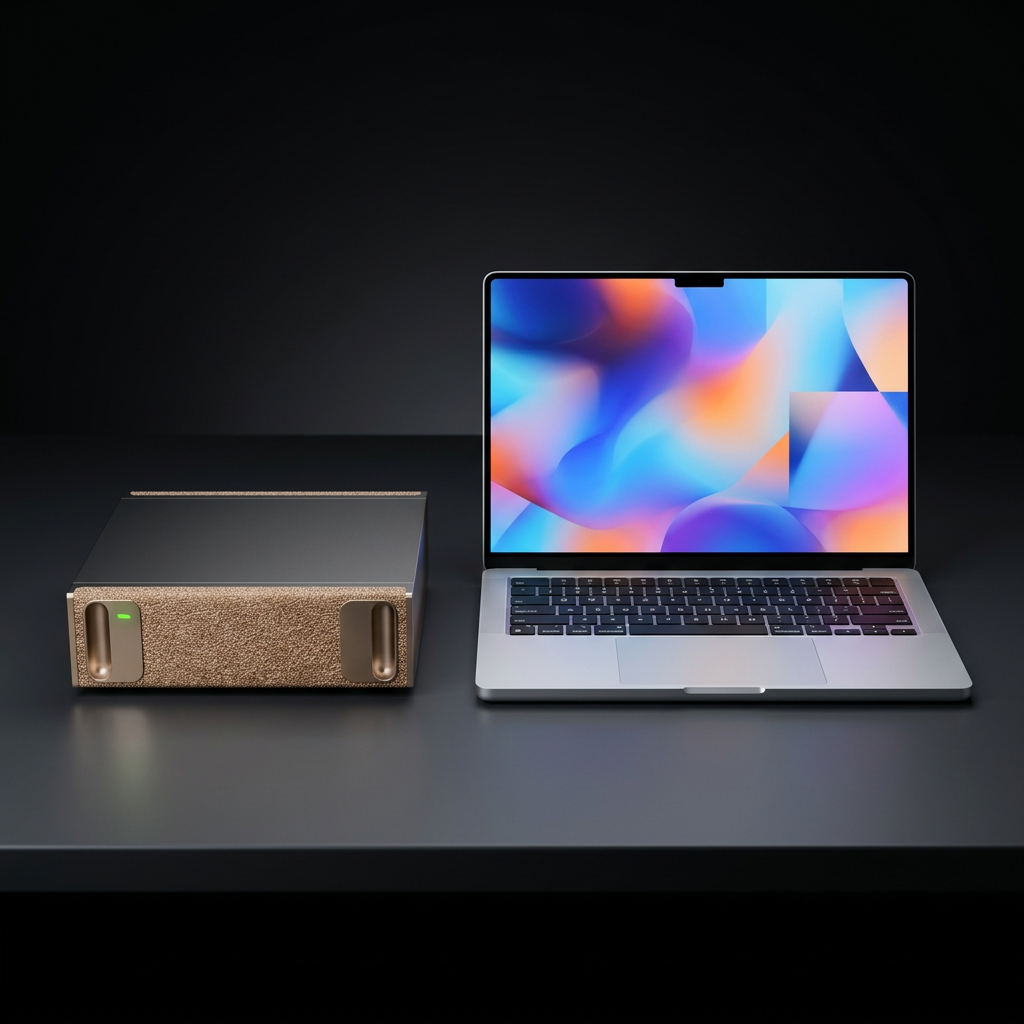
DGX Spark vs M5 Max — The Desktop AI War Nobody Expected
DGX Spark vs M5 Max — The Desktop AI War Nobody Expected
Since late 2025, developers have been stuck in an unusual argument. “What should I actually buy for AI work?” Years ago, this question led to cloud subscriptions or server room budgets. Now, two devices that sit on a desk are going head to head. NVIDIA DGX Spark and Apple MacBook Pro M5 Max. They start from completely different philosophies. That’s exactly what makes the comparison interesting.
Core Specs at a Glance
| Spec | NVIDIA DGX Spark | MacBook Pro M5 Max |
|---|---|---|
| Chip | NVIDIA GB10 Grace Blackwell Superchip | Apple M5 Max |
| CPU | 20-core ARM (Cortex-X925 × 10 + Cortex-A725 × 10) | 18-core (6 super cores + 12 performance cores) |
| GPU | Blackwell architecture, 6,144 CUDA cores | Up to 40-core GPU |
| Memory | 128GB LPDDR5X unified memory | Up to 128GB unified memory |
| Memory Bandwidth | 273 GB/s | Up to 614 GB/s |
| AI Compute | 1 PFLOP (FP4, theoretical) | Undisclosed (~4× M4 Max AI performance) |
| Storage | 4TB NVMe SSD | Up to 8TB SSD |
| Form Factor | Desktop mini PC (150×150×50mm) | Laptop (14” / 16”) |
| Power Draw | Up to 240W (SOC TDP: 140W) | Up to 140W charger (~90W under load) |
| OS | DGX OS (Ubuntu-based) | macOS |
| Price | $4,699 (after Feb 2026 price increase) | From $3,599 (14” M5 Max) |
| Networking | ConnectX-7 200Gbps QSFP, 10GbE | Thunderbolt 5, Wi-Fi 7 |
Design Philosophy: Two Completely Different Bets
NVIDIA DGX Spark was designed from the ground up as an AI development machine. Data center-class Blackwell GPU architecture packed into a box the size of a thick hardcover book — 150×150×50mm. The entire NVIDIA AI software stack ships preinstalled: CUDA, TensorRT-LLM, vLLM. That’s it. No screen, no keyboard. A pure inference and fine-tuning appliance.
M5 Max takes a different path. Apple marketed it as carrying “the world’s fastest CPU core” in a laptop. For developers, AI was a bonus feature. Then the M5 Max 128GB configuration arrived and changed the framing. Video editing, coding, interactive LLM inference — all from a single device. Running on battery for 22 hours.
AI Inference Performance — The Real Numbers
This is where things get complicated.
DGX Spark’s 1 PFLOP FP4 figure is theoretical peak. In practice, running Llama 3.3 70B, decode speed drops to roughly ~2.7 tokens/sec under vanilla llama.cpp setups. The root cause is simple: memory bandwidth bottleneck. At 273 GB/s, the bandwidth can’t keep pace with the Blackwell GPU’s enormous compute capacity. A powerful engine starved of fuel.
Optimized with TensorRT-LLM and NVFP4 quantization, the picture improves dramatically — LMSYS benchmarks showed GPT-OSS 20B at 49.7 tokens/sec decode. Setup matters enormously here.
M5 Max (128GB) benefits from its 614 GB/s bandwidth, delivering strong decode performance. Benchmarks show Qwen3-122B-A10 at 65.9 tokens/sec at 4K context, and Llama 3.1-class 70B models at around 88.49 tokens/sec. Both numbers are well above the human reading threshold of 3–5 tokens/sec.
For small models (sub-8B), DGX Spark pulls ahead. MXFP4 prompt processing reaches ~1,723 tokens/sec, and fine-tuning Llama 3.2B peaks at 82,739 tokens/sec. M5 Max doesn’t get close in this territory.
Inference Speed Summary
| Scenario | DGX Spark | M5 Max (128GB) |
|---|---|---|
| Llama 70B — Decode | ~2.7 t/s (llama.cpp) / ~49.7 t/s (MXFP4, TRT-LLM) | ~88 t/s (MLX, 4K ctx) |
| 8B Model — Prompt Processing | ~1,723 t/s (MXFP4) | ~1,325 t/s (4K ctx) |
| 70B Fine-Tuning (QLoRA) | 5,079 t/s peak | Not feasible (framework limits) |
| 200B Model Inference | Supported (FP4, single unit) | Possible (quantized) |
| 405B Model Inference | Requires 2-unit cluster | Essentially not viable |
Memory Bandwidth — This Is the Real Fight
In local LLM inference, decode-phase performance is fundamentally bandwidth-limited. Every generated token requires reading the entire model’s weights through memory once. There’s no shortcut.
- M5 Max: 614 GB/s (up from 546 GB/s on M4 Max)
- DGX Spark: 273 GB/s
By bandwidth alone, M5 Max is roughly 2.25× wider. This is the structural reason why M5 Max dominates interactive inference against DGX Spark. For anyone running a local coding assistant or conversational AI, this difference is felt in every response.
CUDA vs MLX — The Ecosystem Gap
DGX Spark’s real edge is the CUDA ecosystem. The vast majority of AI development happens in PyTorch, TensorRT, vLLM, and HuggingFace — all built around CUDA. DGX OS ships with NVIDIA’s full AI stack preinstalled. Fine-tune on the desk, deploy to cloud GPU — same codebase, no friction. That portability is a genuine moat.
M5 Max runs on Apple’s MLX framework, which is open-source and improving rapidly, but ecosystem maturity lags behind. Some models and library features arrive on MLX later than CUDA. Complex features like KV-cache reuse in multi-turn agentic workflows are areas where MLX still shows limitations. That said, macOS integration with CoreML means AI tasks run without freezing the UI — a quality-of-life advantage for daily-driver use.
Power and Form Factor
DGX Spark requires a 240W external power adapter. Under AI inference loads, it typically draws 60–90W. After a recent software update, idle power dropped to 22–25W. The physical footprint is tiny — less than a 1-liter volume.
M5 Max MacBook Pro operates on a 140W charger but pulls around 90W under CPU+GPU combined load. The battery means the charger isn’t always necessary. Apple claims 22 hours of video streaming. Heavy LLM inference will eat through battery faster, but the mobility baseline is a different category entirely.
Pricing Reality
DGX Spark launched at 4,699 — a 9,449.
MacBook Pro M5 Max pricing:
- 14-inch: From $3,599 (128GB configuration adds significant cost)
- 16-inch: From 7,349)
At face value the prices sit in the same neighborhood. But DGX Spark is an AI-only appliance, while M5 Max covers all daily workloads. That changes the value equation substantially.
Who Should Buy Which
DGX Spark is the right choice when:
- Fine-tuning 70B–200B parameter models locally is the primary task
- Existing CUDA-based codebases need to run on-premises
- Migrating a cloud AI development workflow to local hardware
- A 2-unit cluster for 405B inference is in scope
- Fixed workstation deployment, no mobility required
M5 Max is the right choice when:
- Interactive LLM use and local coding assistant operation is the focus
- One device needs to cover all development work and AI inference
- macOS ecosystem (iOS development, Final Cut Pro, video production)
- Daily carry portability matters
- Off-grid AI inference with battery power is needed
Bottom Line
DGX Spark is built for people who train and deploy AI. M5 Max is built for people who use AI while working. Both carry 128GB of unified memory, but how that memory is fed — and at what speed — is what separates them.
References
- NVIDIA DGX Spark Official Hardware Specs: https://docs.nvidia.com/dgx/dgx-spark/hardware.html
- NVIDIA DGX Spark Press Release: https://nvidianews.nvidia.com/news/nvidia-dgx-spark-arrives-for-worlds-ai-developers
- Apple MacBook Pro M5 Max Official Specs: https://support.apple.com/ko-kr/126319
- Apple Newsroom M5 Pro & M5 Max Announcement: https://www.apple.com/newsroom/2026/03/apple-introduces-macbook-pro-with-all-new-m5-pro-and-m5-max/
- LMSYS DGX Spark In-Depth Review (Inference Benchmarks): https://lmsys.org/blog/2025-10-13-nvidia-dgx-spark/
- Hardware-Corner M5 Max LLM Benchmarks (March 2026): https://www.hardware-corner.net/m5-max-local-llm-benchmarks-20261233/
- Apple MLX + M5 Neural Accelerator Research Blog: https://machinelearning.apple.com/research/exploring-llms-mlx-m5
- DGX Spark Price Hike Report (Tom’s Hardware): https://www.tomshardware.com/desktops/mini-pcs/nvidia-dgx-spark-gets-18-percent-price-increase-as-memory-shortages-bite
- NVIDIA Developer Blog DGX Spark Performance Analysis: https://developer.nvidia.com/blog/how-nvidia-dgx-sparks-performance-enables-intensive-ai-tasks/
- MacBook Pro M5 Max PCMag Review: https://www.pcmag.com/reviews/apple-macbook-pro-16-inch-2026-m5-max
- Simon Willison DGX Spark Hands-On Review: https://simonwillison.net/2025/Oct/14/nvidia-dgx-spark/
- Reddit r/LocalLLM M4/M5 Max vs DGX Spark Discussion: https://www.reddit.com/r/LocalLLM/comments/1qcmmvw/
- Tom’s Hardware DGX Spark Idle Power Update: https://www.tomshardware.com/tech-industry/artificial-intelligence/nvidia-dgx-spark-update-cuts-idle-power-by-32-percent-or-more