Exploring the potential and profitability of agrivoltaics in greenhouses and the major regulatory changes coming in 2026.
Solar panels on a rooftop. That’s the image most people have. But what if you could put them on top of a greenhouse or vinyl house? Turns out, people are already doing it. Farmers who grow crops and sell electricity at the same time — their numbers are growing fast.
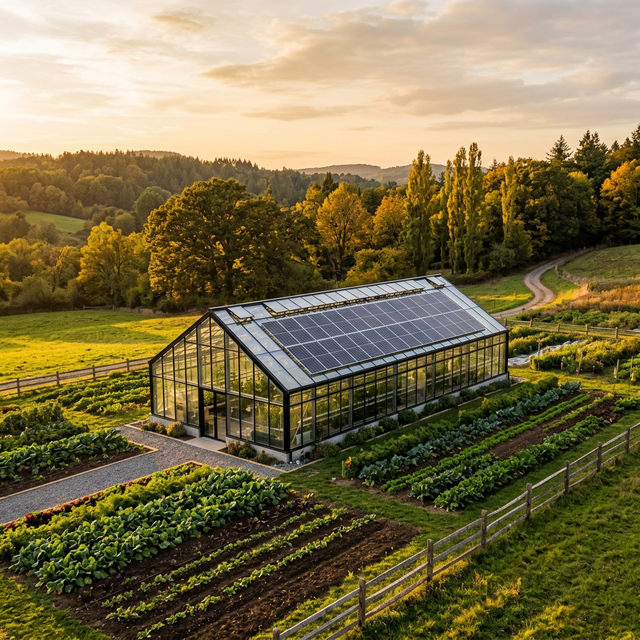
Solar on Vinyl Houses: It Actually Works
Let’s cut to the chase. It works. In 2023, South Korea’s first solar-powered smart farm opened in Yangpyeong, Gyeonggi Province. Built through a partnership between Hanwha Solutions and the National Agricultural Cooperative Federation (Nonghyup), the facility installed a 64kW solar power system on top of vinyl greenhouse structures. It self-generates approximately 93% of the electricity needed for heating, cooling, IoT systems, and environmental controls. Farming without worrying about the electric bill.
The key lies in module size. Hanwha Qcells developed an agrivoltaic solar module that’s half the size of standard panels. It doesn’t significantly block sunlight from reaching the greenhouse interior and minimizes rainwater drip damage. The design lets through the light crops need while generating electricity from the rest.
When Shade Becomes Medicine
”Won’t crops die under solar panels?” That’s always the first question. The answer might surprise you.
Researchers at the University of Arizona grew chiltepin peppers, jalapeños, and cherry tomatoes under a photovoltaic array. The results were striking. Chiltepin pepper yield tripled. Tomato production doubled. Jalapeños produced similar yields but with 65% less water loss through transpiration. The shade from panels lowered daytime temperatures and helped soil retain moisture longer.
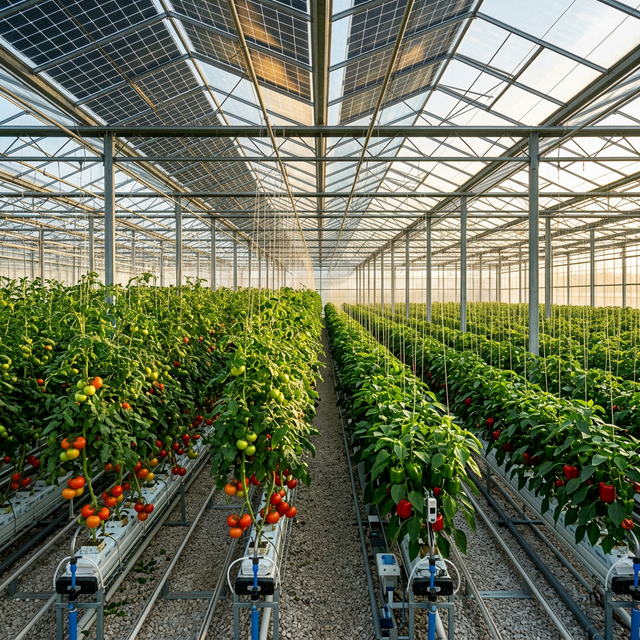
A study in Montpellier, France showed similar results. Growing lettuce and cucumbers beneath solar panels reduced water evaporation by 14 to 29%. In water-scarce regions, that difference can mean survival.
The Revenue Structure in Numbers
In 2025, Yeongam County in South Jeolla Province published results from a pilot combining rice farming with solar power. Rice yield dropped by 21%. But estimated annual revenue from solar generation was about 8.97 million KRW. Combined with rice, total revenue hit roughly 9.89 million KRW — 8.4 times higher than rice farming alone.
There’s a catch, though. These figures exclude the cost of installing solar equipment. In South Korea, the payback period for agrivoltaic systems is at least 14 years. Panel warranties last 25 years, which means the actual profit window after breaking even is shorter than you’d think. This isn’t a get-rich-quick scheme — it requires patience.
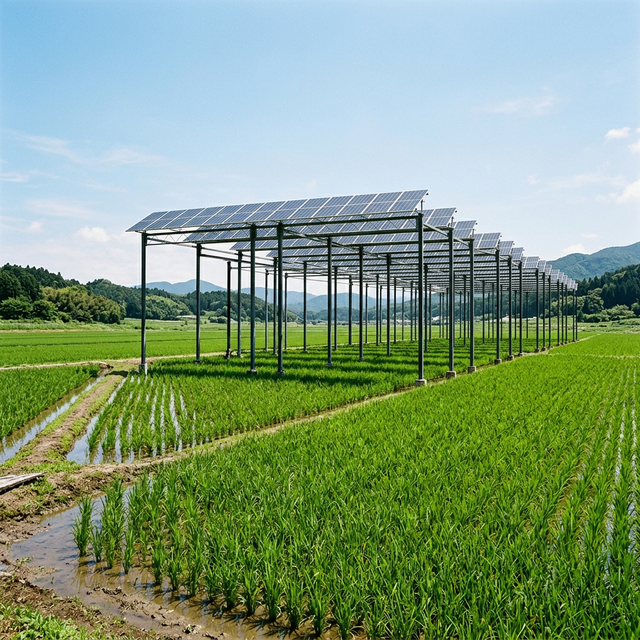
Analysis by the Korea Rural Economic Institute (KREI) backs this up. With the previous 8-year land-use permit, the benefit-cost ratio (B/C) was just 0.74 — a losing proposition. Extending the permit to 20+ years pushes the B/C to 1.24, yielding 2.8 times more revenue than rice alone. Time is literally money in this business.
The Yield Reduction Problem
Solar panels on farmland inevitably reduce crop yields. This is called the yield reduction rate. The government’s target is keeping it under 20%, and the national average sits around 15.7% — manageable on paper.
But reality tells a different story. According to 2025 National Assembly audit data, rice yield in Geochang County, South Gyeongsang Province, plummeted by 71%. Hamyang County saw 51%, Haman County 40%. Relying on averages alone while expanding the program is reckless.
The solution? Choose shade-tolerant crops. In Japan, over 120 crop varieties are grown under agrivoltaic systems. Green tea, mushrooms, and ginseng actually benefit from shading. Blueberries are another promising candidate — a Korean pilot study found that blueberry agricultural revenue (20.51 million KRW) exceeded solar generation revenue (9.87 million KRW). Pairing high-value crops with solar is the winning strategy.
Semi-Transparent Solar Cells: A Game Changer
Conventional solar panels block light entirely. Covering an entire greenhouse roof with them isn’t practical. Enter semi-transparent solar cells. These transmit specific wavelengths that plants need for growth while generating electricity from the rest.
Researchers at North Carolina State University grew red leaf lettuce under semi-transparent organic solar cells (ST-OSCs) for 30 days. The lettuce grew just as well regardless of which wavelength bands were filtered. If this technology becomes commercially viable, greenhouse roofs themselves become power generators.
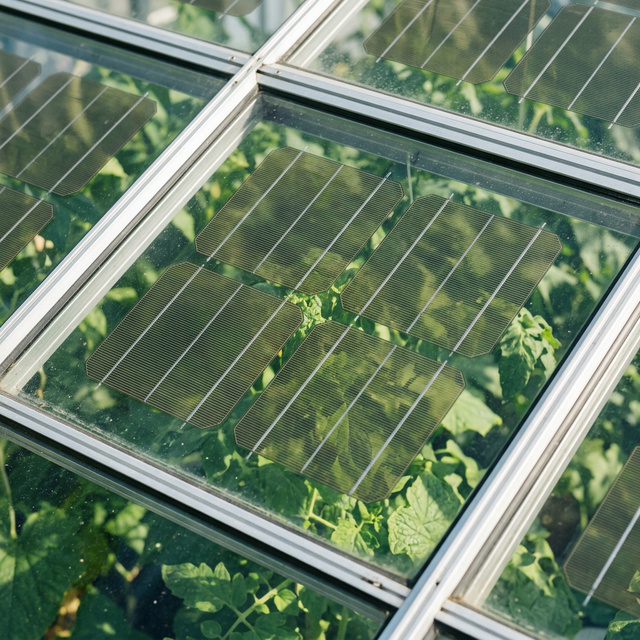
A Korean patent already exists for this concept. Using dye-sensitized or amorphous silicon solar cells, the technology adjusts transmittance and wavelength selection. Red light (660nm) promotes photosynthesis. Blue light (450nm) prevents excessive stem elongation. Green light (530nm) inhibits mold growth. Customized greenhouses that filter optimal wavelengths for each crop are within reach.
Japan Started 15 Years Ahead
Japan’s Solar Sharing concept was proposed in 2004 by farmer Akira Nagashima. Official permits began in 2013, and over the next decade, 6,137 installations were approved — covering 13.6 million square meters of farmland, roughly 4.5 times the area of Yeouido island in Seoul.
Japan allows 20-year project terms and buys electricity through its Feed-in Tariff (FIT) system. This enabled extensive experimentation. Data exists for over 120 crop varieties, and researchers determined the optimal panel-to-open-space ratio is 1:2.
But problems emerged. Without shading limits, some farmers prioritized solar revenue over actual farming. There’s been a noticeable tilt toward shade-loving crops. These are lessons Korea should learn from.
Europe and China Operate at a Different Scale
The world’s largest agrivoltaic installation is in China. The Baofeng PV Park in Ningxia covers 20 square kilometers at a staggering 1GW capacity. Solar panels sit above goji berry crops growing in what was once desert. The project fights desertification, produces electricity, and harvests crops simultaneously. Annual CO₂ reduction: 1.695 million tons.
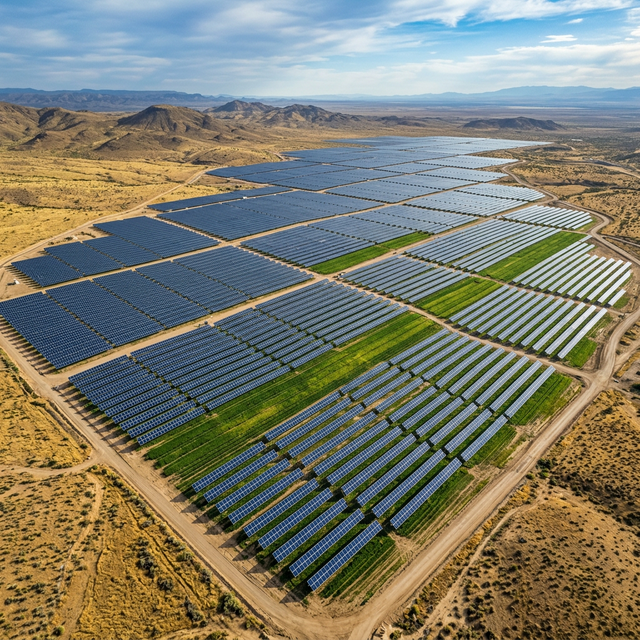
Italy’s Enel is building a 170MW agrivoltaic project in northern Italy. Once complete, it will power 111,000 homes while growing herbs and olives between panel arrays. The Netherlands’ Vattenfall operates tracking-mount pilot projects, and in Germany, free-range chickens lay organic eggs under solar panels.
2026: Korea’s Landscape Is Changing
Korean agrivoltaic projects have been strangled by regulation. The temporary land-use permit lasted only 8 years — less than a third of a panel’s 25-year lifespan. One cooperative leader in Hamyang lamented: “We spent 160 million KRW on installation and barely recovered costs after 5 years. Now we have to tear down equipment that could generate 600 million KRW in future revenue.”
Starting in 2026, things change. The government announced three key reforms. First, agrivoltaic installation will be permitted in agricultural promotion zones. Second, the project period extends to a maximum of 23 years. Third, setback distance standards will be unified nationwide. An Agrivoltaic Special Act has also been submitted to the National Assembly.
Designated renewable energy zones will allow solar installations even in core agricultural areas. The Sunlight Income Village model — where generation revenue flows back to the community — is spreading. The shift from subsidy dependence to self-sustaining revenue has begun.
Who Should Consider Greenhouse Solar?
Installing solar power on greenhouses and vinyl houses is clearly feasible. The technology exists, and regulations are starting to catch up. But it’s not a silver bullet.
South-facing structures with sufficient sunlight are essential for efficiency. Neglecting shade management can devastate crops. Upfront costs are heavy, with payback taking 14+ years. But combine high-value crops with a 23-year business window, and the equation shifts. Selling electricity, selling produce, and saving water — a powerful trifecta.
Rural populations are shrinking. Climate is becoming unpredictable. Agrivoltaic systems are one of the few cards that address both problems at once. Electricity being generated on top of vinyl houses — that’s no longer a vision of the future. It’s happening right now.
References
- Yonhap News, “Hanwha Solutions and Nonghyup unveil Korea’s first solar-powered smart farm”, June 21, 2023
- Future Chosun, “Nonghyup-Hanwha Solutions launch solar-powered smart farm”, July 5, 2022
- Mokpo MBC, “Agrivoltaic rice farming yields 8x revenue in Yeongam County”, Nov 11, 2025
- Barron-Gafford et al., “Agrivoltaics provide mutual benefits across the food–energy–water nexus in drylands”, Nature Sustainability, 2019
- University of Arizona News, “Agrivoltaics Proves Mutually Beneficial Across Food, Water, Energy Nexus”, Sept 2019
- Korea Rural Economic Institute (KREI), “Economic Analysis and Policy Implications for Agrivoltaic Adoption”
- Journal of Environmental Policy, Vol. 33 No. 2, “Improving Korea’s Agrivoltaic Policy”, 2025
- Donga Ilbo, “Rice yield drops up to 71% under agrivoltaic panels”, Oct 13, 2025
- Maeil Business Newspaper, “Japan’s 15-year head start in farm-top solar — lessons and pitfalls”, Feb 2, 2026
- Weekly Kyunghyang, “Lessons from Japan, the agrivoltaic pioneer”, Nov 22, 2022
- IRS Global, “Agrivoltaics gaining momentum overseas, driven by large corporations”, May 2024
- Naver Blog (jjy0501), “Promising crops under transparent solar panels”, Mar 23, 2021
- Korean Patent KR20110024961A, “Greenhouse using semi-transparent solar cells”
- Herald Economy, “Agrivoltaics and Sunlight Income Villages turning rural areas profitable”, Dec 2025
- Korea Energy Service HizonTV, “Three changes coming to agrivoltaics in 2026”, Oct 2025
- E-Daily, “Crisis in agrivoltaics: ‘25-year panels torn down after 3 years’”, July 2023
- Korean Solar Energy Society, “Pilot study on independent-pillar agrivoltaics and high-value crop cultivation”, 2023
- World Economic Forum, “Agrivoltaic farming: Growing crops under solar panels”, 2022
- Miilkii Agrow, “Agrivoltaic greenhouses: Dual-use land strategies for energy and food production”, 2025
- Marrou et al., “Agrivoltaic systems reduce water usage by 14–29%”, Montpellier study, 2013
#Agrivoltaics #SmartFarm #SolarPower #AgriculturalInnovation #RenewableEnergy #NetZero #RuralEconomy #GreenhouseSolar #VinylHouseSolar #FutureAgriculture