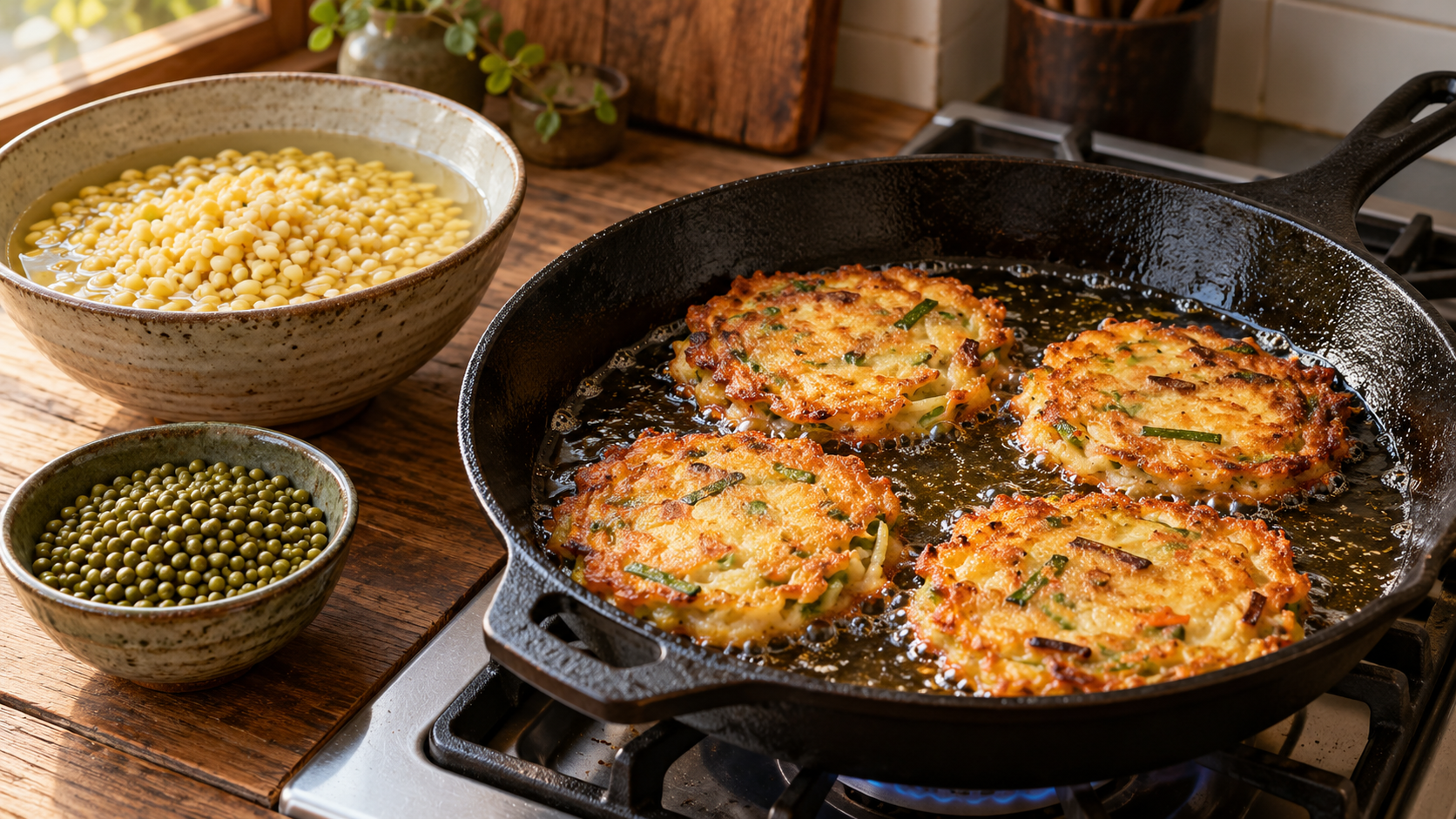
How to make Korean mung bean pancakes (nokdujeon, bindaetteok) from the Korean Food Promotion Institute and national food portal recipes, how many pancakes 1 kg of mung beans makes, soaking times for hulled and whole beans, KAMIS domestic and Chinese mung bean prices on October 20, 2026, cost per pancake, and what growers should offer before the November season.
With mung bean pancakes, time is the problem more than ingredients. Do you soak the night before? When do the skins come off? How many pancakes does a 1 kg bag make? Ahead of November, when Korean households make kimchi and hold memorial rites, here is the order and the quantities. Recipe numbers come from the Korean Food Promotion Institute and the National Institute of Crop Science food portal; where no official number exists, we show the calculation.
Bottom line: Soak hulled mung beans in lukewarm water for about an hour, and whole beans for about 8 hours. The institute’s 4-serving recipe uses 500 g of dry beans, so 1 kg serves 8. At half a cup of batter per pancake, 1 kg makes about 35 pancakes (calculated). On October 20, 2026, domestic mung beans (top grade, 40 kg) averaged KRW 548,000 at wholesale across five cities, about KRW 13,700 per kg; Chinese beans were about half, KRW 6,700.
Earlier notes: prices and harvest in domestic mung bean price 2026, and a related grain in how to cook red beans 2026. Daily prices: mung bean and imported mung bean.
Try the numbers: the produce market calculator shows what you keep after selling in each city.
1. Ingredients and steps
| Ingredient | Korean Food Promotion Institute (4 servings) | Food portal bindaetteok |
|---|---|---|
| Mung beans | 500 g dry | 80 g hulled (½ cup) |
| Water to grind | ½ cup | not stated |
| Pork | 250 g minced | 60 g loin |
| Bean sprouts | 150 g | 60 g |
| Kimchi | 250 g | 60 g |
| Other | 1 tsp salt | 15 g glutinous rice flour, scallion, red chili, 1 tbsp oil |
Soak and skin the beans, grind them thick with a little water, mix in blanched sprouts and seasoned pork and kimchi, then fry rounds in an oiled pan. The institute uses half a cup of batter per pancake.
2. Soaking: hulled versus whole
- Hulled (split) beans: about one hour in lukewarm water (Korean Food Promotion Institute).
- Whole beans: about 8 hours, then rub off the skins (National Institute of Agricultural Sciences).
Rub soaked whole beans hard between your hands under water; the skins float and can be poured off. Repeat three or four times. Use little water when grinding, or the batter spreads thin and soggy.
3. How many pancakes from 1 kg?
No official source gives a count, so we calculated. The 4-serving recipe uses 500 g, so 1 kg serves 8; at the portal’s 80 g per serving, 12–13.
We assumed soaked beans weigh twice the dry weight (cooked mung beans are 2.27 times, from 9.4 g to 60 g water per 100 g in the national composition table; soaking alone absorbs less). For 500 g dry: about 1,000 g soaked beans + 100 g water + 650 g pork, sprouts and kimchi ≈ 1,750 g. At about 100 g per half-cup pancake, that is about 17 pancakes per 500 g, or about 35 per kg.
4. Domestic versus imported prices
KAMIS wholesaler prices on October 20, 2026 (40 kg):
| City | Domestic, top grade | Chinese, mid grade |
|---|---|---|
| Seoul | KRW 500,000 | KRW 213,000 |
| Busan | KRW 483,000 | KRW 345,000 |
| Daegu | KRW 659,000 | KRW 293,000 |
| Gwangju | KRW 498,000 | KRW 260,000 |
| Daejeon | KRW 600,000 | KRW 230,000 |
| Average | KRW 548,000 | KRW 268,200 |
| Per kg | about KRW 13,700 | about KRW 6,705 |
Domestic beans are about 3% above a year earlier and about twice the Chinese price. Online on October 21: Korean whole beans KRW 16,900–19,690 per kg, Korean hulled KRW 26,800, imported hulled KRW 12,880. At 35 pancakes per kg, the beans cost about KRW 770 per pancake for Korean hulled, KRW 480–560 for Korean whole and KRW 370 for imported hulled.
5. Storing batter and pancakes
We found no official guidance on freezing batter or cooked pancakes. Batter with meat and kimchi spoils quickly, so fry it all the same day; freeze leftovers one by one and reheat in a lightly oiled pan. Keep dry beans airtight in a cool, dry place, as weevils are common.
6. For growers
Mung beans ripen unevenly and need three or four hand pickings, which a 2009 Korean Journal of Crop Science paper links to the sharp fall in planted area. RDA’s machine-harvest variety Chaeheun, reported in October 2025, yields 257 kg per 10 a (13% above Sanpo) with a quarter of Sanpo’s pod shattering. Before the November and Lunar New Year pancake seasons, offer 500 g and 1 kg hulled packs, state “2026 Korean” clearly, dry to the government purchase standard of 14.0% moisture or below, and print a portion guide such as “500 g makes 4 servings, about 17 pancakes”.
7. Checklist
- Hulled beans: about 1 hour soak; whole beans: about 8 hours.
- 500 g dry beans and ½ cup water for 4 servings.
- 1 kg ≈ 8 servings ≈ 35 pancakes (calculated).
- KAMIS Oct 20: domestic about KRW 13,700/kg, Chinese about KRW 6,705/kg.
References
- aT KAMIS wholesaler prices: mung beans, domestic top grade and Chinese mid grade, 40 kg, five cities, October 20, 2026 (data.go.kr API).
- Korean Food Promotion Institute, nokdujeon recipe: hansik.or.kr
- National Institute of Crop Science food portal, bindaetteok: nics.go.kr
- National Institute of Agricultural Sciences, ingredient of the month, mung bean: nics.go.kr
- Korean Food Composition Database 10.4: nics.go.kr
- Kim et al., Korean Journal of Crop Science 54(1), 2009: koreascholar.com
- Online prices: Oasis and Foodspring product pages, checked October 21, 2026.