How to cook Korean red beans (pat, adzuki) based on Rural Development Administration recipes and the national food portal: soaking time (about 10 hours), why the first boiling water is poured off, water ratio, how much 1 kg grows after cooking, freezing, KAMIS wholesale prices on October 14, 2026, and what growers should put in direct-sale boxes before Dongji on December 22.
You bring home 1 kg of new-crop red beans. Put them straight into a pot and an hour later some are still hard, while others have split into mush. Every household also has a different opinion on whether to pour off the first red water. Red beans take up water much more slowly than soybeans, so the order of steps matters. This guide sticks to what official sources confirm and says so when no source was found.
Bottom line: Soak red beans for about half a day (around 10 hours), bring them to a boil once and pour that water off, then cook in fresh water until soft. The national food portal says discarding the first water reduces the bitterness from saponins, keeps the red colour, and helps people with weak stomachs avoid discomfort. Working from moisture content, cooked beans weigh about 1.8 times the dry weight. On October 14, 2026, domestic red beans (top grade, 40 kg) averaged KRW 650,600 at wholesale across five cities, about KRW 16,300 per kilogram.
Earlier notes: harvest, drying and storage in red bean harvest time 2026, price trends in red bean price outlook 2026. Daily prices: domestic red bean and imported red bean.
1. The steps
The Rural Development Administration (RDA) used nearly the same order in its 2018 Dongji red bean porridge recipe and its 2025 red bean recipes.
| Step | What to do | Source |
|---|---|---|
| 1 | Pick out stones and damaged beans, rinse | Basic preparation |
| 2 | Soak for about 10 hours | RDA 2018 “about 10 hours”, RDA 2025 “half a day or more” |
| 3 | Bring to a boil once, pour off the water | RDA 2025 recipe, national food portal |
| 4 | Add fresh water and cook until soft | 2018 recipe: 4–5 times the volume of soaked beans |
| 5 | Cool, portion, freeze | National food portal: “portion and freeze” |
Cooking time depends on the dish. The RDA 2025 risotto recipe simmers 1 cup (180 g) of soaked beans in 5 cups of water for 20 minutes after the first water is discarded, which keeps the beans whole. For porridge or paste, cook longer and press a few beans between your fingers to check. We found no official pressure-cooker time, so follow the manufacturer’s grain and bean setting.
2. Why soak and why discard the first water
The national food portal says red beans need two to three times longer to soak than soybeans. A 2023 paper in the Korean Journal of Crop Science found that the tightly packed seed-coat layer acts as a double barrier to water; earlier work it cites put the time to reach half of saturation at 9–10 hours for red beans versus about 1 hour for soybeans.
On the first water, the portal gives three reasons to pour it off: less bitterness from saponins, better red colour, and fewer stomach complaints in sensitive people. We found no official source calling the first water harmful; the RDA presents saponin as a beneficial compound. Discarding it is a taste and comfort choice.
3. How much does 1 kg grow?
No official cooked yield was found. Moisture content gives an estimate: dry red beans hold 8.9 g of water per 100 g (national food portal) and cooked red beans 49.5 g (an older RDA food composition table). If no solids are lost, 91.1 ÷ 50.5 ≈ 1.8. One kilogram of dry beans becomes roughly 1.8 kg cooked. This is our calculation, not an official figure.
| Source | Price per kg | Cost per 180 g cup |
|---|---|---|
| Online domestic red beans (Oct 15) | KRW 15,490–17,500 | KRW 2,790–3,150 |
| Domestic wholesale (Oct 14) | about KRW 16,300 | about KRW 2,930 |
| Imported wholesale (Oct 14) | about KRW 6,500 | about KRW 1,180 |
4. Storage and Dongji porridge
The national food portal recommends freezing cooked beans in single-use portions. No official freezer time was found, so label the date and use the oldest first.
Dongji, the winter solstice, falls on Tuesday, December 22, 2026 at 05:50 (Korea Astronomy and Space Science Institute). The RDA’s 2018 recipe uses 2 cups of red beans with rice-flour dumplings made from half a cup of glutinous rice flour. Two cups of dry beans (360 g) cook up to about 650 g. RDA variety notes list Arari for paste and whole beans, Hongchan and Hongmiin for porridge and paste because they stay bright red, and Hongda for bean tea.
5. Domestic vs imported prices
| City | Domestic top grade 40 kg | Per kg | Sep 14 | A year earlier |
|---|---|---|---|---|
| Daegu | KRW 761,000 | KRW 19,025 | KRW 761,000 | KRW 851,000 |
| Seoul | KRW 724,000 | KRW 18,100 | KRW 724,000 | KRW 820,000 |
| Busan | KRW 670,000 | KRW 16,750 | KRW 670,000 | KRW 777,000 |
| Daejeon | KRW 585,000 | KRW 14,625 | KRW 585,000 | KRW 780,000 |
| Gwangju | KRW 513,000 | KRW 12,825 | KRW 610,000 | KRW 693,000 |
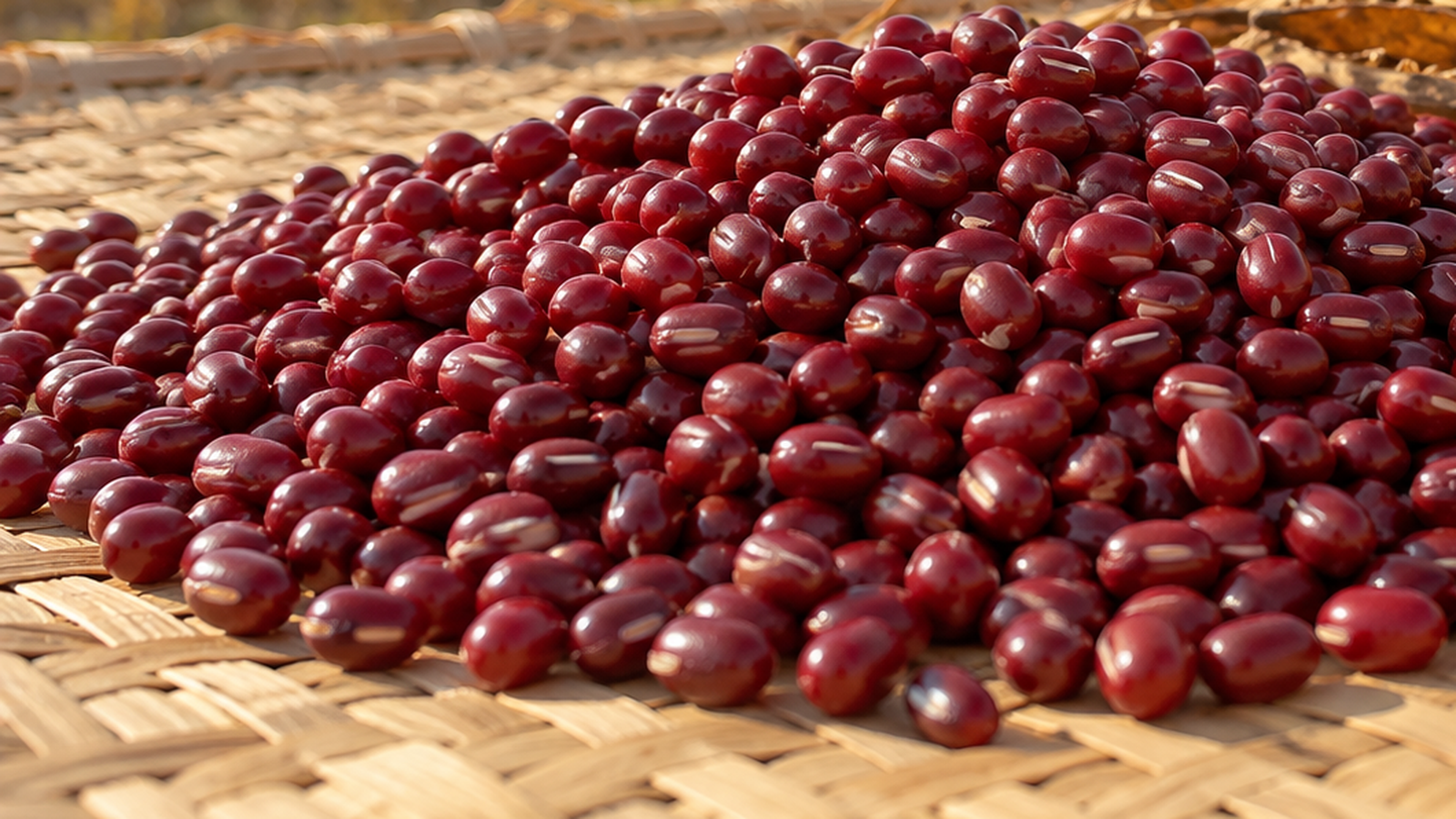
The five-city average of KRW 650,600 is 17.0% below a year earlier. Imported red beans (medium grade) averaged KRW 261,200 per 40 kg, about KRW 6,500 per kilogram, so domestic costs 2.5 times as much. No official comparison of how they cook was found. By appearance, the portal says domestic beans are larger and uneven with a clear white hilum band, while imported beans are small and uniform with a short, faint band. Check the origin label rather than relying on looks.
6. For growers: put cooking instructions in the box
Growers selling new-crop beans direct can add a one-page card with the five steps above, the harvest year, and “soak half a day, discard the first water”. Buyers who cook unsoaked beans and get hard results often assume the beans are old.
| Year | Seoul Oct average | Seoul Dec average | Change |
|---|---|---|---|
| 2021 | KRW 458,368 | KRW 365,091 | −20.3% |
| 2022 | KRW 375,368 | KRW 355,429 | −5.3% |
| 2023 | KRW 440,000 | KRW 450,947 | +2.5% |
| 2024 | KRW 460,000 | KRW 778,800 | +69.3% |
| 2025 | KRW 820,000 | KRW 788,000 | −3.9% |
Wholesale prices rose from October to December in only two of five years. Rather than waiting for December, send regular customers a “shipped before Dongji” notice by late November. KAMIS prices are wholesaler selling prices, so farm-gate auction prices are lower. Compare city by city with the produce market calculator.
References
- RDA press release (December 2018), Dongji red bean porridge recipe: korea.kr
- RDA press release (2025), red bean varieties and recipes: korea.kr
- National food portal (Foodnuri), seasonal food “Red bean”: foodnuri.go.kr
- Kwak et al. (2023), Korean Journal of Crop Science 68(3): cropbio.or.kr
- Korea Astronomy and Space Science Institute, 2026 almanac: kasi.re.kr
- aT KAMIS period wholesale prices (data.go.kr API): domestic and imported red beans, 40 kg, five cities, October 2025 to October 14, 2026; monthly Seoul averages 2021–2025.
- Online prices: Coupang Partners product list, checked October 15, 2026.
- Actual cooking time and yield vary with harvest year, dryness, variety, pot and heat.