How to Check KEPCO Grid Connection Capacity Before a Solar Project
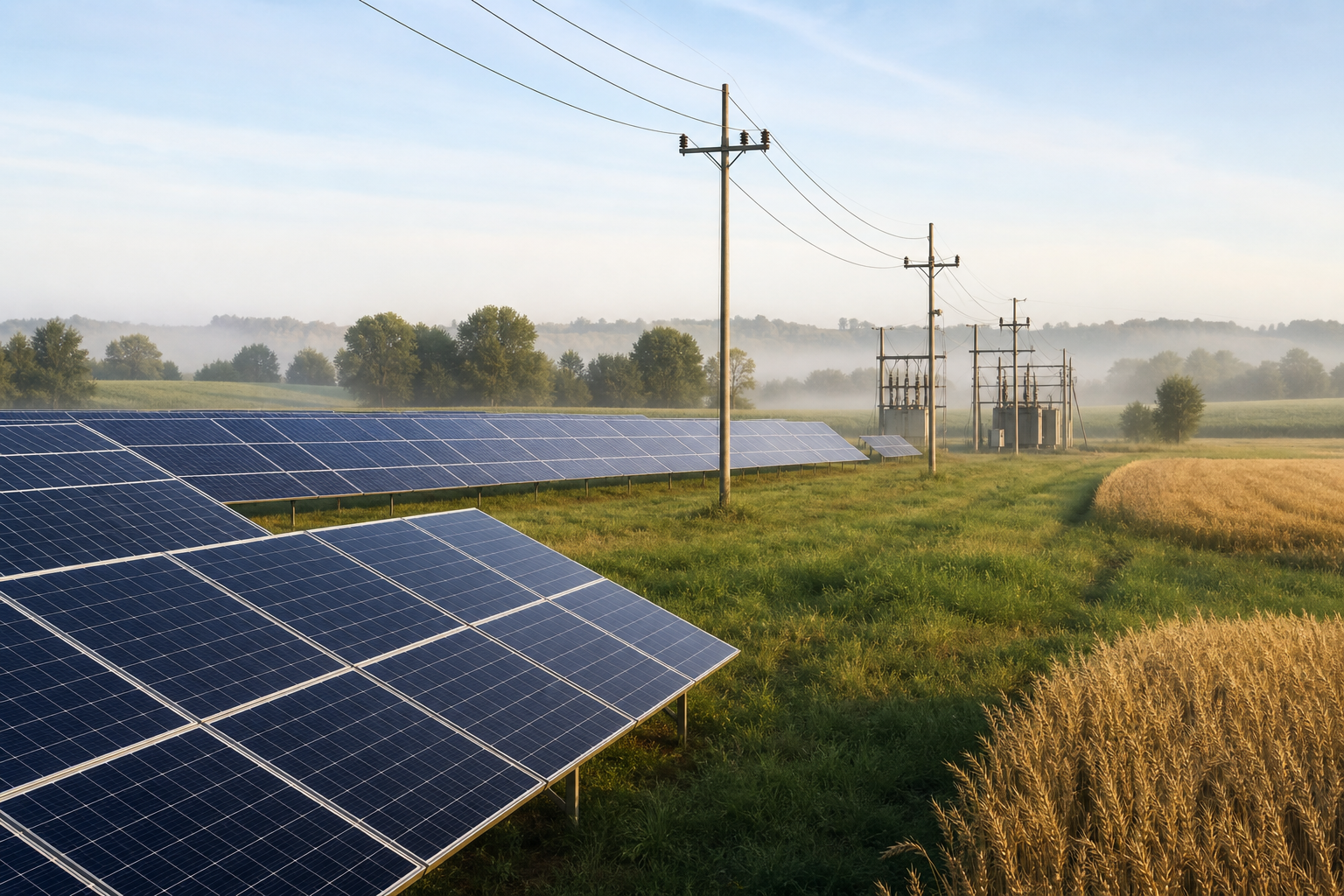
How to Check KEPCO Grid Connection Capacity Before a Solar Project
The land looks fine. The sunlight looks fine. The access road is not bad, and there are not many houses nearby. At that point, many solar project plans jump straight into land price, permits, EPC cost, SMP, REC, and financing.
Then the quiet problem appears. The grid may not have room. A solar plant only becomes a business when the electricity has a path to leave the site. Without grid connection, a neat project spreadsheet becomes a paper kite with no wind.
This article explains how to check KEPCO grid connection capacity before starting a solar power project in Korea. The short answer is simple: check KEPCO ON’s distribution grid spare capacity and renewable energy connection spare capacity before signing anything serious. Still, a number on the screen is not a final approval. It is a starting signal, not a stamped guarantee.
1. Grid connection is the hidden bottleneck in solar projects
Solar projects are not only about sunlight. The generated electricity must be delivered into the KEPCO grid. That is the grid connection problem.
In practice, three parts matter together. The first is the distribution feeder. The second is the substation and main transformer. The third is the wider transmission-side room behind the local grid. A small solar project can still get stuck if one of these parts is full.
KEPCO ON’s distribution grid spare capacity page makes this point clearly. It says that transmission-side grid room should also be checked when checking distribution-side room. It also says that the substation, main transformer, and distribution feeder must all have capacity greater than zero for connection to be possible. One blocked pipe can stop the whole waterway.
That is why the first question is not only “Can this land be permitted.” The sharper question is “Where will the electricity go.” If that question is asked too late, design cost, permit cost, and land deposit may already be tied to the project.
2. Start with two KEPCO ON menus
When checking grid connection capacity, start with KEPCO ON. Two menu areas are useful for solar projects.
- KEPCO ON
Distribution Grid Spare Capacity Inquiry. - KEPCO ON
Renewable Energy Connection Spare Capacity Inquiry.
The distribution grid page includes menu items for distribution transformer spare capacity, distribution feeder spare capacity, regional distribution feeder reinforcement status, and distributed generation connection application progress. The page allows search by address or computerized number. For address search, the user selects province, city, district, town, village, and detailed lot number step by step. The page also notes that when the exact lot number is not available, the closest lot number should be selected.
The renewable energy connection spare capacity page provides table search and map search. Its substation search path uses province, city or county, and town or district fields. For a real project, address-based search and substation-based search should be read together. One view shows the local entry point, while the other helps explain the wider grid situation.
Do not check only once. Check when screening the site. Check again before the land contract. Check again before major permitting and EPC commitments. Grid room can change as other developers apply and as KEPCO’s reinforcement schedule changes. Yesterday’s empty slot may not be your slot today.
3. First check whether every relevant capacity is greater than zero
KEPCO ON’s warning is simple and strong. The substation, main transformer, and distribution feeder all need spare capacity greater than zero for connection to be possible. That means one positive number is not enough. All the key parts must be alive.
A feeder may have spare room, but the substation or main transformer may be constrained. A substation may appear to have room, but the actual feeder near the site may be full. So do not read only the remaining kW number. Also ask which piece of equipment is the bottleneck.
If the spare capacity is smaller than the planned plant size, treat it as a warning. A 100 kW project beside a section with only 50 kW of room is not automatically solved by connecting half the project. The developer may need to review project size, connection point, shared reinforcement, or a different site. Sometimes the best grid strategy is to fold the map and walk away.
There is another trap. The online inquiry does not finally confirm connection availability. KEPCO ON states that the information is a reference for current connection status and not a final decision on whether connection is possible. Do not confuse “it appeared on the screen” with “connection is secured.”
4. When there is no spare room, waiting becomes a cost
If there is no grid room, time enters the project. Time is not free. Interest, land holding cost, permit management cost, equipment price changes, and EPC schedule changes all start to bite.
KEPCO ON warns that when there is no available connection capacity in the area, grid connection can take a long time. It lists average time ranges of 3 to 6 years for substation capacity shortages and 1 to 2 years for main transformer or distribution feeder shortages. For a solar developer, those numbers are not small. One year can change the interest rate, and three years can turn a business plan into a different document.
The Korea Energy Agency’s Renewable Energy Cloud Platform gives a similar practical warning. It says that even if a site can receive development permission for solar, the developer must check spare capacity before starting because solar generation needs a three-phase pole suitable for the plant capacity. It also explains that if the relevant distribution line, transformer, or substation lacks capacity, the developer should contact KEPCO about securing the line.
Grid connection is not a late administrative detail. It belongs on the first page of the business review. It should not be hidden at the bottom of the return calculation. It should be written near the top in red pencil.
5. Distribution feeder connection limits have been expanded before, but that is not a safety net
Korea has adjusted some solar connection limits to reduce connection waiting. According to a Ministry of Trade, Industry and Energy release published by the KDI Economic Information and Education Center, the solar connection allowance for KEPCO distribution feeders was planned to expand by 20% from March 2, 2020. The release said ordinary distribution feeders would move from 10 MW to 12 MW, and large-capacity distribution feeders from 15 MW to 18 MW.
The same release explains why this happened. Solar grid connection applications had increased, and connection waiting volume had grown. As a special measure to reduce waiting, the government and KEPCO tested and decided to expand distribution feeder connection criteria. The release expected that 3,335 sites, or 725 MW, out of 9,585 sites requiring new distribution feeders, could connect immediately.
This should not be read as “most sites are fine now.” The policy helped reduce bottlenecks, but it did not guarantee connection for every project site. Local application density, substation room, line condition, protection coordination, reverse power flow, and possible curtailment still matter. Even good policy news must be translated back into site-level numbers.
6. A practical pre-contract checklist
Before a solar site moves from idea to contract, use this order. It keeps dirt off your boots until the grid has been checked.
- Write down the exact address and lot number of the candidate site.
- Search KEPCO ON distribution grid spare capacity by address or computerized number.
- Check distribution transformer, feeder, substation, and main transformer capacity together.
- Use KEPCO ON renewable energy connection spare capacity inquiry by table and map.
- Read the Renewable Energy Cloud Platform’s grid connection capacity guidance.
- Compare spare capacity with the planned plant capacity.
- If capacity is small or zero, contact the KEPCO office about feasibility, reinforcement, and expected timing.
- Review land contract clauses for cancellation or adjustment if grid connection is impossible or heavily delayed.
- Recheck capacity at each major step: power generation permit, development permit, and construction planning.
- Ask the EPC contractor to separate KEPCO connection work scope and possible grid reinforcement cost.
Numbers 7 and 8 are especially important before paying a large deposit. If the land is secured but the electricity has no road, the site becomes a beautiful storage room. Solar panels eat sunlight, but the business eats grid access.
7. A 100 kW, 500 kW, and 1 MW project do not carry the same grid risk
A 100 kW project may look simple. Still, if the nearby feeder is already full, even a small project can wait. Small does not always mean quick.
At around 500 kW, the connection point, line distance, construction cost, protection devices, and permit schedule become more sensitive. At 1 MW and above, the developer needs an even colder eye. Whether the project can be handled at the distribution level, whether transmission and substation conditions matter, and whether shared reinforcement is needed can change the whole schedule.
The Renewable Energy Cloud Platform’s distribution facility use application guidance also shows why timing must be conservative. For distribution facilities, it lists administrative time such as two months for preparing a connection proposal, one month for acceptance notice, and one month for the use contract. It also lists a 12-month standard construction period for 22.9 kV distribution cases involving 5 MW to under 10 MW connection or new distribution feeder construction. Actual timing can still vary by site condition and consultation.
The lesson is plain. Do not build the project schedule only around panel installation time. Grid connection may be the leash around the entire business calendar.
8. Grid risk directly cuts project returns
Solar return models usually focus on generation, SMP, REC, EPC cost, and loan interest. Grid delay shakes all of them.
Imagine a 500 kW project. The land, design, and construction plan are ready, but grid connection is delayed by one year. Expected revenue for that year does not arrive. Financing cost, land cost, and management cost continue. Permitting and design documents may need updates.
The harsher case is unexpected connection cost. A developer may see a nearby pole and assume connection will be easy. Then the actual review may require feeder reinforcement or a longer connection route. The return can become thin very quickly. An 8% return written in Excel can turn into a 4% piece of paper.
So grid connection review is both a technical review and a financial review. The numbers belong to the power system, but the pain belongs to the cash flow.
9. Do not rely only on the EPC contractor’s words
A good EPC contractor checks the grid first. A weak one talks first about panel capacity and expected revenue. A developer needs to know the difference.
Even when an EPC contractor says connection is possible, open KEPCO ON and check it yourself. Keep the address inquiry result, the substation inquiry result, the KEPCO office communication, and the connection application status. If the story changes later, records become a shield.
Save screenshots with the inquiry date, time, address, selected lot number, displayed spare capacity, and warnings. A screenshot is not a final approval document. It is only evidence of what was seen at that time. That line matters.
Grid problems do not happen only because someone lies. They also happen because data gets old, another applicant enters first, or reinforcement plans move. That is why checking capacity should be a habit, not a one-time ritual.
10. Final judgment should combine KEPCO confirmation and contract protection
A safe workflow has three layers. The first is online inquiry. The second is confirmation with the relevant KEPCO office. The third is reflecting grid risk in the land, EPC, and financing documents.
If the online inquiry shows enough room, the site has passed one gate. That does not mean it is safe to place a large deposit immediately. The developer should still ask KEPCO about expected connection feasibility, required construction, reinforcement needs, and possible waiting. If capacity is zero or very small, caution should rise quickly. Sometimes stopping the project is the best decision.
Contracts should consider grid connection failure, long connection delay, and unexpected connection cost. The exact legal language should be reviewed by a professional, but the business direction is simple. There must be a door out if the grid is blocked. Do not enter a room with no door.
A solar project is not just buying sunlight. It is matching land, grid access, time, and money at the same time. If the electricity road is blocked, the rest becomes a nice drawing. Checking KEPCO grid connection capacity before the project is not optional. It is the seat belt.
One-line summary
Before signing a solar project, check KEPCO ON distribution grid and renewable energy connection capacity, confirm that substation, main transformer, and feeder capacity are all greater than zero, and treat reinforcement waiting time as a direct business risk.
References
- Korea Electric Power Corporation, KEPCO ON,
Distribution Grid Spare Capacity Inquiry, https://online.kepco.co.kr/EWM092D00 - Korea Electric Power Corporation, KEPCO ON,
Renewable Energy Connection Spare Capacity Inquiry, https://online.kepco.co.kr/EWM094D00 - Korea Energy Agency, Renewable Energy Cloud Platform,
Grid Connection Capacity Check, https://recloud.energy.or.kr/process/sub1_3_1.do - Korea Energy Agency, Renewable Energy Cloud Platform mobile guide,
Grid Connection Capacity and Distribution Facility Use Application, https://recloud.energy.or.kr/m/process/sub03.do - KDI Economic Information and Education Center, Ministry of Trade, Industry and Energy,
Solar Power Grid Connection Allowance Expanded by 20%, 2020-02-26, https://eiec.kdi.re.kr/policy/materialView.do?num=197988