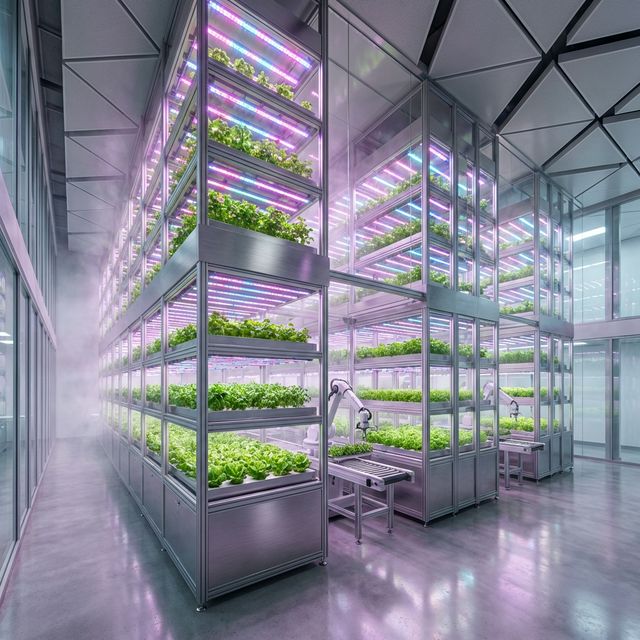
Exploring how AI and smart hydroponics are reshaping agriculture, from intelligent nutrient management to yield prediction and vertical farming profitability.
Growing plants without soil. It sounds like science fiction, but the area of hydroponic cultivation in South Korea has already jumped 12-fold from 474ha in 2000 to 5,634ha in 2021. And now, Artificial Intelligence has climbed aboard. Analyzing every drop of water and speck of light, AI is turning a farmer’s intuition into hard data.
In truth, hydroponics itself isn’t a new technology. However, trying to manually monitor temperature, pH, nutrient concentration, humidity, and light intensity 24/7? As operations scale up, it becomes nearly impossible. AI has stepped into this gap.
Why the renewed focus on hydroponics?
Agricultural water use accounts for 70% of global water consumption. It’s a massive drain on resources. Hydroponics, through recirculation systems, can reduce water usage by up to 90% compared to traditional farming. While growing 1kg of tomatoes requires 60 liters of water in an open field, advanced recirculating hydroponics needs only 4 liters.
Land efficiency is equally overwhelming. By stacking vertically, you can harvest over 10 times more from the same area than a conventional farm. American vertical farming company Plenty has stated they achieved up to 350 times the yield per acre. Saving 95% of water and 99% of land. The numbers alone seem magical, but behind them are AI and robots.
Farming in the middle of a city. In a desert. At the poles. The true weapon of hydroponics is its independence from climate and changing seasons.
What AI does in hydroponics
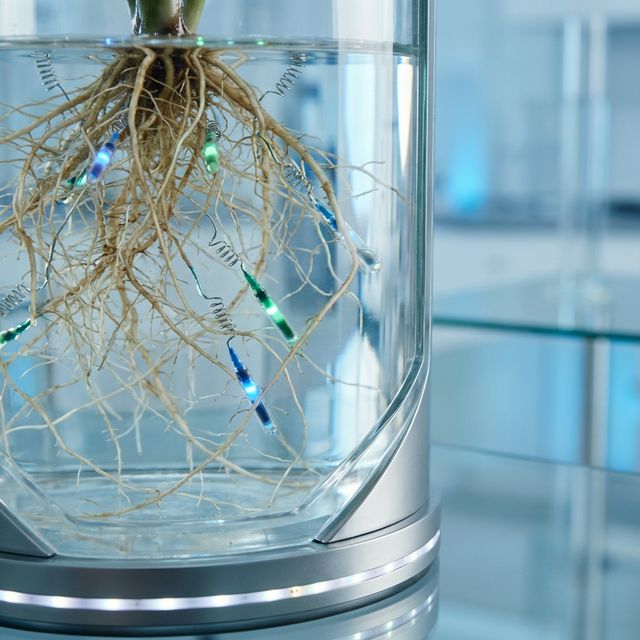
A revolution in nutrient management
In 2024, South Korea’s Rural Development Administration developed an ‘intelligent nutrient supplier’. Traditional nutrient suppliers were used generally, regardless of the crop type. Precise control was difficult, and linking with other greenhouse equipment was tough. The newly built intelligent nutrient supplier is different. An LSTM (Long Short-Term Memory) artificial intelligence model learns the evapotranspiration and drainage volume of tomatoes in real-time to predict the optimal nutrient supply amount and timing. The electrical conductivity (EC) measurement error is just 0.07 dS/m. The maintenance cycle is 3 months.
It’s a level of precision entirely different from the days when humans relied on eyesight and a “this looks about right” mentality.
Growth prediction and yield optimization
In research utilizing machine learning models (SVR, XGB, RF, DNN), the scatter index (SI) for scenarios predicting the fresh weight of lettuce came in at <0.1, meaning under 0.1. This indicates an ‘excellent’ level of accuracy. Yield can be predicted with high precision using only input variables like leaf count, water consumption, and dry weight.
At the ‘Autonomous Greenhouse Challenge’ hosted by Wageningen University in the Netherlands, AI autonomous control achieved a 12% increase in cucumber yield, a 20% reduction in cherry tomato energy use, and a 28% increase in lettuce net profit. In another greenhouse study, AI outperformed humans, recording a 10% increase in tomato yield and a 92% profit jump.
Early pest and disease detection
Computer vision catches anomalies faster than human eyes. It detects issues like nutrient deficiencies and disease infections outside the visible spectrum, allowing for rapid response. Farm Wobo, a Korean AI hydroponics startup, operates a system that provides instant alerts and prevention measures when pests or diseases occur.
Energy and resource savings
AI-based climate control systems can cut energy consumption by 30-40%. This is an estimate from the Resource Innovation Institute (an expert group) based on field experiences in European CEA (Controlled Environment Agriculture). Three academic studies also confirmed energy savings of 9%, 25%, and 32% respectively in plant factories applying AI control.
Modeling by researchers at Cornell and Rutgers showed that linking lighting control with real-time electricity market prices can yield up to 80% cost savings compared to traditional lighting control.
What types of hydroponic systems are there?
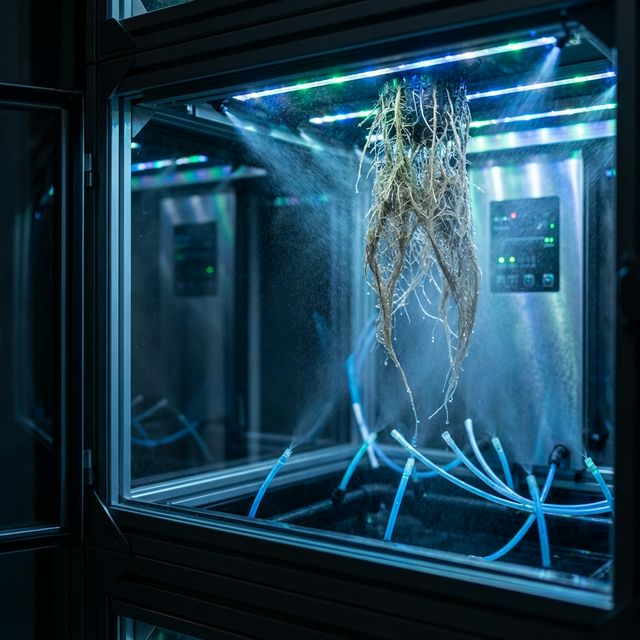
Before discussing AI further, let’s review the basic structures of hydroponic systems. Assuming “all hydroponics are the same” is a mistake.
| Method | Principle | Characteristics |
|---|---|---|
| DWC (Deep Water Culture) | Roots are fully submerged in a nutrient solution | Simple structure, easy maintenance. Uses the most water |
| NFT (Nutrient Film Technique) | A thin film of nutrient solution flows over the roots | Smooth oxygen supply, can optimize growth speed |
| DFT (Deep Flow Technique) | A deep layer of nutrient solution circulates slowly | A hybrid of DWC and NFT. Highly stable |
| Aeroponics | Roots suspended in air are sprayed with a nutrient mist | Uses 90-95% less water than basic hydroponics. High growth promotion effect |
AI integrates with all these systems. IoT sensors collect real-time data, machine learning optimizes the environment, and a cloud dashboard allows monitoring from anywhere.
Is it a profitable market?
The AI hydroponics market is valued at roughly 677.4 million by 2035, with a compound annual growth rate (CAGR) of 6.2%. The Asia-Pacific region is driving this growth. India (CAGR 9.8%) and China (9.1%) are the fastest-growing markets.
The domestic smart agriculture market is also expanding. It was projected to grow from about 310 billion KRW in 2020 to 630 billion KRW in 2025, and the government has set a goal to transition 30% of agricultural production to smart farming by 2027. The Rural Development Administration plans to invest 159.5 billion KRW in smart agriculture and green biotechnology in 2026.
Cloud-based platforms and subscription service models are lowering the barrier to entry for small and medium-sized farms. Remote monitoring and AI-based farm management services are becoming the mainstream trend.
Global companies: Where are they now?
The light and shadows of the vertical farming industry
To be frank, it’s not all rosy. In 2025 alone, 14 indoor farming/CEA companies filed for bankruptcy. The historic total investment gathered by these companies exceeds $1.37 billion.
- Plenty: Once the world’s largest vertical farming company, heavily backed by nearly $1 billion. They touted 350x yields and 95% water savings, but filed for Chapter 11 bankruptcy in March 2025. Spiking energy costs and fundraising difficulties were to blame. However, after restructuring in May 2025, they are attempting a comeback.
- AeroFarms: Pioneer of aeroponics. Filed for bankruptcy in June 2023 and emerged in September of the same year. Under CEO Molly Montgomery, they shed R&D facilities to focus on their Virginia production site, pushing for profitability. She argues they have “proven that vertical farming can operate sustainably and profitably.”
- Bowery Farming: Raised over $700 million but ceased operations in November 2024.
Why did this happen? Indoor farming expert Henry Gordon-Smith offers a sharp diagnosis: “The VC model that expects returns in 5-10 years is fundamentally incompatible with the asset-heavy, margin-sensitive indoor farming business.” He suggests long-term investors like infrastructure funds or family offices are a much better fit.
Strategies of the survivors
It’s not all failures.
- 80 Acres Farms: Acquired Kalera’s facilities and IP, securing $115 million in fresh funding. Adding facilities in Georgia, Texas, and Colorado, they doubled their number of large commercial farms.
- Krop AI (India): Won ‘Best Startup’ at MES 2026 in February. They claim their AI-based hydroponic system achieved a 95% reduction in water use and a 50% cut in operating costs.
- NABTAX: Converts idle urban spaces (rooftops, hangars) into AI+IoT smart farms. They predict the real-time demand of restaurants, hotels, and supermarkets, cultivating only crops that “already have a guaranteed buyer.”
- FreeBonde (Sweden): Creates home AI hydroponic devices roughly the size of a window sill or balcony planter, aiming to eliminate transport and packaging waste entirely.
Where does South Korea stand?
The intelligent nutrient supplier developed by South Korea’s Rural Development Administration in 2024 isn’t just a prototype. They registered 3 patents and conducted field tests at a smart farm in Wanju, Jeollabuk-do. By estimating the evapotranspiration of tomatoes via an LSTM-based AI and applying national communication standards, it interacts seamlessly with other environmental control devices.
Real results are appearing. When a mature tomato farm in Wanju applied the ‘Smart Farm Optimal Environment Setting Guide Service’ based on AI and big data, production jumped by a maximum of 13.7%. Revenue per 1,000㎡ rose from 70.59 million KRW to 86.25 million KRW.
There’s progress in recirculating hydroponics, too. Applying the ‘drainage reuse technology’ developed by the Rural Development Administration to strawberries reduces fertilizer purchase costs by 21% and carbon emissions by 26%. For tomatoes, it’s a massive 63% reduction for both. The reality, however, is that 95% of Korea’s hydroponic area remains non-recirculating. This means the expelled fertilizer solution is just being thrown away. They’ve set a goal to raise the circulation rate to 10% by 2028, but there’s a long way to go.
The AI hydroponics startup Farm Wobo was established in 2022 and is automating the entire cultivation process with its proprietary AI system. They’ve already secured eco-friendly agricultural product certification, GAP certification, and low-carbon certification. The industry needs more companies like this to emerge.
The challenges this technology must solve
Presenting only an optimistic outlook is half the story. The walls of reality remain.
Energy costs are the biggest hurdle. LED lighting and climate control systems are power-hungry. When US energy prices surged 15% year-over-year in 2024, Plenty had to shutter its Compton, California farm. Even if AI saves 30-40% on energy, if those savings fail to outpace rising energy prices, the impact is minimized. Combining these systems with renewable energy is essential.
High initial investment. Sensors, servers, high-speed networks, robots… Highly advanced facilities require substantial infrastructure investment. It’s a scale that small and medium-sized farms hesitate to tackle. Cloud-based subscription models are emerging as an alternative, but the adoption speed remains slow.
Data security is an issue. Sensor calibration, machine learning anomaly detection, and ransomware protection are required. When the food supply chain becomes digital, a hack immediately becomes a threat to food security.
The technology gap and education. The majority of farmers are not accustomed to AI and big data. No matter how good the technology is, it’s useless if it can’t take root in the field.
What changes in the next 5 years?
- AI climate control acts as ‘training wheels’. Novice growers will be able to operate advanced greenhouses. Much like a lane departure warning system for new drivers, AI will prevent fatal mistakes.
- Robot-friendly cultivation systems will appear. New methods are being developed to grow cherry tomatoes in short cycles, allowing robots to maintain and harvest them. Systems that move hydroponic lines past imaging equipment and harvesters are also in the testing phase.
- Breeding enables automation. As tough-skinned blueberries and strawberry varieties suited for mechanical harvesting are developed, the trifecta of hydroponics, AI, and robots falls neatly into place.
- Cultivation and the supply chain connect as one. When real-time production data links up instantly with distribution and consumption, the tragedy of “growing crops but having nowhere to sell them” decreases.
- Facility location criteria change. Not labor availability, but accessibility to renewable energy and proximity to consumer markets will dictate locations. Multi-hundred-acre ‘CEA Farm Parks’ could begin forming in the US and Europe.
Just one thought to close
They say “a journey of a thousand miles begins with a single step.” The future of AI hydroponics isn’t a grandiose vision, but starts right this moment—with a nutrient supplier in a Wanju tomato farm regulating nutrients with a 0.07 dS/m margin of error, and a small Indian startup growing lettuce inside a container farm.
The technology is ready. All that’s left is the resolve of the people planting it in reality.
References
- Future Market Insights, AI for Hydroponic Farming Market, 2025
- Rural Development Administration, “Introducing an ‘Intelligent Nutrient Supplier’ suitable for AI-utilized hydroponics”, 2025.11
- Resource Innovation Institute (AIRWG), 10 Predictions about the Future of Advanced Robotics and AI in Agriculture, Produce Grower, 2025.11
- Genetic Literacy Project, “Smart, sustainable, scalable: AI, hydroponics and the future of farming”, 2025.11
- Mokhtar et al., “Using Machine Learning Models to Predict Hydroponically Grown Lettuce Yield”, Frontiers in Plant Science, 2022
- Rural Development Administration, “Expanding the supply of resource-saving ‘Recirculating Hydroponics’”, 2023.12
- Plenty Unlimited, Company Overview & Technology Platform, prnewswire.com, 2024
- JoongAng Ilbo, “[2025 Energy Eco-Friendly Technology Award] Providing an AI solution for hydroponic farming — Farm Wobo”, 2025.12
- Korea Agro-Fisheries & Food Trade Corp (aT), Trends in the Domestic Smart Agriculture Market, 2023
- Elevenflo, “Plenty Unlimited: Vertical Farming Chapter 11 Case”, 2026.02
- Vertical Farm Daily, “Krop AI wins Best Startup award at MES 2026”, 2026.02
- StartUs Insights, “10 Urban Farming Companies to Watch [2026]”, 2025.07
- AeroFarms, “AeroFarms turned itself around after bankruptcy”, 2025.06
- Ministry of Agriculture, Food and Rural Affairs, “The 1st Smart Agriculture Promotion Master Plan”, 2025