Analyzing the core of future farming: the automated harvesting robotic market. Learn how AI computer vision, autonomous driving, and precision control are bringing the fully unmanned farm to reality.
Picking strawberries in the field sounds quite romantic. But if you are told to do it for 8 hours every day, bent over under a 40-degree heatwave, the story changes. Farmers know this. Harvesting is the most grueling work in agriculture. And the hands that used to do that grueling work are increasingly disappearing.
In reality, the changes taking place on agricultural frontlines right now are beyond imagination. A robotic arm picks up an apple, and AI determines the ripeness of a strawberry in 0.1 seconds. “Does that really happen?” Yes. It is already happening.
Rural villages are aging — The reality told by numbers
The agricultural population in South Korea stood at 1.98 million as of 2025. For the first time in history, the 2 million mark was broken. The proportion of those aged 65 or older accounts for 56%, reaching around 1.1 million. The number of young farmers plummeted from 769,000 in 2000 to 136,000 in 2024. This means 82% evaporated.
The situation in the United States isn’t any different. As of 2024, 60% of U.S. agricultural enterprises delayed projects because they couldn’t secure seasonal labor. On high-value farms in California, labor accounts for 40% of production costs. “Because there are no people, crops are grown but eventually plowed under without being harvested.” This is the portrait of modern-day agriculture.
Just as Lee Seung-don, Director of the National Institute of Agricultural Sciences at the Rural Development Administration noted, “In the near future, the era of ‘1 Farm-1 Robot’ will open in rural areas.” This is not an empty promise.
Harvesting Robots, how far have they come?
A machine picking 30 apples per minute
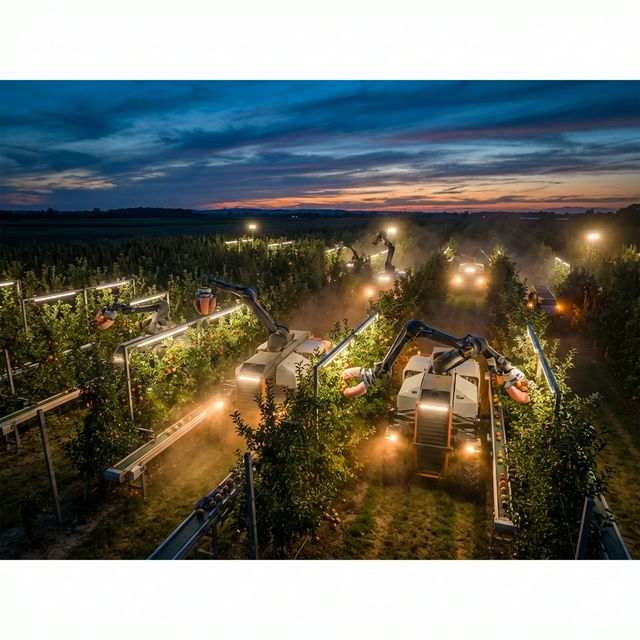
Advanced.Farm in California, USA developed an apple harvesting robot. This robot autonomously navigates between vertical trellis orchards while picking apples with robotic arms attached to both sides. About 30 apples per minute. Three times faster than a human. It finds red ripe fruit using cameras, and AI calculates the optimal working path in real-time based on previous harvest data. Apples picked up by suction pads ride a conveyor belt into standard harvesting boxes. CEO Marc Grossman’s words are impressive: “We are diving deeper into the challenges of robotic harvesting than any other company.”
A robot that picks strawberries better than humans
Tortuga AgTech was a company that operated a fleet of 150 commercial harvesting robots. Specializing in strawberries, table grapes, and berries, they even won the ‘Agricultural Robot of the Year’ awarded by Future Farming in 2024. This company was acquired by the vertical farming enterprise Oishii in March 2025. Oishii declared that “Robotic strawberry harvesting surpassing human farmers will become a reality.” Their goal is cutting harvesting costs by 50%. This is arguably a metric-driven forecast, not an exaggeration.
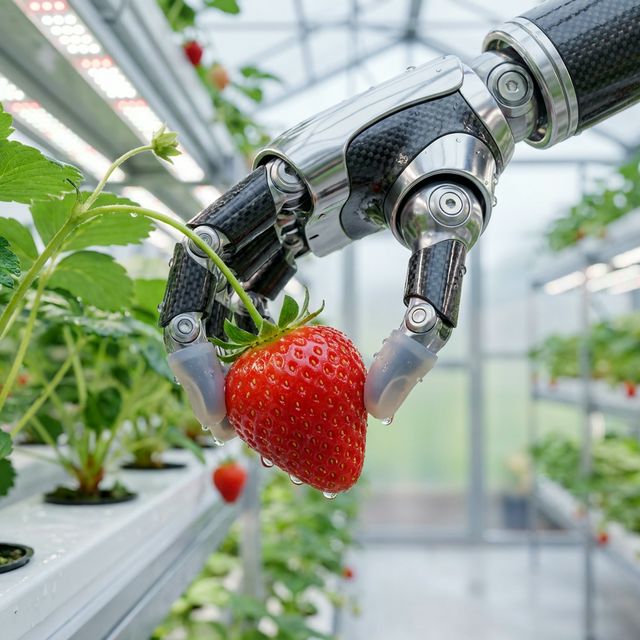
Fieldwork Robotics in the UK built a raspberry harvesting robot. Using AI-based computer vision and soft grippers, it picks raspberries without bruising them. It handles 150 to 300 per hour. It is already on par with human labor capacity, and because night shift operations are possible, it essentially runs 24 hours.
Movements in South Korea
The Korea Institute of Machinery and Materials (KIMM) developed a ‘multiple robot system for horticultural crop harvesting’. It consists of a harvesting robot and a transport robot. The harvesting robot recognizes the position and angle of crops using AI, and effortlessly picks even tough crops with an in-house developed high-power robotic hand. The crop recognition rate is over 90%. When run over 24 hours, it achieves 80% of human efficiency. Once the box is somewhat full, it summons the transport robot to autonomously carry it to the loading dock.
In Seosan, Chungnam, SP Agri operates Korea’s largest strawberry smart farm. An AI-based harvesting robot was deployed as a trial, harvesting about 20kg of strawberries in 8 hours. The key here is the nighttime operation. Even during the night when no humans are present, the robot does not rest. Employees starting work in the morning simply sort and pack the strawberries the robot picked overnight. To call it a ‘strawberry factory rather than a farm’ is not an overstatement.
The ‘Omni Farmer’ developed by the startup Meta Farmers is also noteworthy. Equipped with an RGB-D sensor, it recognizes crop size, ripeness, and pest status, performing autonomous tasks in real-time. What’s remarkable is that a user can teach tasks to the robot as if conversing with it. According to the company, “It catches up to the level of skilled agricultural workers within a few days.”
IoCrops’ greenhouse autonomous robot ‘HERMAI’ performs scouting, spraying, harvesting, and transport, and has completed over 70 field trials across 16 nationwide farms since 2023. The dedicated harvesting robot version is scheduled to launch in 2026.
How does it work? — The trinity of Eyes, Brains, and Hands
The operating principles of harvesting robots are divided into three stages.
Eyes (Recognition): RGB-D cameras, 3D vision sensors, and LiDAR scan the position, size, color, and ripeness of the crops. Fravebot at the Rajecek farm in the Czech Republic even built a digital twin environment. Plant and fruit virtual models are created on NVIDIA Omniverse to pre-train the robot’s neural network. Because it simulates physical laws like the weight of a strawberry, significant learning is already complete before being deployed to a real farm.
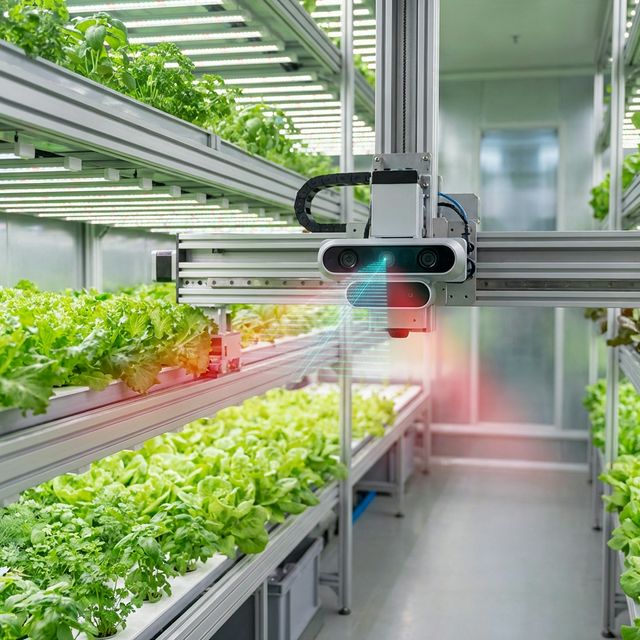
Brain (Judgment): Deep learning algorithms classify ripe and unripe fruits in real time. John Deere’s See & Spray technology scans 2,500 square feet per second and was used on over 5 million acres of farmland in the 2025 season alone. It reduced herbicide usage by an average of 59%, and independent research by Iowa State University noted reductions up to 90.6%. The identical principles apply to harvesting robots. Data accumulates with every harvest, making the model progressively smarter.
Hands (Action): Various end effectors—like soft grippers, vacuum suction pads, and precision cutters—are swapped according to the crop type. Soft fruits like strawberries are gently wrapped, whereas apples are picked up via suction pads. ‘EVE Clever,’ unveiled at the 2025 Seoul AI Robot Show, harvests fruit without damage using a robotic arm mimicking a human hand, and easily manages night operations.
Kubota’s Ambition of Japan — ‘Fully Unmanned Agriculture’
Japanese agricultural machinery giant Kubota took it one step further. Their GPS-based autonomous combine harvester ‘DRH1200A-A Agri Robo’ enables high-precision harvesting within a few centimeters of error margin. They didn’t stop there. ‘Type: V’ and ‘Type: S’, revealed at the 2025 Osaka Expo, are fully autonomous robots. Type: V performs all tasks alone, from tilling to harvesting. It automatically adjusts the height and width of its chassis based on row spacing and crop growth status. The concept is to handle everything on a single platform without needing to buy a tractor, combine, and rice transplanter separately.
The Market is on the Verge of Explosion
The global harvesting robot market size was estimated at roughly 6.93 billion by 2030. The compound annual growth rate (CAGR) spans 21.9%. The growth rate in the Asia-Pacific region is 33.9%, the steepest worldwide.
Looking solely at automatic harvesters yields a CAGR of 26%. As fruit and vegetable producers face severe labor shortages against narrow harvest windows, investments are pouring in.
Looking at the bigger picture, the entire agricultural robot market is expected to surge from around 56.2 billion by 2030. Innovation follows where money flows. Just like water streaming downward, capital gathers wherever there’s opportunity.
Mountains still to be crossed
It is not entirely a bed of roses. Frankly speaking, the wall of reality is daunting.
- Cost issues: Pricing for fully autonomous harvesting robots ranges from a base of 100,000 for advanced multi-functional models. It’s a hefty investment for small-scale Korean farmers to commit to eagerly. The Rural Development Administration is distributing 10 transport robots in 2024, and 13 transport and 10 spraying robots in 2025 to farms through new technology supply initiatives, but they still have a long way to go.
- Technical limits: Technologies allowing the flawless, damage-free harvesting of large, heavily obscured fruits like apples and pears are still in nascent stages. Commercialization demands 3D vision sensor recognition accuracy pushing past 95%, yet outdoor variables like sunlight, wind, and rain constantly interfere.
- Farmers’ technology accessibility: According to the FAO, most farmers in developing countries lack formal training regarding robotics and digital technology. Even with Korea’s 56% elderly farmer demographic, proficiently handling a robot remains a completely separate issue.
- Limits of multi-purpose utilization: Most current harvesting robots are strictly optimized for a specific crop. A strawberry robot cannot pick apples, and a grape robot cannot harvest tomatoes. Developing modular platforms capable of executing a variety of tasks via a single robot remains a significant homework.
So, what happens next?
In agriculture, the phrase “Robots will replace people” is only half right. A more accurate phrasing is, “Robots fill the spots left by disappearing people”. Robots are entering rural areas that the youth have abandoned. It’s not a matter of replacement; it’s a matter of survival.
Kubota’s fully unmanned agriculture, Oishii’s ‘harvesting robots surpassing humans’, John Deere’s AI-based precision farming. These aren’t technologies existing 5 years in the future, but rather, they are operating in fields at this very second. Korea’s Rural Development Administration proclaimed the ‘1 Farm-1 Robot’ era, and the global market is expanding at over 20% annually.
Seeing is believing. Rather than just reading this piece, checking out a single harvesting robot video on YouTube will resonate much faster. The future of agriculture has already begun. We just haven’t entirely seen it yet.
References
- Korea Rural Economic Institute & IoCrops, “Agricultural Outlook 2026: Agricultural Administration and Smart Farming Responding to the Crisis”, 2026.01
- Korea Institute of Machinery and Materials (KIMM), “Successful development of multiple robot systems for horticultural crop harvesting”, 2023.03
- Rural Development Administration (RDA), “Development of integrated management technology for agricultural robots”, 2025.04
- Korea Economic Daily, “It’s more of a factory than a strawberry farm… AI robots manage cultivation and harvest”, 2025.10
- Unicorn Factory, “Growing crops on a building roof, AI robots harvest… the agricultural board completely changes”, 2025.08
- Grand View Research, “Harvesting Robots Market Size, Share | Industry Report, 2030”, 2024
- AgFunderNews, “Oishii acquires Tortuga AgTech’s IP, assets, and engineering team”, 2025.03
- Siemens, “AI helps to monitor and harvest strawberries (Fravebot)”, 2023.12
- japan.go.jp, “AI and Robotics Usher in a New Age for Agriculture (Kubota)”, 2025
- Advanced.Farm, FIRA USA 2024 Press Release
- OpenAI, “John Deere transforms agriculture with AI”, 2025.05
- Robovision, “Top 5 Agricultural Technologies 2025”, 2025.02
- Agricultural Robot Market Share Analysis Report (Mordor Intelligence / GII Korea), 2025
- Fieldwork Robotics & Burro Collaboration Agreement, 2024.11
- Technavio, “Crop Harvesting Robots Market Size 2025-2029”
- IoCrops, “HERMAI greenhouse autonomous robot”, 2025
- Korea Rural Economic Institute, “Agricultural Outlook 2025”, 2025.01