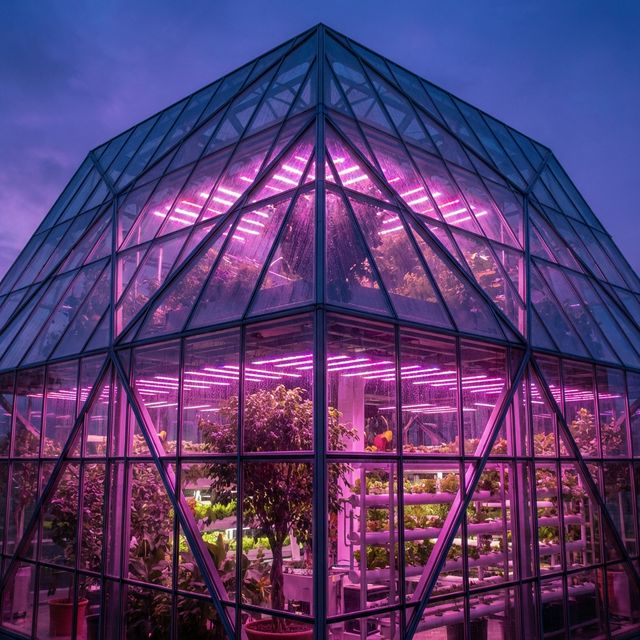
Exploring AI integration in greenhouses. From predictive climate control and automated pest monitoring to the differences between high-tech structures and local setups.
It’s mid-winter, yet inside the vinyl house, it feels like mid-summer. Outside, the snow is piling up, but inside, tomatoes are ripening to a bright red. What happens when you add a spoonful of AI into this picture?
To be honest, vinyl houses and glass greenhouses are old technologies. Yet, they are heavily discussed again today. This is because they are no longer spaces reliant solely on thermometers and human experience, but living environments breathing in real-time through sensors and algorithms.
Why vinyl houses and glass greenhouses?
Open-field cultivation is constantly at the mercy of the weather. Vinyl houses and glass greenhouses mitigate that dependency. When AI is layered on top, the very rules of the “weather game” change completely.
- Greenhouse cultivation often yields more than double that of open fields for the same crops.
- Research shows that greenhouses (especially when combined with hydroponics and nutrient solutions) can reduce water usage by 50-90%.
- Quality variation shrinks, and the percentage of marketable goods rises, translating to less waste.
The catch is, all these advantages depend entirely on achieving excellent “environmental control”. Temperature, humidity, CO₂, nutrient solutions, ventilation, heating, shading… Trying to have a human minutely adjust all of this 24/7? It’s impossible. This is where AI makes its presence known.
What AI actually does in a greenhouse
1. Climate control: Boiler, vents, and curtains all at once
In the past, a farmer would wake up at dawn, check the thermometer, and adjust the boiler. Now, temperature, humidity, and CO₂ sensors stream data in real-time. The AI consumes this data and autonomously decides: “Set the boiler to this temperature, open sideways vents to this percentage, fold or unfold the curtains.”
In the Autonomous Greenhouse Challenge held in the Netherlands, this concept was tested overtly. Algorithms controlled the greenhouse environment instead of humans to grow cucumbers, tomatoes, and lettuce. The results were fascinating. One team pulled out 12% more yield while reducing energy usage by 20%, bringing in a 28% increase in net profit for lettuce.
Another study showed that applying AI-based control in a semi-closed greenhouse can cut heating and cooling energy by 15-30%. This was an optimization scenario that factored in outside temperatures, solar radiation, and electricity prices. While actual figures vary depending on greenhouse structure, region, and crop, the trend is clear: “efficiency undoubtedly surges compared to manual human control.”
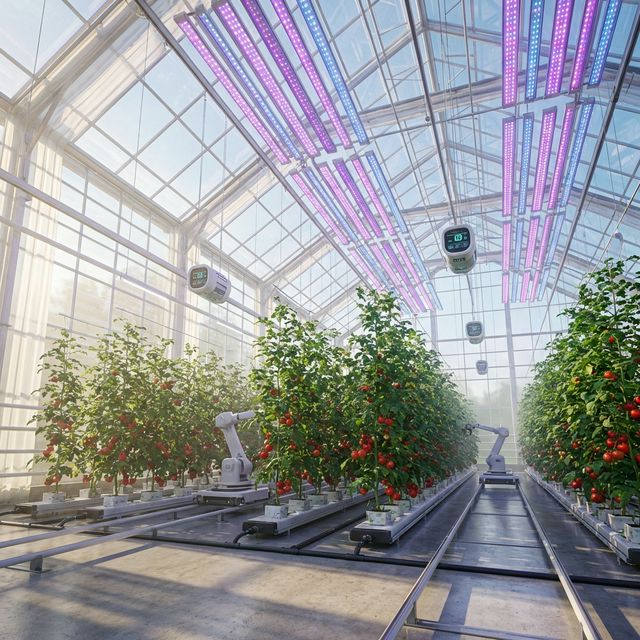
This kind of full-canopy sensing array is what allows the control loop to nudge boilers, vents, and curtains in precise increments across the entire greenhouse block.
2. Predictive control: Looking at “what’s next” instead of “right now”
Most conventional control systems are immediately reactive. If the temperature breaches 25 degrees, the vents open. If CO₂ falls below 600ppm, gas is injected.
AI-based control operates a bit differently.
- It predicts temperature and humidity shifts up to 1-3 hours in advance.
- It considers external data like electricity price fluctuations, sunlight forecasts, and wind strength.
- It makes judgments like, “If we heat the facility a bit more right now, we can save on heating costs later.”
In South Korea, entities like Seoul National University and the Rural Development Administration are researching Korean smart greenhouse control models using deep learning (LSTM, DNN). The goal is “region-customized AI greenhouse control” by learning the climatic characteristics of regions like Chungnam or Jeonnam. It means baking into the model the understanding that 25 degrees on the coast of Jeonnam feels distinctly different from 25 degrees in the inland terrain of Gangwon.
The details of AI in modern greenhouses
Temperature, Humidity, and CO₂: The fundamental trio
In a greenhouse, temperature, humidity, and CO₂ are the core. If these three fall out of sync, everything else becomes practically meaningless.
- Temperature: Directly correlates to crop growth speed. Deviating from the optimal temperature lowers yield and quality.
- Humidity: If it’s too high, diseases (like mold) spread; if it’s too low, transpiration becomes excessive.
- CO₂: The fuel for photosynthesis. In greenhouses, CO₂ is often pushed up to the 800-1,000ppm range.
AI doesn’t just apply rigid settings like “maintain 24 degrees.” It simultaneously observes light, CO₂, and temperature to locate the “peak photosynthetic efficiency zone.” For instance, bumping up the CO₂ in the morning and slightly lowering the temperature in the afternoon to cut down energy consumption.
Pest and disease monitoring
Cameras and computer vision observe from the ceiling and beds of the vinyl house. The AI analyzes leaf colors, spots, and shapes to detect anomalies like nitrogen deficiency, calcium deficiency, or fungal infections. It is exponentially faster than a human walking down the aisles scanning everything by eye.
Attempts to use AI for pest control in smart farm greenhouses are already underway in Korea. By photographing sticky traps, it automatically counts outbreaks of pests like whiteflies and hoverflies, sending alerts the moment they breach threshold levels. The approach shifts from “Ah, we got hit” post-infection, to “Let’s brace ourselves” the moment signs begin to appear.
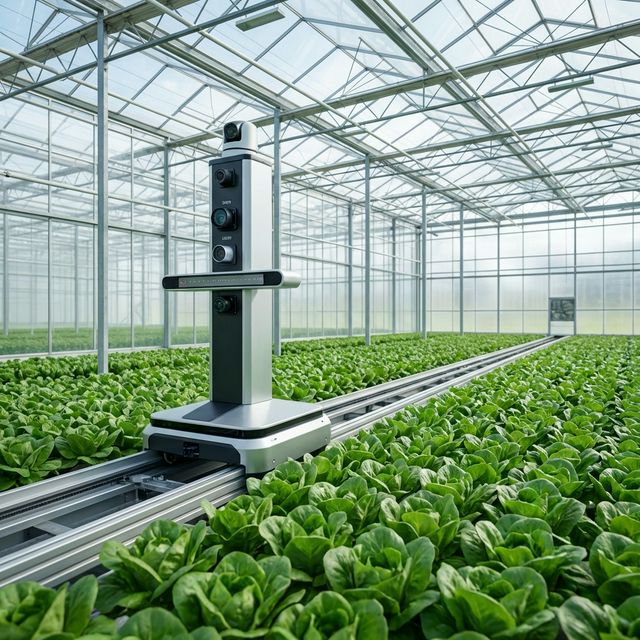
Vision towers positioned over the rows continuously scan foliage so anomalies are flagged before a human scout could walk the entire greenhouse.
Task and labor management
In massive glass greenhouses, human movement is also data. When, where, and how much harvesting, pruning, leaf-plucking, and pest control have been executed are all recorded. Based on this data, the AI recommends “when and which line needs concentrated management.”
It becomes even more interesting when combined with robots. In the Netherlands and Japan, tomato harvesting robots and leaf removal robots are already traversing the commercialization stage.
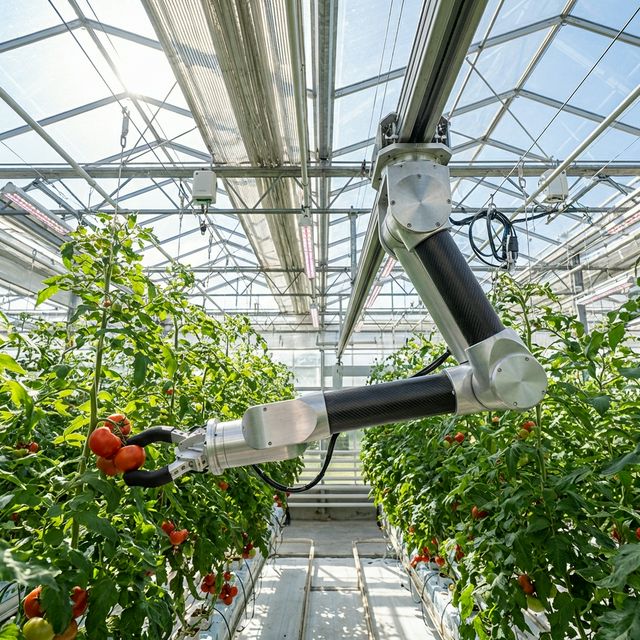
The AI greenhouse control system will eventually design environments considering wide aisles for robots and optimal crop conditions for harvesting.
Vinyl House vs Glass Greenhouse: The AI Perspective
The discussion doesn’t simply end at “vinyl houses are cheap, glass greenhouses are expensive.” From an AI perspective, their structural characteristics are quite distinct.
| Category | Vinyl House | Glass Greenhouse |
|---|---|---|
| Initial Cost | Relatively cheap | Extremely high (steel frames, glass, equipment) |
| Insulation/Sealing | Prone to drafts, gaps, and leaks | Highly sealed allowing precise control |
| Sensors/Equipment | Often introduced incrementally | Often fully stacked from the design phase |
| AI Control Difficulty | Many variables and high irregularity | Relatively stable modeling |
| Core Use Cases | Korean tomatoes, paprika, strawberries | Dutch-style mega greenhouses, export-oriented |
Focusing purely on AI control, glass greenhouses offer a far “easier modeling environment.” This is because they are well-sealed, structurally standardized, and largely equipped with unified hardware. Conversely, vinyl houses carry a tangled history of modifications, additions, and repairs, meaning every farmer’s greenhouse is essentially a unique environment.
This division makes modern research fascinating.
- In glass greenhouses, the focus is on “fully autonomous control and total automation including robots.”
- In vinyl houses, the focus is on “overlaying AI onto existing facilities to maximize efficiency at a minimal cost.”
Both require AI, but the strategy and approach differ wildly.
Where does the Korean AI greenhouse stand?
The Korean Rural Development Administration has pushed the slogan “The era of AI farming” for quite some time. In the development of second-generation smart farm technology, there are only two core keywords:
Cloud and Machine Learning.
- Local weather info, greenhouse sensor data, and production records are aggregated in the cloud.
- Optimal environmental metrics per crop and per region are extracted as big data.
- AI control algorithms are layered on top to provide “recommended settings” and “automatic control.”
Real-world examples are accumulating. Pilot operations targeting outdated vinyl houses in the Chungcheong and Jeolla regions reported that applying AI-based environmental guides resulted in yields jumping by over 10% while energy usage dropped. It feels akin to cloning the “intuition of a veteran farmer” into data and passing it down to beginners.
Effects by numbers: What can you actually believe?
When looking at data on AI greenhouses, you often encounter exaggerated numbers. Statements like “50% increase in yield, 70% reduction in energy.” These are mostly figures derived from highly specific conditions or isolated experiments, making them dangerous to generalize.
A more reliable baseline looks like this:
- Cases where applying AI-based climate control achieves 15-30% energy reduction are repeatedly cited in various papers.
- In the Autonomous Greenhouse Challenge, several results clustered around a 10% yield increase + 15-20% energy reduction.
- For early pest and disease detection systems, the results are largely qualitative rather than quantitative, emphasizing that they “advanced the discovery timeline” rather than “saved X amount of money.”
In other words, claims of “double the harvest at half the cost” should probably be treated as marketing flair. However, there is substantial, convincing momentum behind the idea of “achieving similar yields while definitively cutting energy and labor.” For a farmer, that’s more than enough to qualify as a “technology worth trying.”
Realistic hurdles
If it were a totally perfect story, no greenhouse operation would ever fail. There are several realistic walls to climb.
-
High initial investment- Factoring in sensors, controllers, communication equipment, and cloud subscription fees, the burden on farmers is heavy. - While the physical vinyl house itself is cheap, bolting AI onto it often requires foundational equipment upgrades first.
-
Energy Prices- Even if AI trims energy usage by 20%, if the basic cost of energy spikes by 50%, the savings are effectively neutered. - “Energy-independent greenhouses” coupled with renewables like solar and geothermal are becoming an increasingly vital keyword.
-
Data and Security- Greenhouse operation data goes up to the cloud. - Server outages, hacking, or ransomware immediately translate to production halts. - We are entering an era where farms need to discuss cybersecurity.
-
The Technology Gap- Massive glass greenhouses or export farms absorb these technologies rapidly. - Small vinyl house farmers can easily stall out at the stage of “checking the smartphone app, but putting in the same settings every day anyway.”
Because of this, the trend is shifting towards “phased introduction of semi-automation.”
- First, entrust monitoring and alarms to the AI.
- Next, automate specific equipment (boilers, vents).
- Finally, transition into fully integrated automated control.
How will the greenhouse landscape change in 5 years?
Predicting the future is always risky. Still, looking at current data and trends, a general picture begins to form.
-
AI climate control becomes a default option Newly built glass greenhouses are highly likely to feature AI-based integrated control out of the box. For vinyl houses, budget sensors and subscription services will rapidly proliferate.
-
Predictive maintenance becomes routine Trends move towards receiving alerts that say “the boiler is about to break,” or reasoning that “the ventilation motor’s current pattern is weird, let’s fix it beforehand.”
-
The gap between ‘farms with data’ and ‘farms without’ widens Production data will emerge as a crucial reliability metric for loans, insurance, and contract farming. Data, ultimately, becomes a physical asset.
-
The role of field experts shifts Instead of manually pressing buttons, greenhouse managers will evolve into personnel who “interpret AI recommendations and establish strategy.” A form of an ‘Agricultural Operations PM’.
-
Policy and regulations will catch up Rules regarding greenhouse energy efficiency standards, data standardization, and security guidelines are bound to be drafted. Agriculture is growing nearly as complex as the IT infrastructure industry.
One concluding thought
Vinyl houses and glass greenhouses can no longer be simply referred to as “houses wrapped in vinyl or glass”. They are miniature factories where data pools, algorithms spin, and robots navigate. Ultimately, designing that factory and deciding how much control to hand over to the AI remains the responsibility of the human holding the reins.
References
- Wageningen University & Research, Autonomous Greenhouse Challenge
- Nature Communications, Potential of artificial intelligence in reducing energy and resource use in agriculture, 2024
- Energy-efficient AI-based Control of Semi-closed Greenhouses, 2023
- Rural Development Administration, Policy Data on ‘Opening the Era of AI Farming’, 2018
- Domestic papers analyzing regional characteristics for AI environmental control in Korean smart greenhouses
- Miilkia Agrow, AI-Driven Climate Control in Dutch-Style Greenhouses, 2025
- JHuete Greenhouses, Artificial intelligence (AI) in greenhouses, 2024
- Assorted review and academic papers focusing on yield and quality comparisons involving hydroponics, open fields, and AI facilities.