5 Things Korean Farmers Should Check First After the Agrivoltaics Law Passed
5 Things Korean Farmers Should Check First After the Agrivoltaics Law Passed
May 7, 2026. The South Korean National Assembly passed the “Act on Promotion and Support of Agrivoltaic Power Generation Businesses” at the plenary session. This is the law that had been in the pipeline for years, with farmers asking “when is it finally happening?”
The law passed — but operations cannot begin immediately. The condition is that the law takes effect 6 months after Cabinet approval, meaning around November 2026 is the real starting line. Those who are not prepared when the signal goes off will be stuck at the gate.
There are things that need to be checked right now.
1. Confirm Whether Your Farmland Is in an “Eligible Zone”
The law does not permit everything. Farmland outside agricultural promotion zones (농업진흥지역) is the basic requirement.
Agricultural promotion zones — commonly known as absolute farmland — are off-limits as a rule. There is exactly one exception: farmland designated as a Renewable Energy District under the Rural Spatial Reorganization Act can participate in power generation projects even within agricultural promotion zones.
Whether your land falls inside or outside an agricultural promotion zone can be confirmed through the farmland register (농지원부) or the land registry at your local government office. If it falls inside a promotion zone, the rest of this checklist doesn’t apply. For Renewable Energy District designation status, contact your local municipal agriculture office directly — that’s the fastest way.
2. Verify That You Qualify as an Eligible Operator
The law restricts who can run an agrivoltaic business, specifically to block outside capital from entering. Not just anyone can raise their hand.
Three eligible entities exist:
- Actively farming agriculturalists: This includes both self-cultivating landowners and tenant farmers. The key criterion is being the person who actually farms the land.
- Resident Participation Cooperatives: Composed of farmers and rural residents living in or adjacent to the township where the farmland is located. This is the so-called “Sunshine Income Village” model.
- Agricultural corporations: Permitted only within Renewable Energy Districts.
The “3 years of actual cultivation” requirement that kept coming up during legislative discussions will be finalized in subordinate regulations. The exact figure isn’t confirmed yet, but registering your agricultural management entity (농업경영체) and keeping your farmland register current is advantageous preparation.
3. Facility Standards — Agricultural Machinery Must Be Able to Pass Through
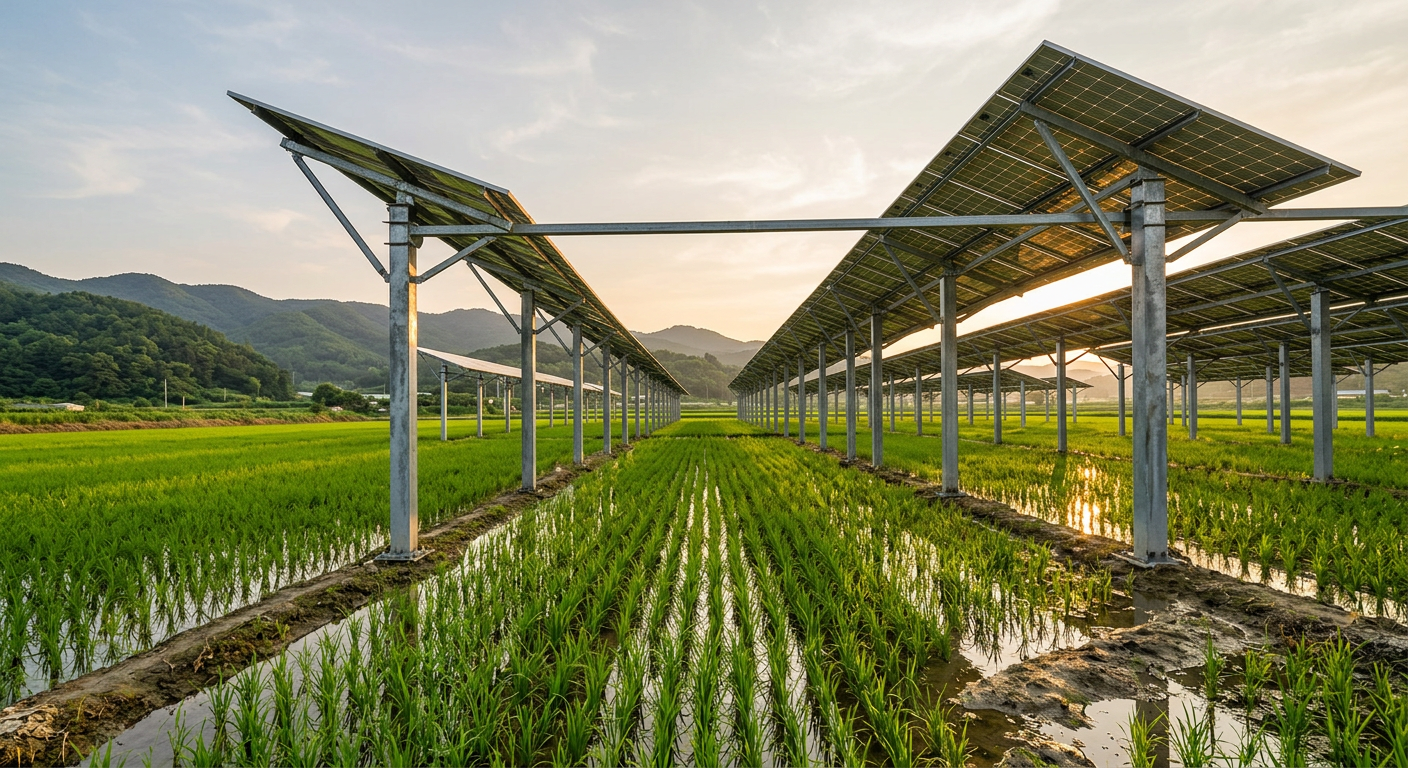
To prevent the focus from shifting to power generation at the expense of actual farming, physical standards are being fixed as numerical thresholds.
The figures currently under discussion:
- Solar panel shading rate ≤ 30%: Panel coverage must not exceed 30% of total area.
- Pillar height 2.5–3m: Tractors, combines, and other farm equipment must be able to pass underneath.
- Structure spacing ~4m: Required to secure crop growth space and working room.
- Capacity range: Government discussions point to a minimum of 300kW and a maximum of 1MW. 1MW requires approximately 2 hectares (~6,000 pyeong) of farmland.
These figures will be finalized in subordinate legislation. Always verify the final official notice before designing any facility. Commissioning a contractor before the standards are confirmed is a recipe for a costly compliance failure.
4. If You’re a Tenant Farmer, Review Your Lease Agreement Now
The law explicitly codifies tenant farmer protections. But for tenant farmers, this is actually the section that requires the most urgent verification.
What the law guarantees:
- Automatic lease renewal obligation for landlords during the project period. This is the mechanism preventing landowners from unilaterally terminating leases to capture solar income themselves.
- Rent increase cap: Rent cannot be raised more than 5% above the agreed rent or deposit.
In reality, now that the law has passed, landowners may start pressuring tenant contracts to secure the solar business rights for themselves. Check the lease agreement terms right now — specifically the contract duration and renewal conditions — before anything else.
5. Understand the Penalties for Violating the Farming Obligation
”Install the solar panels and do the farming loosely — no big deal.” This is completely wrong.
One of the law’s core mechanisms is post-installation management. If a business operator is found to be running the power generation business without actually farming, the consequences escalate as follows:
- Correction order
- Fine (penalty surcharge)
- Business suspension
- Business license revocation
The process is graduated, but it can ultimately result in losing the business entirely. If a restoration-to-original-state order follows, the full installation cost is forfeited. The maximum project period for temporary non-agricultural use permits is 23 years, but farming compliance is re-checked in 3-year re-approval cycles.
Farming activity records must be maintained meticulously. Developing systematic habits of keeping farm work logs, harvest records, and equipment access histories is essential.
Summary
The law passed — but that doesn’t mean you can break ground tomorrow. There’s a 6-month implementation wait, and then subordinate legislation still needs to be finalized. That time is your preparation window.
Is my farmland in an eligible zone → Am I a qualified operator → Can I meet the facility standards → Have I sorted out my lease situation → Can I sustain the farming obligation?
The farms that confirm these five things now and those that don’t will be at entirely different starting points once the implementation date arrives.
References
-
Ministry of Agriculture, Food and Rural Affairs, Press Release: “Act on Promotion and Support of Agrivoltaic Power Generation Businesses” Passed by National Assembly (May 7, 2026) https://www.mafra.go.kr/bbs/home/792/577861/artclView.do
-
Newspim, “Solar Path Opens on Farmland — Agrivoltaics Law Passes National Assembly” (May 7, 2026) https://www.newspim.com/news/view/20260507001282
-
Newsis, “Tenant Farmers Permitted in Farmland Solar — Power Business Restricted Outside Agricultural Promotion Zones” (May 7, 2026) https://www.newsis.com/view/NISX20260507_0003620885
-
Daum News (Gwangju Ilbo), “Compulsory Disposition Orders for Agricultural Land Law Violations — Agrivoltaics Enters Formal Regulatory Framework” (May 8, 2026) https://v.daum.net/v/20260508152430907
-
Environmental Law Journal, “‘Agrivoltaics Law’ Founding Bill Passes National Assembly” (May 2026) http://m.ecolaw.co.kr/news/articleView.html?idxno=118146
-
Korea Beyond Coal (기후솔루션), Commentary: “Sunlight Reaches Rural Korea, But Challenges Remain for Agrivoltaics” (May 2026) https://forourclimate.org/ko/newsroom/1209
-
marin13 Blog, “Agrivoltaics Target September Implementation — 30% Shading Rate Discussions” (Feb 2026) https://marin13.tistory.com/209
-
Korea Energy Agency (KNREC), Rural Solar Power Support Program Guide https://www.knrec.or.kr/biz/introduce/newfin/introfarm.do?gubun=A