Post-Legislation Checklist: Agrivoltaics Law in South Korea (Farmers & Local Governments)
Post-Legislation Checklist: Agrivoltaics Law in South Korea (Farmers & Local Governments)
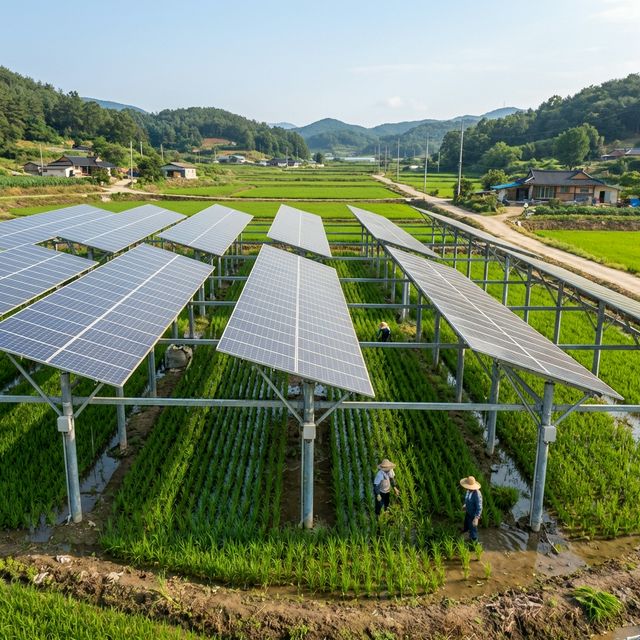
May 7, 2026 — the law finally passed. The “Act on Activation and Support of Agrivoltaic Power Generation Projects” was approved at the National Assembly plenary session. Following deliberation at a Cabinet meeting, enforcement is expected approximately 6 months later — as early as November 2026.
For years, the 8-year cap on farmland use under the Agricultural Land Act made agrivoltaics economically unviable. Solar panels last 20–25 years; nobody invests to tear everything down in 8. That wall has now come down. The usable period extends to a maximum of 23 years, and even absolute farmland (Agricultural Promotion Zones) can be included if designated as a “renewable energy district.”
The law rests on three core principles: food security, prevention of haphazard development, and return of profits to local communities. Violate these and you risk losing your operating permit entirely.
1. First Check: Am I Eligible to Operate?
Without the right qualifications, the best farmland in the country won’t help.
- Actual farmers (owner-farmers and tenant farmers): Must be registered in the township (eup/myeon/dong) of the project site or an adjacent one, and must actively farm
- Resident Participation Cooperatives: Formed by actual farmers and rural residents. This is the backbone of the “Sunlight Income Village” (Haetbit Soduk Maeul) model
- Agricultural corporations: Permitted only in designated renewable energy districts — not in general areas
- External investors, professional energy developers: Not eligible. This provision directly addresses the old problem of outside capital exploiting farmland
💡 Tenant farmers are explicitly included. However, landlords are now legally required to auto-renew lease contracts during the project period and cannot raise rent by more than 5% of the agreed amount.
2. Farmer Checklist
① Site Eligibility Verification (Pre-Project Essential)
| Check Item | Details |
|---|---|
| Agricultural Promotion Zone status | Outside the zone: permitted by default. Inside: requires renewable energy district designation |
| Renewable energy district designation | Under the Rural Spatial Reorganization Act; check with local government |
| Eup/myeon (rural) area status | Properties in dong (urban) areas of composite cities are not eligible |
| Grid interconnection feasibility | Verify connection to KEPCO distribution network before committing |
② Document Preparation Checklist
- Farming Management Entity Registration Certificate or Farmland Register (nong-ji-won-bu)
- Land Registry Certificate (toji deunggibueun)
- Farming Plan (specify crops, farming methods)
- Business Plan (for mayor/county head approval)
- Crop compatibility confirmation (reference Korea Energy Agency crop standards)
- Resident registration copy (confirming eup/myeon/dong address)
- For tenant farmers: farmland lease agreement (standard contract recommended)
③ Step-by-Step Process
Step 1: Draft farming plan — specify crops and cultivation methods
Step 2: Prepare business plan and apply for mayor/county head approval
Step 3: Consolidated permit processing (one-stop handling enabled)
Step 4: Power generation license (Electricity Business Act, Article 7)
※ Under 500kW → mayor/county head/district chief
※ 500kW–3,000kW → city/province governor
Step 5: Construction plan filing (before breaking ground)
Step 6: Install facilities, pass completion inspection
Step 7: Register with Korea Power Exchange, begin power generation
Step 8: Prove continued farmer status every 3 years
Post-compliance is where projects collapse. Failure to farm while operating solar leads to: corrective order → surcharge → suspension → license revocation. Unlicensed or fraudulently licensed operators face up to 5 years imprisonment or a fine of up to 50 million KRW.
④ Basic Economic Feasibility Check
- Estimated annual revenue = Capacity (kW) × Annual generation hours × Power selling price
- Payback period = Total investment ÷ Annual net profit
- Run numbers against a 23-year project horizon — 8 years was never viable
- Confirm eligibility for direct payment subsidies (gong-ik jik-bul-geum): farmland with agrivoltaic installations is now included
3. Local Government Checklist
For local governments, this law could mean a wave of administrative work — or a real opportunity to drive regional economic growth.
① Renewable Energy District Designation Process
The authority to designate renewable energy districts under the Rural Spatial Reorganization Act rests with local governments.
- Survey potential renewable energy district candidates within Agricultural Promotion Zones
- Review current status of rural spatial planning (renewable energy districts are embedded here)
- Design public hearing and community consultation process for residents and farmers
- Prepare environmental impact review checklist for district designation
② One-Stop Permitting Window
The law includes a consolidated permit processing provision. Without a proper counter in place, complaints will pile up fast.
- Designate a dedicated department for agrivoltaics permits
- Integrate power generation license (under 500kW: mayor/county head) and farmland use permits
- Publish official processing timelines (power generation license: ~50 days from receipt)
- Create and distribute a citizen-facing checklist and guidance document
③ Link to Sunlight Income Village (Haetbit Soduk Maeul) Initiative
The central government has announced a plan to establish 500 Sunlight Income Villages by 2030 — 100 per year. For local governments, this is a pipeline to national funding.
- Identify and develop community organizations; support cooperative formation
- Inventory usable land (farmland, reservoirs, etc.)
- Prepare applications for Sunlight Income Village designation
- Design a model for managing village common funds from power generation revenue
④ Farmland Post-Management Reinforcement
The amended Agricultural Land Act (passed alongside this law) mandates a full farmland census and expands illegal lease reporting incentives.
- Establish a full survey plan for all agrivoltaic farmland in the jurisdiction
- Build a periodic verification system for farming activity (every 3-year cycle)
- Operate a violation reporting intake channel
- Revise internal regulations for corrective orders and fines (up to 500,000 KRW)
⑤ Education Support and Center Linkage
The law includes grounds for designating integrated support centers and providing education and consulting.
- Hold at least one information session for local farmers before the law takes effect
- Announce Korea Energy Agency rural solar support programs
- Provide farming plan drafting assistance (via agricultural technology centers)
- Publicize policy loan programs: targeting power generation operators under 500kW
4. Immediate Priority Actions
The law passed — but subordinate regulations are still being drafted. Here’s what to do before they’re finalized.
For farmers:
- Check whether your farmland falls inside or outside an Agricultural Promotion Zone
- Confirm your registered address is in the project eup/myeon/dong or adjacent
- Review farmland lease agreements (check for auto-renewal clauses if you’re a tenant)
- Start community dialogue about forming a cooperative
For local governments:
- Begin surveying potential renewable energy district candidates
- Build a dedicated permit processing team
- Prepare administrative manuals ahead of subordinate regulation rollout (H2 2026)
- Identify candidate villages for the Sunlight Income Village initiative
5. Caution: Still Unresolved Details
The law is passed. But the fine print still depends on presidential decrees (enforcement ordinances) and ministerial rules.
- Eligible crop list for agrivoltaics (delegated to presidential decree)
- Detailed requirements and process for renewable energy district designation
- Method and documentation for triennial farming activity certification
- Surcharge calculation standards and specific corrective order criteria
- Detailed financial support conditions (loan rates, limits, etc.)
Subordinate regulations are expected before the enforcement date (~6 months out). The Ministry of Agriculture, Food and Rural Affairs stated it will “proceed without delay to enact subordinate regulations in time for the enforcement date.” Monitor the ministry’s Rural Energy Policy Division for updates.
References
| Source | Description |
|---|---|
| MAFRA Press Release (May 7, 2026) | Official announcement of National Assembly passage of the Agrivoltaics Activation Act |
| National Assembly Bill Information System (May 6, 2026) | Bill No. 2218837 — substitute bill for the Agrivoltaics Activation Act |
| Newspim (May 7, 2026) | “Farmland solar cleared — Agrivoltaics law passes National Assembly” |
| MAFRA Explanatory Document (Oct 16, 2025) | Policy direction on renewable energy districts and extended farmland use period |
| Korea Energy Agency — Rural Solar Program | Support standards for rural/agrivoltaic power generation under 500kW (knrec.or.kr) |
| Electric Times (Oct 17, 2025) | Farmland use period extension from 8 to 23 years |
| Entropy Times (May 13, 2026) | Key features and expected effects of the Agrivoltaics Act |
| Farm Insight (May 9, 2026) | Mixed reactions in rural communities after law passage |