Agrivoltaic Solar — Installation Sequence & Checklist
Agrivoltaic Solar — Installation Sequence & Checklist

Before You Start
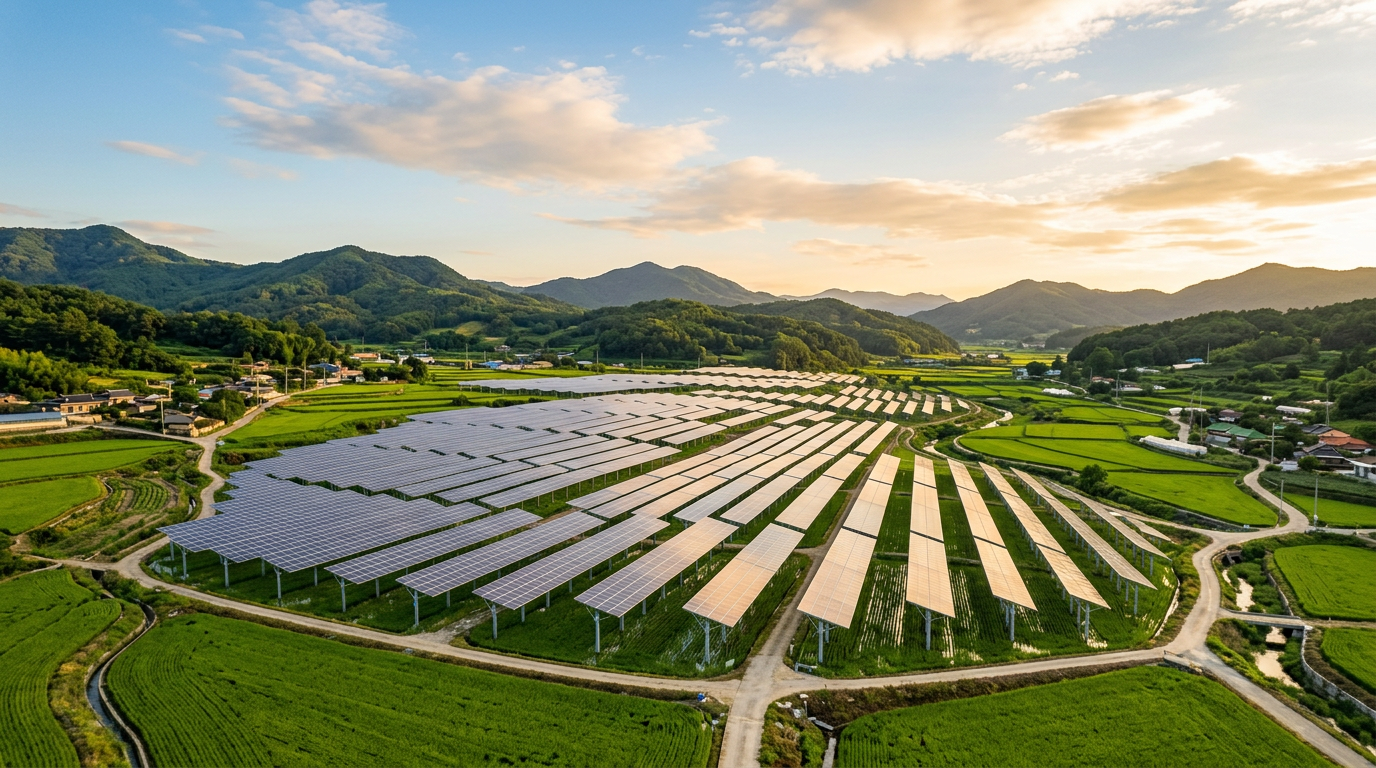
Solar panels hover above a rice paddy. Crops grow underneath. The first time you see it, it looks strange. But it works — and it’s becoming the norm. Agrivoltaics means farming and power generation on the same land, at the same time.
In May 2026, South Korea’s National Assembly passed the Act on the Promotion and Support of Agrivoltaics, extending land-use permits from 8 to 23 years and opening participation to farmers, resident cooperatives, and agricultural companies. Simply put, this is the best time in history to start an agrivoltaic project in Korea.
The question is: where do you begin? Every stage — permitting, design, construction, commissioning — has traps that can cost tens of millions of won if missed. This guide walks through each one.
Overall Project Flow
The construction itself is straightforward. What isn’t is the administrative process surrounding it, which typically takes longer than the physical build.
[Phase 1] Site Evaluation & Pre-Screening
↓
[Phase 2] Permitting (Power Generation → Land Development → Farmland Use)
↓
[Phase 3] Engineering Design & Material Procurement
↓
[Phase 4] Construction (Civil → Structure → Electrical → Grid Connection)
↓
[Phase 5] Pre-Use Inspection → Business Start Declaration → Operation
Total timeline: 1–2 months preparation, 2–3 months permitting, 2–3 months construction. Realistically, plan for 6–9 months from initial decision to commercial operation.
Phase 1 | Site Evaluation — This Is Where Projects Are Won or Lost
Skipping site evaluation leads to one common outcome: completing all permits, then learning the grid connection is impossible. It happens more than you’d think.
1-1. Site Suitability Checks
| Item | Standard | Notes |
|---|---|---|
| Farmland designation | Agricultural Promotion Zone vs. Non-Promotion Zone | Non-promotion zones are the primary target under 2026 law |
| Land category | Must be classified farmland (paddy, dry field, orchard) | Industrial/commercial lots are ineligible for agrivoltaics |
| Slope | Below 15° recommended | South or south-east facing optimal |
| Shade analysis | Evaluate shadows from buildings and trees | Directly impacts annual yield |
| Agricultural machinery access | Must allow 2.5–3m structural height clearance | Tractors and combine harvesters must pass through |
The structural post height of 2.5–3m minimum is the defining physical requirement of agrivoltaics — and what sets it apart from conventional ground-mounted systems. Higher structures mean more steel, which means higher construction costs.
1-2. KEPCO Grid Connection Pre-Check — Never Skip This
No grid connection means no power sales. No power sales means no revenue from a fully built facility. Confirm these four items before anything else:
- Nearby substation capacity surplus — saturated regions mean 1–2 year wait queues
- Distribution line condition — three-phase line availability is mandatory
- Grid connection distance — every additional 100m can add tens of millions of won in connection costs
- Connection backlog volume — timing determines profitability in congested areas
Contact KEPCO directly (call center: 123) or visit the regional branch for the most accurate assessment.
1-3. Setback Distance (Local Ordinance Review)
Setback requirements vary by municipality. Within the same province, neighboring counties can differ by hundreds of meters. Some ordinances require 300m setbacks; others require up to 1km. Request the full ordinance text directly from the county’s agricultural policy or urban planning department. Don’t guess.
Phase 2 | Permitting Sequence
Permitting has a required sequence. Getting the order wrong means starting over.
2-1. Power Generation Business Permit (MoTIE or City/Province)
- Below 100kW: city/provincial governor approval
- Above 3MW: Ministry of Trade, Industry and Energy (MoTIE) approval
- Required documents: application form, business plan, land use plan, financial capacity documentation
- Processing time: approximately 30–60 days
2-2. Temporary Farmland Use Permit (County Farmland Office)
Under the 2026 legislation, the permit duration has been extended to a maximum of 23 years. An agricultural management plan must be attached — detailing what crops will be grown and how farming will continue during the project’s lifespan.
2-3. Development Activity Permit (County Urban Planning Department)
This covers the physical installation of structures. For agrivoltaics, permanent concrete foundations are prohibited. The design must use screw-type or removable foundation systems to allow full site restoration upon project completion.
2-4. Construction Plan Notification (Korea Electrical Safety Corporation)
After the development permit and before breaking ground, file a construction plan notification per the Electricity Business Act. Below 10MW: notification. Above 10MW: approval required.
💡 One-stop processing: Under the 2026 law, the farmland use permit can be processed simultaneously with the power generation business permit in an integrated administrative procedure. Confirm availability with the local office, as rollout timing varies.
Phase 3 | Engineering Design & Material Procurement
Design decisions made here determine 20 years of energy output and revenue. This is not the place to cut corners.
3-1. Core Structural Design Parameters
| Parameter | Value | Basis |
|---|---|---|
| Module coverage ratio | 30% or less of total farmland area | MAFRA Guidelines |
| Post height | 2.5–3m minimum | Agricultural machinery clearance requirement |
| Structural row spacing | Approximately 4m | Tractor operation standard |
| Shading rate | Below 30% | Minimum crop photosynthesis guarantee |
| Azimuth | True south | ±10° deviation acceptable |
3-2. Material Selection
Structural steel coating options:
- Hot-dip galvanizing: Excellent corrosion resistance, low cost (40–100μm coating) — industry standard choice
- Aluminum-coated steel: Superior heat and chemical resistance, higher cost
- FRP coating: Best corrosion resistance, complex application process
Given frequent exposure to fertilizers and pesticides in agricultural environments, chemical-resistant coatings are strongly recommended.
Foundation type:
- Screw-type steel pipe piles (allows full site restoration)
- Permanent concrete foundations are prohibited — this is non-negotiable
Modules:
- Compare monocrystalline vs. bifacial modules (bifacial improves output by 7–10%)
- KS-certified or KEC-certified products are mandatory
3-3. Energy Yield Simulation
Run simulations using PVsyst or equivalent software. Critical note: due to wider panel spacing and elevated structure height, agrivoltaic installations typically yield 15–30% less energy than standard ground-mounted systems. This must be factored into financial projections — not accounting for it is the most common cause of unrealistic revenue forecasts.
Phase 4 | Construction Sequence
Now the actual work begins. Follow the sequence. Out-of-order work creates rework that doubles construction time.
4-1. Civil & Foundation Work
- Survey — GPS benchmarking, boundary staking
- Site preparation — minimal grading to preserve farmland integrity
- Drainage construction — critical for agrivoltaic sites to prevent waterlogging during heavy rain
- Layout marking — chalk line work to mark foundation positions per design drawings
- Ground penetration & screw pile installation — no concrete; helical steel pipes are driven directly into the ground
Agrivoltaic-specific: Structure orientation must align with crop rows to allow machinery paths. Coordinate with the farmer before finalizing layout.
4-2. Structural Assembly
Sequence: Column base plates → Posts (vertical columns) → Girders (primary beams) → Purlins (secondary beams) → Bracing installation
- Bolt torque values at each connection per engineering specifications (typically M16 bolts: 120–150 N·m)
- Use laser level for horizontal/vertical alignment verification
- Wind load design: must meet Korean typhoon/snow load standards (wind speed ≥ 40m/s resistance)
4-3. Module Installation
- Incoming module inspection (check for transport damage, visual defects)
- Module clamp fastening to purlins
- Final tilt angle adjustment (true south, 10–30° slope)
- String wiring verification (series/parallel configuration per design)
Orientation note: Portrait (vertical) module orientation results in approximately 42% average shading rate versus 59% for landscape orientation — a 17% advantage for crop growth. Portrait orientation is the recommended standard for agrivoltaic installations.
4-4. Electrical Work
- DC wiring — module cables routed to junction boxes
- Grounding — main ground + bonding ground (lightning/shock protection)
- Cable tray installation — organized routing, minimize outdoor exposure
- String combiner box installation — DC collection point
- Inverter installation — DC-to-AC conversion (capacity per design)
- Main distribution board — step-up transformer to KEPCO interconnection voltage
- Revenue meter installation — production measurement (KEPCO-synchronized)
- Monitoring system — real-time generation data and alarm system
Effective since May 2023: Solar PV systems must not be directly connected to emergency circuits. The circuit must be configured so that when utility power is lost, solar output is also automatically disconnected.
4-5. Grid Interconnection
- KEPCO service entrance cable installation (22.9kV special high voltage or low voltage)
- Customer-side switchgear connected to KEPCO disconnect switch
- Protection relay coordination testing
- Grid connection is a KEPCO-executed process — after paying the interconnection fee, schedule is determined by KEPCO (allow 3–6 months)
Phase 5 | Commissioning & Business Launch
Construction complete doesn’t mean power sales can begin. Formal inspection approval is required.
5-1. Pre-Use Inspection (Korea Electrical Safety Corporation)
Required documents:
- Pre-use inspection application form
- Engineering drawings (per Electricity Technology Management Act Article 2, Item 3)
- Supervisory engineer deployment confirmation (for low-voltage self-use facilities)
- Self-inspection confirmation if electrical safety manager performs inspection
Submit the application at least 1–2 weeks before the planned completion date. Passing the inspection and receiving the confirmation certificate is required before KEPCO will finalize the grid connection.
5-2. Business Start Declaration
Sequence: Pass inspection → Revenue meter sealing → KEPCO Power Purchase Agreement (PPA) → Business start declaration. Missing the business start deadline within the permit preparation period results in automatic permit cancellation.
5-3. REC Registration
File for Renewable Energy Certificate (REC) issuance with the Korea Energy Agency. The actual revenue combines REC income and SMP (System Marginal Price).
Master Checklist
✅ Pre-Construction Verification
- Farmland designation confirmed (non-promotion zone)
- KEPCO grid connection feasibility pre-screened
- Local setback ordinance reviewed (original text obtained)
- Power generation business permit obtained
- Farmland temporary use permit obtained (2026 law: max 23 years)
- Development activity permit obtained
- Construction plan notification filed
- Permanent concrete foundation use confirmed as prohibited in design
- Electrical safety manager officially designated
✅ During Construction
- Structure post height confirmed at 2.5–3m minimum
- Module coverage ratio at or below 30% of total farmland area
- Shading rate below 30% verified in design
- 4m minimum row spacing for agricultural machinery confirmed
- Screw-type foundation installed (no concrete)
- Portrait (vertical) module orientation applied
- Grounding completed (main + bonding)
- Cable tray installed with minimal external exposure
- Emergency circuit isolation confirmed in wiring configuration
✅ Post-Commissioning
- Pre-use inspection passed (Korea Electrical Safety Corporation)
- Revenue meter sealed
- KEPCO Power Purchase Agreement (PPA) executed
- Business start declaration filed
- REC registration submitted (Korea Energy Agency)
- Real-time monitoring system operational
- Electrical safety manager regular inspection schedule established
- Annual crop yield recording system initiated (for permit renewal)
- 20-year decommissioning cost reserve plan established
Key Numbers to Know
Project cost: Based on government briefings, approximately KRW 1.6 billion per 1MW, or roughly KRW 1.6 million per kW. At that rate: 300kW ≈ KRW 480M, 500kW ≈ KRW 800M, 1MW ≈ KRW 1.6B. Financing structure is typically 23% equity + 77% loan.
Yield reduction: Plan for 15–30% lower energy output compared to conventional ground-mounted systems due to elevated structures and wider spacing.
Decommissioning: Get a removal cost estimate before installation. At project end, decommissioning costs fall entirely on the operator.
Soil monitoring: Conduct soil contamination tests at least once per year and keep records. These become critical documentation during permit renewals and government audits.
References
- National Assembly Agricultural, Food, Maritime and Fisheries Committee (2026.05.06) — Act on Agrivoltaic Promotion and Support (Alternative), 435th National Assembly Session
- Ministry of Agriculture, Food and Rural Affairs (MAFRA, 2026) — Agrivoltaic Guidelines (post height, shading rate, module coverage ratio)
- imun.farm (2026.02.11) — “7 Things to Verify Before Installing Agrivoltaic Solar (2026 Standards)“
- imun.farm (2026.01.28) — “Comprehensive Agrivoltaic Regulations Summary, January 2026”
- Korea Rural Economic Institute — Agrivoltaic Profitability Analysis (minimum 20-year project duration required)
- KoreaScience (2019) — “Study on Construction and Activation of Agrivoltaic Power Systems” (JAKO201909950655063)
- Korea Electrical Safety Corporation (2023) — Agrivoltaic Grid-Tie Pre-Use Inspection Procedures (effective 2023.05.01)
- Renewable Energy Cloud Platform (recloud.energy.or.kr) — Pre-use inspection documentation requirements
- pv-magazine-australia.com (2026.05.13) — “South Korea’s first agrivoltaics law leaves half of farmland off-limits”
- Gwangju MBC (2024.11.12) — “Why agrivoltaic solar uptake remains low”
- Paru Company Blog (2023.02.27) — Agrivoltaic structure standards and shading rate analysis
- ssunlab.com — Solar PV construction procedure (structural work stages detail)