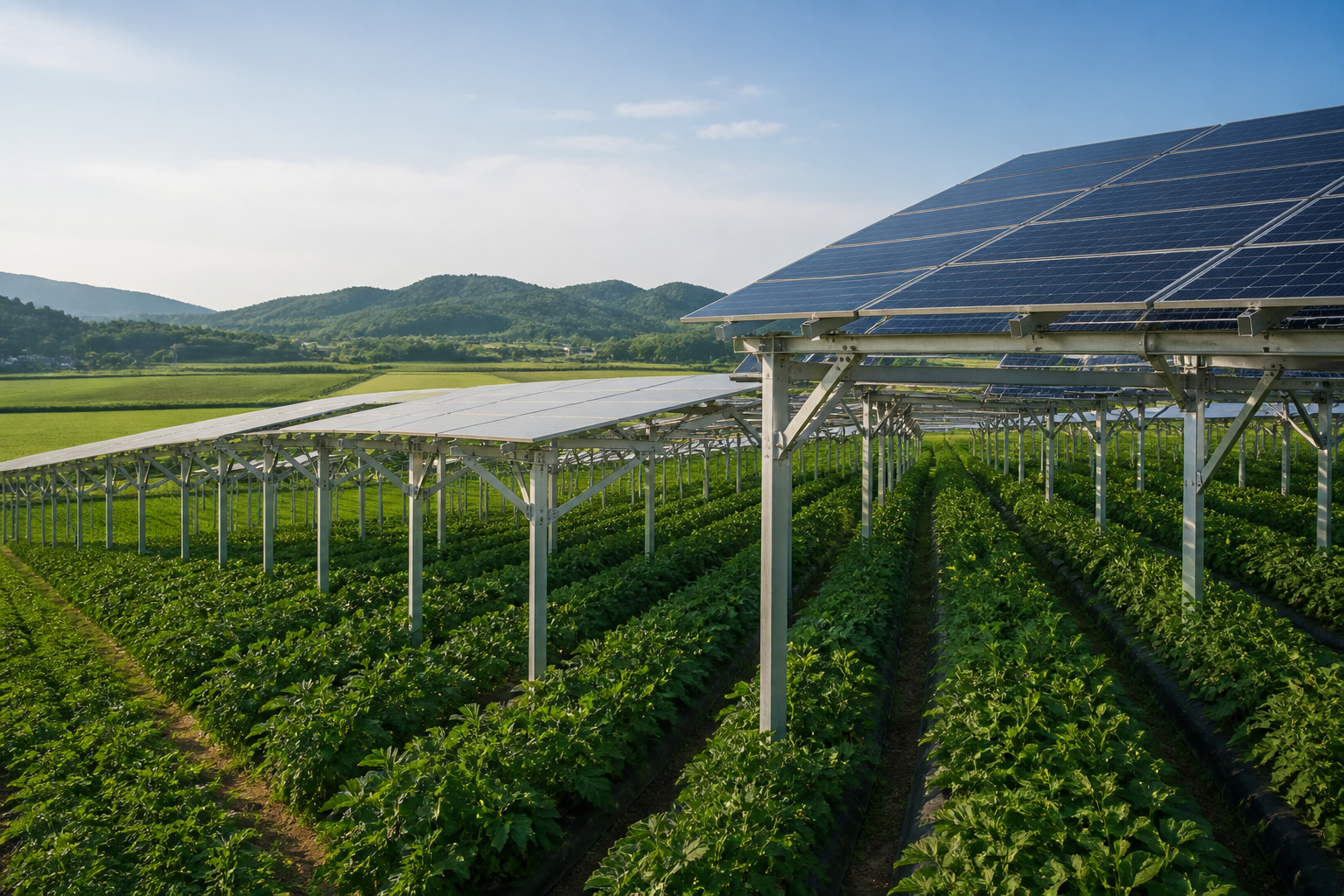
A practical summary of Korea’s new agrivoltaic law as of August 2026: effective date, eligible farmland, permits, farmer requirements, temporary farmland use, tenant protection, and risks.
Agrivoltaic Law in Korea as of August 2026
Agrivoltaics is one of the most debated topics in Korean rural energy. Some say it can raise farm income. Others worry that farmland may slowly turn into solar land. For farmers, the practical question is simple. Can this now be done on farmland, and under what conditions.
As of August 2026, the biggest change is the enactment of the 「Act on the Activation and Support of Agrivoltaic Power Generation Projects」. The law was enacted on June 16, 2026 as Act No. 21804. It is scheduled to take effect on December 17, 2026. That means the law exists, but it is not yet in force as of August 2026.
The practical answer is this. Agrivoltaics has entered the legal framework. But it is not a blanket permission for solar panels on every farmland parcel. Farmer eligibility, farmland type, resident consultation, local government permits, temporary use of farmland, grid connection, and post-management duties all matter.
1. The key point: enacted, but not yet effective
The official title of the new law is the 「Act on the Activation and Support of Agrivoltaic Power Generation Projects」. It was enacted on June 16, 2026 and will take effect six months after promulgation, on December 17, 2026.
This timing matters. A farmer reading the law in August 2026 should not treat it as an already operating permit route. The act sets the framework, while many details are left to presidential decrees and ministry rules. Those lower-level rules will matter for residence period, facility standards, crop restrictions, permit review standards, record-keeping, and reporting.
Search results from the Korean government legislative participation system also show a lower-level decree preparation plan for this law. So the correct August 2026 position is not “everything is settled.” It is “the law has been enacted, and the implementing rules must be checked before execution.” Farming follows seasons, but law follows effective dates.
2. The law defines agrivoltaics
Article 2 defines agrivoltaic power generation as producing solar energy while conducting agricultural production activities, such as cultivating crops or perennial plants specified by presidential decree. The most important phrase is “while conducting agricultural production activities.”
A solar plant placed on farmland with only grass cutting is not the model this law describes. Agricultural production must continue. The solar facility is also defined as a solar energy generation facility installed above farmland for agrivoltaic generation.
That means the project cannot be judged only by generation volume. Can farm machinery pass. Can crops receive enough sunlight. Can workers manage irrigation, pests, and harvest. Can the crop actually be grown under the structure. These questions sit at the center of the law. It is a power project, but the starting point is still farming.
3. Who can become a project operator
Article 5 limits who can operate an agrivoltaic power generation project. It is not a simple structure where any outside developer can lease farmland and install panels. The operator must also have an electric business permit under the Electric Utility Act.
First, an eligible farmer may operate a project. The farmer must live in the same eup, myeon, or dong as the facility, or in an adjacent eup, myeon, or dong, for a period to be set by presidential decree. The farmer must also prove three years of agricultural management under the Farmland Act. Young farmers may receive different treatment under future implementing rules.
Second, a resident participation cooperative can qualify if at least 10 residents from the relevant or adjacent area establish a cooperative for the project. Third, an agricultural corporation can qualify in a renewable energy district if it meets requirements to be set by presidential decree.
The direction is clear. The law tries to keep agrivoltaics centered on local farmers, local residents, and agricultural corporations rather than purely outside developers. Still, details such as residence period, young farmer exceptions, and agricultural corporation requirements must be checked once the decree is finalized.
4. Which farmland can be used
Article 6 defines eligible project sites. The project must be on farmland that can receive temporary non-agricultural use permission under Article 36 of the Farmland Act and must also receive the agrivoltaic project permit.
The law names two main categories. The first is farmland outside agricultural promotion areas. The second is farmland designated as a renewable energy district under the Act on Restructuring and Regeneration Support for Rural Space.
This is where many misunderstandings can occur. The law does not mean that agrivoltaics is now fully allowed inside all agricultural promotion areas, often called protected farmland. Korean government policy clarification has also stated that agrivoltaics inside agricultural promotion areas is not a blanket permission.
There is a special route for resident participation cooperatives. If a mayor, county governor, or district head consults with the Minister of Agriculture, Food and Rural Affairs when granting the project permit, the cooperative may be able to operate outside the two basic categories. Article 9 also creates a deemed designation mechanism for renewable energy districts in certain resident cooperative cases. That is an exception route, not automatic permission.
5. The project period can be up to 30 years
Article 7 provides that the project period can be within 30 years from the date of permit. The exact period is set by the local government head according to presidential decree.
Thirty years is a long time for a farm. It may look attractive in a solar revenue model. But it also affects land use, family succession, lease contracts, sale plans, inheritance, and crop changes. A child can be born and become an adult within that period.
Agrivoltaics should not be treated as a short side job. It should be reviewed as a 20- to 30-year farm management plan involving power generation, agricultural production, finance, maintenance, and restoration. The panels go above the field, but time is what the farm really commits.
6. The permit route is local-government centered
Article 8 sets the permit procedure. A project applicant must go through a resident opinion collection process in the eup, myeon, or dong where the facility is located and obtain permission from the mayor, county governor, or district head. A farmland tenant must obtain consent from the landowner.
The application must include documents such as a facility plan and a farming plan. The local government can request supplementary documents or additional materials. When reviewing the permit, it must consider several points.
- Whether the facility structure and standards allow farm machinery operation and crop sunlight.
- Whether farming can be carried out as planned.
- Whether the project affects landscape, ecosystem protection, and farmland conservation.
- Whether transmission or distribution grid facilities can be used.
- Whether other public-interest standards are met.
Unless there is a special reason, the local government must notify the applicant within 30 days of receiving the application. The consultation period under Article 9 is excluded from that 30-day count. In practice, grid connection and resident consultation may take more time than preparing the application form itself.
7. Temporary farmland use is deemed granted with the project permit
The most important Farmland Act connection is temporary use of farmland for another purpose. Article 10 states that when the local government grants the agrivoltaic project permit, permission for temporary non-agricultural use under Article 36 of the Farmland Act is deemed to have been granted.
This is different from farmland conversion. The land is not being changed into a factory site or miscellaneous land. It remains farmland while temporarily allowing an additional use. That is why farming continuity and restoration become central.
The deemed permission is not automatic without documents. The applicant must submit the relevant Farmland Act documents together with the project permit application. Farmers should prepare farming plans, facility plans, and farmland documents together from the beginning. Administrative procedures still run on drawings, forms, and records.
8. Farming must continue every year
Article 13 sets project operator duties. Unless there is a special reason such as a natural disaster, the operator must conduct agricultural production every year according to the submitted farming plan. The operator cannot grow crops that make it impossible to verify farming or that cannot reasonably be cultivated together with the power project.
The operator must also inspect and maintain the facility according to technical standards. Records of agricultural production, crop cultivation, facility inspection, and maintenance must be prepared and stored. They must be submitted when the local government requests them.
This gives agrivoltaics its legal character. A project that receives a permit and then treats farming casually can face correction orders, business suspension, permit cancellation, and penalties. Article 16 allows an administrative surcharge of up to 500 million KRW, or up to three times the profit from the violation if that amount exceeds 500 million KRW, when farming duties are violated and correction orders are not followed.
Farmers will need more than a few harvest photos. Cultivation records, work records, harvest and sales records, and facility maintenance records will matter. Agrivoltaics is a power project, but it is also record-based farming.
9. Tenant farmers receive some protection
Article 18 addresses tenant protection. If a tenant farmer has a valid agrivoltaic project permit and electric business permit, the landowner cannot refuse lease renewal within the permitted project period without just cause.
There are exceptions. The landowner can refuse in cases such as two or more consecutive unpaid rent periods, fraudulent lease, agreed compensation, unauthorized sublease, or serious violation of tenant duties. The law also limits rent or deposit increases at renewal to 5% of the agreed amount.
This is important because agrivoltaic projects involve construction, financing, grid connection, and long-term operation. If the land lease collapses suddenly, the whole project can fail. That is why the law creates tenant protection.
But tenant farmers cannot act alone. Article 8 requires landowner consent before a tenant applies for the project permit. The tenant must also restore the farmland to its previous condition when the lease ends. Consent, restoration scope, removal costs, and renewal conditions should be written into the contract from the start.
10. Support measures exist, but income is not guaranteed
Articles 21 to 25 provide support measures. The government may establish policy funding measures such as loans and subsidies for eligible farmers, resident cooperatives, and agricultural corporations. The state and local governments may also support stable revenue measures and provide management, technical, financial, and accounting consulting.
The law also supports research on suitable crops under solar structures, cultivation methods, facility technology, and the designation of an agrivoltaic comprehensive support center. This is positive for farmers because agrivoltaics combines law, finance, crop science, and engineering.
Still, support clauses do not guarantee profit. SMP, REC, power purchase contracts, installation cost, financing cost, grid construction cost, and crop yield or quality change must all be calculated separately. The law creates a route. Profit is made, or lost, in the field. A revenue model that counts only power sales is only half a ledger.
11. Agricultural promotion areas still require caution
The biggest misconception in August 2026 is that protected farmland has been fully opened. That is not a safe reading. The basic structure of Article 6 focuses on farmland outside agricultural promotion areas and farmland designated as renewable energy districts. A special route exists for resident participation cooperatives with consultation, but that is not a general green light for individual farmers everywhere.
Agricultural promotion areas remain areas where agricultural production bases must be protected. The new agrivoltaic law also starts with the purpose of preserving agricultural production bases. So permit review will inevitably look at farming continuity, farmland conservation, structure standards, sunlight, machinery operation, local planning, and grid connection.
A farmer should check the parcel first. Is it inside an agricultural promotion area. Is renewable energy district designation relevant. Is the operator an individual farmer, a resident cooperative, or an agricultural corporation. What does the city or county agriculture department say. What does the grid connection review show. The answer begins with the land parcel and the distribution line, not with marketing brochures.
12. Practical checklist for farmers now
As of August 2026, the better move is preparation rather than rushing into construction. These items should be checked before the law takes effect.
- Confirm land location, land category, and whether it is in an agricultural promotion area.
- Check whether the farmer meets agricultural status and three-year farming management requirements.
- If the farmer is young, watch how the decree defines exceptions.
- If the land is leased, confirm landowner consent and lease period.
- Review whether a resident participation cooperative structure is needed.
- Design panel height and spacing around machinery movement and crop sunlight.
- Choose likely crops and record-keeping methods.
- Check grid connection possibility and likely construction cost.
- Identify resident consultation issues in advance.
- Include restoration and removal costs in the business plan.
- Recheck the presidential decree, ministry rules, local ordinances, and local guidelines once issued.
Grid connection should be checked early. Even if the law allows a project, the business cannot move if the distribution line has no available capacity. Agrivoltaics requires law, farming, and electricity to match at the same time. If one wheel is missing, the cart does not move.
13. Bottom line
As of August 2026, Korean agrivoltaics has entered a new stage. A dedicated law has been enacted. It defines project operators, eligible farmland, permits, temporary farmland use, farming duties, tenant protection, policy funding, consulting, research, and support center mechanisms. It is no longer just a pilot-project topic or an unclear exception.
But the door is not wide open. It is not a blanket permission inside agricultural promotion areas. It is not a model where outside developers can freely take farmland. Farming must continue, resident opinions must be collected, local permits must be obtained, grid connection must be checked, and records must be kept.
Agrivoltaics is not simply a solar business placed on farmland. It is a power business inserted into agricultural management. That makes it more promising, and also more demanding. The law has opened a path. The actual path for each farmer will be drawn again through implementing decrees, local interpretation, grid connection, crop choice, and contracts. The August 2026 answer is to prepare carefully before moving fast.
References
- Korean Law Information Center, 「Act on the Activation and Support of Agrivoltaic Power Generation Projects」, Act No. 21804, enacted June 16, 2026, scheduled to take effect December 17, 2026.
- Korean Law Information Center, Farmland Act Article 36 on temporary non-agricultural use of farmland.
- Korean Law Information Center, Farmland Act Article 28 on agricultural promotion area designation and Article 32 on restrictions within agricultural promotion zones.
- Korean Government Legislative Participation Center search results for the lower-level decree preparation plan for the agrivoltaic law.
- Korea Policy Briefing clarification that agrivoltaics inside agricultural promotion areas is not a blanket permission.
- The Act on Restructuring and Regeneration Support for Rural Space, especially provisions related to renewable energy districts.