Agrivoltaic Installation Types and Methods: A Practical Guide
Agrivoltaic Installation Types and Methods: A Practical Guide
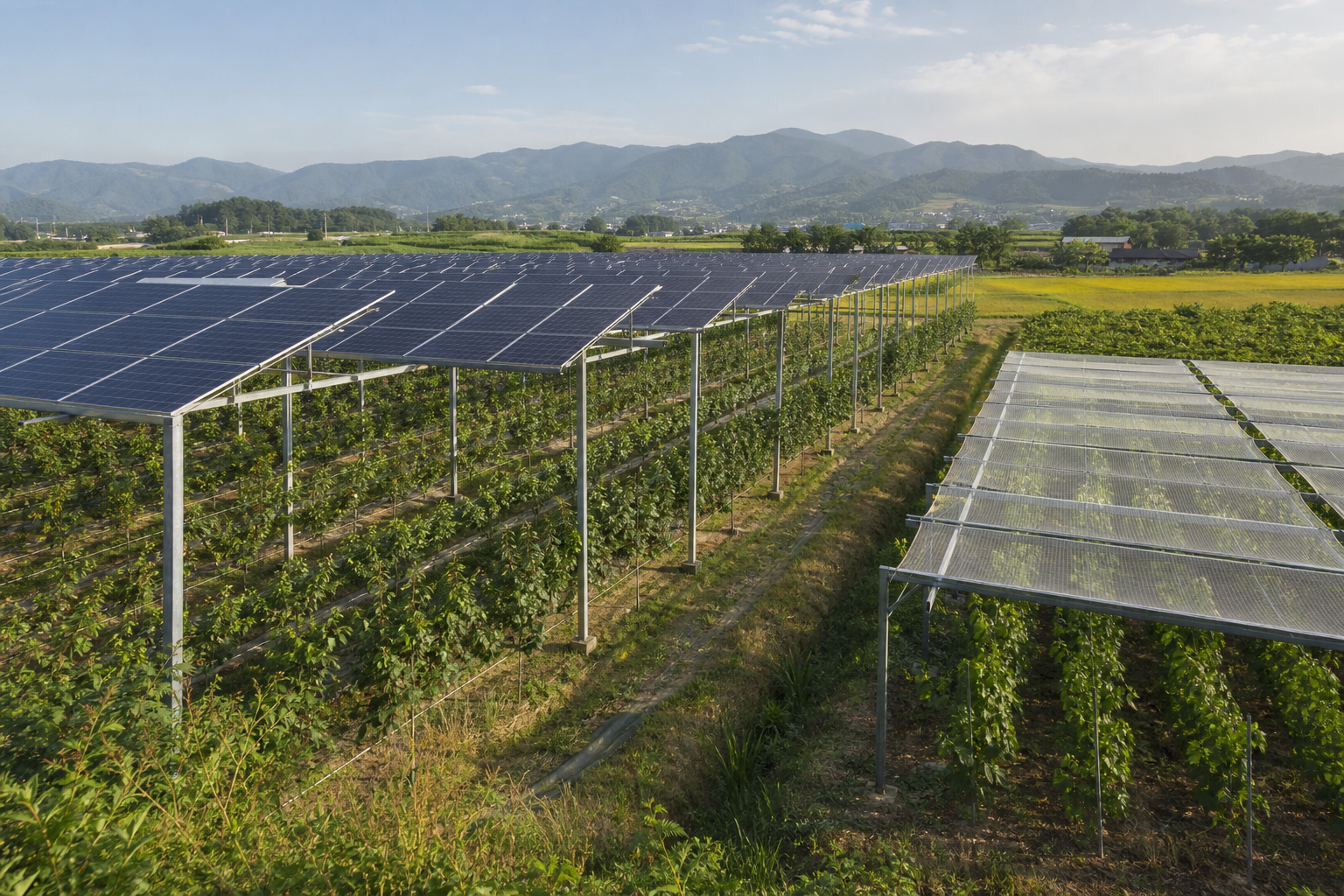
Panels go above the paddy. Panels go above the field. Crops keep growing below. The idea sounds simple.
Then the site visit starts. You have to decide panel height, column spacing, tractor routes, drainage, crop shading tolerance, and electrical routing at the same time. On one drawing, farming and power generation start arm-wrestling.
Agrivoltaics is not just solar installed on farmland. It is solar installed in a way that lets farming continue. Miss that difference, and the cost rises, the crop suffers, and the permit process slows down.
1. Start by separating the installation types
Agrivoltaic systems should be divided along three lines. Does the panel move. How much light passes through. Does the structure let farming continue.
Those three questions form the backbone of the design.
Common types include these.
- Fixed elevated agrivoltaics.
- Single-axis tracking agrivoltaics.
- Dual-axis tracking agrivoltaics.
- Bifacial module agrivoltaics.
- Semi-transparent module agrivoltaics.
- Greenhouse-linked or smart-farm-linked solar.
The names look complicated. They all come back to one question. Does this structure match the crop and the machinery.
2. Fixed systems are the simplest and most common
A fixed system does not move after installation. The direction, tilt, and row spacing are decided once and remain the same. The structure is simple. That makes it easier to maintain and less likely to fail.
In Korea, south-facing tilted systems are common. The tilt often sits around the 20 to 30 degree range depending on region and design. Power output concentrates around midday, while early morning and evening generation is lower.
The advantage is clear. Lower cost. Simple parts. Familiar construction.
The weakness is also clear. The shadow pattern repeats. Crops under the panels receive similar shade at similar times every day. Crops such as rice or soybeans may tolerate some shade, but light-sensitive crops need a more careful layout.
Fixed systems are the most realistic first option for many farmers. They are not flashy, but they creak less. In farming, complex equipment can quickly become the real boss of the field.
3. Single-axis tracking can lift generation
Single-axis tracking moves the panels in one direction. Usually, the panels adjust with the sun’s daily movement. The system can generate more electricity than a fixed structure.
The advantage is generation. Morning and afternoon output may improve. The moving panels can also prevent shade from staying in one place for too long. For crops, the shade passes like a moving curtain.
Nothing is free. Tracking systems add motors, controllers, sensors, bearings, and more wiring. That means more maintenance points.
Farmland is not a factory floor. Rain falls, soil splashes, dust sticks, and weeds grow. A tracking system must survive that environment year after year. Coastal areas, wet paddies, and windy sites need extra durability checks.
Single-axis tracking fits farms that want higher generation and can manage maintenance. The farmer is not only buying panels. The farmer is buying moving responsibility.
4. Dual-axis tracking performs well, but it is the hardest to manage
Dual-axis tracking moves the panel in two directions. It adjusts both vertical and horizontal angles to follow the sun more precisely. The generation potential is attractive.
In agrivoltaics, caution is needed. The structure is complex. Installation cost is higher. Failure points increase. Wind-load design is more demanding.
Machinery movement also matters. Because the panels move, the column locations, rotation range, and working paths must be checked together. If the crop grows tall or uses support posts, interference can appear.
Dual-axis tracking is not automatically the best system. It is a system that accepts complexity in exchange for generation. It costs more and needs more management. That makes it a heavy choice for a small farmer’s first project.
It can still work in the right situation. A professional operator, clear maintenance contract, good wind conditions, low crop height, and strong need for generation can justify it. Do not choose it by spreadsheet alone. Field wind can tear up a beautiful Excel sheet.
5. Bifacial panels use light from the back side too
Bifacial panels generate power from both front and rear surfaces. They can use light reflected from the ground below. In agrivoltaics, where the lower space is open, this can help.
Ground reflectance matters. Bright mulch, vegetation management, soil color, panel height, and row spacing all affect rear-side gain.
Bifacial panels are not always the right answer. They can cost more. The structure needs to be designed so the rear side actually receives useful light. Dust, mud, and deep shade can reduce the advantage.
Crops must also be considered. If bifacial modules are placed too densely, shading can rise. More electricity means little if the crop below loses too much light. This is not a game where only the inverter wins. The crop below has to survive too.
6. Semi-transparent panels put the crop first
Semi-transparent panels allow part of the sunlight to pass through. They may use wider cell spacing or light-transmitting materials.
The advantage is crop growth. They can be useful for crops sensitive to shade. They reduce hard shadow zones and create a softer light distribution.
The weakness is power output. Generation efficiency may be lower than standard modules. The panels can also cost more, and local installation experience may be limited.
Semi-transparent modules are not mainly about maximum solar revenue. They are about reducing crop damage while still producing some electricity. For peppers, fruiting vegetables, or high-value crops that need more light, they may be worth reviewing. Use conservative generation and cost assumptions.
On high-value crop land, the crop comes first. Sometimes one row of peppers tells the truth better than a generation chart.
7. Greenhouse-linked solar is a different calculation
Solar can also be connected to greenhouses. This includes glasshouse roofs, greenhouse-adjacent spaces, work building roofs, or parts of smart farm infrastructure.
This is different from elevated solar on open farmland. Structural load, building rules, self-consumption, and greenhouse light levels all matter.
The advantage is self-consumption. Greenhouses use electricity. Pumps, fans, nutrient systems, cooling units, and thermal curtains all consume power. If the farm uses much of that power during the day, solar can directly reduce electricity bills.
The weakness is internal light. Too many panels reduce light entering the greenhouse. A greenhouse is already a light-control structure, and solar panels make the light calculation more sensitive.
For greenhouse-linked systems, electricity data comes first. Review the last 12 months of utility bills, time-of-use patterns, and heating/cooling load before deciding capacity. A quote without the electricity bill is backwards.
8. Structural design begins with the farm machine
An agrivoltaic structure is not decoration for panels. It is the skeleton that lets farming continue.
Start with machinery. Tractors, rice transplanters, combines, sprayers, and carts must pass through. If workers must keep bending their backs under the structure, the design has failed.
Common practical checks include these.
- Column height is often reviewed around 3 meters or more to allow machinery movement.
- Column spacing should follow machine width and turning radius.
- Panel row spacing must balance shading and work paths.
- Foundations should not block drainage channels or farm roads.
- The structure must handle wind and snow loads.
- Electrical wiring needs waterproofing, grounding, and collision protection.
In paddies, drainage is especially important. One misplaced foundation can disturb the water path of an entire field. In upland fields, work routes and irrigation lines matter more. In orchards, tree canopy height and spraying routes become the issue.
The engineer sees the panels. The farmer sees the ground. A good design begins when both are looking at the same drawing.
9. Each crop needs a different installation approach
In agrivoltaics, crop choice comes first. Choosing panels first and forcing crops underneath creates problems.
Rice is one of the more commonly studied crops. Yield reduction still has to be counted. Shading rate, variety, local sunlight, water management, and panel height all affect the result.
Soybeans, barley, and potatoes may tolerate some shade. Leafy vegetables and certain specialty crops can sometimes benefit from reduced light stress. Peppers, fruit trees, and high-light crops require more caution.
A practical crop-based approach looks like this.
- Rice: start with fixed or wider-spaced structures.
- Soybean, barley, potato: manage shading rate and drainage carefully.
- Leafy greens: semi-transparent panels or distributed shade may help.
- Orchards: check canopy height, spraying routes, and harvest work first.
- Greenhouse crops: evaluate indoor light and self-consumption together.
Farming does not work by averages alone. The same 30 percent shading looks different to every crop. For a light-loving crop, shade can feel less like a blanket and more like a stone.
10. Installation order is almost everything
Agrivoltaic projects lose money when the order is wrong. Many people start with panel quotes, but the site and grid should come first.
A practical sequence looks like this.
- Check land-use restrictions through the land-use plan certificate.
- Ask the local government about farmland rules, development rules, and setback ordinances.
- Check grid connection availability with KEPCO.
- Build a layout around crop type and machinery movement.
- Decide shading rate, panel height, column spacing, and drainage plan.
- Confirm whether temporary alternative farmland-use permission or other permits are required.
- Proceed with power generation permits, development permits, and construction notifications as needed.
- Install foundations, structures, wiring, grounding, and modules.
- Complete pre-use electrical inspection and grid connection.
- Manage farming performance and generation data every year.
Skipping step 3 is dangerous. If the grid is unavailable, the power cannot be sold. Hearing “grid waiting” after the structure is built is a dry kind of pain.
Skipping step 4 is also dangerous. A solar plant where the tractor cannot turn is not agrivoltaics. It is a forest of steel on farmland.
11. Temporary use and restoration under farmland law matter
Article 36 of Korea’s Farmland Act covers temporary alternative use of farmland. The basic structure is permission from the mayor, county governor, or district office head on the condition that the land is restored after a set period. The same article includes solar energy facilities and ICT-linked crop cultivation facilities under specific conditions.
Restoration matters. The point is not to remove farmland permanently. The land must be capable of returning to farmland after the use period. The local authority may require a restoration plan and a restoration-cost deposit.
That affects construction. Foundation type, drainage preservation, cable routing, and future removal all need to be considered from the start. Small items at installation can become large costs at the end.
Feasibility depends on location and local interpretation. Agricultural promotion areas, renewable energy districts, local ordinances, setback rules, civil complaints, and grid access all work together. Pre-consultation is not optional. It is the seat belt.
12. Different systems fit different farms
There is no single correct installation type. Each design fits a different farm.
Fixed systems fit first-time farmers. They are simpler and usually cheaper. Crops with more field experience, such as rice, soybeans, barley, and potatoes, are safer starting points.
Single-axis tracking fits farms seeking higher generation. The farm needs maintenance capacity and a clear repair contract. Windy areas require more caution.
Dual-axis tracking fits projects with professional operation and a strong need for performance. It is heavy for a small farmer’s first system. The project must absorb higher cost and failure risk.
Bifacial modules fit designs that can use reflected light well. Panel height, ground reflectance, and row spacing must support rear-side generation. Crop shading must still be checked.
Semi-transparent modules fit crop-sensitive projects. Generation may be lower, but light distribution can improve. They are worth considering for high-value or light-sensitive crops.
Greenhouse-linked systems fit farms where electricity bill reduction is the main goal. Higher self-consumption makes the project stronger. The electricity bill is the starting document.
13. Final checklist before installation
Before installing agrivoltaics, check both paperwork and the field. One without the other leaves holes.
- Check whether the land is in an Agricultural Promotion Area.
- Check local setback ordinances and development permit standards.
- Confirm grid connection availability first.
- Estimate crop-specific shading sensitivity and yield loss.
- Measure machinery width, turning radius, and working routes.
- Mark drainage channels, farm roads, and irrigation lines on the drawing.
- Decide structure height, column spacing, and panel tilt based on the crop.
- Confirm temporary alternative farmland-use permission and restoration requirements.
- Calculate installation cost, grid cost, maintenance cost, and dismantling cost together.
- Build a system to record annual farming performance and generation.
Agrivoltaics is not just a panel installation business. It is a layout business that keeps farming and electricity from fighting on the same land. If the layout is good, the land does two jobs. If the layout is bad, both jobs become awkward.
In one line, the key question is not which panel to buy. The key question is whether the crop and the farm machine can keep working under the structure.
References
- Korean Law Information Center, Farmland Act, Article 36, Temporary Alternative Use Permission for Farmland, effective August 28, 2026.
- Korean Law Information Center, Farmland Act, Article 32, Restrictions on Acts in Use Zones, effective August 28, 2026.
- Korean Law Information Center, Enforcement Decree of the Farmland Act, Article 29, Acts Allowed in Agricultural Promotion Zones, effective March 24, 2026.
- imun.farm, “Agrivoltaic Panel Installation Structures, Methods, and Types,” May 17, 2026.
- imun.farm, “Agrivoltaic Permitting Flow from Start to Approval,” February 17, 2026.
- imun.farm, “Key Conditions Local Governments Review for Agrivoltaic Permits,” June 8, 2026.
- imun.farm, “How Much Crop Yield Loss Actually Happens Under Agrivoltaics,” February 20, 2026.
- imun.farm, “Real 100kW Agrivoltaic Installation Cost Estimate,” February 19, 2026.