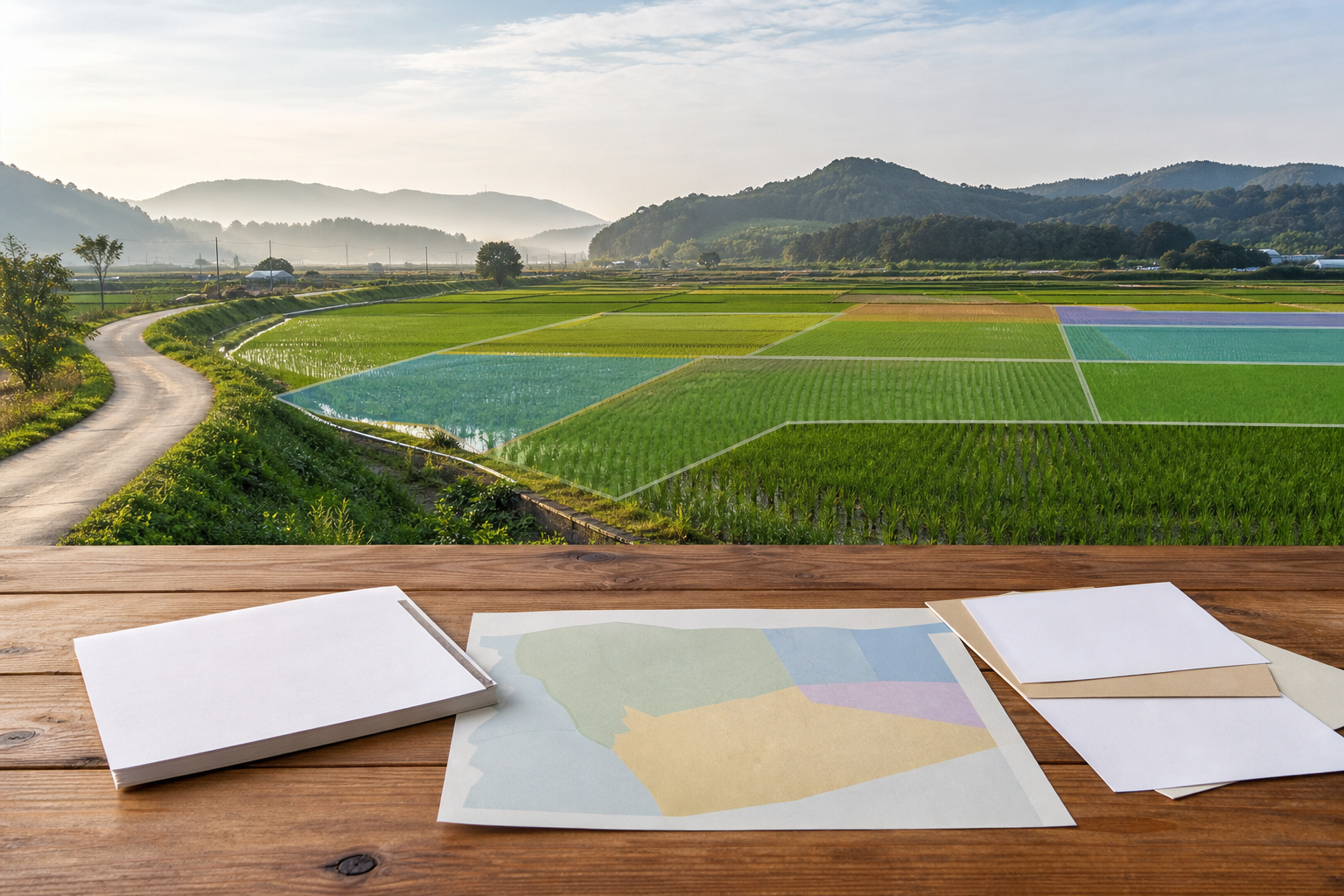
A practical guide to Korea's agricultural promotion zones, farmland conversion, land category changes, and post-conversion use approval.
Korea Agricultural Promotion Zones and Land Use Changes
You find a parcel of land. The paddies are neat. The road is close. The price looks friendly. Then one small phrase appears on the land-use certificate.
Agricultural Promotion Zone.
That phrase changes the mood fast. Some agents call it “absolute farmland.” Some owners say nothing but farming is possible. Others say permits can solve everything. Each version contains a little truth, and each version can mislead you if you treat it as the whole answer.
An Agricultural Promotion Zone is not locked land. It is land with several keys. The Farmland Act, its Enforcement Decree, building rules, national land planning rules, local interpretation, and actual site conditions all move together like small gears under the soil. When one gear slips, the permit process stops.
1. Agricultural Promotion Zones sit inside Agricultural Promotion Areas
Korea’s Agricultural Promotion Area has two main parts. One is the Agricultural Promotion Zone. The other is the Agricultural Protection Zone.
Article 28 of the Farmland Act states that metropolitan mayors and provincial governors designate Agricultural Promotion Areas to use and preserve farmland efficiently. Within that system, an Agricultural Promotion Zone is an area where farmland is clustered and needs to be used for agricultural purposes. An Agricultural Protection Zone protects the farming environment of the promotion zone, including water sources and water quality.
In plain language, the government is saying this land should keep functioning as farmland. It is not just about one paddy. It is about irrigation channels, farm roads, neighboring fields, and agricultural infrastructure as one block. That is why the rules are stricter than for ordinary farmland.
The name sounds stiff. Still, in the market it changes price, financing, construction plans, and negotiation speed. One administrative label can change the face of a field.
2. The basic rule is agriculture first
Article 32 of the Farmland Act draws the line clearly. In an Agricultural Promotion Zone, land-use activities are prohibited unless they are directly related to agricultural production or farmland improvement and are allowed by Presidential Decree.
Agriculture comes first. Other uses are exceptions.
The exceptions are not empty. Facilities for processing and handling agricultural and marine products, agricultural research facilities, farmhouses, agricultural facilities, livestock facilities, public infrastructure such as roads, and certain facilities for rural income development may be reviewed under the law and decree.
This is where confusion starts. An exception does not mean everything is allowed. It means the project can be reviewed. In practice, officials look at facility type, operator, area, road access, drainage, impact on nearby farmland, and local interpretation.
Take a farm warehouse. If it stores harvested crops or farm machinery, it may fit the agricultural purpose. If the same building is used like a general parcel logistics warehouse, the story changes. The shell is still a warehouse, but the inside is a different business. Officials care about that inside.
3. The word “land use change” needs sorting first
People use the term land use change too broadly. That is where many conversations go sideways.
One person may mean changing the use of a building. Another may mean changing the registered land category from paddy to building site. Another may mean approval under the Farmland Act to use converted farmland for a different project. They sound similar, but they are different roads.
There are three buckets.
- Farmland conversion is the procedure for using farmland for non-agricultural purposes.
- Land category change is the cadastral change from field, paddy, or orchard to another category.
- Post-conversion use approval is required when land already used for a permitted conversion project is used for another purpose within a set period.
Do not throw all three into one basket. Sweet potatoes, potatoes, and stones do not become one meal just because they sit in the same pot.
4. Farmland conversion is the starting line
Article 34 of the Farmland Act states that a person who intends to convert farmland must generally obtain farmland conversion permission. Some cases can proceed through notification or consultation. An Agricultural Promotion Zone starts from a stricter position.
The key point is that permission is tied to the actual purpose. You do not simply ask to turn farmland into non-farmland. You explain what you will build, how you will use it, how much land it needs, and whether it harms nearby agriculture.
Imagine a 660-square-meter agricultural product processing facility. The responsible office will look at whether the facility connects to farming. It will look at the product being processed. It will ask who operates it. Wastewater, road access, parking, and building code issues may enter the review. On paper the phrase is short: processing facility. In the office, the review can be as detailed as peeling beans one by one.
Farmland conversion does not end with one approval document. Building permits, development permits, drainage consultation, and farmland preservation charges may move together. If the order is wrong, design fees can leak out early. A small crack becomes a drain.
5. Land category change does not happen just because you ask
A common question is simple. Can land in an Agricultural Promotion Zone become a building site.
The answer is conditional. Article 41 of the Farmland Act restricts changing farmland to land categories other than field, paddy, or orchard. The law allows it only in listed cases, such as farmland converted under permission or notification.
One number matters. When land shape change or construction completion has changed the actual use of the land, the owner must apply for the land category change to the cadastral authority within 60 days from the date the cause occurs.
The usual order looks like this.
- Check whether farmland conversion is possible.
- Complete the needed permission, notification, or consultation.
- Finish the approved project on the land.
- Apply for land category change based on completion.
Land category change is closer to the back door than the front door. You usually do not begin by saying, “Please turn this paddy into a building site.” The approved conversion project has to come first.
6. For post-conversion use approval, remember five years
Now comes the land use change that often creates trouble. Article 40 of the Farmland Act states that when land used or being used for a farmland conversion project is to be used for another purpose within the period set by Presidential Decree, approval from the mayor, county governor, or district office head is required.
The Enforcement Decree gives the period. It is five years.
The starting point also matters. Article 59 of the Enforcement Decree says the period is counted from the date a completion inspection certificate is issued, the date the building is registered in the building ledger, or the date the farmland conversion purpose is completed.
Suppose farmland was converted for an agricultural warehouse. Two years after completion, the owner wants to use the building as a general logistics warehouse or a small factory. The answer is not “it is already a building site, so anything goes.” If it is within five years, post-conversion use approval may be required under the Farmland Act. If farmland preservation charges were reduced or exempted, additional payment issues may follow.
This is where accidents happen. A project starts as agricultural use, then shifts toward rental income after completion. The documents say one thing, the real use says another. To regulators, that mismatch is a bright red sock in a white laundry basket.
7. Focus on function, not the facility name
In Agricultural Promotion Zones, the name of a facility is not enough. Function matters more. Labels can lie.
A farm warehouse can become a problem if it stores unrelated commercial goods. A smart farm may need a different review if the real business is a café or experience center. A processing facility can still face barriers if the raw material, waste system, area, or hygiene rules do not match.
A safer checklist looks like this.
- Check whether the parcel is in an Agricultural Promotion Zone through the land-use certificate.
- Check whether the registered land category is field, paddy, or orchard.
- Check whether the facility will be used by a farmer or agricultural corporation.
- Check whether the facility directly connects to production, storage, processing, or distribution of agricultural products.
- Check the building use under building regulations.
- Check development permit and drainage consultation requirements.
- Check farmland preservation charge reductions and later recovery risks.
- Check whether there is any plan to change use within five years after completion.
This looks annoying. But the annoyance is cheaper than an order to restore land, a stopped construction site, or unexpected charges. It is better to stop water with a small hoe than with a giant shovel later.
8. Costs belong in the same conversation
Passing the permit review is not the finish line. Costs leak from many corners in a promotion zone project.
Think about a 100-pyeong farm warehouse or a small agricultural processing facility. Design fees, survey fees, development permit costs, farmland preservation charges, construction costs, electrical connection, water supply, and drainage work can move separately. Even a simple warehouse can quickly become a project measured in tens of millions of won. A processing facility can become more expensive because sanitation equipment and discharge systems enter the picture.
Farmland preservation charges should not be treated as a footnote. The calculation can differ depending on whether the land is inside an agricultural promotion area, and reductions depend on facility purpose. If you received a reduction and later use the land for another purpose, additional charges may appear. Small print can call a large bill.
So the first question should not be only whether you can build now. You also need to ask how the land will be used within five years. Future use is part of today’s budget.
9. Questions to ask before buying
Do not buy Agricultural Promotion Zone land by instinct. The breeze on the paddy ridge may be soft, but the contract is cold.
Ask these questions before signing.
- Is this land in an Agricultural Promotion Zone or an Agricultural Protection Zone.
- Does the planned facility fit Article 32 of the Farmland Act and Article 29 of the Enforcement Decree.
- Does the project require farmland conversion permission, notification, or consultation.
- Can the project lead to a land category change, or must the land remain farmland.
- Is there any plan to use the land for another purpose within five years after completion.
- If farmland preservation charges are reduced, is there a later recovery risk.
- Do the agriculture office, building office, and development permit office read the project the same way.
The last question matters more than people expect. The agricultural office may see a path, while the building office raises a wall. The building office may agree, while the development permit team stops the project over drainage or road access. Between “legally possible” and “actually buildable,” there is often mud.
10. Agricultural Promotion Zone land is slow land
Agricultural Promotion Zone land is not bad land. It is slow land. It does not fit a plan based on buying fast, building fast, and changing use fast for quick income.
For people who actually farm, there are paths. Farm warehouses, agricultural facilities, crop processing and handling facilities, smart farms, and rural income facilities may be reviewed when they remain tied to agriculture. The path is narrow, paperwork-heavy, and sensitive to sequence.
If land use change is part of the plan, caution matters even more. Using converted farmland for another purpose within five years may require approval. Land category change usually follows completion of an approved conversion project. The project should carry the same story from first consultation to final use.
In one line, an Agricultural Promotion Zone is not land where development is always impossible. It is land that starts creaking as soon as the agricultural backbone is removed. Order comes before ambition here.
References
- Korean Law Information Center, Farmland Act, Article 28, Designation of Agricultural Promotion Areas, effective January 24, 2025.
- Korean Law Information Center, Farmland Act, Article 32, Restrictions on Acts in Use Zones, effective January 24, 2025.
- Korean Law Information Center, Farmland Act, Article 34, Farmland Conversion Permission and Consultation, effective January 24, 2025.
- Korean Law Information Center, Farmland Act, Article 40, Approval of Change of Use, effective January 24, 2025.
- Korean Law Information Center, Farmland Act, Article 41, Restriction on Land Category Change of Farmland, effective January 24, 2025.
- Korean Law Information Center, Enforcement Decree of the Farmland Act, Article 29, Acts Allowed in Agricultural Promotion Zones, effective March 24, 2026.
- Korean Law Information Center, Enforcement Decree of the Farmland Act, Article 59, Approval of Change of Use, effective March 24, 2026.