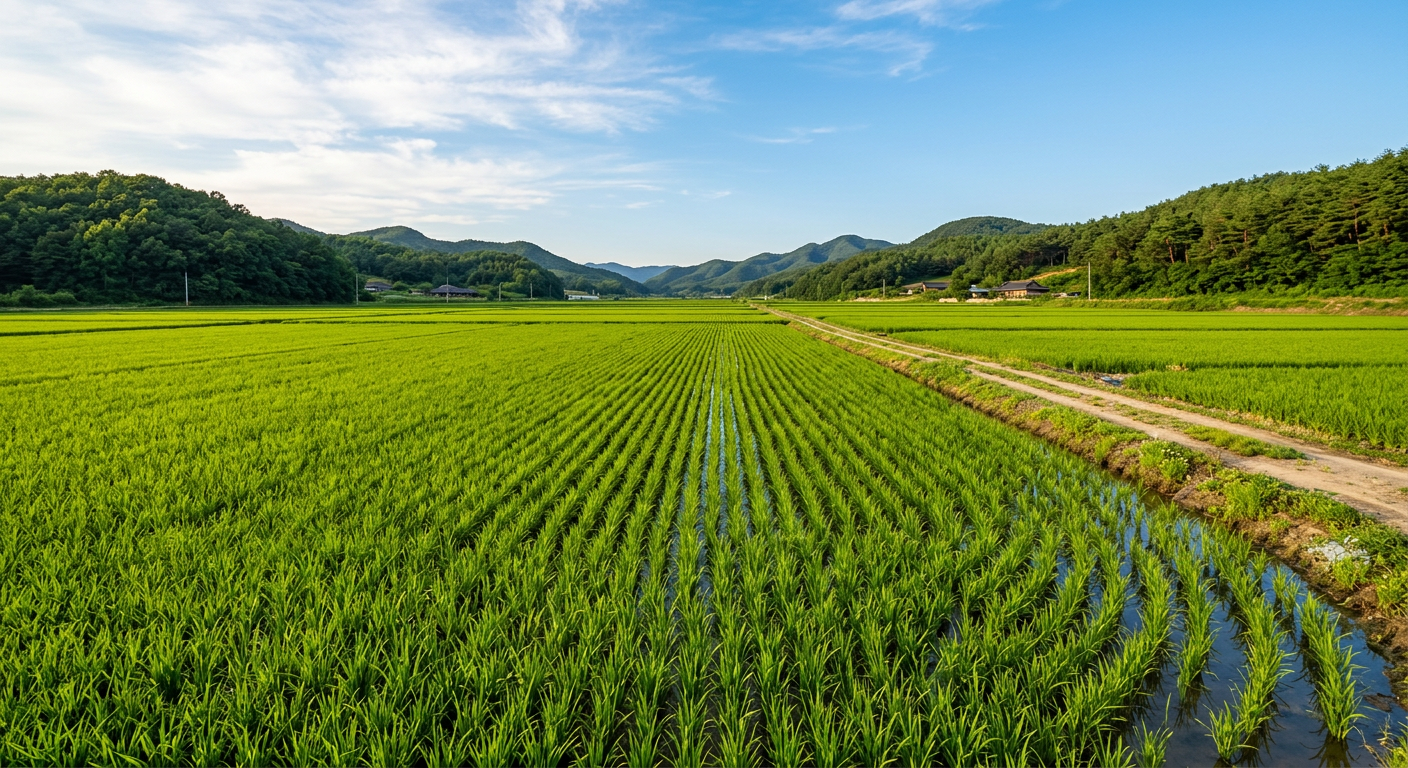
Agricultural Promotion Zones in Korea: Income Beyond Farming Alone
Agricultural Promotion Zones in Korea: Income Beyond Farming Alone
People often talk about agricultural promotion zones in Korea as if they were untouchable land where you can only grow rice and do nothing else. Land prices feel frozen, and many landowners assume that any income other than pure farming is basically blocked. That view is only half true.
In reality, agricultural promotion zones are areas managed with agricultural production at the center . But that does not mean there is a concrete rule that says “you must only grow crops and are forbidden from doing anything else.” Within the boundaries set by law, you can design quite a sophisticated income structure that still revolves around farming.
1. Start with the legal lines on the ground
Before imagining business models, it helps to understand where the law actually draws the line. In agricultural promotion districts, only land-use activities directly related to agricultural production or farmland improvement are allowed in principle . The list of exceptions, however, is surprisingly long.
Article 32 of the Farmland Act and its Enforcement Decree permit various facilities .
- Facilities for processing and handling agricultural and marine products.
- Facilities for agricultural, forestry, livestock, and fishery research and experimentation.
- Farmhouses and agricultural facilities, livestock facilities, and similar buildings.
- Facilities for rural income generation and rural development, within limits defined by Presidential Decree.
From this alone, a pattern appears. As long as the project is anchored in agriculture and rural development, there is room to work. The real keywords are agricultural linkage and rural income development.
2. Farming plus processing: margins change the moment you add value
Processing is one of the most realistic ways to expand income in agricultural promotion zones. For small and mid-sized farms cultivating 3–5 hectares, selling raw products alone often leaves margins painfully thin. Value-added is the only lever.
The Farmland Act explicitly allows processing and handling facilities for agricultural and marine products . This opens many possibilities.
- Polishing and packaging rice under your own brand.
- Drying and grinding red peppers into branded pepper powder.
- Blended grain packs and gift sets.
For example, instead of wholesaling rice at about 2,400 KRW per kilogram, you might sell branded small packages at 4,000 KRW per kilogram. Even after packaging and logistics, you can often secure 30–40 percent thicker margins. On a one-hectare paddy that used to generate about 6 million KRW per year, you might lift that to 8–9 million KRW depending on the market and channel.
Regulation around processing facilities and building codes is strict, but it is clearly not “legally impossible.” The real bottleneck tends to be capital, marketing, and distribution.
3. Experience and tourism: turning fields into places people visit
Many people assume that because agricultural promotion zones are sometimes called “absolute farmland,” experience farms and tourism projects are impossible. So they search online briefly, see complex rules, and give up. But if you read the provisions carefully, you find exceptions that allow facilities for rural income development and rural experience projects .
Administrative guidance and local government cases show that several types of facilities can be permitted in promotion zones .
- Rural experience and recreation facilities under the Rural Experience and Tourism Act, below certain size limits.
- Direct sales outlets, promotion centers, and small cafés combined with farm shops.
- Rural stay facilities and simple lodging linked to agricultural tourism, under conditions.
For instance, a rural experience complex under 20,000 square meters can receive development permits if it meets specific conditions . Programs might include rice-planting experiences, harvest events, seedling planting, and ecological tours along paddy ridges. With an entrance fee of 10,000 KRW and 50 visitors a day, you reach 500,000 KRW in daily revenue; running only 40 days in spring and autumn yields around 20 million KRW.
Here, the land is not converted to non-agricultural use. Instead, farming remains the base, and education and experience become the service on top.
Policy trends are also moving in this direction. The government has announced plans to allow weekend and experience farming even in agricultural promotion zones under certain conditions from around 2025 . Weekend-farm ownership and stay-type facilities are under active discussion.
4. Direct sales and online: digital markets from the middle of a rice field
Agricultural promotion zoning controls land use, not sales channels. In other words, the law may restrict what you build on the land, but not how or where you sell your products. This is where income structures really diverge.
Several realistic combinations are possible.
- Harvest crops, process and pack them, then sell via online shops and marketplaces.
- Bundle direct sales with experience programs and offer subscription boxes to visitors.
- Supply local food stores, urban specialty shops, cafés, and restaurants.
Take a farm producing 20 tons of rice annually. If 10 tons go to traditional wholesale and 10 tons go through your own online channels at higher prices, the difference adds up quickly. With a 800 KRW per kilogram additional margin on 10,000 kilograms, that alone becomes around 8 million KRW in extra profit per year.
Add revenue from experience programs and value-added products like nurungji (scorched rice) or mixed-grain gift sets, and an extra 10–15 million KRW per year in non-basic-farming income becomes plausible. The land remains the same; only the sales model changes.
5. Solar power: still a cautious, policy-dependent option
Agricultural promotion zones and solar power have had a tense relationship for years. As many paddies were converted into solar farms, concerns grew over reduced food production and damaged landscapes. In response, the Ministry of Agriculture strictly limited farmland conversion for solar facilities in promotion zones .
Still, the policy environment is gradually shifting.
- Agrivoltaic pilot sites combining crops and elevated solar panels have been installed at more than 60 locations nationwide .
- Under the current Farmland Act, solar in promotion zones is tightly restricted, but regulatory reform is underway to expand agrivoltaics .
- Proposals have also been made to extend the allowed use period for solar facilities on farmland from 8 years up to around 23 years .
This does not mean that anyone can install solar arrays freely right now. But if agrivoltaics become more broadly permitted, promotion zones could support dual income streams from crops and electricity. A 100 kW agrivoltaic system is often estimated to generate roughly 10–15 million KRW in annual revenue, which could double the total income from a one-hectare paddy in some scenarios, depending on power prices and costs .
For now, solar remains an option that depends heavily on future regulatory changes. It is something to monitor and prepare for, rather than a tool most farmers can use immediately .
6. Practical income routes that work today
Focusing on what is both legally permitted and practically feasible today, several income routes stand out .
- Premium raw-product sales
- Differentiate varieties, growing methods, and packaging to create price tiers.
- Even a 400–600 KRW per kilogram premium on 6 tons per hectare brings an extra 2.4–3.6 million KRW.
- Processing and small-scale packaging
- Add steps such as polishing, drying, grinding, blending, and gift packaging .
- To justify investment in equipment, targeting 30–50 million KRW in annual processed-product sales is a realistic starting point.
- Experience, education, and tourism programs
- Offer rice-planting days, harvest festivals, rural camps, and “one-day farmer” programs .
- With 30–50 participants per day at 10,000–30,000 KRW each for 20–40 days a year, annual revenues can range widely from 6 million to 40 million KRW.
- Direct sales and subscription models
- Build quarterly subscription boxes combining rice, grains, and processed items.
- With 100 subscribers paying 50,000 KRW per box four times a year, you reach 20 million KRW in revenue.
- Future option: agrivoltaics
- Not yet widely viable, but worth watching as regulations evolve .
- If and when it becomes feasible, it could turn promotion-zone paddies into dual-purpose assets.
The key is to treat the promotion zone not as a dead end, but as high-quality farmland with stricter conditions and more layered business design.
7. Three income scenarios with simple numbers
To make these ideas more concrete, here are three simplified income scenarios. Actual results will vary widely by region, crop, climate, and market.
Scenario 1: One-hectare paddy with premium sales
- Annual rice production: 6 tons.
- Full wholesale at 2,400 KRW per kilogram → about 14.4 million KRW revenue.
- If 3 tons move to a premium brand channel at 3,200 KRW per kilogram, the 800 KRW difference on 3,000 kilograms yields roughly 2.4 million KRW extra.
Even with simple channel diversification, promotion-zone land can gain a few million KRW in added income.
Scenario 2: One-hectare paddy with experience farm and subscription
- Experience events in spring and autumn: 20 days, 40 participants per day, 15,000 KRW per person.
- Experience revenue: 40 × 15,000 × 20 = about 12 million KRW.
- 25 households from those visitors join a subscription at 60,000 KRW four times a year.
- Subscription revenue: 25 × 60,000 × 4 = about 6 million KRW.
Together, non-basic-farming income reaches around 18 million KRW. Costs for staffing, safety, and marketing are substantial, but the income structure is clearly different.
Scenario 3: Long-term agrivoltaic combination (conceptual)
- Base rice income from one hectare: roughly 12–15 million KRW.
- Agrivoltaic income from a 100 kW system: about 10–15 million KRW a year, depending on tariffs and REC prices .
On paper, annual totals of 25–30 million KRW from the same hectare become possible. However, this assumes regulatory permission and absorbs large upfront costs of 100–200 million KRW for installation.
8. Agricultural promotion zones: tight rules, not dead land
From the farmer’s perspective, regulations in promotion zones can feel suffocating. You cannot freely build houses, storage, or factories, and solar projects face steep procedural walls. It is understandable that some landowners want to sell and move to more flexible land.
But seen differently, these zones are designated to protect high-quality farmland for stable production . That means they are some of the most productive and reliable agricultural lands. Using that strength as a baseline, and adding processing, experience, tourism, and direct marketing layers, is often the most realistic long-term strategy.
Not every farmer needs to jump into all of these. If even a handful of farms in each region build strong models, others can focus on production and still benefit from shared branding and market access. In that sense, agricultural promotion zones are less “blocked land” and more “land that demands sharper business design.”
References
- Korea Law Information Center, Farmland Act Article 32 and related provisions - Easy Law, “Restrictions on farmland use” and guidance on agricultural promotion areas - Human Rights Administration Office blog, posts on development and rural experience facilities in promotion zones - Ministry of Agriculture, Food and Rural Affairs, press releases on solar restrictions in agricultural promotion areas - Hankyoreh, coverage on agrivoltaics and regulatory relaxation in promotion zones - Chosun Biz, articles on Farmland Act amendments and agrivoltaics periods - Tistory blog overview of “absolute farmland” and promotion area regulations, including weekend farming - Asia Economy article on easing rules for weekend farms in promotion zones