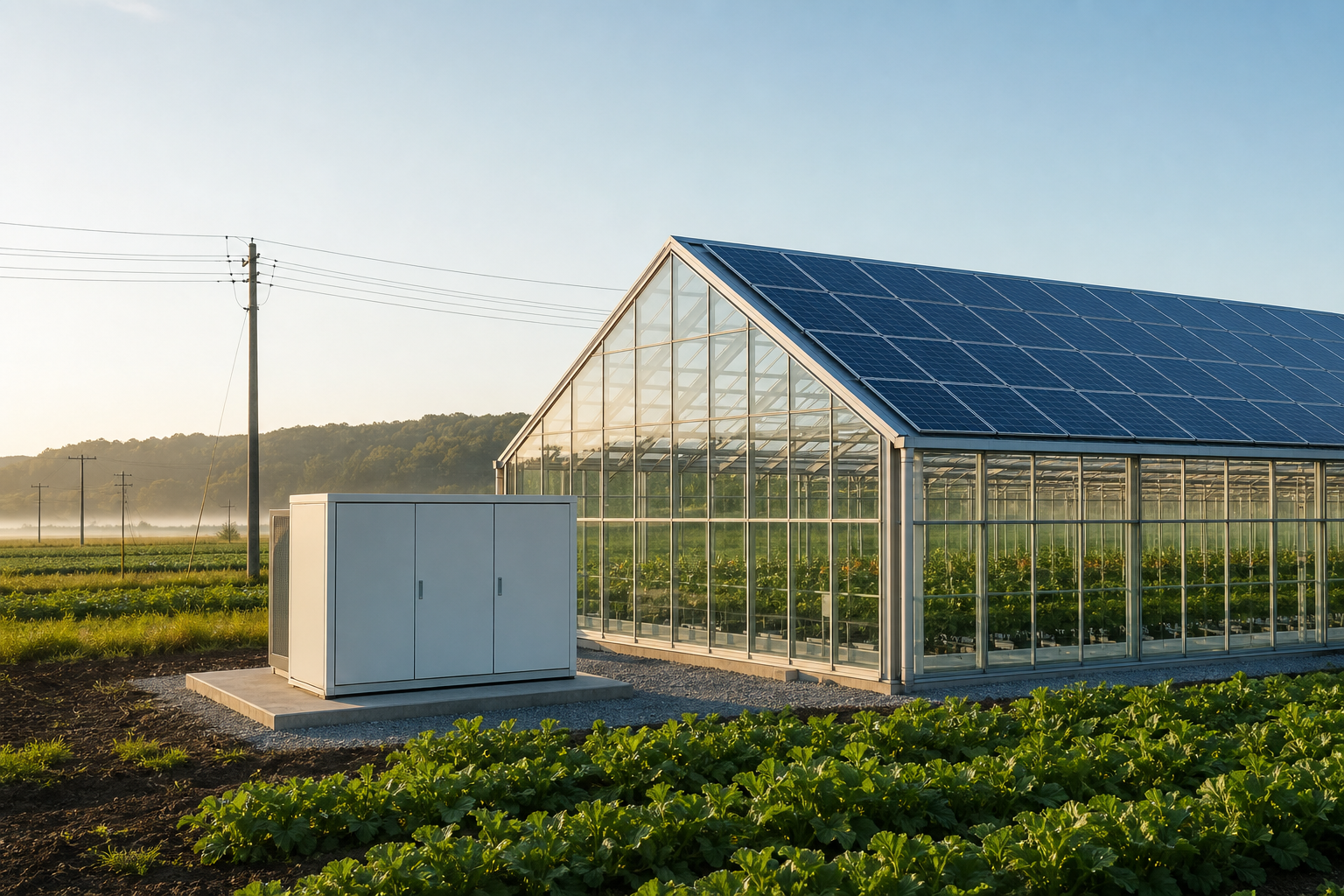
A practical business-case guide to whether self-consumption solar and ESS can reduce smart farm electricity costs enough to pay back.
Agricultural ESS and Self-consumption Solar for Smart Farm Electricity Bills
A smart farm electricity bill can feel quietly heavy. Ventilation fans run. Fertigation pumps run. Cooling and heating support equipment also run. In summer, cooling loads rise. In winter, heating support and circulation equipment keep working. The crop stays silent, but the meter is honest.
That leads to a tempting idea. What if solar panels are installed on the greenhouse roof or nearby land. What if the electricity is used directly inside the smart farm. What if an ESS stores extra daytime power and uses it at night. It sounds reasonable. The problem is the calculator.
The short answer is this. Self-consumption solar can be worth reviewing when the conditions fit. ESS is much harder to justify by electricity-bill savings alone. If the smart farm receives a low agricultural electricity tariff, the avoided cost per kWh is low, and ESS payback becomes long. Subsidies, outage backup value, peak reduction, power quality, and future tariff changes must be considered separately.
1. The first question is the electricity tariff
The first question is not solar capacity. It is the KEPCO tariff category. Korea’s electricity tariff system separates usage into categories such as residential, general, industrial, educational, agricultural, and street lighting. A farm facility does not automatically mean every load receives the same tariff, so the contract category and applicable load must be checked first.
Agricultural electricity is often cheaper than general or industrial electricity. That is the key. Self-consumption solar earns money by avoiding purchased electricity. If the farm would have paid 150 KRW per kWh, using 1 kWh of solar power saves 150 KRW. If the farm would have paid 80 KRW per kWh, it saves only 80 KRW.
The same solar output creates very different payback periods under different tariffs. A farm using agricultural electricity may find that the avoided-cost value is smaller than expected. A facility using a general high-voltage tariff, large cooling loads, or a high contract demand may see a different result. The field may be the same, but the waterway changes the harvest.
2. Self-consumption solar works best when daytime load is high
Solar power is produced during the day. A smart farm matches solar well when it also consumes electricity during the day. Ventilation fans, circulation pumps, fertigation units, shading and ventilation controls, and some cooling loads can align with solar generation. That is real self-consumption.
Night is the problem. Heating circulation, insulation support, some lighting, and control systems may operate after sunset. If the farm produces more solar power than it consumes during the day, surplus power remains. Whether that surplus can be sold to the grid, at what price, and under what interconnection conditions changes the business case.
For self-consumption solar, the load curve matters more than annual generation alone. The farm should review 15-minute or hourly consumption data. If daytime consumption can absorb solar generation, the system becomes simpler. If the farm uses little electricity during the day and much more at night, solar alone reduces less of the bill. That is where ESS enters the conversation.
3. A 100 kW solar example shows the difference
Assume a 100 kW solar system produces 1,300 kWh per kW per year. Annual generation is about 130,000 kWh. Assume annual O&M cost is 3 million KRW. Assume surplus electricity is sold at 90 KRW per kWh. Compare capital costs of 150 million KRW and 180 million KRW.
If the avoided electricity price is 150 KRW per kWh and 80% of solar output is used directly, the annual bill saving is about 15.6 million KRW. Selling the remaining 20% at 90 KRW per kWh adds about 2.34 million KRW. After subtracting 3 million KRW of O&M, the annual net effect is about 14.94 million KRW. A 150 million KRW system pays back in about 10 years. A 180 million KRW system pays back in about 12 years.
If the avoided price is only 80 KRW per kWh, the mood changes. At the same 80% self-consumption ratio, bill saving is about 8.32 million KRW. Add 2.34 million KRW from surplus sales and subtract O&M, and the annual net effect is about 7.66 million KRW. The payback becomes about 19.6 years for 150 million KRW and 23.5 years for 180 million KRW. Low agricultural tariffs create exactly this wall.
The same 100 kW solar system can be a 10-year project for one farm and a 20-year project for another. The sun shines evenly. The tariff table does not.
4. ESS does not create electricity
ESS can feel like it creates extra electricity. It does not. ESS mainly shifts electricity through time. It stores surplus daytime solar power for later use, or charges during cheaper hours and discharges during more expensive hours.
ESS value usually comes from two places. First, it can store solar electricity that would otherwise be curtailed, exported cheaply, or wasted. Second, it can capture time-of-use price differences or reduce peak demand charges. In general or industrial tariffs with large time-of-use spreads and demand charges, ESS may be calculable. Under low agricultural tariffs, the value shrinks.
Efficiency also matters. The battery does not return 100% of what it receives. Inverter loss, battery loss, thermal management, and standby power all exist. Battery capacity also degrades over time. Safety management, insurance, fire protection, installation space, and replacement cost matter. ESS is not a quiet box that prints savings. It is a box with operating cost.
5. A 100 kWh ESS example is strict
Assume a 100 kWh ESS cycles once per day. Assume 300 cycles per year and 90% round-trip efficiency. If the tariff spread or storage value is 50 KRW per kWh, annual gross value is about 1.35 million KRW. After 0.5 million KRW of annual maintenance, net value is about 0.85 million KRW. If the ESS costs 60 million KRW, simple payback exceeds 70 years. The calculator shakes its head.
Even if the spread rises to 100 KRW per kWh, annual gross value is about 2.7 million KRW. After maintenance, net value is about 2.2 million KRW. The 60 million KRW payback is still about 27 years. Considering battery life and replacement, that is still difficult.
Peak reduction can also be smaller than expected. If the ESS reduces contract demand or maximum demand by 20 kW, the annual saving depends on the basic charge. At a low basic charge of around 1,210 KRW per kW per month, the saving is only about 290,000 KRW per year. At a general tariff around 6,990 KRW per kW per month, the same 20 kW reduction saves about 1.68 million KRW per year. The tariff category holds ESS economics by the neck.
6. For agricultural tariffs, self-consumption ratio comes before ESS
If the goal is reducing smart farm electricity cost, the order matters. Do not start with an ESS quotation. Start with daytime electricity use and solar self-consumption ratio. If the farm consumes enough power during the day, solar electricity can be used directly without battery losses or battery capital cost. That is the simplest saving.
ESS becomes a candidate only when a lot of solar power remains unused during the day. But when the avoided electricity price is low, the value of storing that electricity is also low. If surplus export is possible at a reasonable price, selling it may be better than storing it in an expensive battery. If grid interconnection is difficult, curtailment is frequent, or outage backup value is high, ESS gains another role.
So ESS is closer to a power operation tool than a simple bill-saving device. For high-value crops, a short outage may cause real damage. For automated farms, stopping fertigation, cooling, or control systems can be expensive. In those cases, ESS has an insurance value. But insurance value must be calculated separately from electricity-bill savings.
7. Smart farms should start with energy monitoring
The Rural Development Administration has emphasized monitoring facility energy use and managing energy by equipment group in greenhouse farming. Smart farms already use sensors and control systems, but many farms still do not separate electricity use by load. Main power, heating support, cooling, fans, pumps, fertigation, insulation curtains, and lighting should be measured separately where possible.
The business case starts from the load profile. A farm with daytime cooling load may match self-consumption solar well. A farm dominated by nighttime lighting or heating circulation may have a lower solar-only saving ratio. But once ESS is added, capital cost rises sharply. A farmer can end up tearing out the door to fix a small hole.
At least one month of data is needed, and one full year is better. Summer and winter are different. Strawberries, tomatoes, and leafy greens are different. Greenhouse structure, insulation, heat pumps, oil boilers, geothermal systems, air-source systems, and ventilation design all change the load curve. A power meter should come before an ESS quote.
8. When can the business case work?
Self-consumption solar and ESS are not always bad. The conditions must line up.
First, the avoided electricity price must be high. If the farm has general or industrial loads, limited agricultural-tariff applicability, or large cooling peaks, the saving value rises. Second, daytime load must be high. Solar should be consumed when it is generated. Third, subsidies or low-interest financing matter. Solar and ESS require large upfront capital, so financing changes payback sharply.
Fourth, interconnection and permitting must be feasible. Rooftop solar, ground-mounted solar, farmland-related rules, self-consumption systems, and surplus export arrangements each need checking. Fifth, outage damage must be meaningful. High-value crops and automation-heavy smart farms can place real value on backup power. Sixth, peak reduction must be real. If the ESS cannot lower contract demand or measured peak demand, that benefit should not be counted.
When several of these conditions overlap, the system deserves review. When none of them exist, caution is better. Solar may look like it makes money from sunlight, but the actual money comes from conditions.
9. A checklist for beginner farms
A beginner farm should review the following before deciding.
- Check the current KEPCO contract category and actual electricity unit price.
- Collect the last 12 months of electricity bills.
- Obtain hourly or 15-minute consumption data if possible.
- Calculate the share of daytime electricity use.
- Check available solar installation area and structural safety.
- Check surplus export and grid interconnection feasibility.
- Treat ESS separately for outage backup, peak reduction, and surplus storage.
- Include battery life, replacement, insurance, fire protection, and O&M.
- Check subsidy and financing conditions, but test the project without subsidies too.
- Separate crop-damage prevention value from electricity-bill saving.
If any of these are unknown, the business-case number can easily become inflated. The phrase “ESS will cut the bill dramatically” should not be accepted without calculation. If the bill falls but capital cost is larger, the project still loses.
10. The order is solar first, ESS last
For smart farm electricity savings, the order is clear. Measure energy use first. Improve insulation, heat retention, ventilation, pumps, and cooling or heating efficiency next. Then calculate self-consumption solar. ESS comes last.
Self-consumption solar can work when electricity prices are high and daytime load is large enough. In the 100 kW example, an avoided price of 150 KRW per kWh and an 80% self-consumption ratio can produce a simple payback of about 10 to 12 years. But if the avoided price is around 80 KRW per kWh, payback may stretch toward 20 years. Farms using agricultural electricity must see that difference.
ESS needs an even stricter review. By time-of-use arbitrage or bill reduction alone, payback is often too long. It should be reviewed when outage backup, peak reduction, grid limitations, subsidies, and crop-protection value exist together. ESS is not a magic battery. In the right case, it is insurance. In the wrong case, it is an expensive cabinet.
One-line summary
For smart farm electricity savings, calculate self-consumption solar first and review ESS last; under low agricultural electricity tariffs, ESS rarely pays back from bill savings alone.
References
- Korea Electric Power Corporation,
Korean Electricity Tariff Table, https://home.kepco.co.kr/kepco/front/html/CY/E/E/CYEEHP00102.html - Korea Electric Power Corporation,
Major Electricity Tariff Systems, https://home.kepco.co.kr/kepco/front/html/CY/H/C/CYHCHP00207.html - KEPCO ON, electricity contract and tariff guidance.
- Rural Development Administration, greenhouse energy monitoring and smart farm energy management materials.
- Korea Energy Agency, renewable energy facilities and energy storage system guidance materials.
- Korea Energy Economics Institute, electricity tariff structure and time-of-use tariff research materials.
- IMUN.FARM internal scenario reference,
Where Smart Farm + Solar Profitability Is Decided.