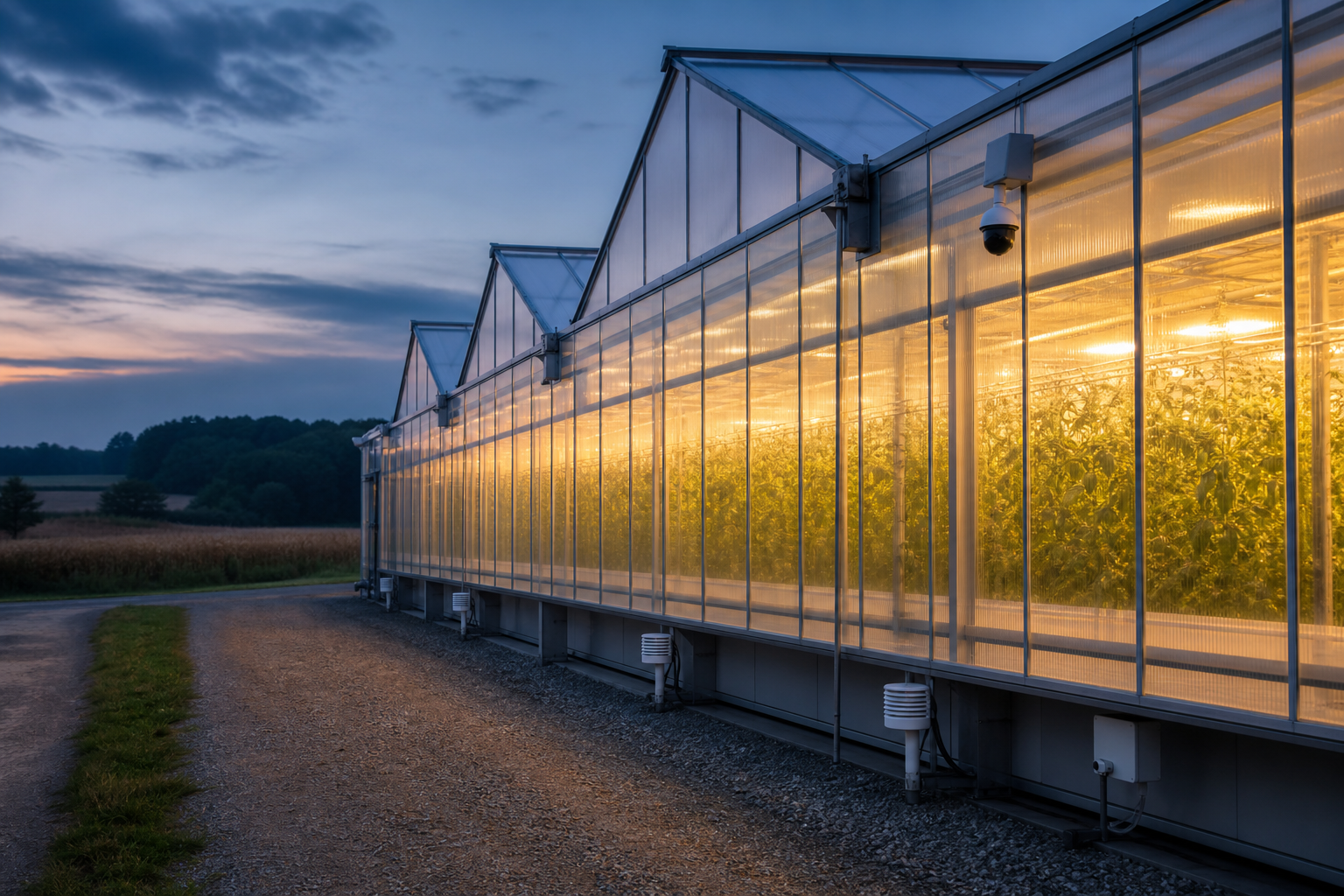
A practical guide for greenhouse farms using CCTV, temperature, power-outage, intrusion, and remote monitoring alerts to reduce real operational risks.
Greenhouse CCTV and Remote Monitoring: Farm Accidents It Can Actually Reduce
At 11 p.m., the greenhouse temperature starts falling. No one hears anything at home. The next morning, the heater is stopped and the crop leaves look weak. That is the kind of scene greenhouse growers never want to see.
Greenhouse accidents often start when nobody is there. Power outages, heater failures, stopped ventilation fans, high temperature, low temperature, intrusions, and irrigation problems can begin quietly at night or during a short trip away from the farm. That is why farm CCTV and remote monitoring are not just gadgets. For many greenhouse farms, they are practical safety tools.
Still, CCTV alone does not solve everything. A camera lets you see. A sensor tells you something changed. An alert makes a person move. If those three do not work together, the farm may spend money without reducing much risk.
This article explains what accidents greenhouse farms can actually reduce with CCTV and remote monitoring, where to install devices, what hidden costs to expect, when payback may make sense, and who should start small.
1. CCTV first reduces intrusion and theft risk
A greenhouse is more open than many people think. It may sit near a road. At night, few people pass by. Inside, there may be crops close to harvest, tools, fertilizer, pesticides, and packing materials. Even when a door is locked, plastic film can be cut.
The most direct value of CCTV is deterrence and evidence. A visible camera near an entrance changes the risk calculation for an intruder. If something happens, recorded footage can help confirm when it happened, who entered, and what was taken.
This matters more during harvest season. For high-value crops such as strawberries, tomatoes, melons, or premium grapes, one intrusion can erase several days of sales. CCTV is partly a tool to catch a thief. More often, it is a tool that makes a thief choose somewhere else.
Installation points for intrusion and theft
- Main greenhouse entrance and side doors.
- Storage areas for tools, pesticides, fertilizer, and packing materials.
- Loading areas and vehicle access routes.
- Electrical panels and irrigation controller boxes.
- Night-vision coverage and recording retention period.
2. For power outages and heater failure, sensors matter before cameras
In winter, power outages and heater failures are among the biggest greenhouse risks. A camera alone may not warn you fast enough. Unless someone is watching the live feed, you may only notice the problem after the feed goes offline or after the crop has already been stressed.
For power outages, low temperature, and heater failure, sensors and phone alerts come first. Korean smart-farm training materials from the Rural Development Administration ecosystem describe smart farms around greenhouse environment monitoring, remote or automatic control, and abnormal-condition alerts. Local agricultural technology center materials also describe greenhouse alert systems that notify growers about power outages, high temperature, low temperature, heater failure, and intrusion. The direction is clear. The camera is the eye. The sensor is the ear.
One temperature sensor is often not enough. A heater zone, a doorway, the center of the greenhouse, and the coldest end may all show different temperatures. If you only measure one safe point, another part of the crop can be damaged first.
Power and low-temperature checklist
- Check whether outage alerts work with backup power or backup communication.
- Place temperature sensors in weak points, not only in the center.
- Watch heater operation together with temperature movement.
- Send alerts to more than one person.
- Test whether night alerts are muted by phone settings.
3. Fire prevention is about reducing warning signs, not just watching flames
Greenhouse fires are serious. Plastic film, insulation, wiring, heaters, and farm materials can sit in one space. If flames are already visible on CCTV, it may be too late. So it is risky to treat CCTV as the main fire-prevention system.
A more realistic approach is to reduce warning signs and catch abnormal conditions early. Keep the electrical panel clean. Keep combustible materials away from heaters. Inspect breakers and wiring. Use high-temperature alerts. Use the camera as a confirmation tool, not the only safety tool.
Remote monitoring helps because it lets the grower notice strange patterns earlier. If temperature rises suddenly at night, if haze appears on the image, or if lights repeatedly go off and on, the grower can check the site quickly. The system may not prevent every fire, but it can reduce late discovery.
A better fire-risk setup
- Include electrical panels and heater areas in camera coverage.
- Set high-temperature alerts.
- Consider smoke or fire detectors separately from CCTV.
- Keep combustible materials away from heating equipment.
- Check electrical safety and insurance coverage together.
4. High temperature and ventilation failures can be caught earlier
In summer, a greenhouse can heat up fast. If ventilation fans stop, side windows fail to open, or shade screens do not move, the crop can be stressed within hours. CCTV helps by showing whether equipment appears to be moving and whether the crop area looks abnormal.
For example, a grower can check whether side windows opened, fans are running, or shade screens are down. But video alone may not clearly show fan rotation or air movement. That is why temperature, humidity, carbon dioxide, and device-status data are useful when paired with CCTV.
The real value is early discovery. Heat damage is hard to undo after it happens. The grower needs time to ventilate, shade, irrigate, or drive to the site. Remote monitoring does not save the crop by itself. It gives the grower time to act.
5. Irrigation problems need more than video
Water problems can be quiet. A pump may stop. A valve may remain closed. A hose may burst. One zone may not receive irrigation. A camera may show water on the floor or wilting plants, but that is often after the problem has already developed.
To reduce irrigation accidents, flow, pressure, tank level, and pump-status sensors are more direct than cameras. CCTV works best as a confirmation layer. When an alert arrives, the grower can open the camera feed and check whether water is leaking or which area looks abnormal.
For hydroponic and fertigation-based greenhouses, delayed irrigation can quickly affect growth. These farms should look at irrigation controllers and alerts before buying many cameras. The camera is the final window, not the whole system.
6. CCTV can also help with work accidents and disputes
Greenhouses and packing areas may involve family workers, daily workers, foreign workers, delivery drivers, and buyers. Falls, equipment contact, broken doors, missing materials, shipment disputes, and loading conflicts can happen. CCTV can provide a record.
Privacy still matters. If cameras are installed where people work, the purpose, camera locations, and retention period should be clearly communicated. Avoid private areas such as bathrooms, rest spaces, or living quarters. A safety system should not feel like a surveillance system aimed at workers.
The purpose should be clear: entrance records, safety, equipment checks, and theft prevention. Good CCTV protects both the farm and the people working there when something goes wrong.
7. The hidden cost is often communication, storage, and installation
When growers compare CCTV prices, they often focus only on camera cost. That is not enough. Many greenhouses have no fixed internet line. Power outlets may be far away. Recording devices, cloud storage, LTE routers, waterproof boxes, cables, brackets, and installation labor can add cost.
A small greenhouse may start with two to four cameras, an LTE router, and basic recording. The first setup can range from several hundred thousand won to the low million-won range depending on equipment and installation. If multiple greenhouse blocks, sensors, cloud storage, and outage backup are added, the cost rises.
Do not start too big. Begin with the places where accidents turn into money: entrances, electrical panels, heaters, central crop zones, pump rooms, and water tanks. More cameras do not automatically mean a better system. The right camera is the one that helps the grower decide what to do.
Hidden cost checklist
- Monthly LTE or 5G router fee.
- Cloud storage fee and recording retention period.
- Whether recording and alerts continue during power outage.
- Waterproof boxes, conduit, cables, mounts, and brackets.
- Service call fees and replacement costs after installation.
8. A simple payback calculation
Remote monitoring does not look like a revenue-making tool. But reducing accidents can have the same effect as earning money. The calculation should stay conservative.
Suppose CCTV plus power and temperature alert setup costs 1.5 million won. Annual communication and cloud storage cost 240,000 won. If the system saves 30 hours of night visits and reduces expected crop-loss risk by 500,000 won per year, the annual benefit may be around 800,000 won before annual operating cost. The simple payback can be in the range of a few years.
The exact number is not the point. Accidents do not happen on a schedule. The important value is reducing the worst day. In greenhouse farming, one bad night can consume a month of profit. Part of this investment should be treated like insurance.
Initial cost = cameras + sensors + installation + communication gear + recorder
Annual cost = communication + cloud storage + maintenance
Annual benefit = saved travel time + reduced expected accident loss
Simple payback = initial cost ÷ (annual benefit - annual cost)
9. Who should adopt it first
Not every farm needs a full system from the start. The first candidates are clear: greenhouses with night heating, high-value crops, farms far from the owner’s home, growers managing several blocks alone, and farms with outside workers or frequent loading activity.
A small greenhouse beside the house may start with one or two cameras and a simple temperature alert. A complex integrated monitoring system may be unnecessary at first. Smart-farm devices are only useful when the grower actually uses them.
A practical adoption order is simple. First, power and temperature alerts. Second, entrance and equipment-check cameras. Third, irrigation, ventilation, and heating control links. Fourth, integrated monitoring across multiple greenhouse blocks. Blocking the most frequent and expensive accident first is better than buying a large system at once.
10. When not to buy yet
If internet is unstable and the system depends only on cloud CCTV, be careful. If power outages are common and there is no backup power, the setup may fail at the exact moment it is needed. If nobody can respond after receiving an alert, the value is limited.
Avoid indoor-only equipment installed casually in wet, dusty greenhouse conditions. Greenhouses have humidity, dust, temperature swings, and water exposure. Check weather resistance, night vision, power stability, and service support.
The biggest mistake is believing that cameras alone make the farm safe. CCTV is not a wall against accidents. It is a window that helps you find out sooner. After installing the window, decide who watches it and who moves when it matters.
15-minute checklist before installation
- Write down the three accidents that would cost the most money.
- Decide whether power outage, high temperature, low temperature, intrusion, or irrigation comes first.
- Prioritize entrances, electrical panels, heaters, pump rooms, and central greenhouse zones.
- Decide whether cameras alone are enough or sensor alerts are needed.
- Confirm whether the internet connection is wired or LTE-based.
- Check whether alerts and communication continue during power outage.
- Confirm video retention period and monthly fees.
- Review worker notification and privacy-sensitive areas.
- Add at least two alert recipients.
- Test real night alerts after installation.
One-line conclusion
Farm CCTV and remote monitoring do not eliminate greenhouse accidents. They reduce late discovery of power outages, low temperature, high temperature, intrusion, and irrigation problems. Alerts matter more than cameras, and response plans matter more than alerts.
References
- Rural Development Administration agricultural human-resource training search result for smart-farm horticulture materials. It described smart farms around greenhouse environment management, environmental data monitoring, and automatic or remote control.
- Local agricultural technology center search results on greenhouse remote alert systems. These referenced alerts for power outages, high temperature, low temperature, heater failure, and intrusion.
- Jeonbuk Agricultural Research and Extension Services M2M remote-management material search result. It referenced temperature and humidity data, SMS alerts, optional CCTV, and monitoring for outage, fire risk, ventilation fans, and heating/cooling equipment.
- Farm CCTV and remote monitoring installation cases and vendor materials. These were used to frame practical cost items such as communication fees, storage, waterproof installation, service, and maintenance.