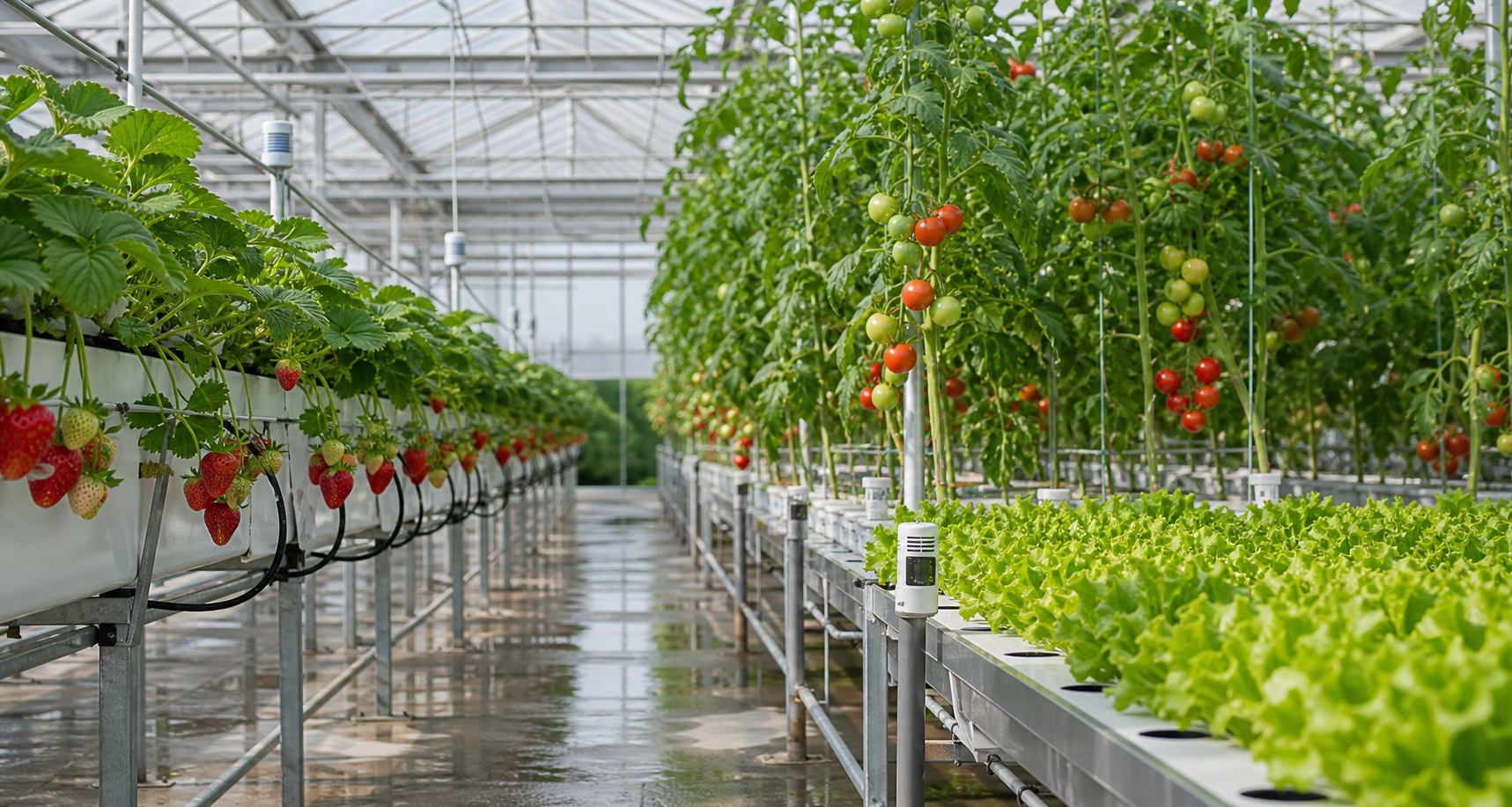
A practical guide to choosing smart farm crops by comparing strawberries, tomatoes, and leafy greens through investment cost, labor, income, and payback period.
Smart Farm Crop Selection: Strawberry, Tomato, or Leafy Greens?
When people plan a smart farm, the equipment quote often comes first. Sensors, fertigation units, automatic vents, screens, and dashboards all look convincing. The screen feels modern. But the crop is what pays the bills.
Should the farm grow strawberries. Should it grow tomatoes. Should it start with fast-turnover leafy greens. This is not a matter of taste. The choice changes capital cost, labor, technical difficulty, sales channels, and payback period. A smart farm with the wrong crop can become an expensive homework assignment.
This article compares strawberries, tomatoes, and leafy greens as smart farm crops. There is no single best crop. A crop for a beginner, a crop for family labor, a crop for a well-funded grower, and a crop for a grower with ready buyers can all be different.
1. Start with a structure you can survive, not the highest income number
The most dangerous phrase in crop selection is “this crop makes money.” High-income crops often require high labor. Premium-priced crops require strict quality. Long-season crops require long attention to pest, disease, climate, and nutrition.
Korea’s Rural Development Administration says crop selection for smart agriculture facilities should consider gross revenue, income, and labor hours together. It also warns that a crop should not be selected only because its income is high while ignoring the labor requirement. The local production base matters too. If the crop is already common in the region, the grower may access better technical support, local projects, packing infrastructure, and marketing channels.
So crop selection should start with three questions. Can I learn this crop. Can I handle the labor peak. Do I already have a way to sell it. Without those three answers, a high-income table is just a pretty poster.
2. Strawberries can earn well, but they demand hands
Strawberries are popular in Korean smart farms. Consumers know them. They fit direct sales, farm visits, local food stores, online sales, and premium gift markets. They also photograph beautifully.
The RDA smart agriculture facility guideline lists greenhouse strawberries at about 23.16 million KRW in gross revenue, 13.23 million KRW in management cost, 9.93 million KRW in income, and about 655 labor hours per 10a. The income number is attractive. The labor number is the catch. The same guideline notes that strawberry farms above 10a, or about 300 pyeong, may typically need two people, depending on region and grower ability.
Strawberry quality turns into price very quickly. Sweetness, firmness, color, size, harvest timing, and packaging all matter. Good fruit can earn a premium. Weak fruit can become discount sales or waste. Strawberries smile at the customer, but the grower starts work early.
Initial investment usually includes raised beds, fertigation, heating, insulation, ventilation, humidity control, and sometimes visitor or direct-sale facilities. If the farm plans experience programs or premium direct sales, parking, packaging, cold storage, and customer flow become part of the real cost. A conservative payback target is often four to six years or longer. Large area and high-end facilities can push it further.
Strawberries suit growers with family labor or reliable workers, a sense for direct sales, and the patience to manage quality every day. For someone entering smart farming mainly to reduce labor, strawberries may be sharper than they look.
3. Tomatoes have more data and scale potential, but the crop is not easy
Tomatoes are a classic smart farm crop. The RDA guideline says tomatoes and strawberries are the main crops in smart agriculture adoption. It also notes that they have more cultivation information and relatively stable demand and prices, which likely explains their popularity.
The guideline lists greenhouse tomatoes at about 18.23 million KRW in gross revenue, 11.84 million KRW in management cost, 6.39 million KRW in income, and about 471 labor hours per 10a. Cherry tomatoes are listed at about 16.99 million KRW in gross revenue, 10.42 million KRW in management cost, 6.58 million KRW in income, and about 575 labor hours. The income may look lower than strawberries, but the knowledge base and sales structure are stronger.
Tomatoes fit scaling and longer cultivation. The grower must manage growth stages, fruit setting, pruning, training, pest and disease pressure, EC, pH, and water balance. Smart farm equipment does not automatically produce good tomatoes. The equipment is an instrument, and the grower still has to play it.
Investment depends on the cultivation method. Soil culture is simpler. Hydroponics is more expensive. Closed-loop hydroponics can add drainage collection, filtration, sterilization, tanks, pipes, and monitoring equipment. The RDA material lists filtration and sterilization, dilution systems, raw water tanks, drainage tanks, and recovery pipes as major equipment for closed-loop tomato hydroponics. The technology is useful, but the bank account notices it first.
Payback can be easier to model than strawberries when sales channels are stable, but higher facility levels lengthen the period. A smaller and simpler facility may target four to six years. A high-end multi-span greenhouse can require seven years or more. Tomatoes fit growers who can stay with data, crop observation, and long-season management.
4. Leafy greens turn quickly, but price and energy cost matter
Leafy greens such as lettuce, spinach, and salad crops grow fast. The crop cycle is short. The facility can look simpler. That is why beginners often feel comfortable with them.
The RDA guideline lists greenhouse lettuce at about 9.8 million KRW in gross revenue, 4.99 million KRW in management cost, 4.81 million KRW in income, and about 478 labor hours per 10a. Greenhouse spinach is listed at about 3.07 million KRW in gross revenue, 1.8 million KRW in management cost, 1.27 million KRW in income, and about 114 labor hours. The unit income can look lower than strawberries and tomatoes. The advantage is speed.
Leafy greens tell the grower quickly whether the system works. A short crop cycle means faster learning. Local restaurants, school meals, salad companies, local food stores, and subscription delivery can all become channels. But the unit margin is thin, and competition is strong. Without scale or stable buyers, the numbers can become narrow.
The risk rises when leafy greens move into vertical farming or fully controlled indoor systems. A Korea Rural Economic Institute report says many Korean vertical farms are still at an early stage and mostly produce leafy greens. It also finds that profitability is highly sensitive to energy cost and productivity. In some cases, farms can show net losses when hiring labor, while profit is possible only when family labor or minimal hired labor is assumed. Leafy greens look calm, but electricity and labor costs are not calm.
A simple greenhouse leafy-green operation may aim for a two-to-four-year payback. A vertical farm or fully controlled indoor farm may need five years or more, and sometimes may not work without strong buyers and energy strategy. The short crop cycle is real. The thin margin is also real.
5. A practical comparison
Exact numbers change by region, facility, variety, skill, and sales channel. Still, the direction is useful.
- Strawberries: medium-to-high initial investment, high labor, strong direct-sales potential.
- Tomatoes: medium-to-high initial investment, high technical demand, good data and sales infrastructure.
- Leafy greens: can start lower in simple facilities, but indoor systems become expensive and margins are thin.
A conservative payback view is four to six years for strawberries, four to seven years for tomatoes, two to four years for simple leafy greens, and five years or more for fully controlled leafy-green systems. These are not promises. They are starting points for cautious planning. Land rent, heating, electricity, labor, loan interest, packaging, and marketing fees can change everything.
Initial investment must include more than the greenhouse frame. Covering, fertigation, beds, irrigation, heating, ventilation, shading, insulation screens, sensors, controllers, packing, cold storage, and work space all matter. A single equipment quote rarely shows the full farm cost. In smart farming, the surrounding costs can bite harder than the main machine.
6. Beginners should test small before scaling
A beginner should not start with a large area just because the spreadsheet looks good. Crops can be studied in books, but they are learned again in the greenhouse. One temperature mistake, one irrigation habit, or one disease outbreak can change the return.
A better path is to complete one crop cycle on a small area. For strawberries, test fruit quality and packaging. For tomatoes, test growth management and buyers. For leafy greens, test crop rotation speed and delivery reliability. After that, the grower can see the real labor load.
Labor type matters. Family labor, permanent workers, and seasonal labor create very different farms. Strawberries require harvest and sorting hands. Tomatoes require long crop management and training work. Leafy greens require repeated harvest, packing, and delivery speed. Smart farming does not remove people. It changes what people must do.
7. Sales channels are not the final step; they are the first step
Sales channels should not be checked after the crop is harvested. They should shape the crop choice from day one. Without buyers, yield becomes inventory. Fresh produce does not wait kindly.
Strawberries fit direct sales, experience farms, local food stores, and premium fruit channels. Tomatoes have more options across wholesale, contracts, food service, and online sales. Leafy greens fit restaurants, school meals, salad companies, and subscription delivery, but price and volume stability are critical.
The market can choose the crop before the greenhouse does. An experience farm may lean toward strawberries. A wholesale-oriented farm may prefer tomatoes. A grower with restaurant buyers may rotate leafy greens quickly. The crop is not chosen only in the field. It is chosen in the market.
8. The final choice is the overlap of capital, labor, and buyers
Smart farm crop selection can be reduced to one sentence. Choose the crop that fits the overlap of your capital, labor, and sales channel. If one of the three is missing, the payback period stretches.
If capital is limited, start with a simpler structure. If labor is limited, avoid crops with heavy harvest and sorting peaks. If sales channels are weak, choose a crop with local demand and existing distribution support.
Strawberries fit growers who can manage quality and direct sales. Tomatoes fit growers who can stay with long-season data and crop management. Leafy greens fit growers who can move product quickly through reliable buyers. Do not let the crop choose you. Choose the crop from your own conditions.
One-line summary
Smart farm crop selection should compare investment cost, labor hours, buyers, and payback period together; beginners should test one crop cycle on a small area before expanding.
References
- Rural Development Administration,
Smart Agriculture Facility Installation and Management Guideline Vol. I, 2024. - Korea Agency of Education, Promotion and Information Service in Food, Agriculture, Forestry and Fisheries,
2022 Smart Agriculture Survey Summary, cited in the RDA guideline. - Korea Rural Economic Institute,
Operating Conditions and Development Tasks of Vertical Farms, 2023. - Rural Development Administration Nongsaro,
Agricultural Investment Analysise-book material.