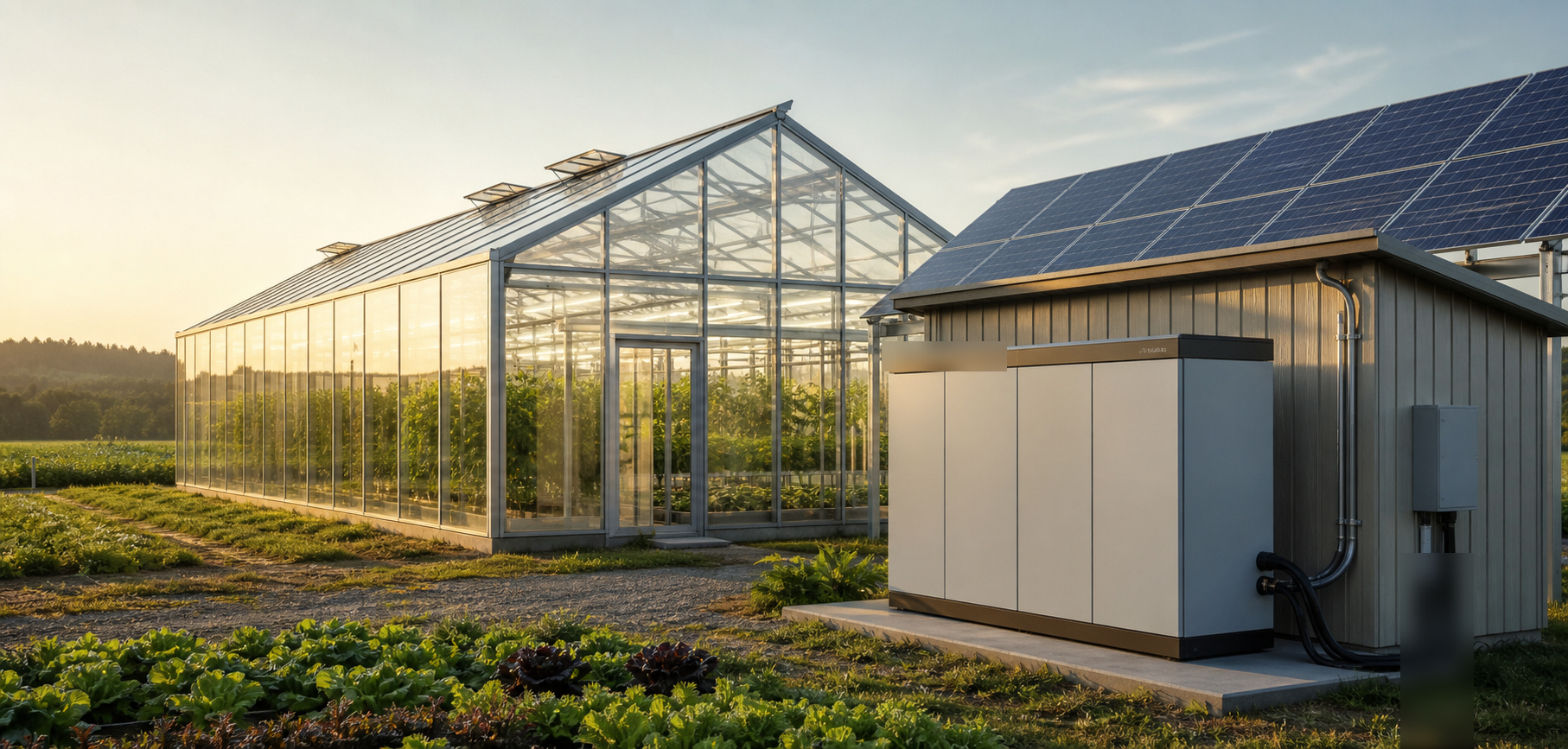
A practical guide to sizing and monetizing agricultural ESS for self-consumption solar, peak shaving, backup power, and smart-farm electricity management.
Agricultural ESS: Setup and Monetization Guide
A farm owner looking at an electricity bill often asks the same question. If solar panels and a battery are installed, will the bill drop sharply. The idea sounds simple. Generate power during the day, store the surplus, and use it at night.
Agricultural ESS is not that simple. An ESS does not create electricity. It moves electricity from one time to another. To make money, a farm needs to know when electricity is cheap, when it is expensive, how much peak demand can be reduced, and how much crop loss can be avoided during an outage.
The practical conclusion is clear. For farms using low agricultural electricity tariffs, ESS payback from electricity bill savings alone is often weak. For smart farms with large daytime loads, self-consumption solar, high outage risk, and good energy data, ESS can still be valuable. The right project starts with the farm’s load profile, not with the battery catalog.
1. Separate the three sources of value
Agricultural ESS value usually comes from three places. The first is electricity bill reduction. The second is peak-demand reduction. The third is avoided crop loss during outages.
These should not be mixed into one vague profit story. Bill savings can be calculated from the tariff and energy use. Peak shaving can be calculated from demand charges and maximum demand data. Outage protection is different. It is an insurance value, not a monthly revenue line.
This separation matters because an ESS that looks weak as a bill-saving device may still be useful as backup for a high-value crop. The opposite is also true. A battery sold as an emergency system may not pay back if the farm has low outage risk and low electricity prices.
2. Calculate self-consumption solar first
Many smart farms and storage facilities use electricity during the day. Fans, pumps, nutrient systems, chillers, dehumidifiers, sorting lines, and cold rooms all consume power. If solar generation is used directly on site, the farm avoids buying electricity from the grid.
Take a 100kW solar system that generates 130,000kWh per year. Assume 80% is consumed on site and 20% is sold at 90 KRW/kWh. If the avoided purchase price is 150 KRW/kWh, annual bill savings are about 15.6 million KRW and surplus sales are about 2.34 million KRW. After 3 million KRW of annual O&M, the net annual effect is about 14.94 million KRW.
At 150 million KRW capex, the simple payback is about 10.0 years. At 180 million KRW capex, it is about 12.0 years. This is a workable range for some farms.
Now change only the avoided electricity price to 80 KRW/kWh. The same system gives about 7.66 million KRW of net annual effect. Payback becomes about 19.6 years at 150 million KRW capex and 23.5 years at 180 million KRW. This is why the farm’s actual tariff is the first number to check.
3. ESS economics are tighter than solar economics
ESS stores energy, but storage has losses. Battery performance declines over time. There are also cooling, inspection, insurance, fire-safety, and replacement costs. That makes the economics tighter than solar.
Assume a 100kWh ESS costs 60 million KRW. It cycles 300 times per year with 90% round-trip efficiency and 0.5 million KRW annual O&M. If the price spread between charging and discharging is 50 KRW/kWh, gross annual value is about 1.35 million KRW and net value is about 0.85 million KRW. Simple payback is roughly 70.6 years.
If the spread is 100 KRW/kWh, gross value is about 2.7 million KRW and net value is about 2.2 million KRW. Payback is still about 27.3 years. The message is not pleasant, but it is useful. ESS should not be purchased only because it sounds profitable.
4. Peak shaving depends on the demand charge
An ESS can reduce short demand spikes if pumps, cooling equipment, or motors start at the same time. This can reduce the maximum demand used for billing. But the result depends on the demand charge.
If the demand charge is 1,210 KRW/kW-month, reducing 20kW saves only about 290,000 KRW per year. If the demand charge is 6,990 KRW/kW-month, the same 20kW reduction saves about 1.68 million KRW per year. The difference is large.
Before buying ESS for peak shaving, the farm should check the tariff class, contracted capacity, basic charge, and at least 12 months of maximum-demand data. A sales phrase such as “peak reduction is possible” is not enough. The real question is how much money the bill will actually lose.
5. Backup value is insurance, not ordinary profit
For some farms, ESS may be most valuable during outages. A winter night without heater control, a summer afternoon without ventilation, or a stopped nutrient system can become a crop accident. In a smart farm, electricity failure is not only inconvenience. It can become biological damage.
This value should be treated as insurance. Tomatoes, strawberries, paprika, leafy greens, mushrooms, nurseries, and cold rooms can be sensitive to short power interruptions. If one outage can create tens of millions of KRW in damage, backup power has real value.
Backup design should focus on critical loads. Do not try to power the whole farm unless the budget supports it. Control panels, a limited number of circulation fans, pumps, communications, nutrient systems, and cold-room controls may be more important than every noncritical load.
6. Setup starts with energy data
ESS sizing starts with data, not battery size. The farm needs 15-minute load data, monthly bills, contracted capacity, equipment schedules, outage history, and crop-loss estimates.
First, divide loads by behavior. Which loads run during the day. Which run at night. Which create short peaks. Which must stay alive during an outage. Then compare those loads with solar generation hours. Finally, check whether operational changes can reduce peaks before adding a battery.
Often, the first answer is not ESS. Sequential pump operation, avoiding simultaneous motor starts, adjusting pre-cooling hours, replacing inefficient fans, or monitoring individual equipment may be cheaper. A battery should not be used to hide a messy load profile.
7. A practical three-step setup
Step one is monitoring. Install metering at the main panel and major equipment groups. Collect at least one season of data, preferably through summer cooling and winter heating.
Step two is self-consumption solar. If the farm has enough daytime load, calculate a solar system around on-site use first. Surplus export should be treated as a secondary value. The main value is electricity the farm no longer buys.
Step three is ESS. Define one main purpose: bill arbitrage, peak shaving, outage backup, or higher solar self-consumption. A project with four vague purposes often has no clear payback.
8. Monetization models
The first model is higher solar self-consumption. The battery stores surplus daytime generation and uses it later. This only works well when the avoided electricity price and the time gap justify the battery cost.
The second model is peak shaving. It fits farms with repeated demand spikes and meaningful demand charges. It is weak when spikes are rare or basic charges are low.
The third model is outage-loss prevention. This is an insurance model. It can fit high-value crops, nurseries, mushroom houses, cold rooms, and tightly controlled smart farms.
The fourth model is energy management as a service. A single small farm may struggle to monetize this, but a farm corporation or a cluster of farms can combine monitoring, demand response, maintenance, and energy consulting. This requires contracts and regulations, not just battery hardware.
9. Safety and installation risks
ESS is an electrical and safety system. Battery, PCS, switchgear, breakers, cooling, ventilation, fire safety, flood risk, insurance, and maintenance access must be designed together. Farms are harsh environments with dust, moisture, heat, cold, chemicals, and limited space.
Do not place the battery casually inside or next to a greenhouse. A separate protected location, ventilation, flood prevention, access control, and inspection route are needed. The solar installer, electrical contractor, ESS supplier, utility coordination, and insurer should be aligned before installation.
Battery degradation and replacement also matter. If a payback calculation includes only initial capex and ignores replacement, insurance, and O&M, it is not a complete calculation.
10. Which farms should consider ESS first
ESS is more suitable for farms with large electricity use, daytime loads, high outage risk, and reliable energy data. Large greenhouses, strawberry and tomato smart farms, paprika farms, nurseries, mushroom houses, cold-storage farms, and farm corporations with sorting and storage facilities can be candidates.
Small farms with low electricity use, low agricultural tariffs, little daytime load, and low outage risk should not rush. For them, energy monitoring, operating schedule changes, efficient pumps and fans, and right-sized self-consumption solar may come first.
One sentence summarizes the decision. ESS is not a box that creates money. It is the final piece added after the farm’s electricity flow is understood. Without the puzzle board, the expensive piece has nowhere to fit.
Field checklist
- Gather the last 12 months of electricity bills.
- Check tariff class, contracted capacity, basic charge, and energy charge.
- Secure 15-minute maximum-demand data.
- Separate daytime, nighttime, peak, and critical outage loads.
- Calculate solar self-consumption before ESS.
- Include battery efficiency, degradation, replacement, O&M, and insurance.
- Design ventilation, flood protection, fire safety, and maintenance access.
- Look for operational peak reduction before buying a battery.
References
- Korea Electric Power Corporation, Korean electricity tariff table and major tariff systems.
- Korea Energy Agency, renewable energy and self-consumption energy program materials.
- Rural Development Administration smart-farm and protected-horticulture energy-management materials.
- IMUN.FARM scenario calculations: 100kW solar at 130,000kWh per year and 100kWh ESS with 300 annual cycles.