Farm Cold Storage: Cost, Electricity, Subsidies, and Real Profit
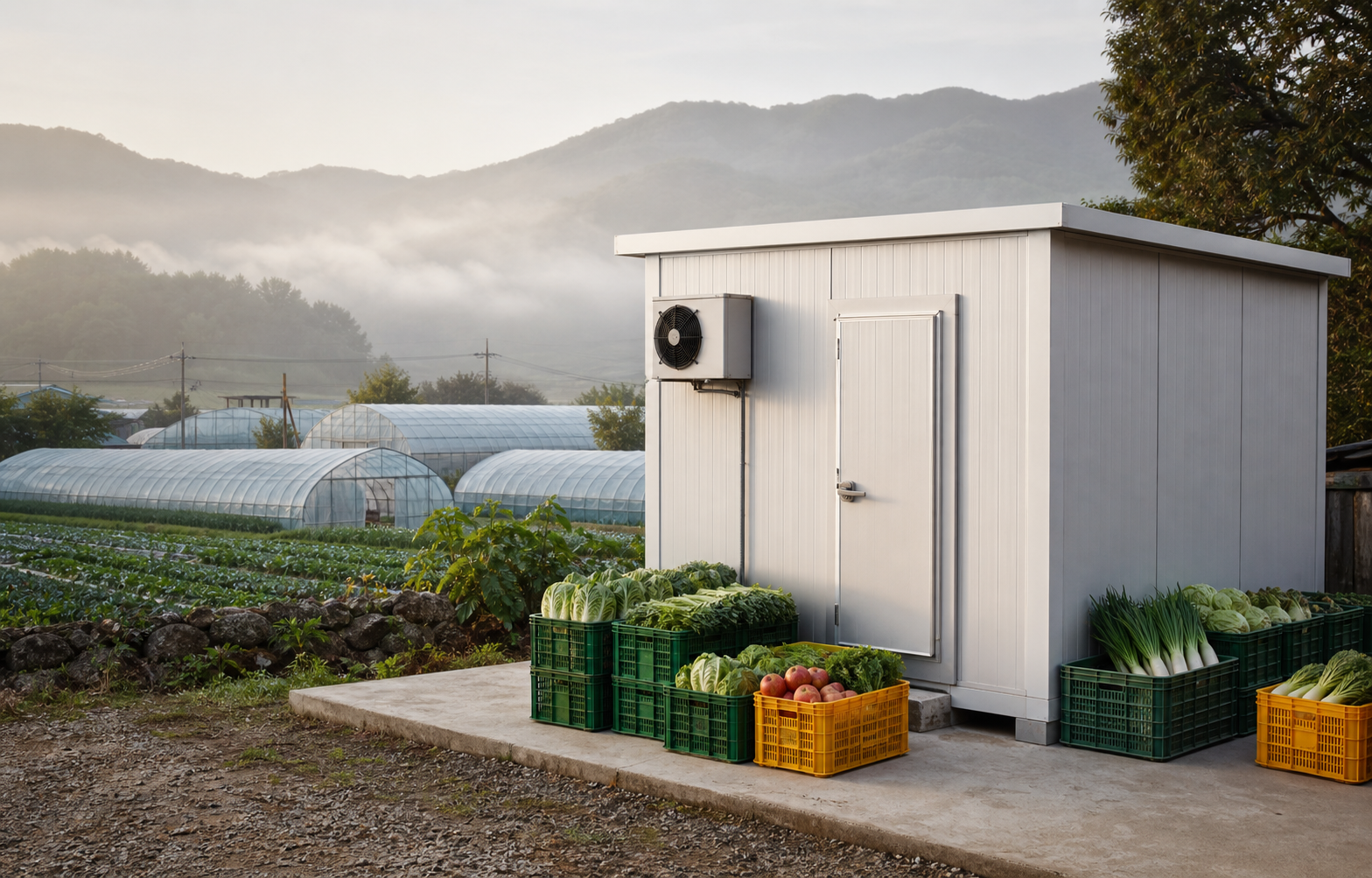
Farm Cold Storage: Cost, Electricity, Subsidies, and Real Profit
Selling crops immediately after harvest is simple. There is no storage schedule, no cooling equipment, and fewer electricity bills to worry about. The problem is the price.
Some days the market is flooded with cabbage, apples, green onions, or leafy vegetables. On those days, a cold storage unit can buy a farm a few extra days. Sometimes those few days are where the margin hides.
A farm cold storage unit is not just a large refrigerator. It brings installation cost, electricity use, insulation, flooring, drainage, doors, and maintenance. Subsidies can reduce the burden, but they also come with eligibility rules, documentation, and follow-up management. The business question is not whether cold storage is useful. The question is whether it gives the farm enough price control to pay for itself.
1. Cold storage makes money when it changes the selling date
The first function of cold storage is preservation. The business value is shipment control. If a crop sells for KRW 1,000 per kilogram today and KRW 1,300 a few days later, cold storage can create real value. If the price does not change, the storage unit may simply become another cost.
Produce begins losing quality after harvest. Temperature, humidity, ethylene, bruising, packaging, and handling all matter. Korea’s Rural Development Administration has published crop-specific storage guidance for fruits and vegetables. It states that many fruits such as apples, pears, grapes, persimmons, and kiwifruit are best stored around 0°C with 90 to 95 percent relative humidity. It also lists strawberries at 0 to 4°C, Korean melon at 5 to 7°C, melon at 2 to 5°C, and cold-sensitive crops such as cucumbers and eggplants at 10 to 12°C.
That point matters. One cold room cannot treat every crop the same way. Cold storage is not just about making a room cold. It is about matching the room to the crop.
2. Installation cost depends on specification, not only floor area
Small farm units are often discussed in the 2-pyeong, 3-pyeong, or 5-pyeong range. They are used for temporary storage before sorting, direct sales, delivery, or local market shipments. That is the first realistic range for many family farms.
A public example gives a useful reference point. A 2023 Jangheung County procurement notice for small farm cold storage listed 91 units of 3-pyeong storage facilities with a total project cost of KRW 577.2 million. Dividing the total by the number of units gives about KRW 6.34 million per unit. The support structure in that notice was 50 percent subsidy and 50 percent farmer contribution.
Larger units move into a different cost range. A 2026 notice from Dosan-myeon, Andong City, listed apple cold storage support at KRW 3.3 million per 3.3 square meters for new installation, with supported unit sizes from 33㎡ to 132㎡. That is roughly 10 to 40 pyeong. At that standard, a 10-pyeong facility is about KRW 33 million, a 20-pyeong facility about KRW 66 million, and a 40-pyeong facility about KRW 132 million.
Those numbers are not universal prices. Actual quotations depend on insulation panel thickness, refrigeration capacity, inverter equipment, floor work, drainage, electrical work, transport, and site conditions. A weak base or long electrical connection can turn the “small extras” into the sharpest part of the bill.
3. Electricity cost may be manageable, but usage habits decide the bill
Cold storage uses electricity every day. That does not mean the compressor runs at full power all day. Door opening frequency, outside temperature, insulation, stored crop temperature, and loading pattern all affect runtime.
KEPCO’s Han전ON tariff page includes agricultural crop cold storage facilities under the use cases for Agricultural Power “Eul.” The tariff table applied from April 1, 2025 lists low-voltage Agricultural Power “Eul” at a basic charge of KRW 1,150 per kW and an energy charge of KRW 65.9 per kWh. For high-voltage service, the basic charge is KRW 1,210 per kW and the energy charge is listed by season at KRW 66.6 to 68.6 per kWh.
A simple estimate helps. If a 2 kW refrigeration unit runs at an average 35 percent duty cycle, monthly use is about 504 kWh. At the low-voltage Agricultural Power “Eul” energy rate, the energy charge is about KRW 33,000, and the 2 kW basic charge adds KRW 2,300, for roughly KRW 35,500 before add-ons. That excludes climate/environment charges, fuel adjustment, VAT, the power industry fund, electrical construction cost, and KEPCO facility charges. The actual bill can differ.
The lesson is still clear. Electricity cost is not only about the machine. Leaving the door open, loading hot produce, weak insulation, and poor airflow all waste money. A cold room with bad habits is like a bucket with a hole in it.
4. Subsidies are conditional discounts, not free equipment
Cold storage support often appears in local government farm subsidy programs. The timing, eligibility, budget, and supported specification differ by city and county. Farmers usually need to check their local agricultural technology center, township office, or agriculture policy department.
Public examples often show a 50 percent support structure. The Jangheung County small cold storage notice used a 50 percent subsidy and 50 percent self-payment model. The Andong City 2026 notice also lists multiple farm support programs with 50 percent subsidy structures, while the apple cold storage item provides separate standard cost and size ranges.
Subsidies reduce upfront cash. They do not remove responsibility. A support program may require farm business registration, minimum cultivated area, local residency or farmland location, completion inspection, settlement documents, and post-management obligations. Assets purchased with public subsidies may also be restricted from disposal or non-purpose use for a certain period.
The better question is not only how much money the farmer receives. It is how long the storage unit must be used, how it must be managed, and what restrictions follow the subsidy.
5. Profit depends on price spread, loss reduction, and sales channels
The profitability of cold storage is decided more by sales strategy than by electricity cost. Can the farm avoid selling into a low-price market. Can it reduce spoilage or quality loss. Can it support direct sales, parcel delivery, school food supply, or local food store schedules.
Imagine a small unit with a farmer contribution of around KRW 3 million after subsidy. If monthly electricity and related operating costs are estimated at KRW 50,000, and the storage unit helps create KRW 500,000 of monthly benefit through better prices or reduced loss, payback can be fast. If it cannot even save KRW 50,000 per month, it is a convenient tool rather than a profit machine.
Three questions decide the investment.
- How much does the selling price improve after storage.
- How much spoilage or quality loss is reduced.
- Does storage actually improve direct sales, delivery, or contract shipment schedules.
If those numbers are visible, the decision becomes easier. Buying by feeling creates equipment. Buying by numbers creates a business tool.
6. It fits some farms much better than others
Cold storage fits farms that need shipment timing control. Fruit farms, leafy vegetable farms, seasoning vegetable farms, direct-sale farms, local food suppliers, and farms that need to gather parcel shipments can benefit. Crops where one or two days of quality difference changes the price can also benefit.
It may not fit every farm. If the entire harvest is sold immediately through a fixed procurement channel, the value may be lower. If crop prices are low and not very volatile, the payback period can become long. If storage technique is poor, quality can fall instead of improving. Cold-sensitive crops can be damaged if stored too cold.
A cold room is not a magic vault. It needs temperature and humidity monitoring, crop-specific settings, airflow management, and entry/exit records.
7. The site checklist is as important as the quotation
A quotation alone is not enough. The site must be checked. Electricity, floor strength, drainage, vehicle access, door direction, sunlight exposure, and work movement all affect operating cost.
Before installation, the farm should check these items.
- Farm business registration and subsidy eligibility.
- Land ownership or, if leased, written permission and restoration terms.
- Eligibility for Agricultural Power “Eul” and required contract capacity.
- Concrete base, drainage, vehicle access, and loading space.
- Panel thickness, refrigeration capacity, and inverter options.
- Door direction, direct sunlight, rain exposure, and airflow.
- Crop-specific temperature, humidity, and ethylene sensitivity.
- Subsidy settlement documents and post-management period.
These details look small before installation. After installation, they become daily work. A badly placed cold room makes the farmer carry regret in boxes.
8. Solar power can help, but it does not erase the bill
Connecting cold storage with solar power sounds attractive. The cold room runs during the day, and solar panels produce power during the day. A well-designed self-consumption system can reduce electricity cost.
The cold room still needs to maintain temperature at night. Solar power does not generate at night. Adding batteries increases cost, and grid connection or electrical design must be reviewed carefully.
A practical sequence is better. First, measure storage electricity use for at least three months. Second, check how much of that load happens during daylight hours. Third, compare self-consumption solar, the agricultural electricity contract, grid connection, and available subsidies. If the electrical work costs more than the savings, the project loses its bite.
9. Cold storage makes sense when the sales plan is already real
Farm cold storage is strongest for farms with a clear sales plan. It helps farms that deliver to local food stores several times a week, collect parcel orders before shipping, handle fruit volume peaks, or avoid selling vegetables on the worst price day.
It is risky when the reason is only “maybe I will use it later.” The room may be cold, but the cash balance can melt quickly. The farm should first write down storage volume, storage period, sales destination, and expected price spread.
A simple rule works. Can the farmer recover the self-payment and operating cost within three to five years. Does the farm already lose money from spoilage or weak selling timing. Does the cold room expand the sales channel.
If the answer is yes, cold storage deserves serious review. It is a small brake for a farm. When the market price is bad, it lets the farmer pause for a moment. For the right farm, that pause can become money.
References
- KEPCO Han전ON, Korean electricity tariff table, Agricultural Power section, including Agricultural Power “Eul” use cases and April 1, 2025 tariff table.
- Rural Development Administration, “Store fruits and vegetables fresh under the right storage conditions,” press release, September 30, 2014.
- Dosan-myeon, Andong City, “2026 vegetable, specialty crop, alternative fruit, and fruit cold storage subsidy project notice,” January 23, 2026.
- Jangheung County, Jeollanam-do, “Small agricultural cold storage installation contractor selection notice,” 2023.
- Ganghwa County, “Public notice of important property acquired through subsidy, 2025 farm cold storage support project,” March 3, 2026.