Building Warehouses & Smart Farms on Protected Agricultural Land: A Real Construction Cost Guide
Building Warehouses & Smart Farms on Protected Agricultural Land: A Real Construction Cost Guide
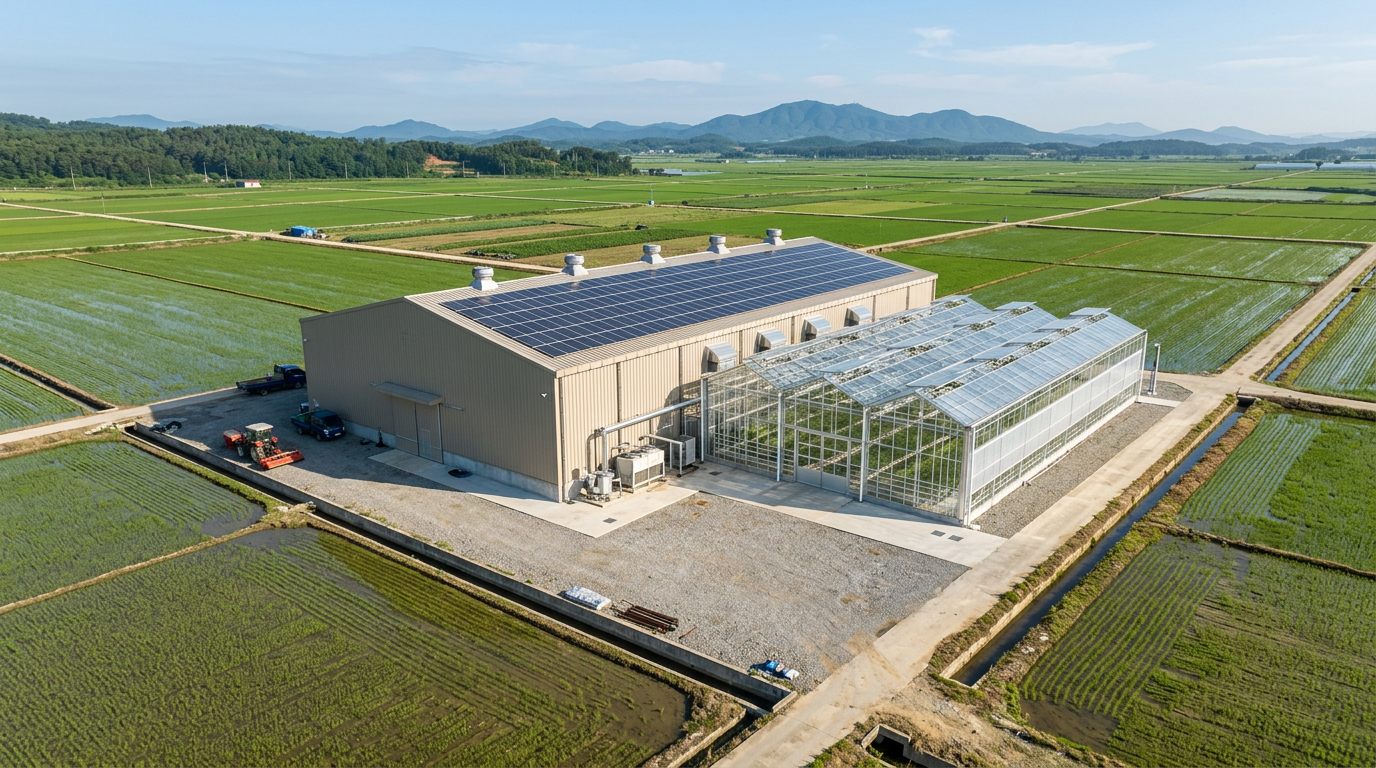
You want to put up a warehouse on your farmland. Simple enough desire — until you find out it sits in an Agricultural Promotion Zone (절대농지, Jeoldae Nongji). That changes everything. Not just paperwork, but who can build, what they can build, and how much it all costs.
South Korea’s Agricultural Promotion Zones are the strictest tier of protected farmland. Non-agricultural structures are banned by default. Only farmers and agricultural corporations can build there — and only certain facility types are allowed. Miss this detail and your permit application dies on the spot.
That said, regulations have been loosening since 2024. Smart farm expansion policies, revised farmland laws in 2025, and new zoning rules are creating genuine openings. The timing matters.
What Is an Agricultural Promotion Zone?
Agricultural Promotion Areas (농업진흥지역) divide into two categories: the Agricultural Promotion Zone (농업진흥구역) and the Agricultural Protection Zone (농업보호구역). What’s commonly called “absolute farmland” refers specifically to the Promotion Zone — land reserved exclusively for farming.
The fundamental rule: non-farmers cannot construct buildings in an Agricultural Promotion Zone. Only verified farmers (농업인) or agricultural corporations (농업법인) may install facilities, and only those explicitly permitted under the Farmland Act.
What Can Be Built
Agricultural Warehouses
The most practical option. Warehouses for drying and storing crops, or storing farming machinery and materials, are permitted. Size limits apply:
- Individual farmer: Up to 1,500㎡ (~454 pyeong)
- Agricultural corporation: Up to 7,000㎡ total, but capped at 3,300㎡ within a Promotion Zone
If you qualify as a farmer under the Farmland Act, this is a notification (신고) procedure — not full permit approval. That distinction cuts weeks off your timeline.
Smart Farms (Smart Crop Growth Facilities)
Legalized through the 2024 Farmland Act revision. Temperature, nutrient, and light-controlled growing facilities in temporary structure form can be installed via farmland temporary alternative-use permits, with usage periods now extended to 16 years (up from 8).
If the land is in a designated Rural Specialization Zone or Smart Agriculture Promotion Zone, no land conversion procedure is needed at all. That’s a significant regulatory shortcut.
Other Permitted Facilities (2025–2026 Standards)
| Facility Type | Permitted Size | Notes |
|---|---|---|
| Agricultural products processing/handling | Under 3 hectares (30,000㎡) | Expanded July 2025 |
| Rice processing complexes (RPC) | Under 30,000㎡ | Special exception |
| Farm equipment/material retail | No cap | Newly permitted 2025 |
| Heatwave/cold wave rest shelters | Small scale | Permitted from H2 2025 |
| Jointly operated farmer warehouses | Per regulation | Must be jointly operated |
Permitting Process
This isn’t like getting a standard construction permit. Farmland has its own administrative track.
Warehouse (farmer notification route):
- File farmland conversion notification with local agricultural affairs office
- Commission architect for design drawings
- Submit building notification to construction office
- Construction commencement notification → Build
Smart Farm (permit route):
- Apply for farmland temporary alternative-use permit
- Areas ≥1,000㎡: Farmland Committee review + provincial governor approval
- Building notification (with structural review)
- Apply for electrical, water, and telecom connections
- Construction commencement notification → Build
Critical note: Construction must begin within 1 year of permit issuance. Coordinate your architect, contractor, and permit timeline before submitting applications.
Farmland Conservation Levy (농지보전부담금)
This is the cost people most often forget to budget for — and it can be substantial.
Formula:
- Inside Agricultural Promotion Zone:
Area (㎡) × Individual Land Price (KRW/㎡) × 30% - Outside Agricultural Promotion Zone:
Area (㎡) × Individual Land Price (KRW/㎡) × 20% - Cap: KRW 50,000/㎡
Example calculation: Converting 500㎡ where land price is KRW 50,000/㎡:
500 × 50,000 × 30% = KRW 7,500,000(~KRW 7.5M)
If the land price is KRW 100,000/㎡, the levy doubles. However, farmers building agricultural-purpose warehouses may qualify for full exemption. Verify this with your local municipal office before finalizing your budget.
Construction Costs: What You Actually Pay
Here’s where the range gets wide. Structure type, size, insulation spec, site conditions, and region all push numbers in different directions. Still, benchmarks exist.
Prefabricated Panel Warehouse (Standard Type)
The most common approach: steel H-beam frame with sandwich panel cladding.
| Work Item | Unit Cost (per pyeong) | Notes |
|---|---|---|
| Steel frame structure | KRW 250,000–500,000 | H-beam spec, span affects price |
| Sandwich panel (wall + roof) | KRW 100,000–300,000 | Insulation thickness varies |
| Concrete flooring | KRW 100,000–200,000 | Reinforced slab included |
| Roof waterproofing | KRW 100,000–250,000 | Slope and material dependent |
| Doors and windows | KRW 50,000–150,000 | Count and type dependent |
| Electrical / telecom | ~10% of total cost | Varies with scale |
Actual cost benchmarks:
- Panel cladding work only (70-pyeong Yangsan case): ~KRW 420,000/pyeong
- Basic complete panel warehouse: KRW 1M–1.5M/pyeong
- 60-pyeong H-beam warehouse (turnkey): ~KRW 54.9M (≈KRW 915K/pyeong)
- 30-pyeong small warehouse (complete with permits): ~KRW 63M (≈KRW 2.1M/pyeong)
The gap between KRW 420K and KRW 2.1M isn’t error — it’s scope. The low end is materials-only panel cladding; the high end includes design fees, foundation work, and electrical. Compare like-for-like.
Smart Farm Facilities
Budget 20–30% more than a basic warehouse. The equipment drives it: nutrient delivery systems, climate sensors, control servers, LED grow lights, ventilation fans.
Total budget by scale (2025 estimates):
| Scale | Total Budget | Per-Pyeong Cost | Common Crops |
|---|---|---|---|
| Small (100–300 pyeong) | KRW 100M–200M | KRW 330K–660K | Lettuce, herbs |
| Mid (400–800 pyeong) | KRW 250M–400M | KRW 310K–500K | Tomato, strawberry |
| Large (1,000+ pyeong) | KRW 450M–800M | KRW 300K–400K | Paprika, export crops |
Itemized breakdown for 500-pyeong smart farm:
| Work Category | Budget Range |
|---|---|
| Site prep + greenhouse structure | KRW 100M–125M |
| Climate control system | KRW 30M–40M |
| Nutrient solution (hydroponic) system | KRW 35M–45M |
| LED supplemental lighting | KRW 30M–50M |
| Integrated control system | KRW 20M–30M |
| Electrical/water/utility connections | KRW 20M–40M |
| Total | ~KRW 300M–350M |
Vertical farms (fully indoor, stacked) are a different category entirely: KRW 2.5M–3.5M/pyeong.
Real-world comparison (1,200-pyeong lettuce smart farm):
- Full-service contractor quote (800 pyeong): ~KRW 1.62M/pyeong
- Owner-managed construction (1,300 pyeong): ~KRW 540K/pyeong
A 3× cost difference. Owner-managed procurement cuts costs dramatically but demands time, experience, and coordination capacity.
Additional Cost Checklist
Beyond the main construction, these must be budgeted:
- Design fees (architecture + civil): KRW 7M–10M
- Site grading / civil work (farmland): ~KRW 100K/pyeong
- Farmland conservation levy: Land price × 30% (check exemption eligibility)
- Electrical connection: Hundreds of thousands to millions, depending on distance and load
- Water/well installation: Separate notification + costs if new well required
- Permit processing (architect agency): Several million KRW, varies by region
Add 15–25% on top of the main construction cost to cover these items.
Sample Scenario: 100-Pyeong Agricultural Warehouse
Building a prefabricated warehouse on protected farmland (100 pyeong, ~330㎡)
| Item | Low Estimate | High Estimate |
|---|---|---|
| Main construction | KRW 42M (KRW 420K/pyeong) | KRW 150M (KRW 1.5M/pyeong) |
| Civil/site work | KRW 10M | KRW 15M |
| Design fees | KRW 7M | KRW 10M |
| Electrical connection | KRW 3M | KRW 8M |
| Farmland conservation levy | KRW 0 (farmer exemption) | KRW 15M (land at KRW 50K/㎡) |
| Total | ~KRW 62M | ~KRW 198M |
Three Things to Confirm Before Breaking Ground
- Do you qualify as a farmer (농업인)? Without this status, no construction is possible in an Agricultural Promotion Zone. Period.
- Is the land within a Rural Specialization Zone or Smart Agriculture Promotion Zone? If yes, the land conversion procedure is dramatically simplified.
- Are you eligible for farmland conservation levy exemption? Agricultural-use warehouses built by farmers often qualify. This alone can save several million KRW.
The regulatory trend since 2025 has been toward loosening: expanded processing facility size limits, 16-year smart farm usage periods, vertical farm deregulation, and new agricultural retail facility permits in Promotion Zones. Direction is clear. For those with valid farmer status and a concrete plan, this is a reasonable window.
References
- Farmland Act Enforcement Decree (Ministry of Legislation, effective 2025.01.24) — https://www.law.go.kr/
- Ministry of Agriculture, Food and Rural Affairs, “Smart Farm Installation Period Extension on Farmland,” July 2024
- Ministry of Agriculture, Food and Rural Affairs, “Full Approval of Smart Farm Installation in Planned Sites,” Newstomato, October 2024
- Farmland Conservation Levy Pre-Calculation Tool (2025 Standards) — https://njy.mafra.go.kr/
- Chosun Biz, “Agricultural Promotion Zone Permitted Activities Expanded [H2 2025 Policy Changes],” June 30, 2025
- Chungnam National University Smart Farm Technology Support Center, “2025 Revised Farmland Act Key Points,” December 2024
- Jujuland Tistory, “Agricultural Warehouse Permit Conditions and Construction Costs,” October 2023
- 2025 Smart Farm Total Setup Cost Analysis (loginsjh-news.com), July 2025
- Chiho Architecture Office, “30-Pyeong Smart Farm vs. Panel Factory: Design, Structure, Cost Comparison (2025),” 2025
- Korea Real Estate Board, “2025 Average Construction Cost by Building Type,” January 2026
- Mani Survey & Design Blog, “Agricultural Warehouse Installation in Agricultural Promotion Zone”