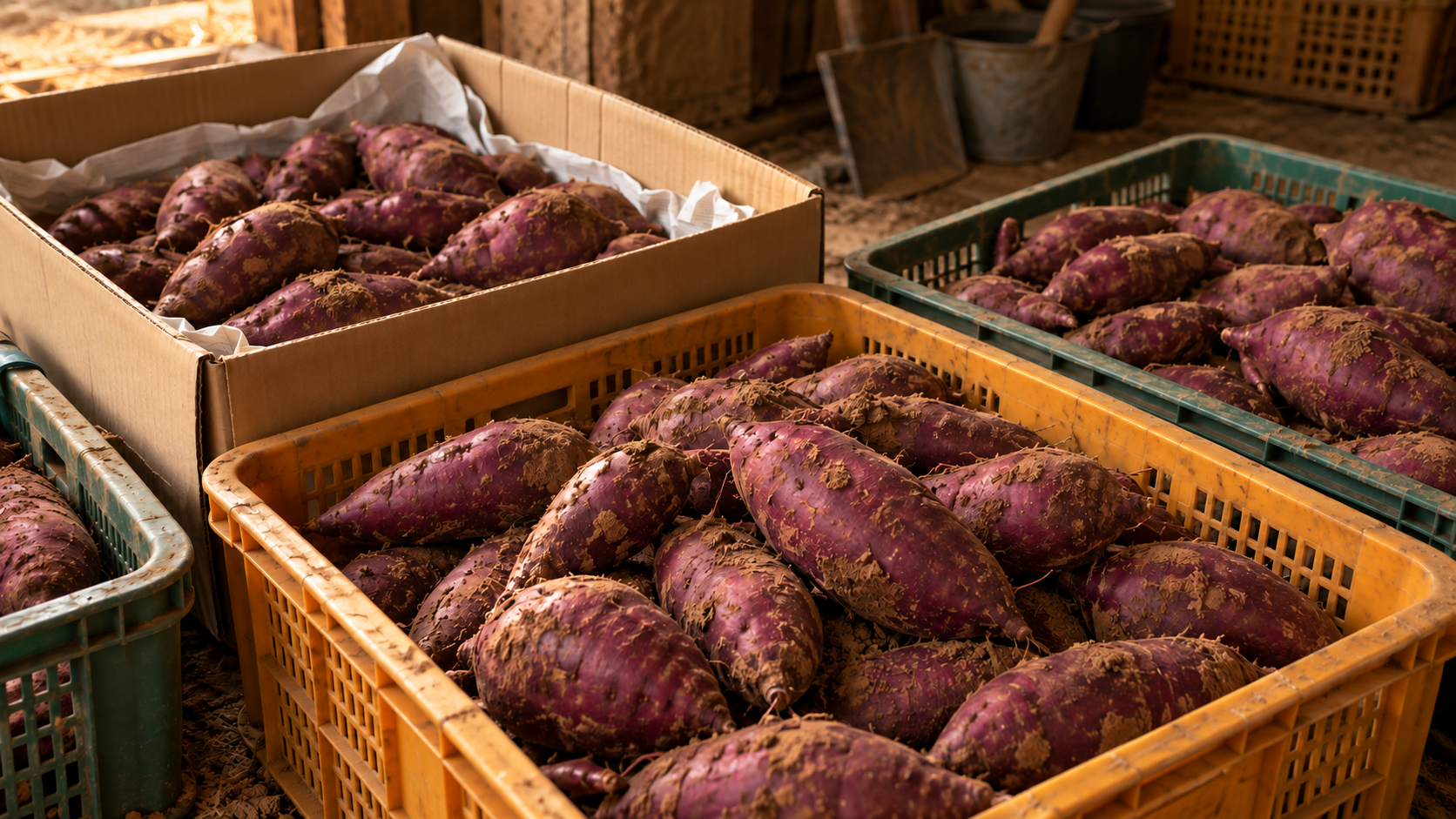
Sweet potato curing conditions from Korea's Rural Development Administration (30–33 °C, 90–95% humidity, 4 days), storage at 12–15 °C, why the fridge is a bad idea, rot rates with and without curing, when stored sweet potatoes get sweeter, and what storing until January or February is worth using KAMIS 10 kg wholesale prices.
A 10 kg box of sweet potatoes sits on the balcony and two weeks later a few have gone soft. Sweet potatoes piled in a farm shed start rotting black by midwinter. The causes are usually the same: harvest wounds that never healed, or storage that was too cold. This note uses only the numbers published by Korea’s Rural Development Administration (RDA).
Bottom line: RDA guidance is to cure within one week of harvest at 30–33 °C and 90–95% humidity for 4 days. Then remove the heat quickly, bring the roots down to 12–14 °C, and store at 12–15 °C with 85–90% humidity. Long periods below 10 °C make them rot, so the fridge is the wrong place. In an RDA trial, rot was 5% after high-humidity curing and 17% with no curing. On October 15, 2026, KAMIS sweet potato (10 kg) averaged KRW 31,540 across five cities.
Earlier notes: Sweet potato 10 kg price and harvest timing 2026, cold storage temperature and humidity by crop.
Try it: see what you would net in each city with the produce market calculator.
1. What curing does
Sweet potato skin is thin, and digging, bagging and moving them leaves small wounds. Pathogens enter through those wounds and cause rot in storage. Curing holds the roots somewhere hot and humid for a few days so a new protective layer forms over the wounds.
RDA lists three benefits: it blocks pathogens such as black rot, it reduces moisture and weight loss in storage, and it speeds the conversion of starch to sugar. Its trial table:
| Treatment | Rot | Weight loss | Total loss |
|---|---|---|---|
| Cured, high humidity (82%) | 5% | 12% | 17% |
| Cured, low humidity (50%) | 13% | 17% | 30% |
| Not cured | 17% | 15% | 32% |
Curing in dry air loses most of the benefit. The table does not state the storage period, so do not read it as “x% after n months”.
2. Curing temperature, humidity and duration
| Item | RDA guidance |
|---|---|
| Start | Within one week of harvest |
| Temperature | 30–33 °C |
| Humidity | 90–95% |
| Duration | 4 days |
| Afterwards | Remove heat quickly, root temperature 12–14 °C |
Above 35 °C the tissue is damaged. Below 30 °C wounds heal slowly and black rot becomes more active, so curing does not work. Putting warm roots straight into storage restarts respiration and heat, which leads to rot.
3. Curing at home
Few homes can hold 30–33 °C and 90–95% humidity for four days, and there is no official home method. More practical steps: check whether the seller says the roots were cured; if unknown, sort out wounded or soft ones on arrival and eat those first; garden-dug roots should rest in an airy place before storage instead of being piled high; and do not trim stems and rootlets too close.
4. Winter storage temperature
| Item | RDA guidance |
|---|---|
| Best | 12–15 °C (workable 10–17 °C) |
| Humidity | 85–90% |
| Too cold | Long periods at or below 10 °C weaken resistance, rot follows |
| Too warm | Higher respiration, sprouting |
| Chilling | Damage after about 24 hours at 0 °C |
In an apartment, a corner away from direct heating or an entryway that never freezes is often close to 12–15 °C. Balconies drop below 10 °C on many December nights. Measure the overnight low with a thermometer rather than guessing. Whole roots meant to keep should not go in the fridge; cooked sweet potatoes are a different matter.
5. Rot, sprouts and chilling
| What you see | Likely cause | What to do |
|---|---|---|
| Dark or soft from a wound | Pathogen through a wound | Remove it, check neighbours |
| Sprouting eyes | Too warm | Move somewhere cooler |
| Odd texture or taste, looks fine | Kept too cold | Move somewhere warmer, eat first |
| Wrinkled skin | Air too dry | Wrap in newspaper, cover the box |
6. Do they really get sweeter?
Yes. In September 2024 RDA reported storage trials of its varieties Sodammi and Hopungmi at 13 °C and 85–90% humidity. After 30 days starch fell and sugars rose. Raw Sodammi had roughly double the fructose and glucose at 30 days and 2.7 and 3.2 times at 90 days. Raw Hopungmi’s sucrose rose 1.9 times and sweetness doubled by day 30 with little change to day 90. Steamed Hopungmi was 1.4 times sweeter at 30 days and 2.1 times at 90 days.
7. For growers: is storing until January worth it?
KAMIS sweet potato (top grade) 10 kg on October 15, 2026:
| City | Oct 15 | Per kg | Sep 15 | A year earlier |
|---|---|---|---|---|
| Daegu | KRW 32,600 | KRW 3,260 | KRW 35,600 | KRW 31,000 |
| Seoul | KRW 32,300 | KRW 3,230 | KRW 36,600 | KRW 32,300 |
| Daejeon | KRW 32,200 | KRW 3,220 | KRW 33,600 | KRW 28,000 |
| Busan | KRW 32,000 | KRW 3,200 | KRW 37,000 | KRW 33,000 |
| Gwangju | KRW 28,600 | KRW 2,860 | KRW 35,000 | KRW 32,600 |
The five-city average is KRW 31,540, 11% below a month earlier and about level with a year ago.
Using KAMIS monthly averages for 11 seasons (2015–2025) with October set to 100, the following January had a median of 111 (higher in 9 of 11 seasons) and February 112 (higher in 10 of 11). But the trial above lost 12% weight and 5% to rot even with good curing. A 10% price gain can disappear into shrinkage, so storing only pays with proper curing and a store held at 12–15 °C and 85–90%. Daily city prices are on the sweet potato price page.
8. Conclusion
Keeping sweet potatoes comes down to two things: heal the wounds within a week of harvest, then hold them at 12–15 °C. At home, sort out the damaged ones and measure the overnight low instead of attempting curing. Growers can expect January–February prices about 10% above October, minus storage losses.
References
- RDA Nongsaro, sweet potato post-harvest management (curing conditions, storage temperature and humidity, curing trial): rda.go.kr
- RDA release on sugar changes in stored Sodammi and Hopungmi (reported September 19, 2024): Newsseoul
- aT KAMIS daily wholesale prices (data.go.kr API): sweet potato top grade 10 kg, five cities, October 2025 to October 15, 2026.
- aT KAMIS monthly wholesale prices (data.go.kr): sweet potato 10 kg, October 2015 to September 2026.
- Actual results vary with variety, harvest damage, soil and storage conditions.