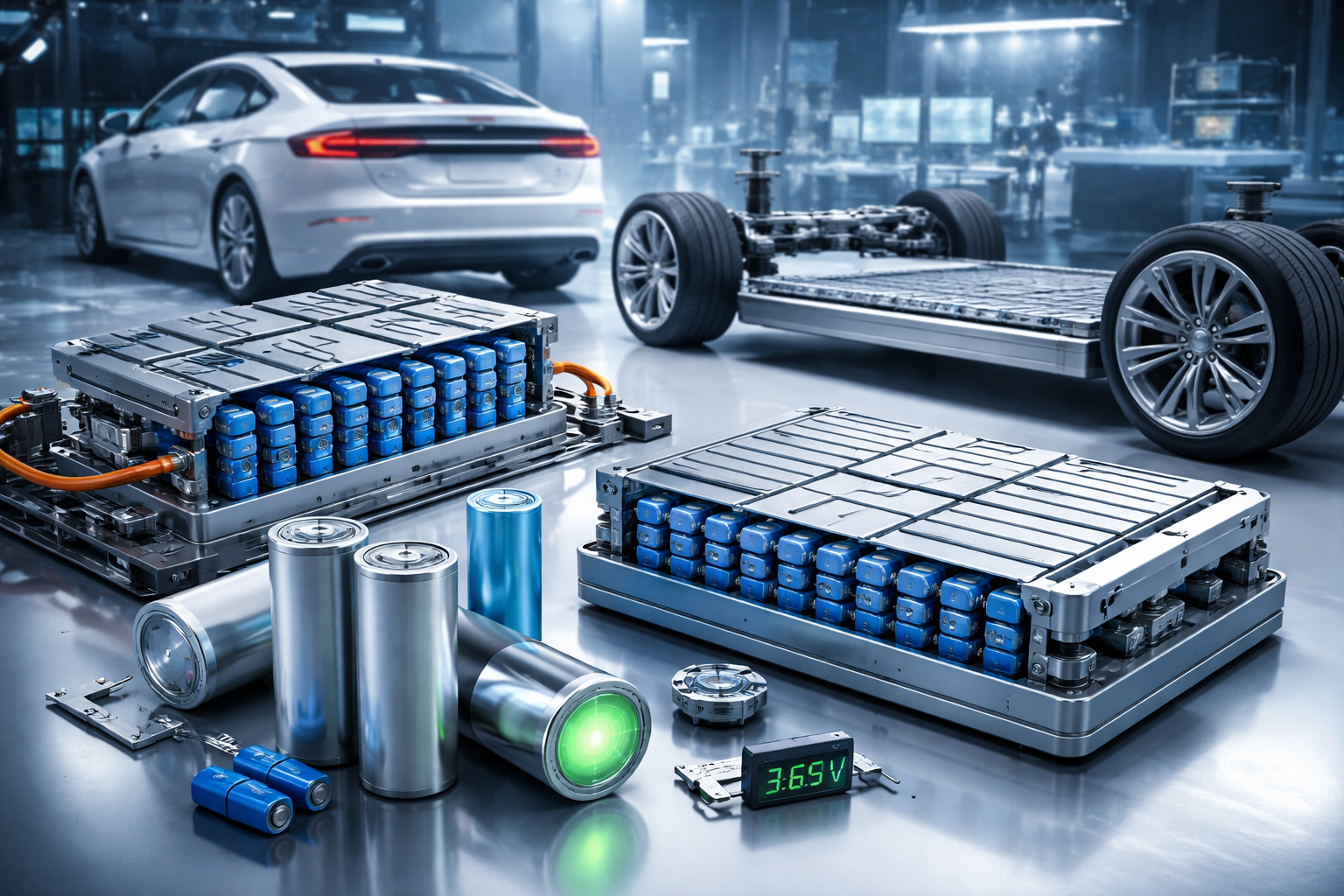
Exploring the battery market’s pivot to ESS driven by AI data centers, despite EV slowdowns, and the future of solid-state and sodium-ion batteries.
In 2025, headlines declared the battery theme dead as EV growth stalled. That verdict was half right — and half completely wrong.
What Actually Happened in 2025
Demand was alive. Global EV battery usage from January to October 2025 reached 933.5GWh — up 35.2% year-over-year. Records were broken, not tombstones set.
But the money? That’s where it hurt.
The billions poured into capacity expansion during 2021–2023 flooded the market as factories came online in 2025. Demand grew, but supply grew faster. Oversupply crushed battery prices. South Korea’s top three battery makers — LG Energy Solution, Samsung SDI, and SK On — bled margin. Their combined global EV battery market share fell to 16%, roughly half of where it stood in 2022.
The cause: CATL and BYD. CATL alone captured 38.1% of the global EV battery market through October 2025, growing 36.6% year-over-year. BYD logged 216% growth in European battery usage over the same period. China’s top six battery makers now control 68.9% of global installed capacity.
Uncomfortable numbers, by any measure.
Then ESS Arrived
When EVs slowed, the battery industry found another door. ESS — Energy Storage Systems.
Global lithium-ion battery shipments for ESS use hit 550GWh in 2025. Up 79% year-over-year. Read that number twice.
The trigger was AI. A single AI training GPU server consumes 10 times the electricity of a standard cloud server. Global data center power consumption is expected to reach approximately 945TWh by 2030 — more than double today’s level. Goldman Sachs projected up to 165% growth versus 2023 levels.
Managing that tidal wave of electricity demand requires ESS. It flattens peak loads, absorbs intermittent renewable energy, and stabilizes power quality. Attaching a battery warehouse next to an AI data center is now standard practice.
LG Energy Solution’s North American ESS order backlog jumped from 50GWh in Q2 2025 to 120GWh in Q3 — a 140% increase in three months. Samsung SDI sees the North American ESS market growing from roughly 80GWh in 2025 to 130GWh by 2030. SK Securities forecasts global ESS market CAGR of around 20%, and the U.S. ESS market CAGR of around 25%, from 2026 to 2030.
If 2025 was the year of the AI chip, 2026 is shaping up to be the year of the battery — specifically, the ESS battery.
What Musk Meant by “Energy Is Currency”
Elon Musk said energy is the real currency. At first, it sounded like classic Silicon Valley hyperbole. It sounds different now.
Data centers run on land and electricity. Renewable energy only flows when the sun shines or the wind blows. Power grids are aging. Battery storage is the only tool that solves all three problems at once.
The ability to store energy is the new competitive moat — for nations, corporations, and data centers alike. Global power demand is projected to reach 890TWh by 2030, 1,800TWh by 2040, and 3,000TWh by 2050. There is no path to meeting that demand without batteries.
The Next Technology Wave: Solid-State and Sodium-Ion
Today’s lithium-ion batteries are not the final word.
Samsung SDI has publicly committed to solid-state battery commercialization by 2027. The target energy density: 900Wh/L. Prototype samples are already being supplied to major automaker clients from the company’s dedicated ‘S-Line’ pilot facility in Suwon. LG Energy Solution is targeting commercial production of graphite-type solid-state batteries by 2029 and anode-free variants by 2030. Toyota and Panasonic are both racing toward 2027–2030 commercialization deadlines.
Solid-state batteries replace liquid electrolytes with solid ones. They don’t catch fire. Energy density is higher. Charging is faster. The current drawbacks — high cost and low mass-production yield — are the only walls left to breach. If those walls fall around 2030, the EV market reshuffles again.
Sodium-ion is a different game entirely. Sodium is abundant, cheap, and found everywhere. Energy density is lower than lithium-ion, but for grid-scale ESS and entry-level EVs, it’s more than sufficient. The sodium-ion battery market is expected to grow from USD 670 million in 2025 to USD 2.01 billion by 2030 — a CAGR of 24.7%. China is the fastest adopter.
By the Numbers: Present and Future Market Structure
| Metric | 2024 | 2025 (Est.) | 2030 (Forecast) |
|---|---|---|---|
| Global EV Battery Demand | ~1,025 GWh | ~1,300 GWh | ~4.7 TWh |
| Global ESS Battery Demand | ~235 GWh | ~550 GWh (+79% YoY) | ~700–800 GWh |
| Global Li-ion Market Size | ~USD 120B | ~USD 150B | USD 200B+ |
| CATL EV Market Share | ~27% | ~38.1% | Continued expansion expected |
| Korea 3 EV Share (ex-China) | ~43% | ~36.3% | ESS pivot as defense strategy |
| Solid-State Batteries | Development | Pilot production | Initial production 2027–2030 |
| Sodium-ion Market Size | ~USD 500M | ~USD 670M | ~USD 2.01B |
What the Market Is Missing
Headlines about EV slowdowns led many investors to file batteries under “finished themes.” That’s a hard conclusion to share.
EV penetration is still climbing from single digits to double digits globally — early innings. Europe maintains strict carbon emission rules, pointing to an EV demand recovery post-2026. North America faces policy uncertainty, but ESS is filling that gap in real time.
The real game is just beginning. The era where “how cheaply and safely you can store energy” determines national competitiveness and corporate profitability is arriving. Batteries are the core infrastructure of that era.
References
- SNE Research, “Global EV Battery Usage Jan–Sep 2025” (Oct 2025)
- SNE Research, “Global ESS Battery Shipments 550GWh in 2025” (Jan 2026)
- IEA, Electricity 2025, Data Center Power Demand Outlook
- Hankyung Business, “ESS-Driven Battery Revival” (Nov 2025)
- SK Securities, “Battery Industry — ESS Batteries: Light and Shadow” (Nov 2025)
- LG Energy Solution Q3 2025 Earnings Call (Nov 2025)
- Samsung SDI Q3 2025 Earnings Call (Nov 2025)
- The Big Data, “Battery Big Three Pivot to Solid-State” (Feb 2026)
- MarketsandMarkets, “Sodium-ion Battery Market Report” (Dec 2025)
- Goldman Sachs, Data Center Power Demand Forecast (2025)
- BusinessPost, “K-Battery 2025 Non-China Market Share 36.3%” (Feb 2026)
- PwC Samil, “EV Chasm — K-Battery Crisis and Response Strategy”
- Grand View Research, “Secondary Battery Market Report” (2024)
- Coherent Market Insights, “Secondary Battery Market 2025–2032” (Sep 2025)
#Battery #BatteryMarket #ESS #EnergyStorage #ElectricVehicles #DataCenter #AIPower #SolidStateBattery #SodiumIonBattery #EnergyTransition