Can Rural Villages Earn Electricity Revenue from Data Centers?
Can Rural Villages Earn Electricity Revenue from Data Centers?
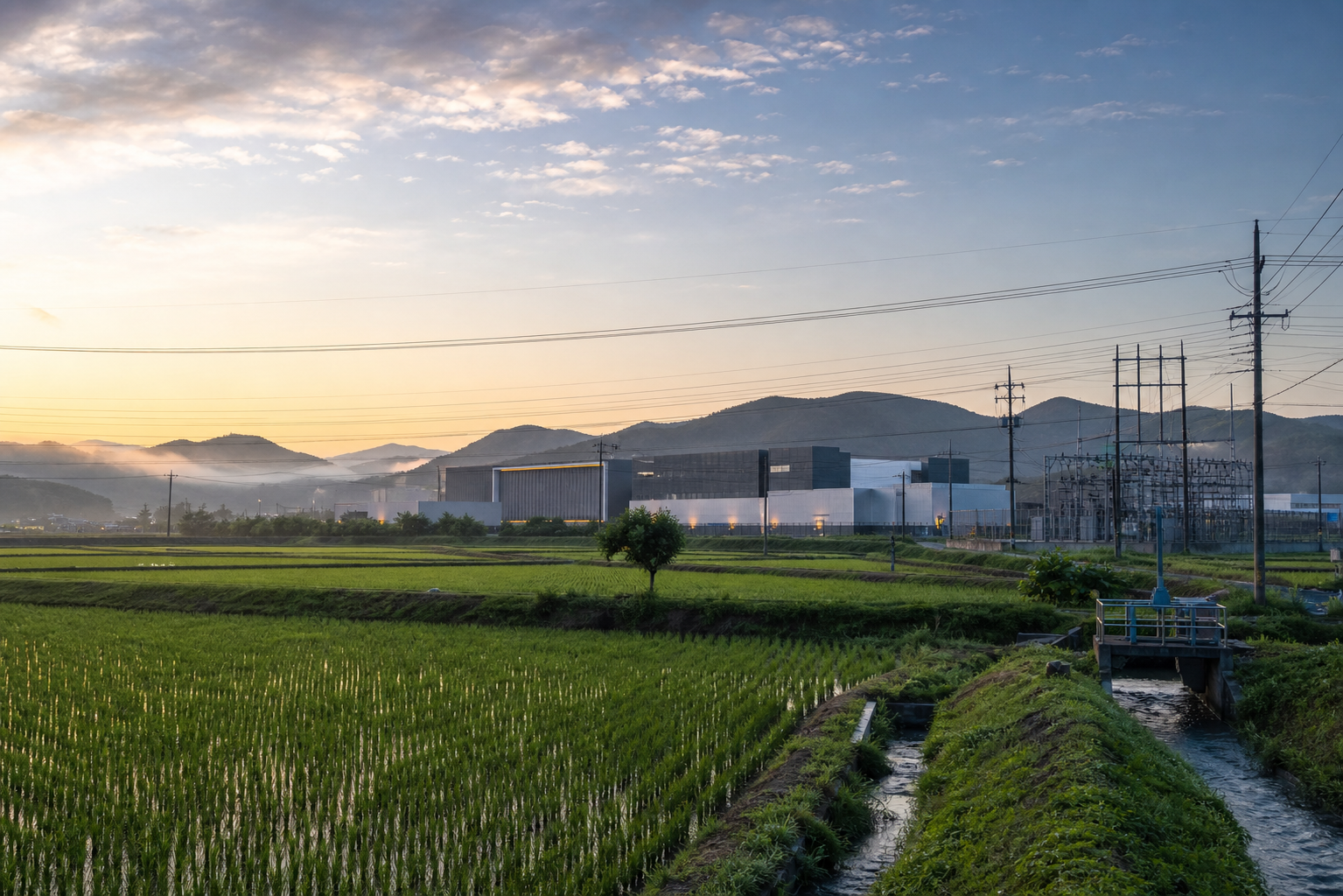
Some rural roads run beside rice fields, power poles, and transmission lines. Electricity passes through the village, but money often does not stay there. Now a new question is appearing. If data centers move into rural areas, can rural communities earn from electricity.
The question sounds reasonable. Data centers consume a lot of power. The Seoul metropolitan grid is under pressure, and the Korean government has tried to ease the concentration of data centers in the capital region. Policy discussions have included regional incentives, grid connection support, facility-charge discounts, and rules that review the impact of large new power demand. For rural communities, a large power user can look like an opportunity.
But placing a large building near rice fields does not automatically place money in the village account. A data center pays electricity bills through the power system. That money does not automatically become resident income. For rural areas to benefit, the project needs contracts, land structure, power structure, and community participation. This is not simply a development story. It is an energy business design problem.
1. Why data centers are looking beyond the capital region
The Ministry of Trade, Industry and Energy has discussed ways to reduce the concentration of data centers in the Seoul metropolitan area because large data centers can put heavy pressure on the power grid. A data center runs servers and cooling systems around the clock. Once it connects, its electricity demand continues.
Land costs are high in the capital region, and grid capacity can be limited. That is why Korea has moved toward reviewing the grid impact of large new electricity users. The Distributed Energy Activation Act is part of the same direction. Its core idea is to produce and consume more electricity near the demand area and reduce pressure from long-distance transmission and large centralized systems.
Rural areas can see an opening here. They have land, potential renewable-energy sites, and some regions want new industrial demand. But opportunity is still only a word until the project solves land use, grid capacity, water, cooling, local opposition, taxes, jobs, and benefit sharing.
2. Electricity bills do not automatically become village income
This is the biggest misunderstanding. If a data center uses a lot of electricity in the village, people may think the village earns electricity revenue. That is not how it works. Electricity payments move through contracts between the user, the utility, and the power market. Unless the village owns land, power assets, or a contract right, the electricity bill itself does not become community income.
Rural income can come from several channels. Land rent. Local taxes and local investment. Community equity in renewable generation or ESS projects. Waste-heat use in greenhouses or public buildings. Regional funds written into a development agreement. Direct power purchase or distributed-energy models that connect local generation and local demand.
So the question is not whether a data center arrives. The question is what the community provides and what it receives by contract. A benefit-sharing banner without a contract is just a banner.
3. Farmland is not empty land
A rice field is not just a vacant site. It is farmland. If the site is in an agricultural promotion zone or another protected farmland category, conversion to a non-agricultural use can be difficult. A data center is not an agricultural facility, so farmland conversion, development permission, building permission, road access, drainage, water, wastewater, and power connection must all be reviewed.
So “a data center on rice fields” should be understood as a symbolic phrase. In reality, likely sites are industrial zones, planned management areas, power-infrastructure-adjacent land, or areas already targeted by local governments for industrial development. A project dropped into the middle of high-quality protected farmland is much less realistic.
Farmers should check land-use status before believing a development story. A project can sound impressive while the permit path is still weak. In rural development, the most expensive phrase is “it will probably work later.”
4. A data center can help the grid or stress the grid
A data center can burden the power grid because it consumes a large and continuous amount of electricity. But with careful design, it can also become a useful demand resource. For example, it may use power during periods of high local renewable generation, pair with ESS, or manage some flexible cooling load.
This is not easy. Data centers value uptime above almost everything. Servers cannot simply shut down. They require backup power, uninterruptible power systems, cooling redundancy, and stable power quality. If the rural grid is weak, connection and reinforcement costs can become large.
Grid capacity is therefore the first checkpoint. Substation capacity, transmission lines, connection availability, and power quality must be verified with the utility and system operators. Land alone is not enough. Electricity needs a path. Without that path, the data center looks good only on a map.
5. Community benefit requires community structure
If residents receive only construction traffic and a few land deals, opposition can grow. Noise, heat, landscape impact, water use, lighting, and grid construction all matter. The story changes if residents receive equity, rent, community funds, energy-project returns, waste-heat benefits, or training and jobs.
This is why community participation is important in agrivoltaics and renewable-energy projects. If outside capital uses rural land and takes the profit away, acceptance falls. Data centers are similar. If electricity passes through the village and profit leaves, the village becomes another corridor.
Possible structures include a village cooperative investing in nearby solar or ESS. A long-term power purchase agreement between the data center and local renewable projects. A local-government agreement that includes community funds and infrastructure obligations. Waste heat supplied to smart farms, seedling houses, cold storage, or public buildings. Only when such structures are written into the project does “earning from electricity” become more realistic.
6. Waste heat and water can become the real issue
A data center uses electricity, but it also produces heat. Cooling design affects both electricity use and water use. In rural areas, water is sensitive. When drought comes, irrigation and household water become the first concern. A cooling system that uses too much water can face local opposition.
Waste heat can also become an opportunity. In some countries, data center heat is used for district heating or greenhouses. In Korea’s rural context, it could theoretically support smart-farm heating, seedling facilities, cold storage defrosting, or public buildings. But the details decide everything. Temperature, distance, pipe cost, seasonal demand, and operating responsibility must be checked.
In rural heat projects, pipes are often more expensive than the idea. A greenhouse beside a data center does not automatically mean lower heating bills. The heat user must be close, stable, and contractually connected.
7. Jobs may be fewer than expected
Data center promotion often mentions jobs. But data centers do not always create large numbers of permanent local jobs. Construction creates temporary work, but operation usually relies on specialized roles in electrical systems, cooling, security, networks, facility management, and cleaning.
There is still an opportunity. If the project connects with local colleges, vocational schools, agricultural technology centers, and local government programs, it can create training paths in electricity, cooling, facility management, ESS, and smart-farm energy systems. But this must be designed. It should not be assumed.
Rural areas should not only receive a building. They should receive an operating ecosystem. That is the difference between a gray box and a local industry anchor.
8. Questions farmers should ask first
When a data center project is discussed locally, farmers should ask practical questions before counting land prices.
- Is the site protected farmland or an agricultural promotion zone.
- Is farmland conversion possible.
- Is there enough substation and transmission capacity.
- How much water will be used and which cooling method is planned.
- Is waste heat use backed by pipe cost and real heat demand.
- Is community benefit a fund, equity, rent, or local power-project participation.
- Is there a local hiring and training agreement.
- How will noise, lighting, traffic, and landscape impact be managed.
- Will the project affect irrigation, drainage, or farm access roads.
- Are community obligations written into a binding agreement.
If these questions have no answers, the project is still a mood, not a business. And mood is not a contract.
9. The real answer is the power contract
Can rural villages earn electricity revenue from data centers. The answer is: possibly, but not automatically. A data center does not turn its electricity bill into resident income by itself. Rural communities need a structure that connects land, power, heat, water, residents, and local government agreements.
The real opportunity is not the data center alone. It is the connection between local power demand and local power production. Renewable energy, ESS, direct power contracts, waste heat, smart-farm heating, and community equity can turn a rural area from a passive site into an energy business participant.
Rural communities should not become another place that hosts someone else’s infrastructure. They should design how electricity creates local value. That design will decide whether a rural data center is an opportunity or just another large building beside the fields.
One-line summary
Rural data centers do not automatically create electricity revenue for residents, but they can become local energy opportunities when community equity, local power contracts, waste heat, and distributed-energy structures are designed from the start.
References
- Ministry of Trade, Industry and Energy, policy materials on easing data center concentration in the capital region.
- National Assembly Research Service, materials on the Distributed Energy Activation Act.
- Distributed Energy Activation Act and related policy materials.
- Korea Electric Power Corporation and Korea Power Exchange public materials on grid connection and large power demand.
- Korea Data Center Council materials on distributed energy and grid-impact assessment.
- Public research materials on agrivoltaics, community participation, and renewable-energy benefit sharing.