KAMIS wholesale prices on October 14, 2026 for domestic, Chinese and Indian sesame per kilogram, online prices for domestic-labelled roasted sesame on October 15 converted to per-kg, roasting temperature and time from National Institute of Crop Science research, weight change, storage, origin labelling, and what growers should check before selling roasted sesame.
A 200 g bag of domestic roasted sesame costs around KRW 14,000 at the supermarket, close to KRW 70,000 per kilogram. Raw domestic sesame at wholesale is about KRW 24,000 per kilogram. Is the gap roasting, packaging or origin? Here is the math for buying roasted seeds versus roasting at home.
Bottom line: On October 14, 2026, KAMIS domestic white sesame (top grade, 30 kg) averaged KRW 723,600 across five cities, about KRW 24,100 per kilogram. On October 15, small packs (105–500 g) of roasted sesame labelled domestic sold online for KRW 55,000–79,000 per kilogram equivalent. Chinese sesame was about KRW 7,100 per kilogram at wholesale. A National Institute of Crop Science study found 220 °C for 3 minutes best for small-batch household roasting.
Earlier notes: Korean sesame seed price 2026, Korean sesame oil price 2026, imported sesame 30 kg price.
1. Roasted sesame per kilogram
Roasted sesame is not a KAMIS item. These are Coupang Partners list prices on October 15, 2026 for products whose title says domestic.
| Product (as titled) | Size | Oct 15 price | Per kg |
|---|---|---|---|
| Dubo Foods, domestic | 180 g | KRW 9,900 | KRW 55,000 |
| Kkaeullim, 100% domestic | 250 g × 2 | KRW 28,990 | KRW 57,980 |
| Domestic low-temperature roasted | 300 g | KRW 19,900 | KRW 66,333 |
| Jayeongoeul, domestic | 200 g | KRW 13,900 | KRW 69,500 |
| Haetnim Maeul, domestic | 200 g | KRW 13,990 | KRW 69,950 |
| Gomgom, domestic | 105 g × 2 | KRW 15,480 | KRW 73,714 |
| 100% domestic | 150 g | KRW 11,900 | KRW 79,333 |
1 kg bags with no origin in the title sold for KRW 9,900–11,850, less than a quarter of the domestic-labelled range. When the gap is that large, check the origin field on the product page.
2. Raw sesame wholesale
| City | Domestic top grade 30 kg | Per kg | Sep 14 | A year earlier |
|---|---|---|---|---|
| Daegu | KRW 808,000 | KRW 26,933 | KRW 808,000 | KRW 802,000 |
| Seoul | KRW 773,000 | KRW 25,767 | KRW 773,000 | KRW 806,000 |
| Busan | KRW 733,000 | KRW 24,433 | KRW 753,000 | KRW 776,000 |
| Daejeon | KRW 701,000 | KRW 23,367 | KRW 727,000 | KRW 827,000 |
| Gwangju | KRW 603,000 | KRW 20,100 | KRW 775,000 | KRW 784,000 |
The average is 9.4% below a year earlier. Chinese sesame (medium) averaged KRW 214,000 per 30 kg (about KRW 7,133/kg) and Indian KRW 158,000 (about KRW 5,267/kg, four cities). Domestic is 3.4 times Chinese. Tariffs explain part of it: the Korea Customs Service describes sesame as subject to a 630% tariff, with aT auctioning import rights at a 40% in-quota rate.
3. How much weight is lost in roasting?
No official roasting yield was found. Most of what roasting removes is water. Nongsaro’s grading standard caps moisture for top grade at 10%, and the national food composition database lists dried white sesame at 2.4 g water per 100 g. So well-dried top-grade seed cannot lose more than about 10% of its weight. The gap between KRW 24,100 raw and KRW 55,000+ roasted comes from sorting, roasting, small packaging, shipping and retail margin, not from weight loss.
4. Roasting at home
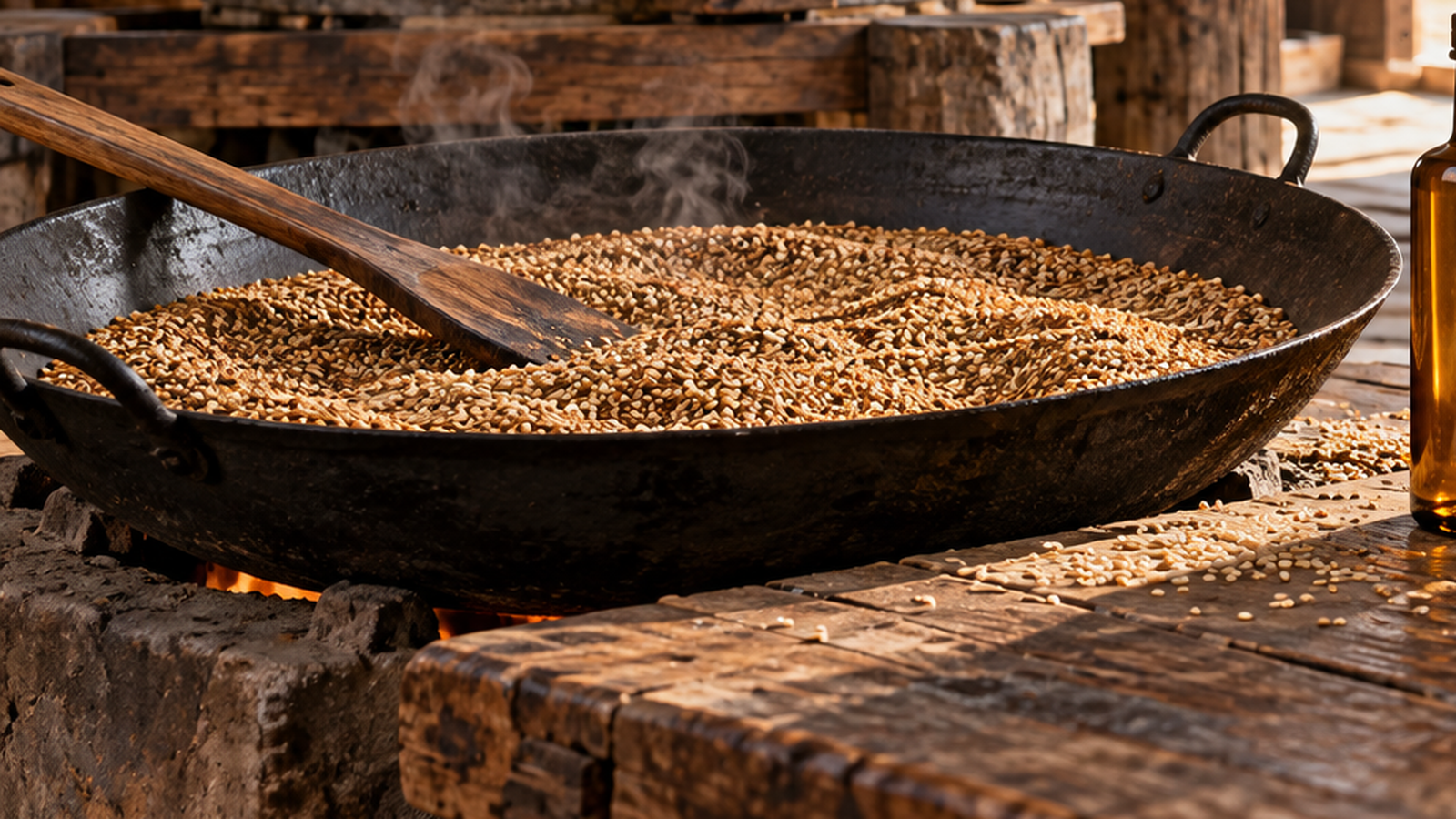
Park et al. (2011, National Institute of Crop Science) found 220 °C for 3 minutes best for small household batches and 220 °C for 5 minutes for oil; large batches need about 20 °C more, and white seeds need more heat than black. Seo et al. (2009) found polycyclic aromatic hydrocarbons in sesame oil rose with higher temperature and longer roasting, peaking at 250 °C for 25 minutes, and were lower with indirect hot-air roasting than direct flame.
- Spread a thin layer in the pan and keep stirring.
- When seeds plump up and a few start popping, lower the heat.
- Once seeds crush easily between fingers, spread them on a tray to cool.
- No official guidance was found on washing before roasting. If you wash, dry completely first.
5. Storage and origin
No official storage guidance for roasted seeds was found. A sesame oil study (Lee et al., 2008) showed oxidation indicators rising slowly and tocopherols and lignans declining monthly at 25 °C. Roast only what you will use within a few weeks, keep it airtight away from light and heat, and grind as needed.
There is no reliable way to confirm origin by eye. Nongsaro notes that domestic sesame tends to be smaller, thinner-skinned and darker when roasted, but roasting blurs these differences. The National Agricultural Products Quality Management Service lists sesame as a labelled item, including heat-treated product still recognisable in form, so roasted whole seeds must carry an origin label.
6. For growers: sell raw or roasted?
Roasting looks like it doubles the price, but each 200 g pack adds its own bag, box and shipping. Article 25 of the Enforcement Decree of the Food Sanitation Act exempts simple processing such as cutting or drying from business registration, but heating “to cause a marked change in composition” is excluded. We found no official ruling on whether roasting counts, so ask the local sanitation office before selling roasted sesame. For wholesale, check city prices first: Daegu and Gwangju differed by KRW 205,000 per 30 kg on October 14. Compare with the produce market calculator.
References
- aT KAMIS period wholesale prices (data.go.kr API): domestic white sesame top grade, Chinese and Indian medium, 30 kg, five cities, October 2025 to October 14, 2026.
- Park et al. (2011), Korean Journal of Crop Science 56(3): koreascience
- Seo et al. (2009), Korean Journal of Food Science and Technology 41(4): earticle
- Lee et al. (2008), sesame oil storage: koreascience
- National food composition database 10.4: nics.go.kr
- Nongsaro sesame material: nongsaro.go.kr
- NAQS origin labelling items: naqs.go.kr
- Korea Customs Service press release (December 23, 2022): korea.kr
- Online prices: Coupang Partners product list, checked October 15, 2026.
- Actual prices and roasting results vary with origin, grade, moisture, equipment and heat.